Have you ever typed etymology vs entomology and then stopped because the two words look almost identical? I have seen this mix-up many times in writing, classrooms, and online posts. The words share several letters, but they point to two completely different subjects. One is about the history and roots of words. The other is the study of insects. 🐝
Once you see the small spelling clue that separates them, the difference becomes much easier to remember. In this guide, I’ll explain etymology vs entomology in plain US English, show you how each word works in real sentences, and give you simple memory tricks you can use when writing.
Whether you are a student, teacher, writer, editor, or curious reader, you can learn this distinction quickly. ✨ Epitaph vs Epithet | Epigram vs Epigraph | Epic vs Epoch
🎯 Quick Answer: Etymology vs Entomology
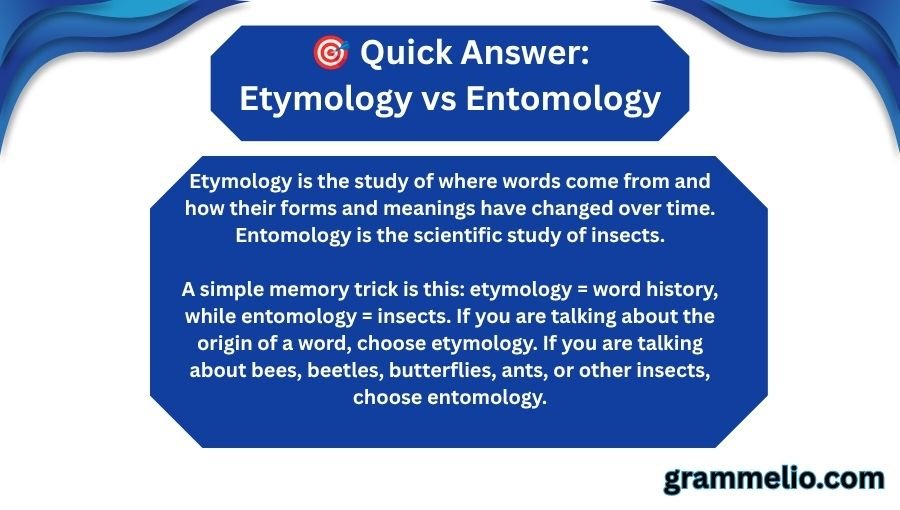
Etymology is the study of where words come from and how their forms and meanings have changed over time. Entomology is the scientific study of insects.
A simple memory trick is this: etymology = word history, while entomology = insects. If you are talking about the origin of a word, choose etymology. If you are talking about bees, beetles, butterflies, ants, or other insects, choose entomology.
| Word | Main Meaning | Easy Reminder | Example |
|---|---|---|---|
| Etymology | The history and origin of words | Words | “The etymology of the word helps explain its meaning.” |
| Entomology | The study of insects | Insects | “She plans to study entomology in college.” |
📚 Understanding Etymology vs Entomology
The clearest way to understand etymology vs entomology is to separate the subjects completely. Etymology belongs to the study of language. Entomology belongs to the study of insects.
The words look similar because both contain the letters -tomo- in their spelling patterns, but that visual similarity does not mean they have similar meanings.
| Form | Type | Meaning | Example | Correct/Incorrect |
|---|---|---|---|---|
| Etymology | Noun | Study of word origins and history | “I enjoy learning about the etymology of English words.” | ✅ Correct |
| Entomology | Noun | Study of insects | “He chose entomology as his field of study.” | ✅ Correct |
| Etymology | Noun | Study of insects | “She studied etymology to identify beetles.” | ❌ Incorrect |
| Entomology | Noun | History of words | “The entomology of this word is fascinating.” | ❌ Incorrect |
What Does Etymology Mean?
Etymology is the study of a word’s history. It looks at where a word came from, how people used it in earlier periods, and how its form or meaning developed.
For example:
“The etymology of the word reveals an interesting history.”
Here, etymology refers to the history of the word itself.
You might study the etymology of an English word by looking at older forms of the word and the languages that influenced it.
What Does Entomology Mean?
Entomology is the study of insects. An entomologist may study insect behavior, structure, life cycles, habitats, classification, or relationships with other living things.
For example:
“My sister is interested in entomology because she loves studying butterflies.”
Here, entomology clearly refers to insects.
Why Does the Difference Matter?
The difference matters because using one word in place of the other can change your entire sentence.
Consider these examples:
- ✅ “The etymology of the word salary has an interesting history.”
- ❌ “The entomology of the word salary has an interesting history.”
The first sentence discusses a word. The second incorrectly makes it sound as though insects are involved.
Now compare:
- ✅ “Her research focuses on entomology.”
- ❌ “Her research focuses on etymology.”
The first sentence suggests insect research. The second suggests language research.
| Question | Answer |
|---|---|
| Is the topic about words? | Use etymology. |
| Is the topic about insects? | Use entomology. |
| Are you studying word history? | Use etymology. |
| Are you studying insect behavior? | Use entomology. |
| Are you writing about beetles? | Use entomology. |
❓ Is Etymology the Same as Entomology?
No. Etymology and entomology are completely different fields. Etymology deals with the history of words, while entomology deals with insects.
I find it helpful to imagine two separate rooms. In the first room, you see dictionaries, old texts, and words written on pages. That is etymology. In the second room, you see insect specimens, microscopes, and research about beetles or butterflies. That is entomology. 🦋
This mental picture makes the difference much easier to recall.
🧠 Why Do People Confuse Etymology and Entomology?
People confuse these words mainly because their spellings and sounds are similar. Both are fairly specialized words, so people may know one but rarely use both.
I once edited a student paper in which the writer said that a researcher had studied the “entomology” of a word. The writer clearly meant etymology. The mistake was not about the student’s understanding of the topic. It was simply a spelling and word-choice mix-up. Understanding etymology vs entomology starts with recognizing that similar spelling does not mean similar meaning.
That is why context matters so much.
| Reason for Confusion | What Happens |
|---|---|
| Similar spelling | The words look alike at a quick glance. |
| Similar sound | Their spoken forms can be easy to mix up. |
| Limited exposure | People may rarely encounter one of the terms. |
| Autocorrect | A typing tool may not catch the wrong word. |
| Fast writing | Writers may choose a familiar-looking word without checking. |
🔤 Etymology: Meaning and Correct Use
Etymology is used when you are discussing the origin, development, or history of a word. It is usually a noun.
You can use it in several common patterns:
- “the etymology of a word”
- “study etymology”
- “English etymology”
- “word etymology”
- “the word’s etymology”
Here are some examples:
“The book explains the etymology of several common English words.”
“Her interest in etymology began in high school.”
“The etymology of the term is surprisingly complex.”
The key idea is always connected to words and their history.
| Meaning | Word Type | Example Sentence |
|---|---|---|
| History of a word | Noun | “The etymology of the term is fascinating.” |
| Study of word origins | Noun | “He enjoys studying etymology.” |
| Word history as a subject | Noun | “Etymology can reveal how language changes.” |
💡 Test Tip for Etymology
Ask yourself:
“Am I talking about a word’s history?”
If the answer is yes, etymology is probably the word you need.
You can also connect the beginning ety- with English words in your memory, even though that is only a memory trick rather than a statement about the word’s actual history.
🐞 Entomology: Meaning and Correct Use
Entomology is the scientific study of insects. In etymology vs entomology, entomology is the insect-related term, while etymology deals with the history of words.
The word commonly appears in academic, scientific, environmental, agricultural, and educational writing.
For example:
“He earned a degree in entomology.”
“The entomology department studies insect populations.”
“Her research examines how insects affect crops.”
The subject can include many kinds of insect research.
| Area | Example |
|---|---|
| Insect behavior | Studying how ants communicate |
| Insect life cycles | Studying how butterflies develop |
| Insect classification | Identifying different insect groups |
| Agriculture | Studying insects that affect crops |
| Ecology | Studying insects within ecosystems |
When you see entomology, think insects.
❓ How Can You Remember the Difference Between Etymology and Entomology?
The easiest method is to connect each word with a strong mental image.
For etymology, picture a dictionary and a timeline of a word.
For entomology, picture a beetle or butterfly.
Here is another quick memory system:
Etymology → words → word history
Entomology → insects → insect science
The word entomology is especially easy to connect with insects because entomology contains a spelling pattern associated with the study of insects.
| Word | Picture in Your Mind | Topic |
|---|---|---|
| Etymology | 📖 Dictionary | Words |
| Entomology | 🐜 Ant | Insects |
| Etymology | ✍️ Written word | Language history |
| Entomology | 🦋 Butterfly | Insect science |
📝 Case Study: A Mix-Up in a School Email
Imagine a student writing an email to a professor: This example shows why etymology vs entomology can matter in professional and academic communication.
“I am interested in your work in entomology, especially the history of the word you discussed.”
The first use of entomology could be correct if the professor studies insects. But if the student meant the history of a word, the second idea requires etymology.
A clearer message would be:
“I am interested in your work in entomology. I was also fascinated by the etymology of the term you discussed.”
Now each word has a clear job.
I once caught myself typing a similar-looking technical word too quickly while editing. I stopped and checked the sentence by asking what subject I was actually discussing. That small habit is useful whenever two words look alike.
| Situation | Correct Word | Example |
|---|---|---|
| Discussing word history | Etymology | “I researched the etymology of the term.” |
| Discussing insects | Entomology | “She works in entomology.” |
| Researching insect behavior | Entomology | “His entomology project focuses on ants.” |
| Researching how a word developed | Etymology | “The etymology of the word changed over time.” |
📏 Grammar Rules Explanation
Etymology and entomology are both nouns, but they refer to different subjects. Grammar does not allow you to switch them simply because their spellings look similar. The basic rule for etymology vs entomology is based on meaning, not spelling: choose etymology for word history and entomology for insects.
The correct choice depends on the meaning of the sentence.
If your subject is the history or origin of a word, use etymology. If your subject is insects or insect science, use entomology.
Most standard English dictionaries and language references treat these as separate terms with separate meanings. The safest approach is to identify the topic before choosing the word.
The important rule is simple:
Words and word history → etymology
Insects and insect science → entomology
✅❌ Correct vs Incorrect at a Glance
| Sentence | Correct/Incorrect | Why |
|---|---|---|
| “The etymology of this word is interesting.” | ✅ Correct | The sentence discusses word history. |
| “The entomology of this word is interesting.” | ❌ Incorrect | The sentence is not about insects. |
| “She studies entomology at college.” | ✅ Correct | She studies insects. |
| “She studies etymology at college because she loves beetles.” | ❌ Incorrect | Beetles point to entomology, not etymology. |
| “I researched the etymology of the phrase.” | ✅ Correct | The topic is language history. |
⚠️ Common Mistakes With Etymology and Entomology
The biggest mistake is choosing the word because it looks right instead of choosing it because its meaning fits.A quick review of etymology vs entomology can help prevent this type of word-choice error.
Fast typing can make this worse. Autocorrect may also fail to help because both words are legitimate English words. A spell-checker can tell you that a word is spelled correctly without telling you that you used the wrong word.
| Similar Confusion | Correct Choice | Why |
|---|---|---|
| It’s / its | Depends on meaning | One is a contraction; one shows possession. |
| Your / you’re | Depends on meaning | One shows possession; one means “you are.” |
| They’re / their / there | Depends on meaning | Each has a different function. |
| Affect / effect | Depends on meaning | They often have different grammatical roles. |
| Etymology / entomology | Depends on subject | One concerns words; one concerns insects. |
Why These Mistakes Happen
1. Fast typing: You know what you mean, so your fingers move faster than your proofreading.
2. Autocorrect: Both words may be recognized as correctly spelled words.
3. Lack of knowledge: If you have not seen the terms often, their meanings can blur together.
4. Visual similarity: Your brain may focus on the shared letters rather than the meaning.
5. Context switching: Moving quickly from a language topic to a science topic can cause accidental substitutions.
❌ Common Wrong Forms and Uses
| Wrong Form or Use | What’s Wrong | Correct Form |
|---|---|---|
| “Entomology of a word” | The subject is word history. | “Etymology of a word” |
| “Etymology of beetles” | The subject is insects. | “Entomology of beetles” |
| “I study etymology to learn about ants.” | The field does not match the subject. | “I study entomology to learn about ants.” |
| “Her entomology research examines word origins.” | Word origins belong to language study. | “Her etymology research examines word origins.” |
| “The entomology of the phrase” | A phrase has a language history, not an insect study. | “The etymology of the phrase” |
❓ Is Etymology Used Only for English Words?
No. Etymology can be used when discussing the history of words in many languages. It is not limited to English.
For example, a language researcher may investigate how a word entered English from another language or how a related form developed over time.
The central idea remains the same: etymology concerns the history of words.
❓ Is Entomology Only About Bugs?
Entomology is the scientific study of insects. In casual speech, people often use “bug” for many small creatures, but not every creature commonly called a bug is technically an insect.
For ordinary writing, however, the easiest rule is to remember that entomology is the study of insects.
If your subject is beetles, ants, bees, butterflies, moths, flies, or other insects, entomology is usually the relevant field.
🕰️ Word Origin and History
The two terms have different histories and were formed from different language roots.
Etymology traces back through older language forms connected with the idea of a word’s true or original sense.
Entomology comes from a Greek-based scientific term connected with insects. Its form relates to a word for an insect and a word meaning study or discourse.
The exact historical development of technical vocabulary can be complex, but you do not need to memorize every stage to use these words correctly.
| Period | Term | General Development |
|---|---|---|
| Classical language period | Roots behind etymology | Connected with the study or true sense of words |
| Classical language period | Roots behind entomology | Connected with insects and study |
| Later academic use | Etymology | Became established as a field involving word history |
| Later scientific use | Entomology | Became established as a field involving insect study |
The useful lesson is that the two words did not develop as alternate spellings of one idea. They refer to different areas of knowledge.
🌎 Etymology vs Entomology in Different Contexts
The right word stays the same even when the setting changes. What changes is the sentence around it. The distinction in etymology vs entomology remains the same whether you are speaking casually, writing professionally, or posting online.
| Context | Which Term to Use | Example |
|---|---|---|
| Everyday conversation | Etymology for word history | “Do you know the etymology of that word?” |
| Everyday conversation | Entomology for insect study | “She loves entomology.” |
| Professional writing | Etymology for language research | “The paper discusses the etymology of the term.” |
| Professional writing | Entomology for insect research | “The report presents findings from entomology research.” |
| Creative writing | Etymology for word-related themes | “He became fascinated by the etymology of names.” |
| Creative writing | Entomology for insect themes | “Her character studied entomology.” |
| Social media/texting | Etymology for word questions | “Does anyone know the etymology of this phrase?” |
| Social media/texting | Entomology for insects | “I just learned something cool about entomology!” |
❓ Which Word Should You Use in Professional Writing?
Use etymology when your professional document discusses word origins or language history. Use entomology when it discusses insects or insect science.
Professional writing makes the distinction especially important because readers expect precise word choice.
For example:
“The report examines the etymology of several technical terms.”
This is appropriate for language research.
By contrast:
“The report examines insect populations through field research in entomology.”
This is appropriate for insect science.
💬 Common Phrases With Etymology
Etymology appears in several natural word combinations. These phrases are useful in essays, articles, classroom discussions, and research.
| Phrase | Meaning |
|---|---|
| Etymology of a word | The word’s history and origin |
| Word etymology | The study or explanation of a word’s history |
| Study of etymology | Learning about word origins |
| English etymology | The history of English words |
| Etymology of a name | The history or origin of a name |
| Explore the etymology | Investigate how a word developed |
🐝 Common Phrases With Entomology
Entomology also appears in natural academic and scientific phrases.
| Phrase | Meaning |
|---|---|
| Study of entomology | Study of insects |
| Field of entomology | Scientific field focused on insects |
| Entomology research | Research involving insects |
| Entomology department | Academic or research unit focused on insects |
| Medical entomology | Study of insects in relation to human health |
| Agricultural entomology | Study of insects related to farming and crops |
🔄 Synonyms and Alternatives
Neither word has a perfect everyday synonym because each names a specific field. However, you can sometimes replace the term with a broader phrase when the context allows.
| Alternative | Works When | Does Not Work When |
|---|---|---|
| Word history | You mean the history of a word | You need the formal name of the field |
| Word origins | You are explaining where words came from | You are discussing insects |
| Language history | The discussion covers broader language change | You specifically mean insect science |
| Insect science | You are explaining entomology to a general audience | A formal academic field name is needed |
| Insect studies | You are writing for a broad audience | You need a precise scientific label |
For example, “word history” can often explain etymology in simple language. “Insect science” can explain entomology to someone who has never heard the term.
❓ Can You Use Etymology in a Sentence About Insects?
Usually, no. Etymology does not mean insect study.
You could mention both terms in the same sentence if the sentence discusses both subjects:
“The article explains the etymology of the word insect and then introduces the field of entomology.”
That sentence is correct because each word has its own role.
This is a useful reminder: the two terms can appear together, but they do not mean the same thing.
❓ Can Etymology and Entomology Be Adjectives?
The base words are nouns. Related adjective forms can appear in English, but they should not be confused with the nouns themselves.
For ordinary writing, focus first on the noun forms:
- etymology → the study/history of words
- entomology → the study of insects
If you need a related adjective, check the sentence carefully and make sure the form fits its grammatical role.
| Base Noun | Basic Idea | Example |
|---|---|---|
| Etymology | Word history | “The etymology is interesting.” |
| Entomology | Insect study | “Entomology is a scientific field.” |
🎯 A Simple Decision Process
If you are still unsure about etymology vs entomology, use this three-step check before choosing a word. If you are still unsure about etymology vs entomology, use this three-step check before choosing a word.
When I am proofreading a sentence containing one of these words, I use a three-step check.
Step 1: Identify the topic
Ask what the sentence is actually about.
Is it about a word, phrase, name, or language history?
Choose etymology.
Is it about insects?
Choose entomology.
Step 2: Replace the word mentally
Try replacing the term with a simple phrase.
If “word history” makes sense, use etymology.
If “insect science” makes sense, use entomology.
Step 3: Read the whole sentence
Make sure the word fits the surrounding ideas.
| Step | Question | Answer |
|---|---|---|
| 1 | Is the subject a word or phrase? | Etymology |
| 2 | Is the subject an insect or insect research? | Entomology |
| 3 | Does the replacement phrase make sense? | Keep the matching term |
| 4 | Does the sentence sound natural? | Proofread once more |
⚠️ A Second Look at Real-World Writing
I once saw a social post that asked for the “entomology” of a popular phrase. The writer was clearly asking where the phrase came from. A reader pointed out the error, and the writer corrected it to etymology.
This kind of mistake is easy to fix because the intended meaning is often obvious from context. Still, in a resume, research paper, client email, or published article, it is better to catch the error before someone else does.
A quick meaning check takes only a few seconds.
❓ Why Does Correct Word Choice Matter?
Correct word choice makes your writing easier to understand. It also shows that you understand the subject you are discussing.
A sentence can be grammatically structured correctly but still use the wrong word. That is why proofreading should involve more than checking spelling.
“The best word is the one that tells the reader exactly what you mean.”
| Situation | Why Getting It Right Matters |
|---|---|
| Resume | Shows care and language accuracy |
| Client email | Prevents confusion and protects professionalism |
| Published content | Builds reader trust |
| Social post | Makes your message clearer and easier to share |
🧩 Special Exception and Edge Cases
There is no major spelling exception that makes etymology mean insect study or entomology mean word history. Their meanings remain separate. Knowing the basic rule for etymology vs entomology makes these unusual sentences much easier to understand.
The main edge case is when both subjects appear in the same sentence.
For example:
“The writer discusses the etymology of insect names before explaining basic entomology.”
This sentence is perfectly correct. It talks about word history first and insect science second.
The trick is not to memorize an exception. It is to identify which subject each word describes.
🧪 Practice Examples
Try these examples before looking at the answers.
Example 1
“I want to learn about the history of the word.”
Answer: etymology.
Example 2
“I want to learn how bees behave.”
Answer: entomology.
Example 3
“The article explains where the phrase came from.”
Answer: etymology.
Example 4
“The scientist studies beetles.”
Answer: entomology.
| Practice | Subject | Correct Term |
|---|---|---|
| 1 | History of a word | Etymology |
| 2 | Behavior of bees | Entomology |
| 3 | Origin of a phrase | Etymology |
| 4 | Study of beetles | Entomology |
❓ What Is the Fastest Way to Tell Etymology and Entomology Apart?
The fastest method is to use a one-word association:
Etymology = words.
Entomology = insects.
If you have only a second to choose, ask yourself whether you see a dictionary or a butterfly in your mental picture.
📖 Dictionary? Etymology.
🦋 Butterfly? Entomology.
That simple test works well for everyday writing, school assignments, and proofreading.
❓ What Is the Difference Between Etymology and Entomology in One Sentence?
The difference is simple: etymology studies the history of words, while entomology studies insects.
That single sentence is enough to solve most usage questions.
❓ Why Are Etymology and Entomology Spelled So Similarly?
They look similar because both are formal words built from older language elements and became established in English as names for fields of study. Their similar appearance does not mean they have the same meaning.
The important point for modern writers is not to compare every letter. Focus on the subject.
❓ Is “Entomology of a Word” Correct?
No, not when you mean the history or origin of the word. The correct expression is “etymology of a word.”
For example:
- ✅ “I researched the etymology of the word.”
- ❌ “I researched the entomology of the word.”
❓ Is “Etymology of Insects” Correct?
It can be correct only if you mean the history or origin of the word insects or the names of particular insects.
If you mean the scientific study of insects, use entomology.
For example:
- ✅ “She studies entomology.”
- ✅ “She researched the etymology of the word insect.”
- ❌ “She studies etymology because she wants to learn about beetles.”
❓ What Does an Entomologist Study?
An entomologist studies insects. Their work may involve insect behavior, classification, ecology, development, agriculture, or other areas connected with insects.
The exact work depends on the research area.
❓ What Does Someone Who Studies Etymology Examine?
Someone who studies etymology examines the history and development of words. They may look at older forms, changes in spelling or meaning, and how words moved between languages or periods.
The goal is to understand how words developed into the forms we use today.
❓ Which Is Correct: Etymology or Entomology?
Both are correct words. The correct choice depends entirely on your meaning.
Use etymology for word history. Use entomology for insect study.
| If You Mean… | Choose… |
|---|---|
| Where a word came from | Etymology |
| How a word changed | Etymology |
| History of a phrase | Etymology |
| Study of bees | Entomology |
| Study of beetles | Entomology |
| Study of insect behavior | Entomology |
✅ Quick Recap Checklist
Use this checklist whenever you are unsure.
| Question | If Yes → Use |
|---|---|
| Am I discussing where a word came from? | Etymology |
| Am I discussing the history of a phrase? | Etymology |
| Am I studying how word meanings changed? | Etymology |
| Am I studying insects? | Entomology |
| Am I researching beetles or butterflies? | Entomology |
| Am I studying insect behavior? | Entomology |
📝 Three Final Practice Sentences
- “The etymology of the word holiday is worth exploring.”
- “Her course in entomology covers insect behavior.”
- “The writer explained the etymology of the phrase before discussing its modern use.”
If you can identify the subject, you can usually select the right word immediately.
🔍 Etymology vs Entomology at a Glance
| Feature | Etymology | Entomology |
|---|---|---|
| Word type | Noun | Noun |
| Main subject | Words | Insects |
| Main idea | Word history | Insect science |
| Common setting | Language and writing | Science and research |
| Memory clue | 📖 Words | 🐞 Insects |
| Example | “The etymology of the word is unclear.” | “He studies entomology.” |
FAQs About Etymology vs Entomology
What is the main difference between etymology and entomology?
Etymology is the study of word history and origins. Entomology is the scientific study of insects.
Is etymology about insects?
No. Etymology is about words and how they developed over time. If you are studying insects, the correct term is entomology.
Is entomology the study of bugs?
Entomology is the scientific study of insects. People often use “bugs” casually for many small creatures, but the formal field focuses on insects.
How can I remember etymology vs entomology?
Use the simple memory pair: etymology = words and entomology = insects. Picture a dictionary for the first and a butterfly for the second.
Which word should I use for the origin of a word?
Use etymology. For example, “I researched the etymology of the word.”
Which word should I use for the study of insects?
Use entomology. For example, “She is interested in entomology.”
Can etymology and entomology appear in the same sentence?
Yes. They can appear together when a sentence discusses both word history and insect science. Each word should clearly refer to its own subject.
Why do people mix up etymology and entomology?
The words look and sound similar, and both are less common than everyday vocabulary. Fast typing, autocorrect, and limited exposure can make the confusion more likely.
Is “the entomology of a word” correct?
No, if you mean the word’s history. The correct phrase is “the etymology of a word.”
Is “the etymology of a butterfly” always wrong?
Not necessarily. If you mean the history of the word or name butterfly, etymology can be correct. If you mean the scientific study of butterflies, use entomology.
🎯 Final Takeaway
Etymology vs entomology becomes easy once you connect each word with its subject. Etymology is about the history and development of words. Entomology is about the scientific study of insects. 📖🐝
When you are unsure, stop looking at the spelling and look at the meaning. Ask, “Am I talking about words?” If yes, choose etymology. Ask, “Am I talking about insects?” If yes, choose entomology. This tiny mental check can prevent a surprisingly common word-choice mistake.
I recommend using the dictionary-picture trick: imagine a book for etymology and an insect for entomology. The stronger the mental image, the easier the distinction becomes. With a little practice, you will recognize the correct term without stopping to think.
Remember the rule: words have etymology, insects belong to entomology. Once that line is clear in your mind, these two look-alike words no longer need to compete for your attention.

[…] in each situation. By the end, you should be able to choose the right word with confidence. ✍️ Etymology vs Entomology | Epitaph vs Epithet | Epigram vs […]
[…] memory tricks. By the end, fair vs fare should feel much easier to handle. ✨ Faint vs Feint | Etymology vs Entomology | Epitaph vs […]