Have you ever written a sentence and stopped because two words looked almost exactly alike? I have seen this happen often with faint vs feint. These words sound the same in most standard US English speech, but they have very different meanings. One can describe losing consciousness, a weak sound, or something barely seen. The other describes a trick or false move, especially when someone tries to fool an opponent. 😅
If you are learning English, writing for work, or simply trying to avoid spelling mistakes, knowing the difference can save you from confusing sentences. In this guide, I will explain faint vs feint in simple terms.
I will show you how each word works, where people make mistakes, and how to remember which spelling belongs in each situation. By the end, you should be able to choose the right word with confidence. ✍️ Etymology vs Entomology | Epitaph vs Epithet | Epigram vs Epigraph
🎯 Quick Answer: Faint vs Feint
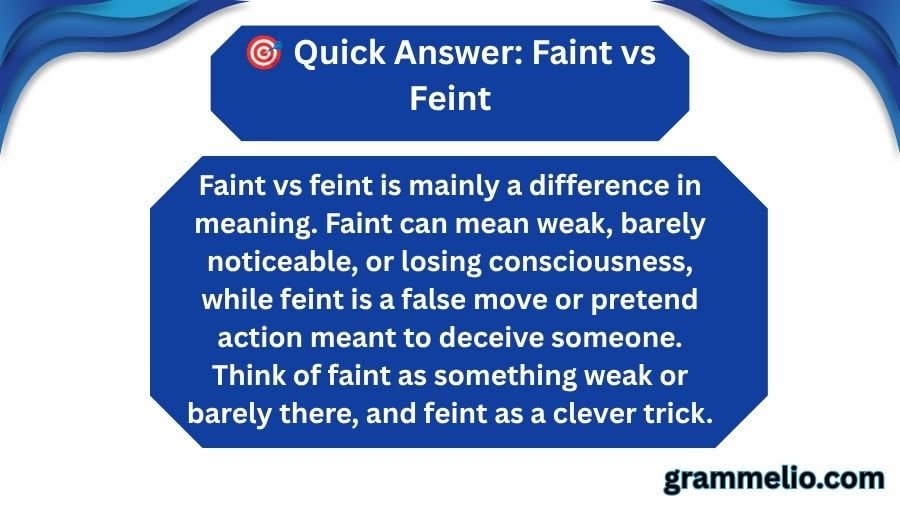
Faint vs feint is mainly a difference in meaning. Faint can mean weak, barely noticeable, or losing consciousness, while feint is a false move or pretend action meant to deceive someone. Think of faint as something weak or barely there, and feint as a clever trick.
| Word | Main Meaning | Example |
|---|---|---|
| faint | Weak, barely noticeable, or briefly unconscious | I heard a faint sound outside. |
| feint | A false move meant to deceive | The boxer made a feint to the left. |
The easiest rule is simple: faint is about weakness or loss of consciousness; feint is about deception or a false move.
Related Word Forms
The two words have several useful forms, but their forms do not behave in exactly the same way.
| Form | Type | Example |
|---|---|---|
| faint | adjective, verb, noun | She felt faint after standing up. |
| fainted | past-tense verb | He fainted during the ceremony. |
| fainting | present participle | She was fainting from the heat. |
| faintness | noun | The medicine caused some faintness. |
| feint | noun, verb | The fighter made a feint. |
| feinted | past-tense verb | The player feinted to the right. |
| feinting | present participle | He was feinting toward the defender. |
Notice that fainted describes someone losing consciousness, while feinted describes someone making a deceptive move.
🧠 Understanding the Basics of Faint vs Feint
The main difference is that faint usually describes something weak, unclear, or a temporary loss of consciousness. Feint describes an action designed to trick another person.
Here is the difference at a glance:
| Form | Type | Meaning | Example | Correct/Incorrect |
|---|---|---|---|---|
| faint | adjective | Weak or barely noticeable | There was a faint smell of smoke. | ✅ Correct |
| faint | verb | Lose consciousness briefly | She might faint in the heat. | ✅ Correct |
| faint | noun | A brief loss of consciousness | He had a faint. | ✅ Correct |
| feint | noun | A deceptive movement | The boxer used a feint. | ✅ Correct |
| feint | verb | Make a deceptive movement | She feinted toward the door. | ✅ Correct |
| feint | adjective | Not normally used this way | He had a feint headache. | ❌ Incorrect |
A useful way to separate them is to ask what the sentence is talking about.
- Is something weak, unclear, or barely noticeable? Use faint.
- Is someone pretending to make a move to fool another person? Use feint.
- Is someone losing consciousness? Use faint.
- Is an athlete making a false move? Use feint.
Faint as an Adjective
As an adjective, faint means weak or difficult to notice.
For example:
I could hear a faint noise from the hallway.
The noise was real, but it was quiet. It was not strong enough to hear clearly.
Other examples include:
- a faint smell
- a faint light
- a faint smile
- a faint sound
- a faint memory
- a faint outline
✅ Correct: There was a faint light in the distance.
❌ Incorrect: There was a feint light in the distance.
The second sentence does not make sense because a light is not making a deceptive move.
Faint as a Verb
As a verb, faint means to lose consciousness for a short time.
She felt dizzy and then fainted.
This use is common in everyday English.
Other examples:
- He fainted from the heat.
- She nearly fainted when she heard the news.
- The patient fainted briefly.
- I thought I was going to faint.
The word feint cannot replace faint in these sentences.
Faint as a Noun
Faint can also be a noun referring to a short period of unconsciousness.
The man had a faint after standing in the hot room.
This noun use is less common in casual US English than the verb faint, but it is still a valid use.
Feint as a Noun
A feint is a false or misleading move designed to make someone react in the wrong way.
The word is common in sports, combat, games, and other situations involving strategy.
For example:
The boxer made a feint toward his opponent’s face.
The boxer did not necessarily intend to strike there. The movement was meant to create a reaction.
Feint as a Verb
As a verb, feint means to make a deceptive movement.
The soccer player feinted left and moved right.
The player pretended to move one way. Then the player went another way.
That is the central idea behind feint: pretend action used as a trick.
💡 What Does Faint Mean in Everyday English?
Faint has several common meanings, but they all connect to the idea of weakness, lack of strength, or reduced awareness.
| Meaning | Word Type | Example Sentence |
|---|---|---|
| Weak or unclear | Adjective | I noticed a faint sound. |
| Barely visible | Adjective | A faint line appeared on the page. |
| Barely noticeable | Adjective | She gave me a faint smile. |
| Lose consciousness | Verb | He began to faint. |
| Brief loss of consciousness | Noun | She suffered a faint. |
The adjective use is especially common when describing the senses.
You might see:
- faint music
- faint footsteps
- faint sunlight
- faint color
- faint scent
- faint memory
A Simple Test for Faint
Try replacing the word with weak, barely noticeable, or lose consciousness.
If the sentence still makes sense, faint is probably the correct choice.
For example:
I heard a faint voice.
Replace faint with weak:
I heard a weak voice.
The meaning changes slightly, but the sentence still works.
Now try:
The boxer made a faint.
That does not make sense. A boxer can make a feint, because a feint is a false move.
🎯 What Does Feint Mean?
Feint means a false action or movement used to deceive someone. It is especially common when talking about sports, fighting, military strategy, or competition.
| Situation | Feint Example |
|---|---|
| Boxing | The boxer made a feint before throwing a punch. |
| Soccer | The player feinted left and ran right. |
| Fencing | The fencer used a feint to open a defense. |
| Strategy | The army’s movement was designed as a feint. |
| Games | The player made a feint to confuse the opponent. |
A feint does not have to be physical. It can sometimes describe a planned action intended to mislead.
The key idea is deception.
If a person wants you to believe they will do one thing but actually plans to do something else, that false move may be called a feint.
Is Faint the Same as Feint?
No. Faint and feint are different words with different meanings, even though they are commonly pronounced alike.
This is an example of a pair of words that can create trouble because their sounds are similar.
Consider these two sentences:
I heard a faint sound.
The fighter made a feint.
The first sentence describes something weak or barely noticeable. The second describes a trick.
They may sound similar when spoken, but the spelling tells the reader which meaning you intend.
Why Do People Confuse Faint and Feint?
People confuse these words mainly because they sound alike. When we speak, we cannot see the spelling. When we write, however, we have to choose the correct form.
I once edited a short sports article in which a writer used faint several times when describing a player’s deceptive movement. The writer clearly understood the action but had never learned the spelling feint. Once we connected feint with the idea of a trick, the correction became easy.
Other reasons include:
- fast typing
- autocorrect
- spell-check limitations
- hearing the word before seeing it
- lack of knowledge about the meanings
- remembering the sound but not the spelling
How Sound Creates the Problem
When two words sound alike, your brain may focus on pronunciation rather than meaning.
That is why faint vs feint belongs to a larger group of commonly confused words.
| Confusing Pair | Main Difference |
|---|---|
| its / it’s | possession / it is |
| your / you’re | possession / you are |
| their / there / they’re | possession / place / they are |
| affect / effect | usually verb / usually noun |
| accept / except | receive / exclude |
| faint / feint | weak or unconscious / deceptive move |
The solution is not to memorize spelling alone. Learn the meaning connected to each spelling.
📝 Case Study: Faint vs Feint in a Real Conversation
Imagine two friends are watching a boxing match.
One says:
“Did you see that faint?”
The other might understand what the speaker means from context, but the spelling is wrong if the speaker is referring to a deceptive movement.
The correct version is:
“Did you see that feint?”
Now imagine a different situation. Someone has been standing outside on a hot day.
“I thought I was going to faint.”
Here, faint is correct because the person is talking about losing consciousness.
I once caught myself typing a similar sound-alike word while writing quickly. I stopped, read the whole sentence, and realized that the meaning—not the sound—was what should guide the spelling. That is a habit I now recommend to students and writers: read the sentence and ask what the word actually means.
Grammar Rules Explanation
The grammar rule is based on meaning and word function.
Faint can work as an adjective, verb, or noun. As an adjective, it describes something weak or difficult to notice. As a verb, it means to lose consciousness. As a noun, it can refer to a brief loss of consciousness.
Feint works mainly as a noun or verb. As a noun, it means a deceptive move. As a verb, it means to make such a move.
Most standard English references agree on this basic distinction.
The safest approach is to ignore the sound for a moment. Look at the action or quality being described.
If the meaning is weak, barely noticeable, or unconscious, choose faint.
If the meaning is a false move designed to deceive, choose feint.
Correct vs Incorrect at a Glance
| Sentence | Correct/Incorrect | Why |
|---|---|---|
| I heard a faint noise outside. | ✅ Correct | The noise was weak. |
| The boxer made a feint to the left. | ✅ Correct | The movement was deceptive. |
| She fainted in the crowded room. | ✅ Correct | She lost consciousness. |
| The player made a faint before scoring. | ❌ Incorrect | A deceptive move is a feint. |
| I noticed a feint smell of flowers. | ❌ Incorrect | A barely noticeable smell is faint. |
⚠️ Common Mistakes With Faint and Feint
The biggest mistake is choosing the spelling based on sound instead of meaning.
Here are the most common errors:
| Wrong Form | What’s Wrong | Correct Form |
|---|---|---|
| feint smell | A smell cannot make a deceptive move | faint smell |
| faint move | A deceptive move is called a feint | feint move |
| I might feint | If you mean lose consciousness, use faint | I might faint |
| he fainted left | A deceptive sports movement is a feint | he feinted left |
| a faint by the boxer | The false move is a feint | a feint by the boxer |
| feint voice | A weak or quiet voice is faint | faint voice |
Mistake 1: Fast Typing
When you type quickly, you may remember the sound but not the spelling. This happens especially when the sentence is about sports or strategy.
Slow down for one second and ask:
Is this about weakness or deception?
That question usually solves the problem.
Mistake 2: Autocorrect
Autocorrect can sometimes make the problem worse because both words are real English words. A spell-checker may not know that you selected the wrong one for your sentence.
For example, both faint and feint are correctly spelled words. Software may not flag the wrong choice.
Mistake 3: Lack of Knowledge
If you have heard feint but never learned its meaning, you may automatically write faint. The reverse can happen too.
The best fix is to learn each word with a memorable example.
Faint = weak.
Feint = trick.
What Is the Difference Between Faint and Feint in Sports?
In sports, feint is the correct word when an athlete makes a false movement to fool an opponent. Faint is correct only when the meaning involves weakness, reduced strength, or losing consciousness.
| Sport | Correct Word | Example |
|---|---|---|
| Boxing | feint | The boxer used a feint. |
| Soccer | feint | She feinted to the left. |
| Fencing | feint | The fencer made a quick feint. |
| Basketball | feint | He used a feint before driving toward the basket. |
| Medical situation | faint | The player began to faint from the heat. |
A sports writer should be especially careful here. Using faint instead of feint can make an otherwise clear report look careless.
How Should You Use Faint vs Feint in Professional Writing?
In professional writing, choose the word based on the exact meaning you want.
Faint is useful when describing weak signs, sounds, feelings, colors, or physical conditions.
Feint is useful when describing strategy, competition, negotiation, or deceptive action.
| Context | Which Term to Use | Example |
|---|---|---|
| Everyday conversation | faint | I heard a faint sound. |
| Professional writing | faint | We detected a faint signal. |
| Creative writing | either, depending on meaning | A faint light flickered ahead. |
| Social media/texting | either, depending on meaning | That feint completely fooled him! |
In business writing, feint is less common than faint, but it can still be useful when discussing strategy or a misleading action.
Usage in Different Contexts
The meaning of a word often becomes easier when you see it in several settings.
Everyday Conversation
You are most likely to see faint in everyday speech.
“I felt faint after standing outside.”
You may also use faint to describe something barely noticeable.
“There is a faint smell of coffee.”
Feint appears less often in casual conversation unless people are discussing sports, games, or strategy.
Professional Writing
Professional writers may use faint when discussing weak signals or signs.
“The test showed a faint mark on the surface.”
Feint can appear in reports about strategy or competitive behavior.
“The first move was a feint intended to distract the other team.”
Creative Writing
Both words can be useful in fiction.
A writer might describe:
“A faint moonlight touched the window.”
Or:
“The swordsman made a feint and stepped back.”
The first creates a soft visual image. The second describes deliberate deception.
Social Media and Texting
Online writing often contains spelling mistakes because people type quickly. If you post about a sports match, remember that the false movement is a feint.
For example:
“That feint was incredible! 🔥”
If you are describing a quiet sound, use faint:
“There was a faint noise behind the door.”
Common Phrases With Faint
There are several common combinations that help you recognize faint.
| Phrase | Meaning |
|---|---|
| faint sound | A sound that is difficult to hear |
| faint light | Weak or dim light |
| faint smell | A smell that is barely noticeable |
| faint memory | A memory that is not clear |
| faint smile | A small or barely noticeable smile |
| faint hope | A weak or small amount of hope |
These phrases all involve something that is not strong or clear.
Common Uses of Feint
Feint is strongly connected with tricks, false moves, and strategy.
| Phrase | Meaning |
|---|---|
| make a feint | Make a deceptive move |
| feint to the left | Pretend to move left |
| feint toward the opponent | Make a false movement toward someone |
| use a feint | Use deception as part of a strategy |
| military feint | A misleading military movement |
| deceptive feint | A false action intended to mislead |
The word may sound unusual if you rarely read sports or strategy writing. Still, its meaning is quite simple.
Can Faint and Feint Be Replaced With Synonyms?
Sometimes. However, the best synonym depends on the meaning.
| Alternative | Works When | Does Not Work When |
|---|---|---|
| weak | faint means not strong | describing a deceptive move |
| slight | something is barely noticeable | describing a strategic trick |
| pass out | faint means lose consciousness | describing a quiet sound |
| trick | feint means deceptive action | describing a weak smell |
| fake move | feint describes a false movement | describing loss of consciousness |
For example, pass out can replace the verb faint in casual speech:
“He fainted.”
“He passed out.”
But pass out cannot replace faint in:
“I heard a faint sound.”
Likewise, fake move can explain feint to a beginner, but it may not fit every formal sentence.
Why Does Getting Faint vs Feint Right Matter?
Correct word choice makes writing easier to understand. It also shows that you understand the meaning behind the words you use.
| Situation | Why Getting It Right Matters |
|---|---|
| Resume | Correct word choice supports a professional image. |
| Client email | Clear wording reduces confusion. |
| Published content | Accurate language builds reader trust. |
| Social post | Correct spelling makes the message easier to read. |
A simple rule can make a big difference:
Good writing does not just sound right; it means the right thing.
That is especially true with words that sound alike.
How Can You Remember the Difference?
The easiest memory trick is to connect each word with a short idea.
Remember Faint With “Weak”
Think:
Faint = weak or barely there.
A faint sound is weak.
A faint light is weak.
A faint smell is weak.
If you faint, your awareness becomes weak because you briefly lose consciousness.
Remember Feint With “Fake”
Think:
Feint = fake move.
The extra e in feint can remind you that someone is making an intentional move to fool another person.
This is not a formal spelling rule. It is simply a memory trick.
| Word | Memory Clue | Meaning |
|---|---|---|
| faint | weak | weak, unclear, or unconscious |
| feint | fake | deceptive movement |
Can You Use Faint as a Verb?
Yes. Faint is a common verb meaning to lose consciousness briefly.
Examples include:
She fainted during the ceremony.
He felt dizzy and thought he might faint.
I almost fainted when I saw the price.
The last example can also be used informally to express strong surprise or shock.
By contrast, feint as a verb means to make a false movement.
The fighter feinted toward his opponent.
The two verbs describe completely different actions.
Can Feint Be Used Outside Sports?
Yes. Feint can describe a deceptive action outside sports.
It may be used in discussions of strategy, conflict, games, or planned deception.
For example:
The first move was a feint designed to distract the other side.
Here, the action is not necessarily part of a sport. The central idea is still a false move.
This broader use is helpful because it shows that feint is not simply a “sports word.” Its basic meaning is deception through a misleading action.
Quick Recap Checklist ✅
Use this checklist whenever you are unsure.
| Question | If Yes → Use |
|---|---|
| Is something weak or barely noticeable? | faint |
| Is someone losing consciousness? | faint |
| Is the sentence about a weak sound? | faint |
| Is someone making a false move? | feint |
| Is an athlete trying to fool an opponent? | feint |
| Is a strategy designed to mislead someone? | feint |
Practice Examples
- I could hear a ___ voice from the next room.
Answer: faint - The boxer made a ___ before throwing the punch.
Answer: feint - She felt dizzy and thought she might ___.
Answer: faint
The pattern is clear: weak or unconscious = faint; deceptive move = feint.
FAQs About Faint vs Feint
What is the difference between faint and feint?
Faint means weak, barely noticeable, or briefly unconscious. Feint means a false or deceptive movement designed to fool someone.
Is faint the correct word for losing consciousness?
Yes. The verb faint means to lose consciousness briefly.
She fainted after standing in the heat.
Is feint a sports word?
It is commonly used in sports, especially when an athlete makes a false move. However, feint can also describe deceptive actions in strategy and other situations.
How do you spell a fake move in boxing?
The correct spelling is feint.
The boxer used a feint to make his opponent react.
How do you spell a weak sound?
The correct spelling is faint.
I heard a faint sound outside.
Are faint and feint homophones?
Yes. In standard US English, they are generally pronounced alike, even though they have different spellings and meanings.
Can faint be a noun?
Yes. Faint can be used as a noun to refer to a brief loss of consciousness, although the verb is more common in everyday use.
Can feint be a verb?
Yes. Feint can be a verb meaning to make a deceptive or misleading movement.
The player feinted left and moved right.
What is an easy trick for remembering faint and feint?
Remember faint = weak and feint = fake move. If something is barely noticeable or someone may lose consciousness, choose faint. If someone is trying to deceive an opponent with a false move, choose feint.
Which word should I use in a sentence about a boxer pretending to punch?
Use feint.
The boxer made a feint toward his opponent.
The word refers to the deceptive movement, not weakness or unconsciousness.
Final Thoughts on Faint vs Feint
Faint vs feint becomes much easier once you connect each spelling to its meaning. Faint describes something weak or barely noticeable, and it can also mean to lose consciousness briefly. Feint describes a false movement or action intended to deceive someone. 🌟 When I teach confusing word pairs, I encourage writers to focus on meaning before spelling. That one habit prevents many mistakes. If you are describing a quiet sound, a weak smell, a dim light, or someone losing consciousness, choose faint. If you are describing a boxer, athlete, player, fighter, or strategist making a deceptive move, choose feint. Keep the simple memory rule in mind: faint is weak; feint is a fake move. Once that connection becomes automatic, you will rarely confuse these two words again. ✨
Remember: when the meaning is clear, the spelling becomes clear too.


[…] and share easy memory tricks. By the end, fair vs fare should feel much easier to handle. ✨ Faint vs Feint | Etymology vs Entomology | Epitaph vs […]