I have seen smart writers pause over epigram vs epigraph because the two words look and sound so much alike. At first glance, it is easy to think they are simply two spellings for the same idea. They are not. An epigram is a short, clever statement that often expresses an idea, lesson, or sharp observation. An epigraph is a short quotation placed at the beginning of a book, chapter, essay, or other piece of writing. ✍️
If you are a student, blogger, teacher, editor, or professional writer, knowing this difference can make your writing much clearer. I often teach people to focus on the job each word performs rather than trying to remember the spelling alone.
Once you see that one is a type of short saying and the other is a quotation used to introduce a larger work, the difference becomes much easier to remember. 😊 Epic vs Epoch | Empathy vs Sympathy | Economic vs Economical
🎯 Quick Answer: Epigram vs Epigraph
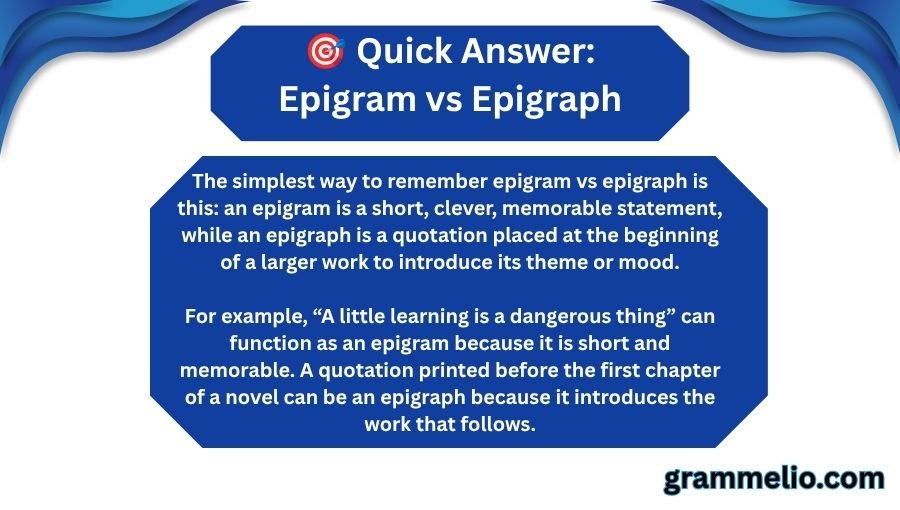
The simplest way to remember epigram vs epigraph is this: an epigram is a short, clever, memorable statement, while an epigraph is a quotation placed at the beginning of a larger work to introduce its theme or mood.
For example, “A little learning is a dangerous thing” can function as an epigram because it is short and memorable. A quotation printed before the first chapter of a novel can be an epigraph because it introduces the work that follows.
Related Word Forms
Both words have useful plural forms, and writers should know how those forms work.
| Form | Type | Example |
|---|---|---|
| epigram | Singular noun | The writer included an epigram in the essay. |
| epigrams | Plural noun | The book contains several epigrams. |
| epigraph | Singular noun | The novel begins with an epigraph. |
| epigraphs | Plural noun | The author used epigraphs from several poets. |
| epigrammatic | Adjective | Her writing has an epigrammatic style. |
| epigraphic | Adjective | The study examines epigraphic writing. |
The most common mistake is not the plural form. It is choosing the wrong base word in the first place.
🔎 Is an Epigram the Same as an Epigraph?
No. An epigram and an epigraph have different jobs in writing. An epigram is a brief saying, while an epigraph is a quotation or short passage placed at the start of a work.
Think about where the words usually appear:
- Epigram: The focus is on the statement itself.
- Epigraph: The focus is on the quotation’s position and purpose.
- Epigram: It is often witty, sharp, or memorable.
- Epigraph: It often gives readers a clue about the theme of a book or section.
Here is the difference at a glance:
| Form | Type | Meaning | Example | Correct/Incorrect |
|---|---|---|---|---|
| epigram | Noun | A short, clever saying | The speech ended with an epigram. | ✅ Correct |
| epigraph | Noun | A quotation placed before a larger work | The chapter opens with an epigraph. | ✅ Correct |
| epigram | Noun | A beginning quotation in a novel | The novel begins with an epigram. | ❌ Usually incorrect |
| epigraph | Noun | Any clever short saying | Her clever joke was an epigraph. | ❌ Incorrect |
| epigrams | Plural noun | Several short sayings | His collection contains many epigrams. | ✅ Correct |
The key is to ask what the word is doing. If you are talking about the short saying itself, think epigram. If you are talking about a quotation placed before another work, think epigraph.
📚 Epigram: Meaning and Correct Use
An epigram is a short statement that expresses an idea in a clever, pointed, or memorable way. Epigrams are often designed to make readers think.
An epigram does not have to appear at the beginning of a book. It can appear in a speech, poem, essay, conversation, or other form of writing.
What makes an epigram an epigram?
An epigram usually has three qualities:
- It is brief.
- It expresses a clear thought.
- It is memorable or striking.
For example:
“The cure for boredom is curiosity.”
This sentence is short and presents a memorable idea. It can work as an epigram.
Another example:
“Good advice is easier to give than to follow.”
The sentence makes a general observation in a compact way.
| Meaning | Word Type | Example Sentence |
|---|---|---|
| Clever short saying | Noun | The teacher shared an epigram with the class. |
| Memorable observation | Noun | His epigram made everyone think. |
| Short witty statement | Noun | The article ended with a sharp epigram. |
💡 Test Tip for Epigram
I use a simple test when checking this word: Could the sentence stand alone as a memorable saying?
If yes, epigram may be the right choice.
For example:
✅ “The writer’s epigram was easy to remember.”
❌ “The book’s epigram appeared before Chapter One.”
The second sentence is usually talking about an opening quotation. In that case, epigraph is the better word.
📖 Epigraph: Meaning and Correct Use
An epigraph is a short quotation, saying, or passage placed at the beginning of a book, chapter, essay, poem, or other work.
Its main purpose is to prepare readers for what follows. An epigraph can suggest a theme, create a mood, raise a question, or connect a work to another writer or idea.
For example, imagine a novel about grief that begins with a short quotation about loss. That quotation is an epigraph because of its placement and purpose.
Where do you find an epigraph?
An epigraph may appear:
- Before a novel
- Before a chapter
- At the start of an essay
- Before a poem or long section
- At the beginning of a nonfiction book
- Before a major part of a larger work
| Feature | Epigram | Epigraph |
|---|---|---|
| Main idea | Short, clever saying | Opening quotation or passage |
| Main focus | The statement itself | Its position and purpose |
| Common location | Almost anywhere | Usually at the beginning of a work |
| Typical effect | Memorable or witty | Sets a theme or mood |
| Can be a quotation? | Yes, sometimes | Yes, commonly |
| Must introduce a work? | No | Usually |
The difference becomes much clearer when you remember that epigraph describes a writing device, while epigram describes a kind of brief statement.
🧠 Why Do People Confuse Epigram and Epigraph?
People confuse these words because they share the same beginning and are closely connected to short pieces of writing. Their similar appearance makes the mistake especially easy when someone is typing quickly.
I once edited a student’s literature paper where the student correctly understood the idea but called the quotation at the beginning of a novel an “epigram.” The student had learned both words but had attached the wrong meaning to each one. Once I explained that an epigraph is the opening quotation, the error disappeared.
There is another reason for the confusion. An epigraph can itself be an epigram.
That sounds strange, but it is perfectly possible.
For example, an author might place a famous short saying at the beginning of a novel. The saying may have the qualities of an epigram, while its position at the beginning makes it an epigraph.
So the two terms can overlap in one example without meaning the same thing.
| Question | Epigram | Epigraph |
|---|---|---|
| Is it usually short? | Yes | Yes |
| Can it be a quotation? | Sometimes | Often |
| Does it have to appear at the beginning? | No | Usually |
| Can it be witty? | Often | Sometimes |
| Does it introduce a larger work? | No | Yes |
| Is it a writing device? | Not mainly | Yes |
✏️ Epigram vs Epigraph at a Glance
The biggest difference between epigram vs epigraph is function. An epigram is valued for its brief and striking message, while an epigraph is used to introduce or frame another piece of writing.
Consider these examples:
Epigram:
“Experience teaches what advice cannot.”
This is presented as a short statement.
Epigraph:
“Experience teaches what advice cannot.”
—Opening quotation before a chapter
Now the same words can function as an epigraph because they have been placed at the beginning of another work.
| Situation | Best Term | Reason |
|---|---|---|
| A clever one-line observation | Epigram | The statement is the focus. |
| A quotation before a chapter | Epigraph | The quotation introduces the chapter. |
| A collection of short witty sayings | Epigrams | The sayings themselves are being collected. |
| A quotation before a novel | Epigraph | It frames the larger work. |
| A memorable line in a speech | Epigram | It functions as a concise saying. |
📝 Case Study: A Student Writing About a Novel
Imagine a student writing this sentence:
“The author uses an epigram before Chapter 1 to introduce the theme.”
The student may actually mean epigraph.
A better sentence would be:
“The author uses an epigraph before Chapter 1 to introduce the theme.”
Why?
Because the sentence is describing a quotation positioned before the chapter. Its role is to frame what comes next.
Now imagine the student writes:
“The author’s epigram about courage is memorable.”
That can be correct if the student is discussing the short, striking statement itself.
This small difference matters in literary analysis. If you are describing what a sentence is, epigram may be appropriate. If you are describing how a quotation is used at the start of a work, epigraph is usually appropriate.
📐 Grammar Rules Explanation
The grammar rule is simple: both epigram and epigraph are nouns, but they name different things.
An epigram names a short, clever, pointed, or memorable statement.
An epigraph names a quotation or short passage placed at the beginning of a larger written work.
Neither word is a different grammatical form of the other. They are separate nouns with related histories and meanings.
Standard reference works and dictionaries agree on the basic distinction between these terms. The safest way to use them is to focus on their function in context.
How the nouns work in sentences
An epigram can act as the subject or object of a sentence:
- “The speaker shared an epigram.”
- “I remembered the epigram.”
- “Her epigram was clever.”
An epigraph can work in the same grammatical positions:
- “The novel has an epigraph.”
- “I studied the epigraph.”
- “The epigraph creates a serious mood.”
The grammar is not the difficult part. The meaning is.
Correct vs Incorrect at a Glance
| Sentence | Correct/Incorrect | Why |
|---|---|---|
| The novel begins with an epigraph. | ✅ Correct | It describes an opening quotation. |
| The speaker ended with a memorable epigram. | ✅ Correct | It describes a short memorable statement. |
| The chapter opens with an epigram from another writer. | ❌ Usually incorrect | The intended term is likely epigraph. |
| The writer created several epigrams. | ✅ Correct | The writer created short sayings. |
| The book’s epigraph helped establish its mood. | ✅ Correct | The quotation frames the book. |
The word usually matters in some examples because language can overlap. A short saying can be both an epigram and an epigraph if it is an epigram used as an opening quotation.
⚠️ Common Mistakes With Epigram and Epigraph
The most common mistake is using epigram whenever someone means “a quotation at the beginning of a book.”
That shortcut does not work.
Another mistake is assuming that an epigraph must always be witty. It does not. An epigraph can be serious, sad, poetic, mysterious, thoughtful, or humorous.
People also sometimes assume that an epigram must always be funny. It does not have to be funny. It is more useful to think of it as brief, pointed, and memorable.
I once caught myself typing “epigram” while editing a review of a novel. I stopped because the sentence was about the quotation printed before the first chapter. Changing it to “epigraph” fixed the meaning immediately.
Similar Grammar Confusions
| Confusion | Correct Choice | Simple Rule |
|---|---|---|
| it’s / its | Depends on meaning | “It’s” means “it is”; “its” shows possession. |
| your / you’re | Depends on meaning | “Your” shows possession; “you’re” means “you are.” |
| affect / effect | Depends on function | “Affect” is often a verb; “effect” is often a noun. |
| advice / advise | Depends on word type | “Advice” is a noun; “advise” is a verb. |
| epigram / epigraph | Depends on function | A saying is an epigram; an opening quotation is an epigraph. |
Fast typing, autocorrect, and incomplete knowledge can all cause these errors. But with epigram vs epigraph, the strongest defense is understanding the meaning.
Common Wrong Forms and Uses
| Wrong Form or Use | What’s Wrong | Correct Form |
|---|---|---|
| The novel begins with an epigram. | Usually the opening quotation is an epigraph. | epigraph |
| The author added an epigraph to his speech. | A speech can have an opening quotation, but “epigraph” is mainly used for written works and sections. | opening quotation, if more natural |
| She wrote an epigraph about friendship. | If the focus is on the saying itself, the word may be epigram. | epigram |
| The book contains many epigraph. | Singular form is used after “one”; plural is needed here. | epigraphs |
| The writer published several epigraphs as sayings. | The term depends on their role. | epigrams, if they are being treated as sayings |
| He chose an epigram for the front of his novel. | It can be an epigram, but its role at the front makes it an epigraph too. | epigraph |
🏛️ Word Origin and History
The two words have a related history, which helps explain why they look so similar. Both are connected to an ancient Greek word family associated with writing or inscription.
Over time, the words developed into different English terms with different uses. Epigram became associated with short, pointed statements and literary sayings. Epigraph became associated with an inscription or quotation placed in relation to a larger work.
You do not need to memorize the ancient language roots to use the words correctly. The modern difference is much more useful.
| Period | Form | General Development |
|---|---|---|
| Ancient period | Related Greek word family | Words connected with writing or inscription. |
| Later literary use | Epigram | Became associated with short literary statements. |
| Later literary use | Epigraph | Became associated with inscriptions and opening quotations. |
| Modern English | Epigram | Commonly means a short, pointed, memorable saying. |
| Modern English | Epigraph | Commonly means an opening quotation or passage. |
The important point is that the similar spelling is not an accident, but their modern meanings should still be kept separate.
🌎 Usage in Different Contexts
The correct choice can depend on what you are discussing. In everyday conversation, epigram is more likely to describe a memorable saying. In literary analysis, epigraph is common when discussing opening quotations.
| Context | Which Term to Use | Example |
|---|---|---|
| Everyday conversation | Epigram | That short saying sounds like an epigram. |
| Professional writing | Either, depending on meaning | The report opens with an epigraph. |
| Creative writing | Either, depending on role | The author placed an epigraph before the story. |
| Social media/texting | Epigram | Her short, clever post reads like an epigram. |
Everyday Conversation
You might say:
“He ended his talk with a clever epigram.”
This means he ended with a short, memorable saying.
You would not normally call an ordinary opening quotation an epigram just because it is short.
Professional Writing
In academic or professional writing, precision matters.
For example:
“The report begins with an epigraph about leadership.”
This tells the reader that a quotation has been placed before the main text.
Creative Writing
Creative writers often use epigraphs to establish mood.
A mystery novel might begin with a quotation about fear. A historical novel might begin with a quotation about war. A book of essays might begin with a thoughtful statement.
Social Media and Texting
Most casual social media users will not need the word epigraph. They may, however, describe a memorable line as an epigram.
Still, context matters. If someone posts a quotation above a longer essay or online article as an introduction, you could describe its role as an epigraph.
💬 Common Phrases With Epigram and Epigraph
These words do not have many fixed idioms, but several natural phrases are common in literary and academic writing.
| Phrase | Meaning |
|---|---|
| a witty epigram | A clever, memorable short saying |
| a memorable epigram | A short statement that is easy to remember |
| a sharp epigram | A pointed or striking saying |
| an opening epigraph | A quotation at the beginning of a work |
| a chapter epigraph | An epigraph placed before a chapter |
| a literary epigraph | An opening quotation used in literary writing |
These phrases make the difference easier to see. Notice how opening epigraph naturally describes position, while witty epigram describes the quality of the saying.
🔄 Synonyms and Alternatives
Sometimes you can replace these words with simpler phrases. This is useful when your audience may not know the terms.
For epigram, alternatives include:
- witty saying
- short saying
- memorable statement
- pointed remark
For epigraph, alternatives include:
- opening quotation
- introductory quotation
- quotation at the beginning
- opening passage
| Alternative | Works When | Does Not Work When |
|---|---|---|
| witty saying | You mean an epigram | You mean an opening quotation |
| memorable statement | You mean a brief saying | You need to stress its position before a work |
| opening quotation | You mean an epigraph | The saying is being discussed by itself |
| introductory quotation | You mean an epigraph | The text is not functioning as an introduction |
| pointed remark | You mean an epigram | The quotation is mainly being used to frame a chapter |
Using a simpler phrase can sometimes make your writing clearer, especially for a general audience.
❓ Can an Epigram Also Be an Epigraph?
Yes. A single quotation can be both an epigram and an epigraph if it is a short, clever saying that is placed at the beginning of a larger work.
For example, suppose an author places a short, memorable saying before a novel. The saying can be called an epigram because of what it is. It can also be called an epigraph because of how and where it is used.
This is one of the most useful facts to remember about epigram vs epigraph.
The terms are not always mutually exclusive. They describe different aspects of the text.
| Description | Term |
|---|---|
| A short, clever saying | Epigram |
| A quotation before a book | Epigraph |
| A clever saying before a book | Both may apply |
| A long opening passage | Epigraph |
| A short saying used in conversation | Epigram |
🧩 How To Remember the Difference
The easiest memory trick is to connect each word with its main job.
Think “gram” for the saying
Epigram contains gram, which can remind you of a written statement.
Think:
Epigram = a brief written idea.
It is often clever and memorable.
Think “graph” for the opening text
Epigraph contains graph, which can remind you of something written or placed with a larger text.
Think:
Epigraph = a quotation placed before a larger work.
This is not a complete history lesson. It is simply a memory tool.
| Word | Memory Cue | Meaning |
|---|---|---|
| Epigram | Brief statement | Short, clever, pointed saying |
| Epigraph | Before the main text | Opening quotation or passage |
🆚 Key Differences Between Epigram and Epigraph
The clearest way to master epigram vs epigraph is to compare their purpose, location, and meaning.
| Difference | Epigram | Epigraph |
|---|---|---|
| Definition | Short, pointed saying | Opening quotation or passage |
| Main purpose | Express an idea memorably | Introduce or frame a larger work |
| Location | Flexible | Usually before a work or section |
| Tone | Often witty or sharp | Any tone |
| Length | Usually brief | Usually brief, but can be a short passage |
| Literary use | Saying or observation | Framing device |
| Common setting | Speeches, essays, conversation | Books, chapters, essays |
Once these differences become familiar, choosing the correct word becomes much easier.
❓ Why Does the Difference Matter?
The difference matters because the wrong word can change what readers think you mean.
Compare these sentences:
“The author wrote a clever epigram.”
This tells us about the nature of the statement.
Now compare:
“The author placed an epigraph before the first chapter.”
This tells us about the statement’s role in the book.
The first sentence focuses on what the words are. The second focuses on how the words are being used.
That distinction is especially useful in literary analysis, editing, academic writing, and book reviews.
💼 Why It Matters in Professional Writing
Correct word choice shows control and care. This is especially important when you are writing for teachers, editors, clients, publishers, or professional readers.
| Situation | Why Getting It Right Matters |
|---|---|
| Resume or portfolio | Shows strong language skills. |
| Client email | Makes your meaning clear. |
| Published content | Prevents readers from learning the wrong usage. |
| Social post | Helps you communicate a precise idea. |
A single vocabulary mistake rarely ruins an entire piece of writing. But repeated word confusion can make readers question your accuracy.
As I often tell writers:
“The right word makes the intended meaning easier to see.”
That is the real value of learning epigram vs epigraph.
🎯 What Is the Fastest Way to Choose the Right Word?
Ask one question:
Am I talking about the short saying itself, or its role as an opening quotation?
If you are talking about the saying itself, choose epigram.
If you are talking about an opening quotation before a book, chapter, or similar work, choose epigraph.
| If You Mean… | Choose… |
|---|---|
| A clever short saying | Epigram |
| A pointed observation | Epigram |
| A memorable statement | Epigram |
| A quotation before a chapter | Epigraph |
| A quotation before a novel | Epigraph |
| An opening passage that frames a work | Epigraph |
This test works in most everyday writing situations.
⚠️ What Are the Most Common Usage Errors?
The biggest error is treating the two words as interchangeable. They are related, but they are not identical.
Another error is thinking every epigraph must be witty. It does not. An epigraph may be serious or reflective.
A third error is thinking every epigram is used at the start of a book. It is not.
Here are some quick examples:
✅ The novelist chose an epigraph for the opening page.
❌ The novelist chose an epigram for the opening page.
The second sentence is not always impossible, because the quotation could itself be an epigram. But if the writer is naming the literary device used to introduce the book, epigraph is the precise choice.
🧪 Practice: Test Yourself
Try choosing the correct word before looking at the answers.
Example 1
“The essay begins with a quotation about freedom.”
Answer: epigraph.
Why? The quotation is being used at the beginning of the essay.
Example 2
“Her short observation about success was clever and memorable.”
Answer: epigram.
Why? The focus is on the statement itself.
Example 3
“The writer included a brief quotation before every chapter.”
Answer: epigraphs.
Why? These quotations serve as opening material for the chapters.
Example 4
“The speaker ended with a sharp saying about human nature.”
Answer: epigram.
Why? The saying itself is the focus.
| Practice Sentence | Answer | Reason |
|---|---|---|
| The novel opens with a quotation. | Epigraph | It comes before the novel. |
| The speaker made a clever short statement. | Epigram | The statement itself is the focus. |
| Each chapter has an opening quotation. | Epigraph | The quotations frame chapters. |
| The writer collected witty sayings. | Epigrams | The sayings are being collected. |
❓ Can an Epigraph Be Written by the Author?
Yes. An epigraph does not have to come from a different writer. An author can use their own words as an opening quotation if they want to frame the work in that way.
The important point is the role the text plays. If a quotation or statement appears before the main work and serves as an introduction or frame, it can function as an epigraph.
This is another reason not to define an epigraph simply as “a quote from another person.” Its position and function are more important.
❓ Is Every Short Quote an Epigram?
No. A short quotation is not automatically an epigram.
A quotation may simply be a quotation. To call it an epigram, it should have the qualities of a short, pointed, clever, or memorable statement.
For example, a short sentence taken from a long speech may be a quotation without being an epigram.
Likewise, a quotation at the beginning of a book may be an epigraph even if it is not witty.
❓ Is an Epigraph Always at the Beginning?
An epigraph is normally placed at the beginning of a work or section. Its purpose is to introduce, frame, or suggest something about the text that follows.
That is why location is such a helpful clue. If a writer says that a quotation appears before a novel or chapter, epigraph is usually the correct term.
❓ Can a Poem Have an Epigraph?
Yes. A poem can have an epigraph if the poet places a quotation or short passage before the poem to help establish its theme or mood.
For example, a poet might place a quotation about memory before a poem about childhood. The quotation can prepare readers for the poem’s subject.
❓ Can an Epigram Be Long?
An epigram is generally brief. Its strength comes from saying something clearly and memorably in a small amount of space.
If a statement becomes a long paragraph or extended passage, calling it an epigram may no longer be the best choice.
The exact length is less important than its concise and pointed nature.
❓ Which Word Should I Use in Literary Analysis?
Use epigram when you are analyzing a short, clever, pointed, or memorable statement. Use epigraph when you are analyzing a quotation placed before a book, chapter, poem, essay, or other larger section.
For example:
“The epigram captures the author’s view of pride.”
This discusses the statement.
“The epigraph prepares readers for the novel’s theme of loss.”
This discusses the opening quotation’s role.
❓ What Is the Main Difference Between Epigram and Epigraph?
The main difference is function.
An epigram is a short, memorable, often clever statement. An epigraph is a quotation or short passage placed at the beginning of a larger work or section.
Remember:
Epigram = the saying.
Epigraph = the opening quotation.
That simple contrast will solve most cases of epigram vs epigraph.
❓ How Can I Remember Epigram vs Epigraph?
Use the phrase:
Epigram = memorable message.
Epigraph = opening quotation.
Then ask yourself what you are describing.
If you care about the words as a short saying, choose epigram.
If you care about the words because they appear before another work, choose epigraph.
❓ Can One Text Be Both an Epigram and an Epigraph?
Yes. A short, clever saying can be an epigram by nature and an epigraph by function if an author places it before a book, chapter, or other work.
This overlap is not a contradiction. The two words describe different features of the same text.
❓ Are Epigram and Epigraph Interchangeable?
No, they are not fully interchangeable.
An epigram is defined by the kind of statement it is. An epigraph is defined mainly by its role as an opening quotation or passage.
Sometimes one text can fit both descriptions, but that does not make the words synonyms.
❓ Should I Use Epigram or Epigraph for a Book’s Opening Quote?
Use epigraph when you mean the quotation’s role as the opening text.
For example:
“The novel begins with an epigraph from a nineteenth-century poem.”
If the quotation is also a short, clever saying, you could describe its content as an epigram, but epigraph is the clearest term for its position in the book.
✅ Quick Recap Checklist
Use this checklist whenever you are unsure about epigram vs epigraph.
| Question | If Yes → Use |
|---|---|
| Is it a short, clever saying? | Epigram |
| Is the statement itself the focus? | Epigram |
| Is it a memorable observation? | Epigram |
| Is it placed before a book? | Epigraph |
| Is it placed before a chapter? | Epigraph |
| Does it frame the work that follows? | Epigraph |
| Can it be both a clever saying and an opening quotation? | Both may apply |
Practice Examples
- The author placed a quotation before Chapter Two. → Epigraph
- The teacher shared a clever saying about patience. → Epigram
- The novel opens with a short quotation that sets its mood. → Epigraph
If you can answer these three examples correctly, you already understand the central distinction.
📌 A Simple Rule for Writers
When editing your own work, remember this one rule:
An epigram is a short, pointed saying. An epigraph is an opening quotation or passage.
That rule is short enough to memorize and strong enough to handle most real-world examples.
When the same quotation fits both descriptions, do not panic. Look at what you are discussing. If you are describing the saying’s style or message, epigram may be appropriate. If you are describing its role before a larger work, epigraph is appropriate.
This way of thinking is more reliable than memorizing spelling alone.
🔍 Epigram vs Epigraph: Final Comparison
Before you finish, review the difference one more time.
| Feature | Epigram | Epigraph |
|---|---|---|
| What is it? | A short, pointed, memorable saying | An opening quotation or passage |
| Where does it appear? | Anywhere appropriate | Usually before a larger work or section |
| What does it do? | Expresses an idea in a concise way | Introduces or frames another text |
| Does it need to be witty? | Often has a witty or sharp quality | No |
| Does it need to be a quotation? | No | Often, but not always in the narrow sense of “someone else’s words” |
| Can it overlap with the other term? | Yes | Yes |
| Main memory clue | Short saying | Opening quotation |
The most important thing is not to memorize every possible edge case. Learn the central difference first.
🌟 Conclusion
Epigram vs epigraph becomes much easier once you focus on function rather than spelling. An epigram is a short, pointed, memorable statement. An epigraph is a quotation or short passage placed at the beginning of a book, chapter, poem, essay, or similar work. The two can sometimes describe the same words, but they do so for different reasons. An epigram describes the nature of the statement. An epigraph describes the statement’s role and placement. ✨
When I edit writing, I find that this simple distinction solves most mistakes: epigram is the saying, while epigraph is the opening quotation. If you remember that line, you can choose the right word with confidence in essays, book reviews, creative writing, academic work, and everyday discussion. The goal is not to make your vocabulary sound complicated. The goal is to make your meaning clear. Once you understand what each word does, these two similar-looking terms stop being confusing and become easy, useful parts of your writing vocabulary. Keep the rule simple, check the context, and let the meaning guide your choice.

[…] and memory tricks behind epitaph vs epithet so you can use both words with confidence. 📝 Epigram vs Epigraph | Epic vs Epoch | Empathy vs […]