I have seen even strong writers pause when they come across epitaph vs epithet. The words look and sound so much alike that it is easy to switch them by accident. Yet they describe very different things. An epitaph is connected with a person who has died and usually appears on a grave or memorial.
An epithet is a word or phrase used to describe a person, often by highlighting a quality, role, or trait. If you are writing an essay, editing a story, or simply trying to choose the right word in conversation, knowing this difference can save you from an awkward mistake.
I will walk you through the meaning, grammar, history, examples, and memory tricks behind epitaph vs epithet so you can use both words with confidence. 📝 Epigram vs Epigraph | Epic vs Epoch | Empathy vs Sympathy
🎯 Quick Answer: Epitaph vs Epithet
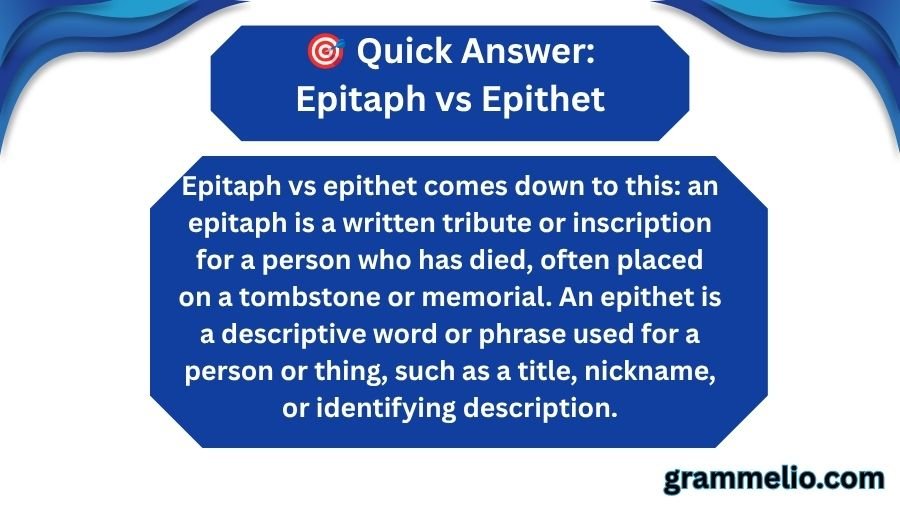
Epitaph vs epithet comes down to this: an epitaph is a written tribute or inscription for a person who has died, often placed on a tombstone or memorial. An epithet is a descriptive word or phrase used for a person or thing, such as a title, nickname, or identifying description.
A simple memory trick is:
- Epitaph = words for the dead.
- Epithet = a descriptive name or phrase.
For example, “Beloved mother and devoted friend” could be an epitaph on a grave. “Richard the Lionheart” contains an epithet because “the Lionheart” describes Richard.
Epitaph vs Epithet: The Basic Difference
The clearest way to understand epitaph vs epithet is to ask what the word does. An epitaph remembers or honors someone who has died. An epithet describes or identifies someone.
An epitaph is usually connected with death, remembrance, and memorials. It may be a short sentence, a quotation, a name, or a few words placed on a gravestone.
An epithet has a wider use. It can be positive, neutral, humorous, or negative. It may function like a nickname or descriptive title.
| Form | Type | Meaning | Example | Correct/Incorrect |
|---|---|---|---|---|
| Epitaph | Noun | Memorial words for a deceased person | “She wrote an epitaph for her father.” | ✅ Correct |
| Epithet | Noun | A descriptive name or phrase | “The Great” is an epithet used for some rulers. | ✅ Correct |
| Epitaph | Noun | A general nickname | “He earned the epitaph ‘The Swift.’” | ❌ Usually incorrect |
| Epithet | Noun | Words carved on a grave | “The epithet was carved on his tombstone.” | ❌ Usually incorrect |
The key difference is purpose. An epitaph serves as a memorial. An epithet serves as a description or label.
What Does Epitaph Mean?
An epitaph is a short written statement about a person who has died, especially one written on a tombstone or memorial.
It may include:
- The person’s name
- Their dates
- A message of love
- A religious or personal statement
- A short quotation
- A description of their life
- Words of remembrance
An epitaph does not have to be long. In fact, many effective epitaphs are only a few words.
Consider:
“A loving father and faithful friend.”
That sentence could appear on a grave. It remembers the person and honors their life.
Epitaph in a Sentence
Correct:
✅ “The family chose a simple epitaph for their grandmother.”
The word epitaph works because the sentence is about memorial words for someone who has died.
Incorrect:
❌ “Everyone knew him by the epitaph ‘Red.’”
This is not the natural use of epitaph. If “Red” was his nickname, epithet or nickname would be a better choice.
Another Example
✅ “The stone carried an epitaph honoring his years of service.”
❌ “The soldier was given the epitaph ‘Brave.’”
The first sentence refers to memorial writing. The second refers to a descriptive label, so epithet is more suitable.
What Does Epithet Mean?
An epithet is a descriptive word or phrase used with a person’s name or used to identify someone by a particular quality, role, or trait.
For example:
- Alexander the Great
- Richard the Lionheart
- Alfred the Great
- Ivan the Terrible
In these examples, “the Great,” “the Lionheart,” and “the Terrible” work as descriptive labels.
An epithet can also be used outside historical names. A writer might call someone “the office genius” as a playful descriptive phrase. The exact meaning depends on context.
An epithet can be:
- Complimentary
- Critical
- Humorous
- Descriptive
- Traditional
- Poetic
| Meaning | Word Type | Example Sentence |
|---|---|---|
| Descriptive title | Noun | “The Great” became an epithet associated with Alexander. |
| Descriptive phrase | Noun | The writer gave the hero the epithet “the fearless.” |
| Insulting label | Noun | The cruel epithet followed him for years. |
| Traditional name | Noun | The ruler became known by an epithet that reflected his reputation. |
The important point is that an epithet describes. It does not specifically mean a message written for someone who has died.
Is Epitaph the Same as Epithet?
No. Epitaph and epithet are not synonyms. They have different meanings and are used in different situations.
An epitaph is connected with a person’s death and remembrance. An epithet is connected with description or naming.
Think about two different scenes.
In the first scene, you are standing in a cemetery. You see a stone that says:
“She brought kindness wherever she went.”
That is an epitaph.
In the second scene, you are reading a history book. You see:
“William the Conqueror”
“The Conqueror” is an epithet.
| Feature | Epitaph | Epithet |
|---|---|---|
| Main purpose | Memorialize someone who died | Describe or identify someone |
| Usually connected with death | Yes | No |
| Often found on a grave | Yes | No |
| Can be a nickname | No, not normally | Yes, in some contexts |
| Can describe a quality | Yes, in a memorial | Yes |
| Common in history and literature | Sometimes | Often |
A Simple Rule
If you mean memorial words, choose epitaph.
If you mean a descriptive label or title, choose epithet.
That rule handles most everyday cases.
Why Do People Confuse Epitaph and Epithet?
People confuse these words because they look almost identical. Both begin with epit-, both are nouns, and both are connected to words used to describe people.
I once reviewed a student’s history essay in which the student wrote that a famous ruler “was remembered by his epitaph.” The student clearly meant a descriptive title. The sentence made sense at first glance, but the wrong word changed the meaning. Once we replaced epitaph with epithet, the sentence became clear.
Another reason for confusion is that both words can appear in discussions of names, memorials, history, and literature.
| Confusing Pair | Correct Choice | Basic Difference |
|---|---|---|
| It’s / its | Depends on meaning | Contraction vs. possession |
| Your / you’re | Depends on meaning | Possession vs. “you are” |
| Affect / effect | Depends on meaning | Usually verb vs. noun |
| Epitaph / epithet | Depends on context | Memorial writing vs. description |
| Principal / principle | Depends on meaning | Person or main thing vs. rule or belief |
The spelling difference is small. The meaning difference is much larger.
How Can You Remember Epitaph vs Epithet?
The easiest memory trick is to connect epitaph with after death.
Notice the ending:
epitaph → death → grave → memorial
For epithet, think:
epithet → description → title → nickname
You can also remember these two questions:
- Is this written to remember someone who died?
→ Use epitaph. - Is this a descriptive name or phrase?
→ Use epithet.
💡 Test Tip
Cover the sentence and ask yourself: “Am I talking about a grave or a descriptive label?”
If the answer is “grave,” choose epitaph. If the answer is “descriptive label,” choose epithet.
Correct Meanings and Uses of Epitaph
An epitaph has a focused meaning, but it can appear in several related contexts.
1. A Grave Inscription
This is the most familiar use.
✅ “The epitaph on the stone read, ‘Forever in our hearts.’”
The phrase is an epitaph because it appears as a memorial for someone who died.
2. A Memorial Statement
An epitaph can also refer more broadly to a written tribute.
✅ “The book ended with an epitaph honoring the victims.”
Here, the word is being used for a memorial statement rather than simply pointing to the stone itself.
3. A Figurative Final Statement
In some writing, epitaph can be used figuratively for a final statement that sums up a person, event, career, or idea.
For example:
✅ “That failed project became an epitaph for the company’s old strategy.”
This is a figurative use. It suggests that something marked the end of an era or approach.
| Epitaph Use | Example | Meaning |
|---|---|---|
| Grave inscription | “The epitaph was carved into the stone.” | Memorial words |
| Memorial tribute | “The poem served as an epitaph.” | Words honoring the dead |
| Figurative ending | “The defeat became an epitaph for the campaign.” | A symbolic ending |
Correct Meanings and Uses of Epithet
An epithet also has several related uses.
1. A Descriptive Title
A famous example is Alexander the Great. “The Great” functions as a descriptive title.
2. A Nickname or Label
A person may receive an epithet because of an important trait or reputation.
For example:
“She became known by the epithet ‘the Peacemaker.’”
The phrase identifies her through a quality or role.
3. A Negative Label
An epithet can also be insulting.
For example:
“The politician rejected the insulting epithet used against him.”
Here, epithet refers to a hostile or offensive label.
4. A Literary Description
Writers sometimes use descriptive phrases as epithets to make a character memorable.
| Epithet Use | Example | Purpose |
|---|---|---|
| Historical title | “the Great” | Identifies a ruler by reputation |
| Nickname | “the Swift” | Highlights a quality |
| Negative label | “the Coward” | Criticizes a person |
| Literary description | “the wise old king” | Gives a character a clear trait |
📝 Case Study: A Simple Writing Mix-Up
Imagine that a museum is preparing a display about a famous historical leader.
The first draft says:
❌ “The leader’s famous epitaph was ‘the Conqueror.’”
That sentence sounds wrong because “the Conqueror” is a descriptive title, not a memorial inscription.
A better version is:
✅ “The leader was known by the epithet ‘the Conqueror.’”
Now imagine the museum displays a stone honoring someone who died.
The draft says:
❌ “The stone contains the person’s epithet.”
If the words are a memorial message, the better sentence is:
✅ “The stone contains the person’s epitaph.”
This small change makes the purpose of the words clear.
Grammar Rules for Epitaph vs Epithet
The grammar rule is simple: both words are nouns, but they name different kinds of things.
Use epitaph when the noun refers to an inscription or statement honoring someone who has died.
Use epithet when the noun refers to a descriptive name, title, or label.
Both can appear after articles such as an or the.
Examples:
- an epitaph
- the epitaph
- an epithet
- the epithet
Both can also be pluralized normally:
- epitaphs
- epithets
The surrounding words usually reveal which meaning you need.
Correct vs Incorrect at a Glance
| Sentence | Correct/Incorrect | Why |
|---|---|---|
| “The family selected an epitaph for the grave.” | ✅ Correct | It is a memorial statement. |
| “The king was known by the epithet ‘the Great.’” | ✅ Correct | It is a descriptive title. |
| “The epithet was carved on her tombstone as a final tribute.” | ❌ Usually incorrect | The intended word is epitaph. |
| “The ruler’s epitaph was ‘the Conqueror.’” | ❌ Incorrect in the intended sense | “The Conqueror” is a descriptive label. |
| “The author created an epithet for the hero.” | ✅ Correct | The phrase describes the hero. |
Most mistakes happen because writers focus on spelling instead of meaning.
⚠️ Common Mistakes With Epitaph and Epithet
The biggest mistake is treating the two words as interchangeable. They are not.
Other errors happen because writers type quickly, trust autocorrect, or have never learned the distinction.
I once caught myself typing epitaph in a draft when I meant a descriptive title. The sentence looked fine until I read it aloud. That quick reread reminded me of a useful rule: when two words look nearly the same, check the meaning before checking the spelling.
| Common Confusion | Why It Happens | Better Approach |
|---|---|---|
| Epitaph / epithet | Similar spelling | Check whether the word means memorial or description |
| Its / it’s | Apostrophe confusion | Test whether “it is” fits |
| Your / you’re | Similar sound | Test whether “you are” fits |
| Their / there / they’re | Same sound | Check meaning and sentence role |
| Then / than | Similar sound in fast speech | Check comparison or time meaning |
Why These Errors Happen
Fast typing: Your fingers may choose the familiar spelling before your brain checks the meaning.
Autocorrect: A spelling tool may notice that a word is spelled correctly but cannot always tell whether it fits the meaning.
Lack of knowledge: If you have never learned the difference, the two words can look interchangeable.
Specific Wrong Forms and Uses
| Wrong Form or Use | What’s Wrong | Correct Form |
|---|---|---|
| “His epitaph was the Brave.” | Uses a descriptive title as a memorial word | “His epithet was the Brave.” |
| “The epithet was carved on her grave as a tribute.” | Refers to a memorial inscription | “The epitaph was carved on her grave as a tribute.” |
| “She wrote an epithet for her late father.” | Intended meaning is a memorial message | “She wrote an epitaph for her late father.” |
| “The king’s epitaph was the Great.” | Confuses title with memorial inscription | “The king’s epithet was the Great.” |
| “They placed an epithet on the tombstone.” | A memorial inscription is intended | “They placed an epitaph on the tombstone.” |
Epitaph vs Epithet in Different Contexts
The right word stays the same even when the setting changes. What matters is the meaning.
| Context | Which Term to Use | Example |
|---|---|---|
| Everyday conversation | Epitaph | “They chose a short epitaph for the grave.” |
| Professional writing | Either, depending on meaning | “The historian explained the ruler’s epithet.” |
| Creative writing | Either, depending on meaning | “The poet created an epitaph for the fallen hero.” |
| Social media/texting | Usually whichever meaning fits | “That quote could make a touching epitaph.” |
Everyday Conversation
You might discuss an epitaph when talking about cemeteries, family memorials, or historical graves.
“What did they put on his epitaph?”
More naturally, you might say:
“What did they put on his tombstone?”
But epitaph is correct when you mean the words themselves.
Professional Writing
Historians, teachers, editors, and writers may use epithet when discussing historical names.
“The ruler became famous for the epithet ‘the Wise.’”
They may use epitaph when discussing memorial inscriptions.
Creative Writing
Both words can appear in stories and poems.
A novelist might write:
“She wondered what epitaph would someday appear on her grave.”
A historical writer might write:
“The warrior carried the epithet ‘the Red.’”
Social Media and Texting
Informal writing often uses simpler words such as nickname, grave inscription, or memorial. Still, knowing the difference helps when you want precise language.
Common Phrases With Epitaph
There are several natural phrases built around epitaph, although they are usually literal or descriptive rather than idiomatic.
| Phrase | Meaning |
|---|---|
| Write an epitaph | Create memorial words |
| A fitting epitaph | A memorial statement that suits the person |
| A final epitaph | Words that serve as a final memorial |
| Carve an epitaph | Put memorial words into stone |
| Epitaph on a tombstone | Memorial writing on a grave marker |
| A brief epitaph | A short memorial statement |
These phrases are especially useful in formal writing, literature, history, and discussions of cemeteries.
Common Phrases With Epithet
Epithet is often used with phrases describing titles, names, or labels.
| Phrase | Meaning |
|---|---|
| Descriptive epithet | A phrase that describes someone |
| Famous epithet | A well-known descriptive title |
| Historical epithet | A title associated with a historical figure |
| Honorific epithet | A title expressing praise or respect |
| Derogatory epithet | An insulting descriptive label |
| Use an epithet | Apply a descriptive name or phrase |
When you see epithet, think description rather than death.
Synonyms and Alternatives for Epitaph and Epithet
Sometimes a simpler word works better. The best alternative depends on what you mean.
| Alternative | Works When | Does Not Work When |
|---|---|---|
| Memorial inscription | You mean words written in memory of someone | You mean a person’s nickname |
| Tombstone inscription | You mean writing on a grave marker | You mean a historical title |
| Tribute | You mean words honoring someone | You need the precise meaning of a grave inscription |
| Nickname | You mean an informal name | You mean a formal grave inscription |
| Descriptive title | You mean a label based on a quality | You mean memorial writing |
For example, memorial inscription can often replace epitaph. But nickname is not always a perfect replacement for epithet, because an epithet may be more formal or descriptive.
Why Does Epitaph vs Epithet Matter?
Knowing epitaph vs epithet matters because precise word choice makes writing easier to understand. The two terms are close in spelling but far apart in meaning.
Clarity in Communication
A wrong word can make your sentence confusing.
Compare:
❌ “The historian discussed the ruler’s epitaph.”
Readers may think the historian discussed words written after the ruler’s death.
✅ “The historian discussed the ruler’s epithet.”
Now readers know the subject is a descriptive title.
Professionalism
Precise vocabulary makes essays, articles, reports, and academic writing stronger. A reader may overlook a small typo, but using the wrong word can change the meaning of an entire sentence.
Digital Communication
Online writing moves quickly. People often rely on spell-check tools. But spell-check can confirm spelling without confirming meaning.
A useful habit is to pause whenever two words look almost identical.
“Correct spelling is only half the job. The word must also fit the meaning.”
| Situation | Why Getting It Right Matters |
|---|---|
| Resume | Shows careful word choice |
| Client email | Prevents confusing communication |
| Published content | Protects accuracy and credibility |
| Social post | Helps readers understand your message |
How To Use Epitaph and Epithet in Creative Writing
Creative writing gives both words room to shine.
An epitaph can add emotion to a story. A character might read a grave inscription and learn something about the person buried there.
For example:
“She lived with courage. She left with love.”
That could serve as a fictional epitaph.
An epithet, on the other hand, can quickly tell readers something about a character.
For example:
“Mara the Fearless”
The epithet tells us how people viewed Mara.
| Writing Purpose | Better Word | Example |
|---|---|---|
| Honor a dead character | Epitaph | “His epitaph praised his kindness.” |
| Give a character a title | Epithet | “The warrior earned the epithet ‘the Fearless.’” |
| Create a memorial scene | Epitaph | “She stood before the epitaph in silence.” |
| Show reputation | Epithet | “His epithet reflected his courage.” |
Is There a Special Exception?
There is no major spelling exception that makes epitaph and epithet interchangeable. The main edge case is figurative use.
An epitaph can sometimes describe something that symbolically marks an ending. For example, a failed plan might be called “an epitaph for an old way of thinking.”
That does not turn epitaph into a synonym for epithet. It simply extends the memorial idea into a figurative context.
An epithet can also be positive or negative. It does not always have to be an insult. Historical titles such as “the Great” show that an epithet can express praise.
How To Avoid Confusing These Words Again
I recommend using a two-step check.
Step 1: Identify the purpose
Ask:
Are these words honoring someone who has died?
If yes, use epitaph.
Step 2: Identify the role
Ask:
Is this word or phrase describing someone or acting like a title?
If yes, use epithet.
The Grave Test
Imagine the sentence printed on a gravestone.
If it makes sense there, epitaph may be right.
If the sentence is about what people called someone during life, epithet is probably right.
This is not a perfect test for every figurative use, but it works very well for everyday writing.
Epitaph vs Epithet: Quick Recap Checklist
| Question | If Yes → Use |
|---|---|
| Are you talking about memorial words for someone who died? | Epitaph |
| Are you talking about words on a grave or memorial? | Epitaph |
| Are you talking about a descriptive title? | Epithet |
| Are you talking about a nickname or identifying label? | Epithet |
| Are you describing a positive or negative label applied to someone? | Epithet |
| Are you using the word figuratively to mean a final symbolic statement? | Epitaph |
Practice Examples
- “The family chose a touching ___ for the memorial.”
Answer: epitaph - “The ruler became famous by the ___ ‘the Wise.’”
Answer: epithet - “The words carved into the grave were a simple ___.”
Answer: epitaph
The more you practice by meaning, the less likely you are to confuse the spelling.
Frequently Asked Questions About Epitaph vs Epithet
What is the difference between epitaph and epithet?
An epitaph is a memorial statement, usually for someone who has died. An epithet is a descriptive word or phrase used as a title, nickname, or label.
Is an epitaph always on a tombstone?
No. An epitaph is commonly associated with a tombstone or grave, but the word can also refer more broadly to a written tribute or memorial statement. It can even be used figuratively to describe something that marks an ending.
Is an epithet a nickname?
An epithet can function like a nickname or descriptive title, but the terms are not always exact synonyms. An epithet often highlights a person’s quality, reputation, role, or character.
What is an example of an epithet?
In the name Alexander the Great, “the Great” is an example of an epithet because it describes the ruler and reflects how he was known.
What is an example of an epitaph?
A statement such as “A loving father and faithful friend” can be an epitaph when it is used as a memorial inscription for someone who has died.
Can an epithet be negative?
Yes. An epithet can be insulting or critical as well as positive or neutral. The meaning depends on the descriptive label and the context in which it is used.
Can epitaph be used figuratively?
Yes. An epitaph can sometimes be used figuratively for something that symbolizes the end of a person, period, project, or idea.
Which word should I use for a grave inscription?
Use epitaph when you mean the words written in memory of someone who has died. A grave inscription is one of the clearest examples of an epitaph.
Which word should I use for a historical title?
Use epithet when you mean a descriptive historical title, such as “the Great,” “the Wise,” or another identifying phrase.
How can I remember epitaph vs epithet?
Remember epitaph = memorial and epithet = description. If the words belong to a grave or memorial, think epitaph. If the words describe or label someone, think epithet.
Epitaph vs Epithet: Final Takeaway
Epitaph vs epithet becomes easy once you focus on meaning instead of spelling. An epitaph is a memorial statement connected with someone who has died. An epithet is a descriptive name, title, or label used for a person or thing. 🧠
When I need to choose between them, I use one simple question: Am I talking about remembrance after death, or description during life? Remembrance points to epitaph. Description points to epithet.
If you are writing about a grave, memorial, or final tribute, epitaph is usually the word you need. If you are writing about a historical title, nickname, reputation, or descriptive label, epithet is the better choice.
The spelling may be tricky, but the meanings are not. Remember the grave for epitaph and the descriptive label for epithet—and you will rarely mix them up again. ✨

[…] a student, teacher, writer, editor, or curious reader, you can learn this distinction quickly. ✨ Epitaph vs Epithet | Epigram vs Epigraph | Epic vs […]