I have taught and edited English for years, and disperse vs disburse is one of those word pairs that can cause trouble even for strong writers. The words look and sound somewhat alike, but they describe very different actions. One is mainly about spreading people or things out. The other is about paying out money. If you have ever paused over a sentence such as “The funds were dispersed” or “The crowd was disbursed,” you are not alone.
I have seen this mix-up in emails, reports, school assignments, and business documents. In this guide, I will show you the difference in plain US English.
By the end, you will have simple rules, examples, memory tricks, and practice questions to help you choose the right word with confidence. 😊 Deprecate vs Depreciate | Coarse vs Course | Decent vs Descent vs Dissent
🎯 Quick Answer: Disperse vs Disburse
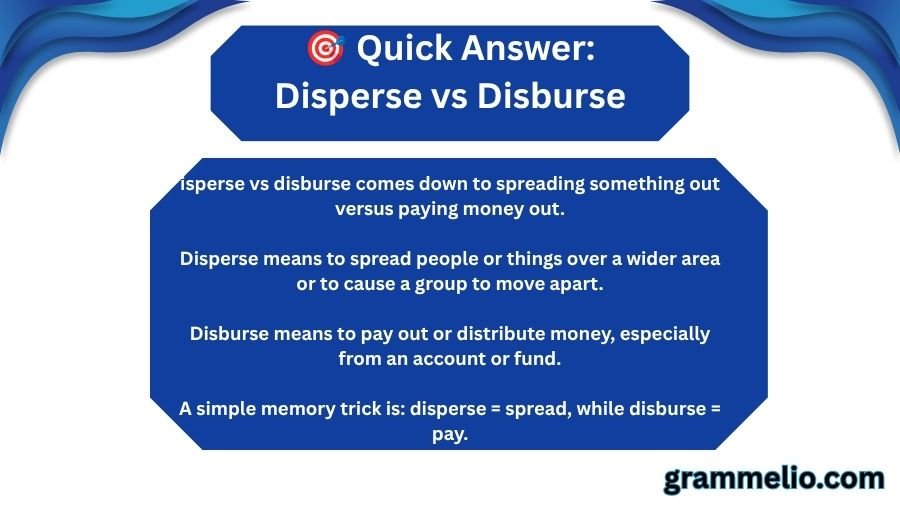
Disperse vs disburse comes down to spreading something out versus paying money out.
- Disperse means to spread people or things over a wider area or to cause a group to move apart.
- Disburse means to pay out or distribute money, especially from an account or fund.
A simple memory trick is: disperse = spread, while disburse = pay.
| Word | Basic Meaning | Common Object | Simple Example |
|---|---|---|---|
| Disperse | Spread out or scatter | People, objects, crowds, seeds | The crowd began to disperse. |
| Disburse | Pay out money | Funds, wages, grants, payments | The office will disburse the funds. |
What Does Disperse Mean?
Disperse means to spread out, scatter, or move apart. It can describe people, animals, objects, clouds, groups, or other things that move from one place into several places.
For example:
The students dispersed after the meeting.
The students were together first. Then they went in different directions.
Disperse can also be used as a transitive verb. In that form, something causes people or things to spread out.
The police dispersed the crowd.
Here, the police caused the crowd to move apart.
Common meanings of disperse
| Meaning | Word Type | Example Sentence |
|---|---|---|
| Spread over an area | Verb | The seeds dispersed across the field. |
| Move apart | Verb | The crowd dispersed after the concert. |
| Break up a group | Verb | Officers dispersed the gathering. |
| Scatter something | Verb | Wind dispersed the leaves. |
| Spread in different directions | Verb | The birds dispersed at sunrise. |
Disperse in everyday language
You can use disperse when people leave a gathering.
- The fans dispersed after the game.
- The protesters dispersed peacefully.
- The children dispersed across the playground.
- The clouds dispersed by noon.
You can also use it for physical things.
- The smoke dispersed into the air.
- The seeds dispersed across the ground.
- The light dispersed through the glass.
The main idea stays the same: something that was together becomes spread out.
What Does Disburse Mean?
Disburse means to pay out money. It is commonly used when an organization, government office, bank, school, company, or other institution releases funds.
For example:
The university will disburse the scholarship funds next week.
The university is paying or releasing money.
Unlike disperse, disburse is closely tied to money and financial payments.
Common uses of disburse
| Situation | Example |
|---|---|
| Scholarship | The school will disburse scholarship funds. |
| Loan | The bank will disburse the loan. |
| Grant | The agency will disburse the grant. |
| Payroll | The company disburses employee payments twice a month. |
| Project funding | The organization will disburse funds for the project. |
You will often see disburse in formal financial writing. It may sound more official than simply saying pay or give.
For example:
The charity disbursed $50,000 to local programs.
This means the charity paid or released $50,000 to those programs.
🧭 Disperse vs Disburse at a Glance
The fastest way to understand disperse vs disburse is to focus on what is being spread or released.
| Feature | Disperse | Disburse |
|---|---|---|
| Main idea | Spread out | Pay out |
| Usually involves | People or things | Money |
| Common setting | Groups, nature, crowds | Finance, business, government |
| Can describe movement? | Yes | Usually no |
| Financial meaning? | No | Yes |
| Example | The crowd dispersed. | The bank disbursed the funds. |
A one-second test
Ask yourself:
“Am I talking about money?”
- If yes, choose disburse.
- If no, disperse may be the correct choice when the meaning is spreading or moving apart.
This test will solve most cases quickly.
Is Disperse the Same as Disburse?
No. Disperse and disburse are not interchangeable. They share a similar spelling, but their meanings are different.
Disperse is about spreading or scattering.
Disburse is about paying out money.
Compare these sentences:
The crowd dispersed after the speech.
The people went in different directions.
The company disbursed the employee bonuses.
The company paid out money.
The two verbs may look like close cousins, but replacing one with the other can completely change the meaning.
The key difference
| Question | Correct Word |
|---|---|
| Did people move apart? | Disperse |
| Did objects scatter? | Disperse |
| Did clouds spread out? | Disperse |
| Was money paid out? | Disburse |
| Were grant funds released? | Disburse |
| Was a loan paid to a borrower? | Disburse |
💡 How Can You Remember the Difference?
A useful memory trick for disperse vs disburse is to connect the middle sounds with their meanings.
Think:
PERSE → spread
BURSE → money
You do not need to remember the exact word history to use this trick. Just remember the practical difference:
Disperse = spread apart.
Disburse = send money out.
Another trick is to picture two scenes.
Scene 1: A crowd
Imagine 100 people standing in one place. The event ends. People walk away in different directions.
They disperse.
Scene 2: A bank
Imagine an organization has approved a payment. The bank sends the money to the recipient.
The bank disburses the funds.
That visual contrast can make the difference easier to remember. 🧠
Why Do People Confuse Disperse and Disburse?
People confuse these words because they look and sound very similar. Both begin with dis-, both are verbs, and both can describe something being distributed outward.
The biggest clue is the noun that follows the verb.
If the sentence mentions money, funds, grants, payments, loans, or expenses, disburse is usually the word you want.
If it mentions people, crowds, objects, animals, smoke, clouds, or seeds, disperse is usually the better choice.
I once reviewed a short workplace report in which a writer said that a company had “dispersed grant money.” The sentence was understandable, but the intended financial meaning made disbursed the stronger choice. We changed the word, and the sentence immediately sounded more precise.
Compare these pairs
| Sentence | Meaning |
|---|---|
| The crowd dispersed. | People moved apart. |
| The funds were disbursed. | Money was paid out. |
| The smoke dispersed. | Smoke spread away. |
| The grant was disbursed. | Grant money was released. |
The similarity in spelling is the problem. The surrounding context usually provides the solution.
📝 Case Study: A Workplace Payment Mix-Up
Imagine a nonprofit sends an email to its finance team:
“The scholarship office will disperse the student payments on Friday.”
A reader may understand the sentence, but disburse is the better choice because the office is releasing money.
The revised sentence is:
“The scholarship office will disburse the student payments on Friday.”
Now imagine a different email:
“After the meeting, the students dispersed across campus.”
Here, disperse is correct because the students moved apart.
This small change matters in professional writing. Financial documents need especially clear language because a single wrong word can make a sentence sound careless or confusing.
Case study comparison
| Situation | Original Idea | Best Word | Reason |
|---|---|---|---|
| Students leave a meeting | Students moved apart | Disperse | People spread out |
| Scholarship office releases money | Payments are released | Disburse | Money is paid out |
| Smoke spreads | Smoke moves through an area | Disperse | Material spreads |
| Bank releases a loan | Loan money is sent | Disburse | Funds are paid |
📚 Grammar Rules Explanation
The grammar rule behind disperse vs disburse is simple: both words function primarily as verbs, but they describe different actions.
Disperse means to spread, scatter, or cause something to spread.
Examples:
The birds dispersed across the valley.
The wind dispersed the smoke.
Disburse means to pay or release money.
Examples:
The bank disbursed the loan.
The agency disbursed the grant funds.
The words cannot normally replace each other because their meanings are different. Standard English reference works consistently distinguish the two uses.
The easiest grammatical approach is to look at the object of the verb.
- Disperse + crowd makes sense.
- Disperse + smoke makes sense.
- Disburse + funds makes sense.
- Disburse + payment makes sense.
A sentence such as “The bank dispersed the loan” may sometimes be understood from context, but disbursed is the precise choice when you mean that the bank paid or released the loan money.
Correct vs Incorrect at a Glance
| Sentence | Correct/Incorrect | Why |
|---|---|---|
| The crowd dispersed after the event. | ✅ Correct | The people moved apart. |
| The crowd disbursed after the event. | ❌ Incorrect | A crowd does not normally involve money. |
| The bank disbursed the loan. | ✅ Correct | The bank released money. |
| The bank dispersed the loan. | ❌ Incorrect | The intended meaning is financial. |
| The smoke dispersed into the air. | ✅ Correct | The smoke spread out. |
⚠️ Common Mistakes With Disperse and Disburse
Most mistakes happen for three simple reasons:
- Fast typing — writers type the first similar-looking word.
- Autocorrect — software may not understand the intended meaning.
- Lack of knowledge — the writer knows the words look different but does not know how their meanings differ.
I once caught myself typing the wrong form in a financial sentence while editing quickly. I stopped when I saw the word “funds” and changed it immediately. That is why I recommend checking the noun after the verb.
Similar grammar confusions
| Confusing Pair | Correct Difference |
|---|---|
| its / it’s | Possession / it is |
| your / you’re | Possession / you are |
| affect / effect | Usually influence / result |
| accept / except | Receive or agree / excluding |
| advice / advise | Noun / verb |
| then / than | Time or sequence / comparison |
These pairs share a common problem: the words look or sound alike but serve different purposes.
Specific wrong forms to avoid
| Wrong Form or Use | What’s Wrong | Correct Form |
|---|---|---|
| Disburse the crowd | A crowd is not being paid | Disperse the crowd |
| Disperse the grant | Grant money is being released | Disburse the grant |
| Disbursed the smoke | Smoke is spreading | Dispersed the smoke |
| Disbursed the people | People are moving apart | Dispersed the people |
| Disperse the scholarship funds | Funds are being paid | Disburse the scholarship funds |
| Disburse across the field | No payment is involved | Disperse across the field |
What Are the Related Forms of Disperse and Disburse?
Both verbs have related forms that appear in normal English writing.
| Base Form | Related Form | Type | Example |
|---|---|---|---|
| disperse | dispersed | Past tense/past participle | The crowd dispersed. |
| disperse | dispersing | Present participle | The crowd is dispersing. |
| disperse | dispersal | Noun | The dispersal happened quickly. |
| disburse | disbursed | Past tense/past participle | The bank disbursed the loan. |
| disburse | disbursing | Present participle | The office is disbursing funds. |
| disburse | disbursement | Noun | The disbursement was approved. |
Notice the useful noun pair:
- dispersal = the act of spreading or scattering
- disbursement = the act of paying out money
These forms can help you recognize the intended meaning even when the verb is not present.
When Should You Use Disperse?
Use disperse when the central idea is spreading out or moving apart.
1. Groups of people
The audience dispersed after the show.
2. Objects
The wind dispersed the leaves.
3. Animals
The herd dispersed when it heard the noise.
4. Smoke, clouds, or gases
The fog dispersed as the sun rose.
5. Ideas or information
In some contexts, disperse can describe something spreading across an area.
The light dispersed through the room.
The exact meaning changes slightly with the object, but the central idea remains spreading apart or over an area.
When Should You Use Disburse?
Use disburse when money is being paid, released, or distributed.
Common financial objects
| Object | Example |
|---|---|
| Funds | The agency disbursed the funds. |
| Money | The office disbursed the money. |
| Grant | The foundation disbursed the grant. |
| Loan | The bank disbursed the loan. |
| Payment | The company disbursed the payment. |
| Scholarship | The school disbursed the scholarship funds. |
Disburse is especially common in business, accounting, banking, government, education, and nonprofit writing.
How Does Disperse vs Disburse Work in Different Contexts?
The context can make the correct choice almost automatic.
| Context | Which Term to Use | Example |
|---|---|---|
| Everyday conversation | Disperse | The crowd dispersed quickly. |
| Professional writing | Either, depending on meaning | The team dispersed; the bank disbursed funds. |
| Creative writing | Disperse | The clouds dispersed over the hills. |
| Social media/texting | Either, depending on meaning | The crowd dispersed after the show. |
| Banking | Disburse | The lender disbursed the loan. |
| Government funding | Disburse | The agency disbursed the funds. |
| Nature | Disperse | Birds disperse across the region. |
| Event management | Disperse | Security asked the crowd to disperse. |
Can Disperse Be Used With Money?
Sometimes you may see disperse used in a loose or nonstandard way to mean distributing money, but it is not the best choice when you specifically mean paying out funds.
For financial writing, choose disburse.
For example:
The organization disbursed the relief funds.
This is clear and precise.
If you are talking about money being spread among different recipients, you might also use distribute, depending on the exact meaning.
The charity distributed food and supplies.
The charity disbursed emergency funds.
The first sentence focuses on handing out items. The second focuses on paying out money.
Can Disburse Be Used for People?
Generally, no, not when you mean that people leave or spread apart.
If a group leaves a location, use disperse.
The protesters dispersed after the announcement.
If you write:
The protesters disbursed after the announcement.
the word suggests a financial action rather than people moving away.
This is one of the clearest ways to separate the two verbs.
What Is the Difference Between Disperse and Distribute?
These words are related, but they are not identical.
Disperse focuses on spreading or scattering.
Distribute often focuses on giving or delivering something to different people or places.
Compare:
The wind dispersed the seeds.
The seeds were scattered.
The teacher distributed the worksheets.
The worksheets were deliberately given to students.
| Word | Main Idea | Example |
|---|---|---|
| Disperse | Scatter or spread apart | The birds dispersed. |
| Distribute | Give out or spread among recipients | She distributed the papers. |
| Disburse | Pay out money | The bank disbursed the funds. |
This three-way distinction is useful because writers sometimes confuse all three.
How Can You Use These Words in Professional Writing?
Professional writing rewards precision. If you are writing a report, email, financial statement, grant document, or workplace memo, choose the verb that exactly matches the action.
Use disperse for:
- crowds
- teams
- groups
- smoke
- seeds
- animals
- clouds
- objects
Use disburse for:
- funds
- grants
- loans
- payments
- scholarships
- wages
- financial awards
A simple editing habit can help:
Circle the noun after the verb.
If the noun is financial, check disburse.
If the noun describes a group or something spreading, check disperse.
What Are Common Phrases With Disperse and Disburse?
Both words appear in useful phrases, although their phrases belong to different areas of English.
| Phrase | Meaning |
|---|---|
| Disperse the crowd | Cause a crowd to move apart |
| Crowd dispersed | People left in different directions |
| Smoke dispersed | Smoke spread through the air |
| Funds disbursed | Money was paid out |
| Disburse funds | Release or pay money |
| Disbursement of funds | Payment or release of money |
These phrases are helpful because they show the normal partners for each word.
🧩 Synonyms and Alternatives
Sometimes another word will work better than either term.
| Alternative | Works When | Does Not Work When |
|---|---|---|
| Scatter | Things spread in different directions | You mean a formal financial payment |
| Spread | Something moves over an area | You need a precise financial term |
| Break up | A group separates | Money is being paid out |
| Distribute | Items are deliberately given to people | You specifically mean money being released from an account |
| Pay out | Money is released | People or objects are spreading |
For example, pay out can often replace disburse in everyday speech.
The company paid out the funds.
But disburse may sound more natural in a formal financial report.
Similarly, scatter can replace disperse in some contexts.
The birds scattered.
However, disperse may be better when the writing is formal or when you want to emphasize gradual spreading.
💼 Why Does Getting Disperse vs Disburse Right Matter?
Choosing the correct word improves clarity. The reader should not have to guess whether you mean people moving away or money being paid.
Clear word choice also improves professionalism. A financial report that uses the wrong verb can look less polished, even when the general meaning is obvious.
I often tell writers that precision does not mean using difficult words. It means using the right simple word for the job.
A useful rule is:
Clear words make clear actions.
Why accuracy matters
| Situation | Why Getting It Right Matters |
|---|---|
| Resume | Shows strong vocabulary and attention to detail |
| Client email | Prevents confusion |
| Financial report | Makes money-related actions precise |
| Published content | Builds reader trust |
| Social post | Keeps short messages clear |
In professional settings, a tiny spelling difference can carry a large meaning difference.
⚖️ Is There a Special Exception?
There is no major exception that changes the basic rule for ordinary US English. The safest approach is still simple:
Disperse = spread or move apart.
Disburse = pay out money.
Some writers may use broader words such as distribute when discussing money or physical items. That does not make disperse and disburse interchangeable.
Context always matters. A word can have more than one related use, but the financial sense of disburse is the key distinction learners need to remember.
🧠 How Can You Avoid the Mistake in the Future?
When I edit a sentence containing one of these verbs, I use a three-step check.
Step 1: Find the action
Ask what is happening.
Is something spreading?
Or is money being paid?
Step 2: Find the object
Look at what comes after the verb.
- crowd → disperse
- smoke → disperse
- seeds → disperse
- funds → disburse
- grant → disburse
- loan → disburse
Step 3: Replace the word mentally
Try using spread out.
If the sentence still makes sense, disperse is probably right.
Then try pay out.
If that works, disburse is probably right.
| Mental Replacement | Likely Word |
|---|---|
| Spread out | Disperse |
| Scatter | Disperse |
| Move apart | Disperse |
| Pay out | Disburse |
| Release funds | Disburse |
| Make a financial payment | Disburse |
🔍 Disperse vs Disburse: Practice Examples
Try choosing the correct word before looking at the answer.
Example 1
“The employees began to _____ after the meeting.”
Answer: disperse.
The employees are moving apart.
Example 2
“The bank will _____ the approved loan tomorrow.”
Answer: disburse.
The bank is releasing money.
Example 3
“The wind caused the smoke to _____.”
Answer: disperse.
The smoke is spreading out.
Example 4
“The agency will _____ the grant funds next month.”
Answer: disburse.
Money is being paid out.
Example 5
“The crowd refused to _____.”
Answer: disperse.
The people are being asked to move apart.
📋 Quick Recap Checklist
Use this table whenever you are unsure.
| Question | If Yes → Use |
|---|---|
| Are people moving apart? | Disperse |
| Are objects scattering? | Disperse |
| Is smoke spreading? | Disperse |
| Are animals spreading across an area? | Disperse |
| Is money being paid out? | Disburse |
| Are funds being released? | Disburse |
| Is a loan being paid to a borrower? | Disburse |
| Is a grant being released? | Disburse |
Practice
- The audience began to ______ after the performance.
- The university will ______ the scholarship funds next week.
- The fog slowly ______ across the valley.
Answers:
- disperse
- disburse
- dispersed
❓ FAQs About Disperse vs Disburse
What is the main difference between disperse and disburse?
Disperse means to spread out, scatter, or move apart. Disburse means to pay out or release money.
Is it correct to say “disperse funds”?
It can appear in informal or broader writing, but disburse funds is the precise standard choice when you mean paying or releasing money.
Is it correct to say “disburse the crowd”?
No. When you mean that a crowd moves apart, use disperse the crowd.
Does disburse always involve money?
In standard modern use, disburse is strongly associated with paying out or releasing money or funds. If money is the focus, it is usually the right choice.
Does disperse mean “distribute”?
Sometimes their meanings overlap, especially when something is spread across an area. However, disperse emphasizes scattering or spreading, while distribute often emphasizes giving something to different people or places.
How do you remember disperse vs disburse?
Remember disperse = spread and disburse = pay. If people or things move apart, choose disperse. If money is being released, choose disburse.
Which word should I use in a financial report?
Use disburse for money, funds, grants, loans, payments, and similar financial amounts.
Which word should I use for a crowd leaving?
Use disperse.
For example:
The crowd dispersed after the announcement.
Can both words be verbs?
Yes. Both disperse and disburse are commonly used as verbs. Their meanings, however, are different.
What is the noun form of disburse?
The common noun is disbursement, meaning a payment or the act of paying out money. The noun related to disperse is dispersal, meaning the act of spreading or scattering.
🎯 Final Takeaway: Disperse vs Disburse Made Simple
Disperse vs disburse becomes easy once you connect each word with its core action. Disperse means to spread out, scatter, or move apart. Disburse means to pay out or release money. 🌟
If you are talking about a crowd, smoke, seeds, animals, clouds, or objects spreading across an area, choose disperse. If you are talking about funds, grants, loans, payments, scholarships, or other money being released, choose disburse.
My favorite shortcut is only two words:
Disperse = spread.
Disburse = pay.
When you are unsure, look at the noun connected to the verb. A crowd disperses. A bank disburses funds. Once you build that connection, this confusing pair becomes much easier to handle.
Use the right word, keep your meaning clear, and your writing will sound more polished every time. ✨




[…] to remember. 🎨 Let’s break it down so you can choose the right word with confidence. 😊 Disperse vs Disburse | Deprecate vs Depreciate | Coarse vs […]