Have you ever typed a sentence and suddenly wondered whether you should write sail vs sale? I see this mix-up often, especially when two words sound exactly alike but have very different meanings.
If you are a student, teacher, blogger, business owner, or simply someone who wants to write better English, learning this difference can save you from embarrassing mistakes. 😊
I have taught and edited English for years, and I can tell you that these two words are much easier to remember once you connect each one with a clear idea. Sail vs sale is not really a difficult grammar problem.
It is mainly a spelling and meaning problem. One word is connected to boats and moving across water. The other is connected to buying, selling, and lower prices. ⛵
Once you know the simple rule, choosing the right word becomes almost automatic. Rye vs Wry | Root vs Route vs Rout | Road vs Rode vs Rowed
🎯 Quick Answer: What Is the Difference Between Sail vs Sale?
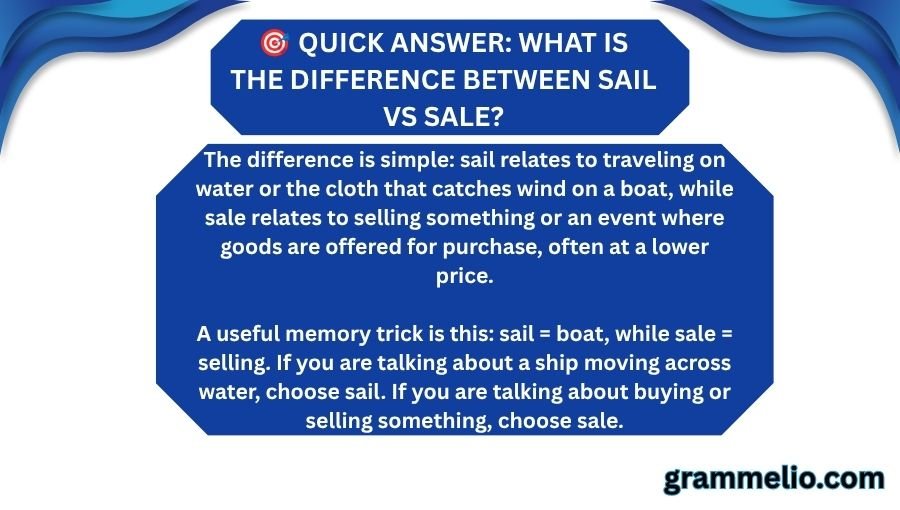
The difference is simple: sail relates to traveling on water or the cloth that catches wind on a boat, while sale relates to selling something or an event where goods are offered for purchase, often at a lower price.
A useful memory trick is this: sail = boat, while sale = selling. If you are talking about a ship moving across water, choose sail. If you are talking about buying or selling something, choose sale.
Sail vs Sale: Understanding the Basics
The core difference between these words comes down to meaning. Sail is usually connected with boats, ships, or traveling across water. Sale is connected with selling goods or services.
Both words are pronounced alike in standard American English, so you cannot always depend on sound alone. You need to look at the meaning of the sentence.
| Form | Type | Meaning | Example | Correct/Incorrect |
|---|---|---|---|---|
| sail | noun/verb | A trip on water, a boat’s cloth, or traveling by boat | We will sail tomorrow. | ✅ Correct |
| sale | noun | An act of selling or a special offer | The store has a sale. | ✅ Correct |
| sail | noun | Cloth used to catch wind on a boat | The sail was torn. | ✅ Correct |
| sale | noun | A period when products are sold at reduced prices | I bought it during the sale. | ✅ Correct |
| sail | verb | To travel on water by boat | They sailed across the lake. | ✅ Correct |
Sail: Meaning and Correct Use
The word sail has several related uses. Most of them connect to boats, ships, or movement across water.
As a verb, sail means to travel on water in a boat or ship.
We plan to sail along the coast this weekend.
Here, sail describes an action. The people are traveling by boat.
As a noun, sail can mean the large piece of cloth attached to a boat’s mast. Wind pushes against the sail and helps move the boat.
The boat’s sail caught the wind.
In this sentence, sail names part of the boat.
It can also refer to a trip on a boat.
We went for a sail around the bay.
So, when you see sail, think boat, water, wind, or sailing.
Sale: Meaning and Correct Use
The word sale is a noun. It is connected to selling or purchasing something.
For example:
The store is having a summer sale.
This means the store is offering products for customers to buy, often at lower prices.
Sale can also describe the act of selling something.
The sale of the house was completed on Friday.
Here, sale means the transaction in which the house was sold.
The word can also appear in business and marketing.
Our online sale begins tomorrow.
The sentence has nothing to do with boats. It is about selling products.
A Simple Meaning Table
| Meaning | Word Type | Example Sentence |
|---|---|---|
| Travel by boat | Verb | We will sail across the lake. |
| Cloth on a boat | Noun | The sail was bright white. |
| A trip by boat | Noun | We went for a sail. |
| An act of selling | Noun | The sale was completed yesterday. |
| A special shopping event | Noun | The store announced a big sale. |
🧠 Is Sail the Word for Traveling on Water?
Yes. Sail is the correct word when you are talking about traveling across water by boat or ship.
You might sail across a lake, river, sea, or ocean. You might also say that a ship sails toward a destination.
Correct and incorrect examples
✅ Correct: We will sail across the lake tomorrow.
❌ Incorrect: We will sale across the lake tomorrow.
The second sentence is wrong because sale does not mean traveling by boat.
Here is another example:
✅ Correct: The captain sailed the boat toward the island.
❌ Incorrect: The captain saled the boat toward the island.
Notice another useful point: the past tense of sail is sailed, not saled.
When Sail Works as a Noun
Sail can also name part of a boat.
The sailor raised the sail.
It can also describe a boat trip.
We took a sail before dinner.
The exact meaning depends on the sentence, but the basic idea remains connected to boats and water.
💰 Is Sale the Word for Shopping and Selling?
Yes. Sale is the correct word when you are talking about selling something or a period when products are offered for purchase.
You will see sale often in stores, advertisements, websites, emails, and social media posts.
For example:
The shoes are on sale this weekend.
This means the shoes are being offered at a special price.
You can also use sale when discussing business transactions.
The sale of the company took several months.
Here, sale refers to the act of transferring ownership through a business transaction.
Shopping Examples
✅ Correct: I found this jacket on sale.
❌ Incorrect: I found this jacket on sail.
The incorrect version changes the meaning completely.
Another example:
✅ Correct: The store’s holiday sale starts Friday.
❌ Incorrect: The store’s holiday sail starts Friday.
Unless the store is somehow selling boats and using a clever name, sale is the word you need.
Sail vs Sale at a Glance
If you remember only one rule, remember this: sail is about boats, while sale is about selling.
| Feature | Sail | Sale |
|---|---|---|
| Main idea | Boats and water | Selling and buying |
| Part of speech | Noun and verb | Mainly noun |
| Common setting | Ocean, lake, boat | Store, website, business |
| Example | We sail every summer. | The sale starts Monday. |
| Memory clue | Think “sailboat” | Think “sell” |
📝 Case Study: A Small Mistake in a Store Email
I once edited a short promotional message where a writer had typed, “Our weekend sail starts Friday.” The business was not selling boats. It was advertising discounted clothing.
The intended sentence was:
“Our weekend sale starts Friday.”
The mistake probably happened because sail and sale sound alike. A quick spell-check might not catch the problem because both words are real English words.
This is why I recommend checking meaning, not just spelling. Ask yourself what the sentence is actually talking about.
If it is about discounts, products, customers, or selling, use sale.
If it is about boats, ships, wind, or traveling on water, use sail.
📚 Grammar Rules Explanation for Sail vs Sale
The grammar rule is based on meaning and word function.
Sail can work as both a noun and a verb. As a noun, it can name the cloth used to catch wind on a boat or a trip on a boat. As a verb, it means to travel by boat or ship.
Sale is a noun related to selling. It can refer to the act of selling something or an event in which products are offered for purchase.
Most standard English reference sources treat these as separate words despite their identical sound in common American English.
The key is context. Pronunciation alone cannot tell you which spelling to choose.
Correct vs Incorrect at a Glance
| Sentence | Correct/Incorrect | Why |
|---|---|---|
| We sailed across the ocean. | ✅ Correct | The sentence describes boat travel. |
| The store has a huge sale. | ✅ Correct | The sentence describes selling. |
| We went on a sale yesterday. | ❌ Incorrect | A boat trip is a sail. |
| These shoes are on sail. | ❌ Incorrect | A shopping discount is a sale. |
| The ship’s sail was damaged. | ✅ Correct | The sentence refers to part of a boat. |
⚠️ Why Do People Confuse Sail and Sale?
People confuse these words mainly because they sound the same. This makes them homophones: words that have the same pronunciation but different meanings and spellings.
I once caught myself typing sail in a sentence about a store promotion. I had been writing quickly and was thinking about the sound rather than the meaning. That tiny mistake reminded me how easily even familiar words can get mixed up.
Here are some common reasons:
- Fast typing: Your brain may choose the first spelling that comes to mind.
- Autocorrect: Technology can sometimes suggest or preserve the wrong real word.
- Lack of knowledge: New English learners may not know that two spellings have different meanings.
- Sound-based writing: If you hear a word before writing it, you may choose the wrong spelling.
- Limited proofreading: Small homophone errors are easy to miss during a quick review.
Similar Grammar Confusions
| Confusing Pair | Correct Difference |
|---|---|
| it’s / its | It’s means “it is”; its shows possession. |
| your / you’re | Your shows possession; you’re means “you are.” |
| their / there / they’re | They show possession, location, and “they are.” |
| to / too / two | They have different meanings and uses. |
| hear / here | Hear relates to sound; here relates to place. |
| sail / sale | Sail relates to boats; sale relates to selling. |
Common Wrong Forms of Sail and Sale
| Wrong Form | What’s Wrong | Correct Form |
|---|---|---|
| sale across the ocean | Uses a selling word for travel | sail across the ocean |
| on sail | Uses the boat word for shopping | on sale |
| a sail at the store | Uses the boat word for a discount event | a sale at the store |
| go for a sale | Uses the selling word for a boat trip | go for a sail |
| saled the boat | Incorrect past-tense form | sailed the boat |
🌊 How Sail Works in Everyday English
In everyday English, sail often appears in conversations about boating, vacations, sports, travel, and outdoor activities.
You might hear:
“Are you going to sail this weekend?”
Or:
“They sailed around the island.”
It can also appear in figurative expressions. For example, someone might say that a project “sailed through” a process when it moved through that process easily.
The word remains connected to the idea of smooth movement.
Common Sail Examples
✅ Correct: We sailed around the island.
❌ Incorrect: We saled around the island.
✅ Correct: The wind filled the sail.
❌ Incorrect: The wind filled the sale.
🛍️ How Sale Works in Everyday English
Sale is extremely common in shopping and business language.
You may see it on store signs:
SALE — 30% OFF
You may see it in emails:
Our spring sale ends Sunday.
You may also hear it in normal conversation:
“I got these shoes on sale.”
The word does not mean “cheap” by itself. A sale is an event or situation involving selling. Products may be discounted, but the word sale itself refers to selling or the special shopping event.
Common Sale Examples
✅ Correct: The furniture is on sale.
❌ Incorrect: The furniture is on sail.
✅ Correct: We bought it during the weekend sale.
❌ Incorrect: We bought it during the weekend sail.
💼 Sail vs Sale in Professional Writing
Professional writing needs extra care because a single wrong word can change the meaning of a message.
Imagine a company writing:
“Our new sail begins Monday.”
A reader might wonder whether the company is launching a boating event.
The intended message may be:
“Our new sale begins Monday.”
In business writing, proofreading is especially useful when words are homophones.
| Context | Which Term to Use | Example |
|---|---|---|
| Everyday conversation | Depends on meaning | We will sail tomorrow. |
| Professional writing | sail for boating; sale for selling | The sale begins Monday. |
| Creative writing | Depends on the scene | The ship’s sail caught the wind. |
| Social media/texting | Depends on meaning | These shoes are on sale! |
✍️ Sail vs Sale in Creative Writing
Creative writers can use both words naturally because stories may include boats, stores, travel, or business.
For example:
The white sail disappeared beyond the horizon.
Here, sail creates a picture of a boat.
In another story:
She rushed into town before the sale ended.
Here, sale creates a shopping situation.
The important thing is to match the spelling with the intended meaning.
📱 Sail vs Sale in Social Media and Texting
Social media posts often contain short sentences, which makes homophone errors easier to miss.
For example:
“Everything is on sale today!”
is correct for a shopping post.
But:
“We’re ready to sail!”
is correct for a boating post.
Because social media writing is often fast, it is worth taking a few seconds to reread important posts before publishing them.
🔤 Common Phrases With Sail
English has several familiar phrases that use sail.
| Phrase | Meaning |
|---|---|
| Set sail | Begin a journey by boat |
| Sail away | Travel away by boat |
| Sail across | Travel across water by boat |
| Smooth sailing | A situation that goes easily |
| Sail through | Move through something easily |
| Sail around | Travel around an area by boat |
Examples in Context
The crew will set sail at sunrise.
After the repairs, the ship sailed away.
The project was smooth sailing after the first week.
These phrases are useful because they give you strong mental connections between sail and movement.
🛒 Common Phrases With Sale
Sale also appears in many common expressions.
| Phrase | Meaning |
|---|---|
| On sale | Available at a special or reduced price |
| For sale | Available to buy |
| Hold a sale | Organize a selling event |
| Clearance sale | Sale designed to move remaining stock |
| Going-out-of-business sale | Sale connected with a business closing |
| Sale price | Price offered during a sale |
For example:
The house is for sale.
These headphones are on sale.
The store is having a clearance sale.
These expressions make it easier to recognize sale when you see it.
🔄 Synonyms and Alternatives for Sail and Sale
Sometimes another word can replace sail or sale, but the replacement depends on the exact meaning.
| Alternative | Works When | Does Not Work When |
|---|---|---|
| travel by boat | You mean traveling on water | You mean the cloth on a boat |
| cruise | You mean a boat trip | You mean a store discount |
| sell | You mean the action of giving something to a buyer | You mean a special discount event |
| discount | You mean a reduced price | You mean the entire selling process |
| promotion | You mean a marketing offer | You mean traveling by boat |
For example, “travel by boat” can sometimes replace sail:
We will sail across the bay.
We will travel by boat across the bay.
But you cannot replace the noun sail in:
The sail caught the wind.
with travel by boat. The meaning is different.
Likewise, discount can sometimes describe a sale, but the two words are not always interchangeable.
🤔 Why Does Getting Sail vs Sale Right Matter?
Correct word choice helps readers understand your message without stopping to figure out what you meant. This matters in school, work, business, publishing, and online communication.
A useful rule I give writers is simple:
“Choose the spelling that matches the picture in your mind.”
If you picture a boat, think sail.
If you picture a store or transaction, think sale.
| Situation | Why Getting It Right Matters |
|---|---|
| Resume | Shows careful writing and attention to detail |
| Client email | Prevents confusion and protects professionalism |
| Published content | Improves trust and readability |
| Social post | Makes the message clear to readers |
A single homophone mistake may not ruin a message, but repeated mistakes can make writing look careless.
🧩 How To Remember the Difference
The easiest memory trick is to connect each word with a related word.
Sail = Sailing
Think:
sail → sailing → boat
If the sentence makes you think about water, wind, or a ship, sail is probably correct.
Sale = Selling
Think:
sale → sell → store
If the sentence makes you think about products, customers, prices, or transactions, sale is probably correct.
The One-Second Test
Ask yourself:
“Am I thinking about a boat or a business transaction?”
- Boat → sail ⛵
- Selling → sale 🛍️
This quick test works in most everyday situations.
🎯 Sail vs Sale: A Simple Decision Guide
| Question | If Yes → Use |
|---|---|
| Is the sentence about a boat? | sail |
| Is it about traveling on water? | sail |
| Is it about the cloth on a boat? | sail |
| Is it about selling something? | sale |
| Is it about a store discount? | sale |
| Is something available to buy? | sale |
Practice Examples
- The ship will ___ at dawn.
Answer: sail - The store’s summer ___ starts tomorrow.
Answer: sale - These shoes are on ___.
Answer: sale - We plan to ___ across the lake.
Answer: sail - The boat’s ___ was damaged by the storm.
Answer: sail
🧪 Quick Practice: Can You Choose the Right Word?
Try these before checking the answers.
- We watched the boat ___ toward the harbor.
- The furniture is on ___ this week.
- The captain raised the ___.
- The company announced a holiday ___.
- They decided to ___ around the island.
Answers
- sail
- sale
- sail
- sale
- sail
The pattern is clear: boats and water take sail, while selling and shopping take sale.
❓ Is Sail the Same as Sale?
No. Sail and sale sound alike but have different meanings and spellings. Sail is connected mainly with boats and traveling on water, while sale is connected with selling and shopping.
❓ Why Do Sail and Sale Sound the Same?
They are pronounced the same in standard American English, even though they have different spellings and meanings. This makes them homophones and explains why writers often confuse them.
❓ Should I Say “On Sail” or “On Sale”?
You should say “on sale.” The phrase means that something is available at a special price or as part of a sales promotion.
✅ The shoes are on sale.
❌ The shoes are on sail.
❓ Should I Say “Set Sail” or “Set Sale”?
The correct phrase is “set sail.” It means to begin traveling by boat or ship.
The crew will set sail at sunrise.
“Set sale” is not the standard phrase for beginning a boat journey.
❓ Is It “Sail the Boat” or “Sale the Boat”?
The correct expression is “sail the boat.” Sail can function as a verb describing travel by boat.
They sailed the boat across the lake.
If you mean selling the boat, you would say:
They sold the boat.
Notice that the past tense of sell is sold, not saled.
❓ What Is the Plural of Sale?
The plural of sale is sales.
For example:
The company’s sales increased this year.
Sales commonly appears in business, marketing, and retail language.
❓ What Is the Past Tense of Sail?
The past tense of sail is sailed.
For example:
We sailed across the lake yesterday.
The form saled is not the standard past tense of sail.
❓ How Can I Easily Remember Sail vs Sale?
Use the memory pair sail = sailing = boat and sale = sell = store. If you picture water and a ship, choose sail. If you picture a store, product, price, or transaction, choose sale.
❓ Is “For Sale” Always About Money?
Usually, for sale means that something is available for someone to buy. It can refer to homes, cars, furniture, products, businesses, and many other things.
For example:
The house next door is for sale.
❓ Can Sail Be Used as a Noun and a Verb?
Yes. Sail can be a noun when it refers to the cloth on a boat or a trip by boat. It can be a verb when it means to travel by boat or ship.
Sale, on the other hand, is mainly used as a noun.
❓ What Is the Fastest Way to Check Sail vs Sale?
Look at the subject of the sentence. If the subject involves boats, water, wind, or a sea journey, choose sail. If it involves selling, shopping, prices, products, or transactions, choose sale.
✅ Quick Recap Checklist
The difference between these two words is easy once you connect each one with its main idea.
| Question | If Yes → Use |
|---|---|
| Does it involve a ship or boat? | sail |
| Does it involve movement across water? | sail |
| Does it refer to a boat’s cloth? | sail |
| Does it involve selling something? | sale |
| Does it involve a store promotion? | sale |
| Is something available to buy? | sale |
| Does the word follow “on”? | Usually on sale for shopping |
| Does the phrase mean starting a boat journey? | set sail |
Final Practice
✅ Correct: The ship will sail at noon.
❌ Incorrect: The ship will sale at noon.
✅ Correct: The store’s sale ends tonight.
❌ Incorrect: The store’s sail ends tonight.
Once you connect the words with their meanings, these errors become much easier to avoid.
FAQs About Sail vs Sale
What is the main difference between sail and sale?
Sail relates to boats, ships, and traveling on water. Sale relates to selling something or a shopping event where products are offered for purchase.
Is “sail” a verb?
Yes. Sail can be a verb meaning to travel by boat or ship.
We sailed across the lake.
Is “sale” a verb?
No. Sale is normally a noun. The related verb is sell.
The store sells clothing.
The store has a sale.
What does “on sale” mean?
“On sale” means that an item is available for purchase, often at a reduced or special price.
What does “set sail” mean?
“Set sail” means to begin a journey by boat or ship.
Is “saled” a correct word?
Saled is not the standard past-tense form of sail. The correct past tense is sailed.
What is the past tense of sell?
The past tense of sell is sold.
She sold her old car.
This is useful because sale is related to sell, not sail.
Are sail and sale homophones?
Yes. In standard American English, they sound alike but have different spellings and meanings.
How do I remember which one to use?
Think sail = boat and sale = sell. That short connection solves most cases.
Which one should I use for a discount?
Use sale.
The store is having a big sale.
You can also say:
The shoes are on sale.
Which one should I use for a boat trip?
Use sail.
We went for a sail.
Or:
We sailed around the island.
Conclusion
Sail vs sale becomes easy when you remember one simple idea: sail belongs with boats, while sale belongs with selling. If you are talking about traveling across water, raising a boat’s cloth, or taking a trip by boat, choose sail. If you are talking about shopping, prices, products, or a business transaction, choose sale. 😊
I recommend using the two-word memory trick whenever you are unsure: sail = boat; sale = sell. It takes only a second and works in emails, school assignments, business writing, social media posts, and everyday conversations. ⛵
Remember that both words are real English words, so spell-checkers may not catch a mistake between them. That is why meaning matters more than sound. Read the whole sentence and ask what idea you are trying to express.
When you picture the right meaning first, the spelling usually follows naturally. Boat means sail. Selling means sale. Keep that rule in mind, and you will rarely mix these two words up again.


[…] post, or social media caption, you’ll learn how to choose the right word with confidence. ✍️ Sail vs Sale | Rye vs Wry | Root vs Route vs […]