Have you ever stopped while writing because you could not remember whether you needed sheer vs shear? I see this mix-up often in emails, school assignments, social posts, and even polished business documents.
The words sound alike, but they do not mean the same thing. One can describe something that is very steep, thin, or complete. The other relates to cutting, trimming, or a strong sideways force. 😅
If you are learning English, improving your writing, or simply trying to avoid small spelling mistakes, knowing the difference can save you from awkward sentences. In this guide, I will explain sheer vs shear in plain US English.
I will show you how each word works, give you easy examples, point out common mistakes, and share simple memory tricks. By the end, choosing the right word should feel much easier. ✨ Seas vs Sees vs Seize | Sear vs Seer vs Sere | Sail vs Sale
🎯 Quick Answer: Sheer vs Shear
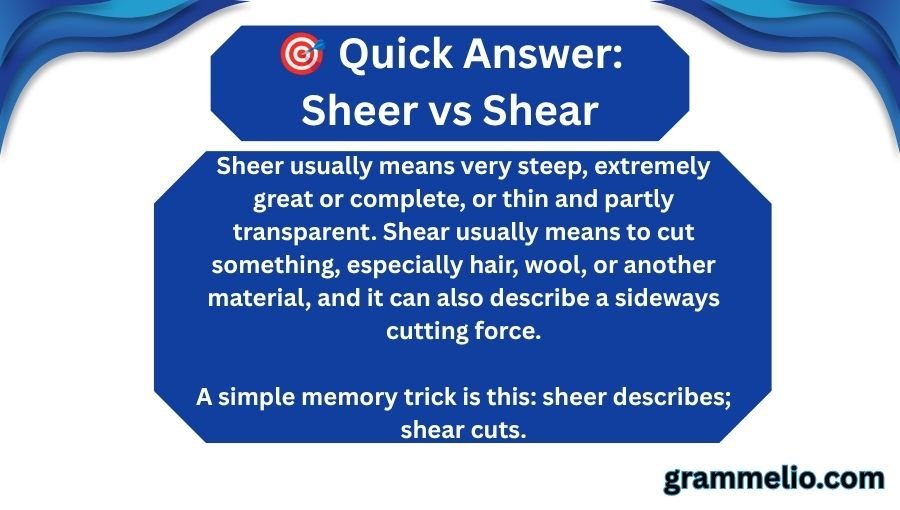
Sheer usually means very steep, extremely great or complete, or thin and partly transparent. Shear usually means to cut something, especially hair, wool, or another material, and it can also describe a sideways cutting force.
A simple memory trick is this: sheer describes; shear cuts.
| Word | Main Meaning | Example |
|---|---|---|
| Sheer | Very steep | The hikers faced a sheer cliff. |
| Sheer | Complete or extreme | Her success was due to sheer effort. |
| Sheer | Thin and partly transparent | She wore a sheer blouse. |
| Shear | Cut or trim | Farmers shear sheep each spring. |
| Shear | Cut away | The machine can shear metal. |
| Shear | Sideways force | The bridge was designed to resist shear. |
What Is the Difference Between Sheer and Shear?
The main difference between sheer vs shear is their meaning and grammatical use. Sheer is commonly an adjective or, in some uses, an adverb. Shear is commonly a verb or noun connected with cutting or force.
Think of the words as belonging to different worlds.
- Sheer often describes a quality.
- Shear often describes an action.
- Sheer can describe a cliff, fabric, effort, size, or surprise.
- Shear can describe cutting hair, wool, plants, or materials.
- Shear can also be used in science and engineering.
Here is the basic contrast:
| Form | Type | Meaning | Example | Correct/Incorrect |
|---|---|---|---|---|
| Sheer | Adjective | Very steep | The road ended at a sheer drop. | ✅ Correct |
| Sheer | Adjective | Complete or extreme | It took sheer determination. | ✅ Correct |
| Sheer | Adjective | Thin and see-through | The curtains were sheer. | ✅ Correct |
| Shear | Verb | To cut | They shear the sheep in spring. | ✅ Correct |
| Shear | Verb | To cut or break under force | The bolt sheared under pressure. | ✅ Correct |
| Shear | Adjective | Used as a normal replacement for “sheer” | It was a shear surprise. | ❌ Incorrect |
The spelling difference is small, but the meanings are far apart.
🧠 How Can You Remember Sheer vs Shear?
The easiest way to remember sheer vs shear is to connect shear with scissors.
The word shear contains the idea of cutting. Sheep are often sheared for their wool. Hair can be sheared, too. A tool called shears is also used for cutting.
Sheer, on the other hand, often describes something rather than an act of cutting.
Try this memory line:
Shear cuts. Sheer describes.
For example:
- The farmer will shear the sheep.
- The sheep stood beside a sheer cliff.
The first sentence involves an action. The second describes the cliff.
💡 Test Tip
When you are unsure, ask yourself:
“Am I talking about cutting?”
If the answer is yes, shear is probably the word you need.
If you are describing something as steep, extreme, complete, or thin, sheer is usually correct.
| Question to Ask | Choose | Example |
|---|---|---|
| Does it involve cutting? | Shear | Shear the wool. |
| Does it describe a steep surface? | Sheer | A sheer wall. |
| Does it mean complete or extreme? | Sheer | Sheer luck. |
| Does it describe thin fabric? | Sheer | Sheer curtains. |
| Does it describe sideways force? | Shear | Shear stress. |
Sheer: Meaning and Correct Use
Sheer has several common meanings, so context matters. It can describe something that is very steep, extremely large or strong, complete, or thin enough to let light through.
Sheer Means Very Steep
One common use of sheer is to describe something that rises or falls almost straight up or down.
Examples:
- The hikers climbed a sheer rock face. ✅
- The mountain had a sheer drop on one side. ✅
- The boat passed beneath a sheer cliff. ✅
Here, sheer tells us about the steep shape of something.
It does not mean “cut.”
Sheer Means Complete or Extreme
Another common meaning is “complete,” “pure,” or “very great.”
Consider these examples:
- The project succeeded through sheer determination. ✅
- Her victory was a result of sheer hard work. ✅
- We escaped by sheer luck. ✅
In these sentences, sheer adds a sense of intensity.
If someone says, “It was sheer luck,” they mean that luck alone explains the result.
Sheer Means Thin or Partly Transparent
Sheer can also describe fabric that is very thin and lets light or an image pass through.
Examples include:
- The window had sheer curtains. ✅
- She bought a sheer scarf. ✅
- The dress was made from sheer material. ✅
This meaning is common in clothing and home decoration.
Sheer as an Adverb
In some expressions, sheer can work in ways that add strong emphasis to an adjective or idea.
For example, someone might describe a person as having climbed a wall by sheer force of will. In ordinary modern writing, though, the most common uses you will meet are adjective uses.
| Meaning of Sheer | Word Type | Example Sentence |
|---|---|---|
| Very steep | Adjective | The cliff was sheer. |
| Complete or extreme | Adjective | It was sheer luck. |
| Thin and transparent | Adjective | Sheer fabric covered the window. |
| Very great in degree | Adjective | The sheer size of the building surprised me. |
Shear: Meaning and Correct Use
Shear is most often used when something is cut, trimmed, or separated by force. It can also be a noun for a cutting tool or a type of force.
Shear as a Verb
The most familiar use of shear is as a verb meaning to cut hair, wool, or another material.
Examples:
- Farmers shear sheep for their wool. ✅
- The barber sheared the sides of his hair. ✅
- The machine shears thin metal sheets. ✅
The past tense is sheared, although shore or other unrelated forms should not be confused with it.
Shear as a Noun
Shear can also be a noun connected with cutting or cutting force. The plural form shears is especially common when talking about cutting tools.
For example:
- The gardener used shears to trim the hedge. ✅
- The fabric was cut with sharp shears. ✅
Shear in Science and Engineering
In technical writing, shear can describe a force that pushes different parts of a material in different directions.
For example:
- Engineers tested the material for shear strength.
- The bolt failed because of shear force.
- The soil showed resistance to shear stress.
This is a specialized use, but it follows the same basic idea: movement or force that acts across a material rather than simply pulling it apart.
| Shear Use | Meaning | Example |
|---|---|---|
| Verb | To cut or trim | They shear sheep. |
| Verb | To cut through material | The blade sheared the plastic. |
| Noun | Cutting action or force | The material resisted shear. |
| Plural noun | Cutting tool | Use garden shears. |
| Technical noun | Sideways force | Shear stress damaged the joint. |
📝 Sheer vs Shear in a Real-Life Case Study
Imagine that you are writing an email to a clothing company. You want to describe a fabric and explain that a tailor cut it.
You might write:
“The designer chose a sheer fabric and used sharp shears to cut it.”
That sentence uses both words correctly.
Sheer describes the fabric.
Shears identifies the cutting tool.
I once edited a short product description where the writer called a lightweight curtain material “shear.” The meaning was clear from the rest of the paragraph, but the spelling made the description look unfinished. Changing shear to sheer fixed the problem immediately.
This is a useful lesson: context can help readers understand you, but correct spelling makes your writing cleaner and more professional.
| Situation | Correct Word | Why |
|---|---|---|
| Thin curtain material | Sheer | It describes the fabric. |
| Cutting the fabric | Shear | It describes the cutting action. |
| Very steep mountain wall | Sheer | It describes the slope. |
| Trimming sheep’s wool | Shear | It means to cut. |
| Extreme effort | Sheer | It means complete or great. |
📚 Grammar Rules Explanation for Sheer and Shear
The key grammar rule is simple: choose the word based on its meaning, not its sound.
Sheer and shear are homophones in many varieties of English. That means they sound the same or nearly the same in ordinary speech, while their spellings and meanings differ.
Sheer is commonly an adjective.
It can describe:
- a steep cliff
- thin fabric
- great size
- complete effort
- extreme luck
Shear is commonly a verb or noun.
As a verb, it means to cut or trim. As a noun, it can refer to cutting or a sideways force. Shears is also a common plural noun for a cutting tool.
The important point is that spelling follows meaning.
Most standard English reference works distinguish these words clearly, and good editing practice does the same.
Correct vs Incorrect at a Glance
| Sentence | Correct/Incorrect | Why |
|---|---|---|
| The cliff had a sheer face. | ✅ Correct | “Sheer” means very steep. |
| The farmer will shear the sheep. | ✅ Correct | “Shear” means to cut wool. |
| Sheer luck helped us find the lost dog. | ✅ Correct | “Sheer” means complete or extreme. |
| Shear luck helped us find the lost dog. | ❌ Incorrect | “Shear” does not mean extreme or complete. |
| They used shears to trim the bushes. | ✅ Correct | “Shears” are cutting tools. |
⚠️ Why Do People Confuse Sheer and Shear?
People confuse these words mainly because they sound alike. When we hear a word, we cannot always see its spelling.
Three common causes are especially easy to spot:
- Fast typing: You type the first spelling that comes to mind.
- Autocorrect: Your device may not catch a correctly spelled but incorrectly used word.
- Lack of knowledge: You may know the meaning but have never learned the spelling difference.
I once caught myself typing “shear” when I meant “sheer” in a note about a steep trail. I knew the meaning perfectly, but I was typing quickly and focused on the sound. That small mistake reminded me why homophones need extra attention.
Similar Grammar Confusions
| Confusing Pair | Common Problem | Correct Difference |
|---|---|---|
| Its / It’s | Both sound similar | “Its” shows possession; “it’s” means “it is” or “it has.” |
| Your / You’re | Same sound | “Your” shows possession; “you’re” means “you are.” |
| Their / There / They’re | Similar sounds | They have different meanings and uses. |
| To / Too / Two | Same or similar sounds | Direction, excess/addition, and the number 2. |
| Sheer / Shear | Same sound | Description vs. cutting. |
Common Wrong Forms for Sheer and Shear
| Wrong Form | What’s Wrong | Correct Form |
|---|---|---|
| Shear cliff | Cutting word used for a steep surface | Sheer cliff |
| Shear luck | Cutting word used for extreme luck | Sheer luck |
| Shear curtains | Cutting word used for thin fabric | Sheer curtains |
| Sheer the sheep | Describing word used for cutting | Shear the sheep |
| Sheer the hedge | Wrong verb for cutting | Shear the hedge |
| Shear determination | Wrong word for extreme effort | Sheer determination |
Is Sheer the Same as Shear?
No, sheer and shear are not the same word. They may sound alike, but their meanings and uses are different.
Use sheer when you describe something such as a steep cliff, thin fabric, extreme effort, or complete luck.
Use shear when you mean cutting or trimming something, or when you are talking about shear force in a technical setting.
A quick comparison makes the difference clear:
| Sheer | Shear |
|---|---|
| Describes | Usually names an action |
| Steep | Cut |
| Thin and transparent | Trim |
| Extreme | Cutting force |
| Complete | Cutting tool in “shears” |
How Are Sheer and Shear Used in Different Contexts?
The context usually makes the right choice easy. In everyday speech, sheer often appears in descriptions, while shear appears when someone cuts something.
| Context | Which Term to Use | Example |
|---|---|---|
| Everyday conversation | Sheer | That was sheer luck. |
| Everyday conversation | Shear | They shear the sheep every year. |
| Professional writing | Sheer | The sheer size of the project was challenging. |
| Professional writing | Shear | The engineer measured shear strength. |
| Creative writing | Sheer | A sheer cliff rose above the sea. |
| Social media/texting | Sheer | That was sheer chaos! |
| Clothing | Sheer | The top has sheer sleeves. |
| Gardening | Shear | Shear the hedge in late spring. |
What Are Common Phrases With Sheer?
Sheer appears in several common combinations. These phrases often describe intensity, size, steepness, or transparency.
| Phrase | Meaning |
|---|---|
| Sheer luck | Complete or unexpected luck |
| Sheer determination | Very strong determination |
| Sheer force | Great strength or power |
| Sheer size | Very large size |
| Sheer cliff | A very steep cliff |
| Sheer fabric | Thin, partly transparent fabric |
For example, “We found the cabin by sheer luck” means there was no careful plan behind the discovery. Luck played the main role.
Another common phrase is “sheer determination.” It suggests that someone succeeded because they refused to give up.
What Are Common Expressions With Shear?
Shear is less common in everyday fixed expressions than sheer, but it has several useful combinations, especially in farming, gardening, manufacturing, and technical writing.
| Phrase | Meaning |
|---|---|
| Shear sheep | Cut a sheep’s wool |
| Shear a hedge | Trim a hedge |
| Shear force | A sideways cutting force |
| Shear stress | Stress caused by forces acting across a material |
| Shear strength | A material’s ability to resist shear |
| Shearing machine | A machine used for cutting material |
These expressions all connect back to the central idea of cutting or sideways force.
🔍 How Does Sheer vs Shear Work in Professional Writing?
Professional writing requires extra care because a small spelling mistake can change the meaning of a sentence. In a report, proposal, product description, or client email, choosing the correct word makes your writing look more polished.
Consider these examples:
- “The sheer volume of requests surprised the team.” ✅
- “The machine is designed to shear metal.” ✅
The first sentence describes an extreme amount. The second describes an action.
When I proofread professional content, I often check homophones separately because spell-check programs may not catch them. A word can be spelled correctly and still be the wrong word.
| Professional Situation | Correct Usage | Example |
|---|---|---|
| Business report | Sheer | The sheer number of orders caused delays. |
| Engineering report | Shear | The joint must withstand shear stress. |
| Fashion description | Sheer | The blouse has sheer sleeves. |
| Agriculture report | Shear | Workers shear the sheep in spring. |
✍️ Sheer vs Shear in Creative Writing
Creative writers often use sheer to create strong visual images. A sheer cliff can make a scene feel dangerous. Sheer darkness can create a sense of mystery. Sheer fabric can add visual detail.
For example:
The narrow path ended beside a sheer wall of rock.
Here, sheer helps the reader picture the steep rock face.
Shear can also appear in creative writing when an action involves cutting:
With one quick motion, shears cut through the old cloth.
The two words create very different images.
| Writing Goal | Better Choice | Example |
|---|---|---|
| Describe a steep cliff | Sheer | A sheer cliff towered above them. |
| Show extreme fear | Sheer | Sheer panic filled the room. |
| Describe thin fabric | Sheer | A sheer curtain moved in the breeze. |
| Show cutting | Shear | The blade sheared through the rope. |
Can Sheer Mean Extremely Large or Great?
Yes. Sheer can describe something that is unusually large, powerful, or intense.
Examples:
- The sheer size of the stadium amazed me.
- The sheer amount of work took months to finish.
- The team succeeded through sheer effort.
In these examples, sheer adds emphasis. It tells the reader that the amount or degree is striking.
This is different from shear, which does not normally carry this meaning.
| Expression | Meaning |
|---|---|
| Sheer size | Extremely large size |
| Sheer volume | Extremely large amount |
| Sheer effort | Great effort |
| Sheer determination | Complete, strong determination |
| Sheer luck | Pure or complete luck |
Can Shear Be Used for Cutting Hair?
Yes. Shear can mean to cut or trim hair, wool, or similar material.
For example:
- The farmer sheared the sheep.
- The stylist sheared the thick hair.
- The machine shears the material into strips.
However, in ordinary conversation, people often use cut, trim, or shave depending on the exact action. Shear is especially common when the idea is a deliberate cutting or trimming process.
| Word | Typical Use | Example |
|---|---|---|
| Shear | Cut or trim material | Shear the wool. |
| Cut | General cutting | Cut the paper. |
| Trim | Remove excess | Trim the hedge. |
| Shave | Remove hair close to the skin | Shave the beard. |
Does Shear Have a Plural Form?
Yes. Shears is a common plural noun for a cutting tool.
For example:
- The gardener picked up the shears.
- These shears are sharp.
- Keep the shears away from children.
Do not confuse shears with sheer’s.
Sheer’s is the possessive form of the adjective or noun “sheer” in a context where possession is grammatically appropriate. It is much less common.
| Form | Meaning | Example |
|---|---|---|
| Sheer | Describes something | Sheer fabric |
| Shears | Cutting tools | Garden shears |
| Sheared | Past form of shear | They sheared the sheep. |
| Shearing | -ing form | Shearing wool takes skill. |
What Are Good Synonyms for Sheer and Shear?
Synonyms can help when you want to avoid repetition, but they cannot always replace the original word. The best alternative depends on the exact meaning.
| Alternative | Works When | Does Not Work When |
|---|---|---|
| Steep | Describing a sharp slope | Talking about extreme effort |
| Extreme | Describing a very high degree | Describing thin fabric |
| Complete | Describing total intensity | Talking about cutting |
| Transparent | Describing thin material | Describing a cliff |
| Cut | Describing the action of shear | Describing sheer luck |
For example, “a sheer cliff” can often become “a steep cliff.” But “sheer luck” cannot naturally become “steep luck.”
Likewise, “shear the sheep” can be replaced by “cut the wool,” but the exact meaning and style may change.
💡 How Can You Avoid the Sheer vs Shear Mistake?
Use a three-step check.
Step 1: Identify the meaning
Ask whether you mean:
- steep
- thin or transparent
- complete
- extreme
- cutting
- trimming
- sideways force
Step 2: Match the meaning
If you mean steep, thin, complete, or extreme, choose sheer.
If you mean cutting, trimming, or cutting force, choose shear.
Step 3: Read the sentence again
Make sure the sentence still makes sense.
| If You Mean… | Use |
|---|---|
| Very steep | Sheer |
| Very great | Sheer |
| Complete | Sheer |
| Thin and partly transparent | Sheer |
| Cut | Shear |
| Trim | Shear |
| Cutting force | Shear |
Why Does Getting Sheer vs Shear Right Matter?
Correct word choice improves clarity. It also shows that you understand the difference between similar words.
This matters in:
- school assignments
- resumes
- client emails
- published articles
- product descriptions
- social media posts
- technical documents
A reader may understand a wrong word from context, but that does not make the mistake correct.
Clear words make clear ideas easier to trust.
| Situation | Why Getting It Right Matters |
|---|---|
| Resume | Shows attention to detail |
| Client email | Builds a professional impression |
| Published content | Improves readability and trust |
| Social post | Prevents avoidable confusion |
| Technical report | Protects the intended meaning |
🧩 Special Cases and Edge Uses
There is no major spelling exception that makes sheer and shear interchangeable. However, shear has an important technical use in science and engineering.
In technical contexts, shear can describe a force that causes layers of a material to move sideways relative to one another. You may encounter terms such as shear stress, shear strength, and shear force.
This does not change the basic memory rule. Shear still connects to cutting or sideways action.
Sheer, meanwhile, keeps its descriptive meanings, such as steep, extreme, complete, or thin and transparent.
Is Sheer vs Shear a Common Homophone Problem?
Yes. These words are easy to confuse because their sounds can be identical in ordinary speech. When people hear them, there is no spelling clue.
That is why writing requires you to think about meaning.
Compare:
- “The sheer cliff was dangerous.”
- “The workers shear the sheep.”
If you hear only the word, you may not know which spelling is intended. Once you understand the sentence, the correct spelling becomes clear.
| Heard Word | Possible Spelling | Meaning |
|---|---|---|
| “sheer/shear” | Sheer | Steep, extreme, complete, or thin |
| “sheer/shear” | Shear | Cut, trim, or cutting force |
How Do You Use Sheer and Shear in Everyday Sentences?
Here are several practical examples you can copy as patterns.
Examples With Sheer
- We reached the top despite the sheer difficulty of the climb.
- The sheer wall made the route dangerous.
- The curtains were made of sheer white fabric.
- By sheer luck, I found my missing keys.
- The sheer size of the crowd surprised everyone.
Examples With Shear
- Farmers shear sheep for wool.
- The gardener used tools to shear the hedge.
- The machine can shear thick material.
- The engineer calculated the shear force.
- The bolt failed because of excessive shear stress.
Notice how the meaning guides the spelling every time.
❌ Common Sentence Mistakes to Watch For
Seeing incorrect examples can make the rule easier to remember.
| Incorrect | Correct | Reason |
|---|---|---|
| The mountain had a shear cliff. ❌ | The mountain had a sheer cliff. ✅ | “Sheer” means very steep. |
| It was shear luck. ❌ | It was sheer luck. ✅ | “Sheer” means complete or pure. |
| She wore shear curtains. ❌ | She wore sheer curtains. ✅ | “Sheer” describes thin fabric. |
| They will sheer the sheep. ❌ | They will shear the sheep. ✅ | “Shear” means cut wool. |
| The farmer sheared the sheep. ❌ | The farmer sheared the sheep. ✅ | “Sheared” is the correct past form. |
🎯 Quick Recap Checklist
Use this checklist whenever you are unsure.
| Question | If Yes → Use |
|---|---|
| Am I describing a very steep surface? | Sheer |
| Am I describing thin, partly transparent material? | Sheer |
| Am I describing something extreme or complete? | Sheer |
| Am I talking about cutting wool or hair? | Shear |
| Am I talking about trimming something? | Shear |
| Am I discussing a sideways cutting force? | Shear |
Practice Examples
- The climbers stood below a ___ cliff.
Answer: sheer ✅ - The farmer will ___ the sheep tomorrow.
Answer: shear ✅ - We won the game through ___ determination.
Answer: sheer ✅
If you can answer these quickly, you have the core rule down.
FAQs About Sheer vs Shear
What is the difference between sheer and shear?
Sheer describes something such as a steep surface, extreme quality, complete effort, or thin fabric. Shear means to cut or trim something and can also refer to a sideways force.
Is it sheer luck or shear luck?
The correct phrase is sheer luck. Here, sheer means pure, complete, or unexpected.
Example: We found the lost wallet by sheer luck. ✅
Is it a sheer cliff or a shear cliff?
The correct phrase is sheer cliff. Sheer describes the cliff as very steep.
Is it shear sheep or sheer sheep?
The correct verb is shear.
Example: Farmers shear sheep to collect their wool. ✅
Is sheer fabric correct?
Yes. Sheer fabric is a standard phrase for fabric that is thin and allows light or an image to pass through.
What does shear mean in engineering?
In engineering, shear can describe a force that acts across a material and can cause different parts of it to move sideways relative to each other. Terms such as shear stress and shear strength are common in technical writing.
Are sheer and shear pronounced the same?
They are commonly pronounced alike in English, which is why they are easy to confuse when heard aloud. Their spellings and meanings are different.
What is the plural of shear?
Shears is a common plural noun for a cutting tool.
Example: The gardener used sharp shears to trim the bushes. ✅
Can sheer mean extreme?
Yes. Sheer can emphasize that something is very great, strong, or complete.
Examples include sheer determination, sheer effort, sheer size, and sheer luck.
How can I remember sheer vs shear?
Remember: shear cuts; sheer describes. If you are talking about cutting, trimming, or cutting force, choose shear. If you are describing something as steep, thin, extreme, or complete, choose sheer.
Final Thoughts on Sheer vs Shear
Sheer vs shear becomes much easier once you stop focusing on how the words sound and start focusing on what they mean. Sheer is mainly a describing word. It can describe a steep cliff, thin fabric, extreme effort, complete luck, or something unusually large. Shear is connected to cutting, trimming, and sideways force. ✨
When I teach confusing word pairs, I always recommend using meaning as your first test. Do not ask only, “Which spelling sounds right?” Ask, “What am I trying to say?” If you mean cutting, choose shear. If you mean steep, extreme, complete, or thin, choose sheer.
A simple phrase can help you remember the rule forever: shear cuts, sheer describes. Keep that line in mind when you write emails, assignments, reports, captions, or articles. The more you notice these words in real sentences, the faster the correct spelling will become automatic. 📝
Remember the meaning, choose the spelling, and let your writing stay clear.


[…] writing a school assignment, a professional email, a social media post, or a creative story. ✍️ Sheer vs Shear | Seas vs Sees vs Seize | Sear vs Seer vs […]