Have you ever typed a sentence and stopped because you could not decide between soar vs sore? I see this mix-up often when helping students, bloggers, and everyday writers improve their English. The two words look and sound close, but they have very different meanings.
One usually describes something moving high or rising quickly. The other describes pain, tenderness, or something that feels irritated. ✍️ If you know what each word means, the choice becomes much easier.
In this guide, I will explain soar vs sore in plain US English. I will show you how each word works, give you clear examples, point out common mistakes, and share simple memory tricks.
By the end, you should feel confident choosing the right word in schoolwork, emails, social posts, and everyday conversations. 😊 Skeptic vs Septic | Shone vs Shown | Sheer vs Shear
🎯 Quick Answer: Soar vs Sore
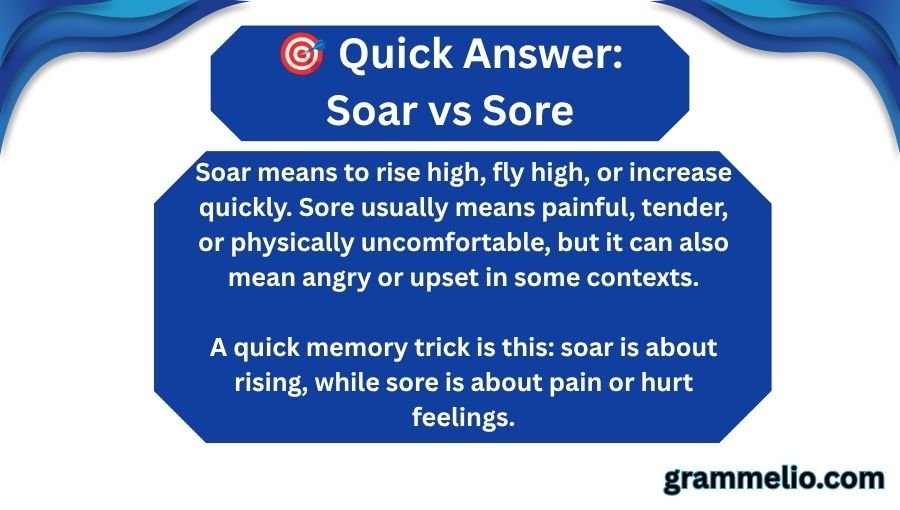
Soar means to rise high, fly high, or increase quickly. Sore usually means painful, tender, or physically uncomfortable, but it can also mean angry or upset in some contexts.
A quick memory trick is this: soar is about rising, while sore is about pain or hurt feelings.
| Word | Main Meaning | Example |
|---|---|---|
| Soar | Rise or fly high | The eagle began to soar. |
| Sore | Painful or tender | My legs are sore after the hike. |
| Soar | Increase greatly | Prices began to soar. |
| Sore | Angry or upset | He was sore about losing the game. |
What Is the Difference Between Soar and Sore?
The main difference is meaning. Soar describes upward movement or a sharp rise. Sore describes physical pain, tenderness, irritation, or sometimes anger.
Both words can sound similar when spoken. That is why spelling mistakes are common. However, their roles in a sentence are usually easy to separate once you focus on the meaning.
| Form | Type | Meaning | Example | Correct/Incorrect |
|---|---|---|---|---|
| Soar | Verb | Rise or fly high | Birds soar above the trees. | Correct |
| Sore | Adjective | Painful or tender | My shoulder is sore. | Correct |
| Soar | Verb | Increase quickly | Costs continue to soar. | Correct |
| Sore | Adjective | Angry or upset | She felt sore after the argument. | Correct |
| Sore | Verb | Rise or fly high | The plane will sore into the sky. | Incorrect |
The last sentence is wrong because sore does not mean “fly high.” The correct word is soar.
🔍 Is Soar the Same as Sore?
No. Soar and sore are not the same word. They have different meanings and are used in different ways.
When you are talking about an eagle flying high, use soar. When you are talking about a painful muscle, use sore.
Consider these examples:
✅ The hawk began to soar over the valley.
❌ The hawk began to sore over the valley.
The first sentence is correct because the hawk is flying high.
Another pair makes the difference just as clear:
✅ My feet are sore after walking all day.
❌ My feet are soar after walking all day.
Here, sore is correct because the feet hurt.
Soar: Meaning and Correct Use
Soar is mainly a verb. It means to rise high, fly high, or move upward quickly.
I often teach students to connect soar with the image of a bird rising into the sky. Once that picture becomes familiar, the spelling is easier to remember.
Soar Means to Fly High
Birds, airplanes, and other flying objects can soar.
For example:
The eagle soared above the mountain.
The eagle did not simply move forward. It rose and traveled high through the air.
More examples:
✅ The hawk soared over the field.
❌ The hawk sore over the field.
✅ The glider soared above the clouds.
❌ The glider sore above the clouds.
Soar Means to Rise Quickly
Soar can also describe numbers, prices, temperatures, emotions, or other things that rise sharply.
For example:
Gas prices soared during the summer.
The sentence does not involve flying. Instead, it means prices increased greatly or quickly.
Other examples include:
- Interest rates soared.
- Her confidence soared after the successful presentation.
- The temperature soared into the upper 90s.
- The company’s sales soared after the launch.
Soar Can Describe Success or Emotion
Writers sometimes use soar in a more figurative way.
A person’s spirits can soar. Their confidence can soar. Their hopes can soar.
For example:
My spirits soared when I received the good news.
The person’s spirits are not physically flying. The word creates an image of something rising.
| Meaning | Word Type | Example Sentence |
|---|---|---|
| Fly high | Verb | The eagle soared over the lake. |
| Rise quickly | Verb | Food prices soared this year. |
| Increase greatly | Verb | Her confidence soared. |
| Rise emotionally | Verb | His spirits soared after the victory. |
💡 Test Tip for Soar
Ask yourself:
“Is something rising, flying, or increasing?”
If the answer is yes, soar is probably the word you need.
Think:
Soar = up.
That simple connection works in most everyday situations.
Sore: Meaning and Correct Use
Sore is usually an adjective. It describes something that hurts, feels tender, or is irritated.
It can also describe someone who feels angry or disappointed.
Sore Means Painful
This is the most common use of sore.
You might have:
- sore muscles
- a sore back
- a sore throat
- sore feet
- a sore shoulder
- a sore knee
For example:
My legs are sore after exercising.
The word describes how the legs feel.
Correct and incorrect examples:
✅ My arms are sore after lifting weights.
❌ My arms are soar after lifting weights.
✅ I woke up with a sore throat.
❌ I woke up with a soar throat.
Sore Can Describe Irritation
Sore can also describe a place on the body that is irritated or sensitive.
For example:
The skin around the cut became sore.
Here, sore tells us that the area is painful or uncomfortable.
Sore Can Mean Angry or Upset
In informal English, sore can describe someone who is angry, disappointed, or resentful.
For example:
He was sore about losing the competition.
This does not mean that he had a physical injury. It means he was unhappy or upset about the result.
| Meaning | Word Type | Example |
|---|---|---|
| Physically painful | Adjective | My back is sore. |
| Tender | Adjective | The area is sore to the touch. |
| Irritated | Adjective | Her throat feels sore. |
| Angry or upset | Adjective | He was sore about the decision. |
⚖️ Soar vs Sore at a Glance
The easiest way to separate the words is to connect each one with a different idea.
Soar = rise, fly, or increase.
Sore = hurt, tender, or upset.
| Feature | Soar | Sore |
|---|---|---|
| Usual word type | Verb | Adjective |
| Main idea | Rising or flying | Pain or irritation |
| Can describe birds? | Yes | No |
| Can describe muscles? | No | Yes |
| Can describe prices? | Yes | No |
| Can describe anger? | Sometimes no | Yes |
| Example | Prices soared. | My feet are sore. |
📝 Why Do People Confuse Soar and Sore?
People confuse soar vs sore because the words are pronounced similarly in many varieties of English. Their spellings are also only one letter apart.
I once reviewed a student’s short story about a bird flying over a lake. The student wrote that the bird “sored” into the sky. The meaning was obvious, but the spelling changed the word. Once we connected soar with “up,” the student remembered it immediately.
Other reasons include:
- Fast typing
- Autocorrect
- Hearing the word instead of seeing it
- Limited vocabulary practice
- Confusing homophones
- Writing from memory
| Similar Confusion | Correct Word 1 | Correct Word 2 | Main Difference |
|---|---|---|---|
| Your / you’re | Your | You’re | Possession vs. “you are” |
| It’s / its | It’s | Its | “It is” vs. possession |
| They’re / their / there | They’re | Their / there | Different meanings |
| To / too / two | To | Too / two | Different uses |
| Soar / sore | Soar | Sore | Rise vs. pain |
These pairs show why listening alone is not always enough. Context matters.
⚠️ Common Mistakes With Soar and Sore
The most common mistake is using sore when you mean soar.
Another mistake is using soar when you mean that something hurts.
I once caught myself typing a sentence about rising sales and almost wrote “sore.” I was typing quickly and had focused on the sound rather than the meaning. That small mistake reminded me of a useful rule: stop and ask what the word is supposed to mean.
Common Wrong Forms
| Wrong Form or Use | What’s Wrong | Correct Form |
|---|---|---|
| The eagle will sore. | Sore means painful, not fly high. | The eagle will soar. |
| My legs are soar. | Soar does not describe pain. | My legs are sore. |
| Prices are sore. | Prices can rise, not become physically painful. | Prices are soaring. |
| I have a soar throat. | A painful throat is a sore throat. | I have a sore throat. |
| Her confidence was sore. | Rising confidence is described with soar. | Her confidence soared. |
| The plane sored upward. | The verb for rising or flying high is soar. | The plane soared upward. |
📚 Grammar Rules Explanation for Soar vs Sore
The key grammar rule is based on meaning and word function.
Soar is a verb. It tells us about an action or change. Something can soar through the air, soar above something, or soar in value.
Sore is most often an adjective. It describes a condition or feeling. A person can be sore after exercise, have a sore throat, or feel sore about an unfair result.
This distinction makes many sentences easy to check.
Ask:
- Is the sentence describing something rising or flying?
- Is it describing pain or tenderness?
- Is it describing someone who is angry or disappointed?
If the first answer is yes, choose soar. If the second or third answer is yes, choose sore.
Most standard English references agree on this basic distinction, so the safest approach is to focus on meaning rather than pronunciation.
Correct vs Incorrect at a Glance
| Sentence | Correct/Incorrect | Why |
|---|---|---|
| The bird began to soar. | Correct | The bird is flying high. |
| My back is sore. | Correct | The back is painful. |
| The cost of rent began to soar. | Correct | The cost increased sharply. |
| My throat is soar. | Incorrect | A painful throat is a sore throat. |
| Her hopes soared after the announcement. | Correct | Her hopes rose greatly. |
🔄 Related Word Forms
The two words have several useful forms that can help you recognize them in longer sentences.
Soar changes as a verb: soars, soared, soaring.
Sore can appear as sorer and sorest when comparing degrees of pain or irritation.
| Form | Type | Example |
|---|---|---|
| Soar | Base verb | Birds soar overhead. |
| Soars | Present-tense verb | The plane soars above us. |
| Soared | Past-tense verb | The eagle soared away. |
| Soaring | Present participle | The bird is soaring. |
| Sore | Adjective | My legs are sore. |
| Sorer | Comparative adjective | My back feels sorer today. |
| Sorest | Superlative adjective | This is my sorest muscle. |
🧑💼 Case Study: A Workplace Email
Imagine a company manager sends this message:
“Sales began to sore after our new product was released.”
The intended meaning is clear. The manager means sales increased quickly. But the spelling is wrong.
The corrected sentence is:
“Sales began to soar after our new product was released.”
Now imagine a different email:
“My shoulders are sore after moving the office equipment.”
That sentence is correct because the writer is talking about physical pain.
This small difference matters in professional writing. A spelling error may not completely block understanding, but it can make the writer look careless.
| Situation | Incorrect | Correct |
|---|---|---|
| Business growth | Sales began to sore. | Sales began to soar. |
| Physical pain | My feet are soar. | My feet are sore. |
| Flight | The bird sored away. | The bird soared away. |
| Health | I have a soar throat. | I have a sore throat. |
🌎 Usage in Different Contexts
The choice between soar vs sore depends on what you are describing.
In everyday conversation, sore often appears when people talk about exercise, injuries, or illness. Soar appears when people discuss flying, rising prices, or sudden increases.
In professional writing, soar is useful for growth and numbers. Sore is more common in health or emotional situations.
Creative writing can use soar figuratively to describe dreams, hopes, or spirits.
| Context | Which Term to Use | Example |
|---|---|---|
| Everyday conversation | Sore | My legs are sore. |
| Everyday conversation | Soar | Watch that bird soar! |
| Professional writing | Soar | Demand continued to soar. |
| Professional writing | Sore | Employees reported sore muscles. |
| Creative writing | Soar | Her dreams began to soar. |
| Social media/texting | Sore | I worked out yesterday, and I’m so sore! |
💬 Common Phrases With Soar and Sore
Both words appear in common expressions.
With soar, you will often see phrases connected with movement, growth, success, and emotion.
With sore, common phrases usually involve pain or anger.
| Phrase | Meaning |
|---|---|
| Soar through the sky | Fly high |
| Soar to new heights | Reach a higher level of success |
| Spirits soar | Feel very happy or hopeful |
| Prices soar | Prices increase sharply |
| Sore muscles | Muscles that hurt or feel tender |
| Sore loser | Someone who reacts badly after losing |
The phrase “sore loser” is especially useful to remember because sore can refer to emotional anger or disappointment.
🧠 How to Remember the Difference
A simple memory trick can make soar vs sore much easier.
Think of the A in soar as pointing upward.
You can imagine:
soar → up → sky → rise
For sore, think:
sore → hurt → pain
Try these mental pictures:
- 🦅 Eagle = soar
- 📈 Prices = soar
- 💪 Muscles = sore
- 😠 Angry loser = sore
| If You Mean… | Choose |
|---|---|
| Fly high | Soar |
| Rise quickly | Soar |
| Increase greatly | Soar |
| Feel pain | Sore |
| Feel tender | Sore |
| Feel angry after losing | Sore |
✏️ Practice Examples
Try choosing the correct word before looking at the answer.
Example 1
“The airplane began to ___ above the clouds.”
Answer: soar
✅ The airplane began to soar above the clouds.
❌ The airplane began to sore above the clouds.
Example 2
“My legs are ___ after the marathon.”
Answer: sore
✅ My legs are sore after the marathon.
❌ My legs are soar after the marathon.
Example 3
“House prices continued to ___.”
Answer: soar
✅ House prices continued to soar.
❌ House prices continued to sore.
Example 4
“I have a ___ throat.”
Answer: sore
✅ I have a sore throat.
❌ I have a soar throat.
| Question | If Yes → Use |
|---|---|
| Is something flying high? | Soar |
| Is something rising quickly? | Soar |
| Is something increasing greatly? | Soar |
| Does a body part hurt? | Sore |
| Does something feel tender? | Sore |
| Is someone angry about losing? | Sore |
🎯 Why Does Getting Soar and Sore Right Matter?
Correct word choice makes writing easier to understand. A reader should not have to stop and guess what you mean.
In a resume, professional email, article, or social post, small spelling mistakes can affect how polished your writing looks.
I use a simple editing habit: whenever two words sound alike, I check the meaning before I check the spelling. That habit catches many errors before they reach the final draft.
A useful writing principle is:
“Clear words make clear ideas.”
| Situation | Why Getting It Right Matters |
|---|---|
| Resume | Shows careful writing |
| Client email | Builds a professional impression |
| Published content | Improves clarity and trust |
| Social post | Prevents avoidable confusion |
🧩 Synonyms and Alternatives
Sometimes you can replace soar or sore with another word. The best alternative depends on the exact meaning.
For example, rise, climb, and increase may replace soar in some sentences. Painful, tender, and aching may replace sore.
However, alternatives do not always preserve the same tone.
| Alternative | Works When | Does Not Work When |
|---|---|---|
| Rise | Something moves upward or increases | You mean physical pain |
| Increase | Numbers or amounts grow | You mean flying |
| Climb | Something rises steadily | You mean a painful body part |
| Painful | Something causes physical discomfort | You mean emotional anger in every context |
| Tender | A body part hurts when touched | You mean prices increasing |
For example:
Prices soared.
You could say:
Prices increased sharply.
But simply saying:
Prices rose.
may sound more neutral because soared often suggests a strong or noticeable increase.
💡 When Should You Use Soar in Figurative Writing?
Soar works well in figurative writing because it creates a picture of upward movement.
You can write:
- Her confidence soared.
- His hopes soared.
- Their dreams soared.
- The team’s popularity soared.
- Her spirits soared after the good news.
These sentences are not about literal flight. They use the idea of rising to describe change or emotion.
Sore can also be figurative:
- He was sore about the criticism.
- She was a sore loser.
- The argument left him sore.
Here, the word connects physical pain with emotional hurt or anger.
| Figurative Use | Meaning |
|---|---|
| Confidence soared | Confidence increased greatly |
| Spirits soared | Someone became happier |
| Hopes soared | Hope became stronger |
| Sore about something | Upset or angry |
| Sore loser | Person who reacts badly to losing |
🔎 Can Soar Be Used for Things That Do Not Fly?
Yes. Soar does not only describe physical flight. It can describe a strong increase in numbers, prices, success, emotions, or other abstract things.
For example:
The company’s profits soared.
Profits cannot physically fly. The sentence means profits increased greatly.
Likewise:
Her confidence soared.
Confidence is not a physical object. The sentence means her confidence rose significantly.
This is one reason soar is a useful word in both everyday and professional English.
📈 Can Sore Describe Emotional Pain?
Yes. Sore can describe emotional anger, disappointment, or resentment in informal English.
For example:
He was sore after losing the match.
The sentence can mean he was upset about losing.
However, context matters. If you want to describe sadness, hurt, or anger more precisely, words such as upset, angry, disappointed, or hurt may be clearer.
| Situation | Natural Expression |
|---|---|
| Physical pain | My shoulder is sore. |
| Anger after losing | He was sore about the loss. |
| Disappointment | She was disappointed. |
| General anger | He was angry. |
| Emotional hurt | She felt hurt by the comment. |
🗣️ Soar vs Sore in Everyday Speech
When people speak, context usually makes the meaning clear. Someone saying “My back is sore” is talking about pain. Someone saying “Prices are soaring” is talking about rising costs.
The problem becomes more noticeable in writing because the spelling changes.
Listen for the idea behind the sentence:
- Sky or increase → soar
- Pain or irritation → sore
This works especially well when proofreading text messages, captions, emails, and school assignments.
📱 Soar vs Sore in Texting and Social Media
Texting is one place where mistakes can happen quickly. People often type without rereading what they wrote.
For example:
❌ “My legs are soar lol.”
The intended meaning is obvious, but the spelling is incorrect.
The correct version is:
✅ “My legs are sore lol.”
Likewise:
❌ “That eagle is soring above us.”
Correct:
✅ “That eagle is soaring above us.”
Social media posts are informal, but correct spelling still makes your message easier to read.
❓ What Is the Easiest Way to Remember Soar vs Sore?
Remember one short rule:
Soar goes up. Sore hurts.
If something rises, flies, or increases sharply, use soar.
If something hurts, feels tender, or describes an upset person, use sore.
| Memory Word | Meaning |
|---|---|
| Soar = UP | Rise or fly |
| Sore = HURT | Pain or irritation |
FAQs About Soar vs Sore
What is the difference between soar and sore?
Soar means to fly or rise high, or to increase quickly. Sore usually means painful or tender and can sometimes mean angry or upset.
Is it “sore throat” or “soar throat”?
The correct phrase is “sore throat.” A sore throat is a throat that hurts or feels irritated.
✅ I have a sore throat.
❌ I have a soar throat.
Is it “prices soar” or “prices sore”?
The correct phrase is “prices soar.” It means prices increase sharply.
✅ Food prices continue to soar.
❌ Food prices continue to sore.
Is it “my muscles are sore” or “my muscles are soar”?
The correct sentence is “My muscles are sore.” The adjective sore describes muscles that hurt or feel tender.
Can soar describe emotions?
Yes. Soar can describe emotions or feelings that rise strongly. For example, “Her spirits soared” means she became very happy or hopeful.
Can sore mean angry?
Yes. In informal English, sore can mean angry, upset, or disappointed, especially after losing or experiencing something unfair.
For example:
He was sore about losing the game.
Is soar a verb?
Yes. Soar is primarily a verb. It describes an action or change, such as flying high or increasing quickly.
Is sore an adjective?
Yes. Sore is commonly used as an adjective. It describes something painful, tender, irritated, or, in some informal contexts, emotionally upset.
How do you pronounce soar and sore?
In many varieties of US English, soar and sore sound the same or very similar. This makes context and spelling especially important when writing.
What is a quick trick for remembering the spelling?
Use this rule: soar = up, sore = hurt. Picture an eagle going up when you see soar, and think of aching muscles when you see sore.
🚀 Final Takeaway
Soar vs sore becomes simple once you connect each word with its meaning. Use soar when something flies high, rises, or increases greatly. Use sore when something hurts, feels tender, or describes someone who is upset or angry. 😊
When I edit English writing, I recommend checking the meaning before checking the spelling. If the sentence is about upward movement or growth, think soar. If it is about pain or hurt feelings, think sore. This one small test can prevent a surprisingly common spelling mistake.
Remember the rule:
Soar goes up. Sore hurts.
Once that connection becomes automatic, you will be able to choose the right word quickly in essays, emails, conversations, and online writing. ✨ Clear word choice does not have to be complicated. Sometimes, one simple memory trick is all you need.


[…] the end, you should feel confident choosing the right word every time. ✍️ Soar vs Sore | Skeptic vs Septic | Shone vs […]