Have you ever typed a sentence and paused because you were not sure whether to write some vs sum? I have seen this mix-up often when helping students, bloggers, and everyday writers improve their English.
The two words sound exactly alike in standard American English, but they have very different meanings and jobs in a sentence. That makes them easy to confuse, especially when you are typing quickly. 😊
If you understand what each word means and look at the role it plays in the sentence, the choice becomes much easier. In this guide, I will explain some vs sum in simple US English, show you correct and incorrect examples, and give you easy memory tricks.
By the end, you should feel confident choosing the right word every time. ✍️ Soar vs Sore | Skeptic vs Septic | Shone vs Shown
🎯 Quick Answer: Some vs Sum
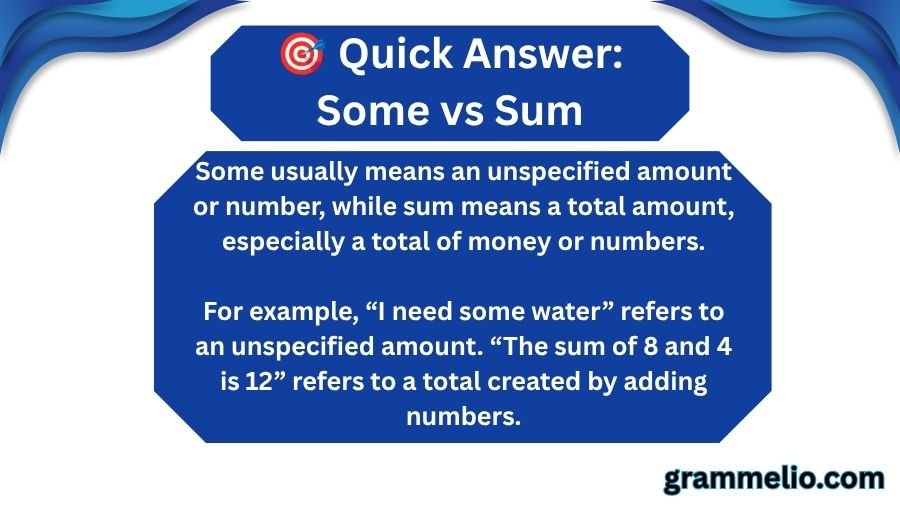
Some usually means an unspecified amount or number, while sum means a total amount, especially a total of money or numbers.
For example, “I need some water” refers to an unspecified amount. “The sum of 8 and 4 is 12” refers to a total created by adding numbers.
The easiest rule is:
- Some = an amount or number that is not specified
- Sum = a total, especially one produced by addition
Although some and sum sound alike, they are not interchangeable.
Is Some the Same as Sum?
No. Some and sum are different words with different meanings and grammatical uses. Their similar sound is the main reason people confuse them.
Some is commonly used as a determiner, pronoun, or adjective-like word before a noun. It can refer to an unknown, unspecified, or limited amount or number.
Examples:
- “I bought some apples.”
- “Would you like some coffee?”
- “Some people prefer tea.”
Sum, on the other hand, is mainly a noun. It refers to a total amount or the result of adding numbers.
Examples:
- “The sum of 5 and 7 is 12.”
- “She paid a large sum of money.”
- “The final sum was higher than expected.”
So, if you are talking about an unspecified amount, choose some. If you are talking about a total, choose sum.
Some vs Sum: Meaning and Correct Use
The main difference between some vs sum is meaning. One points to an unspecified amount or number. The other points to a total.
| Form | Type | Meaning | Example | Correct/Incorrect |
|---|---|---|---|---|
| some | Determiner/pronoun | An unspecified amount or number | I need some help. | ✅ Correct |
| sum | Noun | A total amount or result of addition | The sum is 25. | ✅ Correct |
| some | Used for a mathematical total | A result of addition | The some of 4 and 5 is 9. | ❌ Incorrect |
| sum | Used to mean an unspecified amount | An unknown amount | Give me sum water. | ❌ Incorrect |
The words may sound similar, but their meanings give you the answer.
What Does Some Mean?
Some refers to an amount or number that is not stated exactly.
It can be used with both countable and uncountable nouns.
For example:
- “I have some books.”
- “I need some advice.”
- “She bought some bananas.”
- “We need some information.”
In “some books,” the exact number is unknown or not important. In “some advice,” the exact amount is also not stated.
What Does Sum Mean?
Sum means a total. It is often used in mathematics, finance, accounting, and formal writing.
For example:
- “The sum of 10 and 15 is 25.”
- “He received a large sum of money.”
- “The sum of the two payments was $500.”
When you see sum, think total.
Some and Sum as Different Parts of Speech
Another useful clue is grammar.
Some can work before a noun:
“I bought some food.”
It can also stand alone:
“Would you like some?”
Sum normally functions as a noun:
“The sum was correct.”
It can also appear in phrases such as:
“a large sum of money”
That grammatical difference can help you choose the right spelling.
💡 Test Tip: Replace the Word With “Total”
Here is one of my favorite quick tests.
If you can replace the word with total, use sum.
- “The sum of 6 and 4 is 10.”
- “The total of 6 and 4 is 10.”
Both work.
But:
- “I need some water.”
- “I need total water.”
That does not work.
So, ask yourself:
Does this sentence mean an unspecified amount, or does it mean a total?
If it means an unspecified amount, choose some.
If it means a total, choose sum.
| Meaning | Word | Example Sentence |
|---|---|---|
| Unspecified amount | some | I need some milk. |
| Unspecified number | some | Some students stayed late. |
| Mathematical total | sum | The sum of 7 and 8 is 15. |
| Total amount of money | sum | He paid a large sum. |
Why Do People Confuse Some and Sum?
People confuse some and sum mainly because they are homophones. Homophones are words that sound the same but have different meanings and spellings.
When we speak, there is no obvious spelling difference between the words. We hear the sound, but we do not see the letters.
I once reviewed a short school assignment where a student wrote “the some of the numbers” several times. The student clearly understood the math but had connected the sound of the word with the wrong spelling. Once we changed the sentence to “the sum of the numbers,” the problem made sense immediately.
Other common causes include:
- Fast typing
- Autocorrect
- Speech-to-text software
- Weak spelling habits
- Limited vocabulary knowledge
- Writing based only on sound
This is why some vs sum mistakes can happen even to people who understand English well.
Key Differences Between Some and Sum
The easiest way to understand some vs sum is to compare their jobs.
| Feature | Some | Sum |
|---|---|---|
| Main idea | Unspecified amount or number | Total |
| Common word type | Determiner/pronoun | Noun |
| Used in math | Not normally for totals | Yes |
| Used with money | Yes, when amount is unspecified | Yes, when referring to a total amount |
| Example | I need some money. | The sum was $200. |
| Sound | Same | Same |
Consider these sentences:
“I saved some money.”
This does not tell us exactly how much money was saved.
“The sum was $200.”
This tells us that $200 is the total.
The context makes the correct spelling clear.
How Is Some Used in Everyday English?
Some is extremely common in everyday English. We use it when the exact amount or number is unknown, unimportant, or not stated.
Some With Countable Nouns
Use some with plural countable nouns when you mean an unspecified number.
Examples:
- “I bought some apples.”
- “Some students left early.”
- “She invited some friends.”
- “We saw some birds.”
The number could be three, five, ten, or another amount. The speaker does not need to give the exact number.
Some With Uncountable Nouns
You can also use some with uncountable nouns.
Examples:
- “I need some water.”
- “Can I have some advice?”
- “She gave me some information.”
- “We need some patience.”
Here, some means an unspecified amount.
Some as a Pronoun
Sometimes the noun is understood and does not need to be repeated.
For example:
“Would you like some?”
The listener understands that some refers to something already mentioned, such as food or coffee.
How Is Sum Used in Mathematics and Finance?
Sum is strongly connected with totals and addition.
In mathematics, a sum is the result you get when you add numbers together.
For example:
3 + 5 = 8
The sum is 8.
You might also see sentences such as:
- “Find the sum of 12 and 9.”
- “The sum of the two numbers is 21.”
- “Add the values to find their sum.”
The word is also common when discussing money.
For example:
“The company paid a large sum for the property.”
Here, sum means a specific or substantial amount of money.
Sum Does Not Always Mean a Math Problem
Although students often meet sum in math class, the word is not limited to arithmetic.
It can refer to a total amount of money or another quantity.
For example:
“She inherited a considerable sum.”
This does not require an addition problem. It simply refers to an amount of money.
📝 Case Study: Some vs Sum in a Workplace Email
Imagine that an employee is preparing a budget email.
The employee writes:
“We received some payments this week, and the some of those payments was $8,000.”
The first some is correct because the employee means an unspecified number of payments.
The second word should be sum because it means the total.
Correct version:
“We received some payments this week, and the sum of those payments was $8,000.”
This example shows why context matters. The two words can appear in the same sentence because they perform different jobs.
I once caught a similar issue while editing a business note. The writer had used the wrong spelling in a sentence about a total payment. The meaning was easy to understand, but the spelling made the sentence look careless. A one-word correction made the whole sentence more professional.
📚 Grammar Rules Explanation
The grammar rule for some vs sum is based on meaning and sentence function.
Use some when you mean an unspecified amount or number. It commonly appears before nouns and can also stand alone when the noun is understood.
Use sum when you mean a total amount or the result of addition. It is generally used as a noun.
Most standard English reference sources agree on this basic distinction.
The key point is that pronunciation does not determine spelling. English contains many homophones, so writers must use meaning and context to select the correct word.
Correct vs Incorrect at a Glance
| Sentence | Correct/Incorrect | Why |
|---|---|---|
| I need some sugar. | ✅ Correct | “Some” means an unspecified amount. |
| The sum of 4 and 6 is 10. | ✅ Correct | “Sum” means the mathematical total. |
| The some of 4 and 6 is 10. | ❌ Incorrect | A mathematical total is a “sum.” |
| She gave me some useful advice. | ✅ Correct | The amount of advice is unspecified. |
| He paid a large some of money. | ❌ Incorrect | The correct phrase is “a large sum of money.” |
A simple meaning check will solve most cases.
⚠️ Common Mistakes With Some and Sum
The biggest mistake is choosing the spelling based only on sound.
Because the words sound alike, your brain may select whichever spelling appears first in memory.
Mistake 1: Using Some for a Total
❌ “The some of 5 and 9 is 14.”
The correct sentence is:
✅ “The sum of 5 and 9 is 14.”
Mistake 2: Using Sum for an Unspecified Amount
❌ “I need sum water.”
Correct:
✅ “I need some water.”
Mistake 3: Confusing “Some Money” With “A Sum of Money”
Both can be correct, but they mean different things.
“I saved some money.”
This means an unspecified amount.
“I saved a large sum of money.”
This emphasizes the amount as a total or substantial quantity.
Other Homophone Confusions
| Confusing Words | Correct Meaning | Common Problem |
|---|---|---|
| some / sum | Unspecified amount / total | Sound alike |
| there / their / they’re | Place / possession / they are | Same or similar sound |
| your / you’re | Possession / you are | Fast typing |
| its / it’s | Possession / it is | Apostrophe confusion |
| to / too / two | Direction / also / number | Sound alike |
These mistakes are common because English spelling does not always match pronunciation.
Specific Wrong Forms to Avoid
| Wrong Form | What’s Wrong | Correct Form |
|---|---|---|
| the some of 5 and 6 | “Some” does not mean mathematical total | the sum of 5 and 6 |
| sum water | “Sum” cannot mean an unspecified amount | some water |
| a some of money | Incorrect noun choice | a sum of money |
| the some total | Wrong word for the total | the sum total |
| some of 4 and 8 is 12 | “Some” does not mean addition result | the sum of 4 and 8 is 12 |
Fast typing, autocorrect, and speech-to-text can make these errors even easier to miss.
What Are the Most Useful Memory Tricks?
You do not need a complicated rule to remember some vs sum.
Try these simple tricks.
Think “SOME = Some Amount”
The word some often points to an amount that is not exact.
“I need some water.”
Think:
some = not exact
Think “SUM = Total”
The word sum is connected with addition.
“The sum of 2 and 3 is 5.”
Think:
sum = total
Use the Math Test
If numbers are being added, sum is usually the word you want.
- 4 + 5 = 9 → the sum is 9
- 10 + 15 = 25 → the sum is 25
If you are simply talking about an unknown amount, use some.
- some food
- some time
- some money
- some people
| Memory Clue | Word |
|---|---|
| Not exact | some |
| An unspecified number | some |
| A total | sum |
| Addition result | sum |
| Total amount of money | sum |
Some vs Sum in Different Contexts
The correct word depends on what you are trying to say. The context does not change the basic rule.
| Context | Which Term to Use | Example |
|---|---|---|
| Everyday conversation | some | I need some help. |
| Professional writing | some | We received some requests. |
| Creative writing | Either, depending on meaning | Some travelers stayed behind. |
| Social media/texting | some | I need some coffee! |
| Mathematics | sum | Find the sum of the numbers. |
| Finance | sum | The company paid a large sum. |
In casual writing, some is far more common. In math and financial contexts, sum appears more often.
Common Phrases With Some
Unlike sum, some appears in many everyday phrases.
| Phrase | Meaning |
|---|---|
| some time | An unspecified period of time |
| some day | An unspecified future day |
| some people | An unspecified group of people |
| some kind of | An unspecified type |
| some of | A portion of a larger group or amount |
| some more | An additional unspecified amount |
Examples include:
“I need some time to think.”
“Some people prefer working at night.”
“Would you like some more?”
These phrases are natural because some expresses an amount or number without giving an exact figure.
Common Phrases With Sum
Sum also appears in several useful expressions.
| Phrase | Meaning |
|---|---|
| sum of | The total produced by adding things |
| a sum of money | An amount of money |
| large sum | A substantial amount |
| small sum | A relatively small amount |
| sum total | The complete total |
| lump sum | One payment of the full amount |
For example:
“The sum of the expenses was $1,500.”
Or:
“He received a lump sum payment.”
The phrase sum total deserves special attention. It means the complete total.
Can Sum Mean an Amount of Money?
Yes. Sum can refer to an amount of money, especially when the amount is viewed as a total or a notable quantity.
For example:
“They spent a large sum on the project.”
This does not necessarily mean the speaker is adding numbers in the sentence. Sum can simply mean an amount of money.
Compare:
“I need some money.”
This means an unspecified amount.
“I need a sum of money.”
This sounds more formal and focuses on the amount as a defined quantity.
“They paid a large sum of money.”
This emphasizes that the amount was substantial.
Can Some Be Used in Math?
Yes, some can appear in a mathematical sentence, but it does not normally name the result of addition.
For example:
“Some students solved the equation.”
Here, some describes an unspecified number of students.
But:
“The sum of 7 and 3 is 10.”
Here, sum names the result.
This distinction is easy to remember:
Some can describe how many. Sum can describe the total.
Synonyms and Alternatives
Sometimes you can replace these words with other expressions. However, the replacement must preserve the meaning.
| Alternative | Works When | Does Not Work When |
|---|---|---|
| a few | Referring to an unspecified small number | Referring to an uncountable amount |
| an amount of | Referring to an unspecified quantity | You need a natural everyday phrase before plural count nouns |
| a total | Referring to a final amount | You simply mean an unspecified amount |
| quantity | Referring to an amount, often formally | You want casual everyday wording |
| portion | Referring to part of something | You mean the mathematical result of addition |
For example, some can sometimes become a few:
“I have some questions.”
“I have a few questions.”
But these are not always identical. A few usually suggests a small number, while some is less specific.
Similarly, sum can often be replaced with total:
“The sum was $500.”
“The total was $500.”
That replacement works because both can refer to a final amount.
Why Does Getting Some vs Sum Right Matter?
Correct spelling helps readers understand your meaning without stopping to decode the sentence.
In schoolwork, the difference matters because sum is a standard math term. In professional writing, a spelling error can make an otherwise clear message look rushed.
A useful rule is:
“Choose the word that matches the meaning, not just the sound.”
| Situation | Why Getting It Right Matters |
|---|---|
| Resume | Shows careful writing |
| Client email | Builds a professional impression |
| Published content | Improves clarity and trust |
| Social post | Prevents distracting spelling errors |
Imagine reading:
“The some total was $20,000.”
The reader may understand it, but the incorrect spelling immediately stands out.
Correct spelling is a small detail that supports clear communication.
How Can You Check Your Sentence Quickly?
When you are unsure, stop and ask what the word means.
Question 1: Am I talking about an unspecified amount or number?
If yes, use some.
“I need some paper.”
Question 2: Am I talking about a total?
If yes, use sum.
“The sum of the numbers is 40.”
Question 3: Am I talking about a mathematical result?
If yes, use sum.
“The sum of 9 and 11 is 20.”
Question 4: Can I replace the word with “total”?
If yes, sum may be correct.
This four-question check takes only a few seconds.
🧠 How To Remember the Difference Forever
I teach students to connect each word with one simple idea.
Some → unspecified
Sum → total
That is enough for most situations.
You can also connect sum with addition:
5 + 5 = 10 → The sum is 10.
Then connect some with everyday quantities:
some water
some food
some people
some time
some money
If you remember those examples, the spelling becomes much easier.
What Should You Choose in Formal Writing?
In formal writing, choose the word that expresses the exact idea.
Use some when the amount or number is not specified.
“Some employees requested additional training.”
Use sum when referring to a total or amount.
“The sum of the expenses exceeded the original budget.”
Formal writing does not change the basic rule. It simply makes accuracy more important because readers may pay closer attention to word choice.
Quick Recap Checklist
Use this checklist whenever you are unsure.
| Question | If Yes → Use |
|---|---|
| Does the word mean an unspecified amount? | some |
| Does it mean an unspecified number? | some |
| Does it mean a total? | sum |
| Does it refer to the result of addition? | sum |
| Does it describe an unknown amount of water, food, time, or money? | some |
| Does it refer to a total amount of money? | sum |
Practice Examples
- “Can I have ___ coffee?”
- Answer: some
- “What is the ___ of 20 and 30?”
- Answer: sum
- “We received ___ new applications.”
- Answer: some
- “The ___ of the two bills is $750.”
- Answer: sum
- “I need ___ time to finish.”
- Answer: some
FAQs About Some vs Sum
What is the difference between some and sum?
Some refers to an unspecified amount or number. Sum refers to a total or the result of addition.
Is sum a synonym for some?
No. Sum and some have different meanings. Their similar pronunciation can make them confusing, but they cannot normally replace each other.
Is the sum of numbers the same as some numbers?
No. Some numbers means an unspecified group or number of numbers. The sum of numbers means the total produced by adding them.
Should I say “the some of 5 and 5”?
No. The correct phrase is “the sum of 5 and 5.”
The result is 10, so sum is the correct word.
Should I write “some money” or “sum money”?
Write “some money” when you mean an unspecified amount of money.
For example:
“I need some money.”
“Sum money” is not correct in that sentence.
Is “a sum of money” correct?
Yes. A sum of money is a correct phrase. It usually sounds more formal than some money.
For example:
“She received a large sum of money.”
Is some singular or plural?
Some can be used with plural countable nouns and uncountable nouns.
Examples:
- “some books”
- “some students”
- “some water”
- “some advice”
The noun after it determines the grammatical number.
Is sum only used in mathematics?
No. Sum is common in mathematics, but it can also refer to an amount of money or a total amount.
For example:
“He paid a large sum.”
Why do some and sum sound the same?
They are pronounced alike in standard American English, but they have different spellings and meanings. This makes them homophones.
What is the easiest way to remember some vs sum?
Remember:
Some = an unspecified amount or number.
Sum = a total.
If you are adding numbers, think sum. If you mean “an amount, but I am not saying exactly how much,” think some.
Final Thoughts on Some vs Sum
Some vs sum is a small spelling difference with a clear meaning difference. Some refers to an unspecified amount or number, while sum refers to a total, especially the result of addition or a total amount of money. 😊 Once you stop relying only on sound and start checking the meaning of the sentence, the choice becomes much easier.
When you see an unknown amount of food, water, time, money, or people, some is usually the right choice. When you see addition, a total, or a formal reference to an amount, sum is usually correct. 💡
The best habit is simple: read the sentence, identify the meaning, and then choose the spelling. Do not let pronunciation make the decision for you.
Remember this one-line rule:
Some means an unspecified amount or number; sum means a total.
Master that distinction, and you will rarely confuse these two homophones again.




[…] to choose the right word with confidence. Let’s make this confusing pair easy to remember. 😊 Some vs Sum | Soar vs Sore | Skeptic vs […]
[…] easier. By the end, you should be able to spot the right word almost instantly. 😊 Tail vs Tale | Some vs Sum | Soar vs […]