Have you ever stopped while writing because you could not remember whether the word should be seas vs sees vs seize? I have seen this spelling mix-up many times, especially because all three words sound almost exactly alike in everyday American English. 🌊
The trouble is that their meanings are completely different. Seas refers to large areas of salt water, sees is a form of the verb “see,” and seize means to take hold of something, often quickly or by force.
If you are a student, teacher, writer, professional, or anyone who wants clear English, knowing the difference can save you from awkward mistakes. ✍️
In this guide, I will explain each word in simple terms, show you how to use it correctly, and give you easy memory tricks that make the spelling much easier to remember. Sear vs Seer vs Sere | Sail vs Sale | Rye vs Wry
🎯 Quick Answer: Seas vs Sees vs Seize
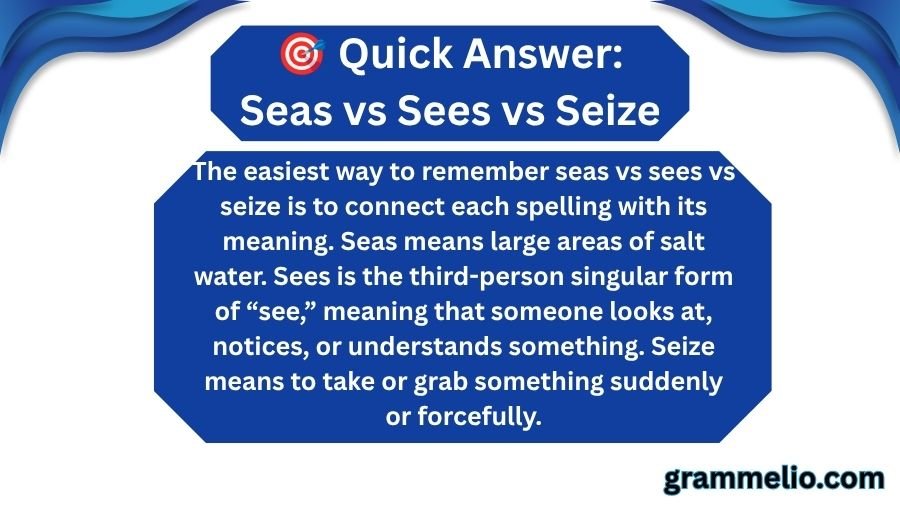
The easiest way to remember seas vs sees vs seize is to connect each spelling with its meaning. Seas means large areas of salt water. Sees is the third-person singular form of “see,” meaning that someone looks at, notices, or understands something. Seize means to take or grab something suddenly or forcefully.
Think of them this way:
- Seas = water 🌊
- Sees = looks or notices 👀
- Seize = grabs or takes ✋
The three words are pronounced alike in most standard American English speech, but their spellings and meanings are different.
Seas vs Sees vs Seize: Understanding the Basics
The core difference is simple: seas is a noun, sees is a verb, and seize is also a verb. Once you know the job each word performs, choosing the correct spelling becomes much easier.
| Form | Type | Meaning | Example | Correct/Incorrect |
|---|---|---|---|---|
| seas | Noun | Large areas of salt water | The ship crossed rough seas. | ✅ Correct |
| sees | Verb | Looks at, notices, or understands | Maria sees the problem. | ✅ Correct |
| seize | Verb | Takes or grabs suddenly | Police may seize illegal goods. | ✅ Correct |
A useful trick is to look at the words around the confusing term. Ask yourself what the sentence is talking about.
If it involves water, you probably need seas.
If someone looks at or notices something, you probably need sees.
If someone takes hold of something, you probably need seize.
Seas: The Water Word
Seas is the plural form of sea. A sea is a large body of salt water. The plural form refers to more than one sea or can describe broad areas of ocean water.
For example:
The sailors traveled across several seas.
Here, seas is a noun. It names bodies of water.
Another example:
The rough seas made the boat move from side to side.
In this sentence, seas describes the water conditions.
✅ Correct: The sailors crossed dangerous seas.
❌ Incorrect: The sailors crossed dangerous sees.
The second sentence uses the wrong spelling because the sentence is about water, not seeing.
Sees: The Looking Word
Sees comes from the verb see. It is used with singular third-person subjects such as he, she, it, or a singular noun.
For example:
She sees a bird outside the window.
The subject is she, so the verb becomes sees.
You can also use sees for noticing or understanding something:
He sees why the plan failed.
Here, sees does not simply mean looking with the eyes. It means understanding or recognizing an idea.
✅ Correct: Daniel sees the mountain from his window.
❌ Incorrect: Daniel seas the mountain from his window.
The first sentence describes what Daniel can see. The second uses the plural noun for bodies of water.
Seize: The Taking Word
Seize means to take hold of something suddenly, firmly, or by authority.
For example:
The officer decided to seize the stolen property.
Here, seize means to take possession of something.
It can also mean taking an opportunity:
She decided to seize the opportunity.
In this case, nobody is physically grabbing anything. The phrase means to make good use of an opportunity before it disappears.
✅ Correct: You should seize the opportunity.
❌ Incorrect: You should sees the opportunity.
The first sentence means you should take advantage of the opportunity. The second has the wrong verb form.
What Is the Difference Between Seas and Sees?
Seas refers to bodies of salt water, while sees is a verb meaning “looks at,” “notices,” or “understands.” They sound alike, but they perform different jobs in a sentence.
Compare these examples:
The sailor crossed the seas.
The sailor sees a lighthouse.
In the first sentence, seas is a noun. In the second, sees is a verb.
This difference is especially useful when you are proofreading. If the word describes a thing or place, check whether sea makes sense. If the sentence describes what a person or thing notices, sees is probably correct.
A Simple Grammar Test
Try replacing the word with bodies of water.
If the sentence still makes sense, use seas.
The ship crossed the seas.
→ The ship crossed the bodies of water.
That works.
Now try replacing the word with looks at.
She sees the painting.
→ She looks at the painting.
That works too.
This quick replacement test is one of the easiest ways I teach students to separate confusing homophones.
Why Is Seize Different From Seas and Sees?
Seize means to take, grab, capture, or take advantage of something. Unlike seas and sees, its spelling contains a z sound in the written form.
The meaning makes the difference clear:
The dog tried to seize the toy.
Here, the dog is trying to grab the toy.
The government may seize the property.
Here, seize means to take property under legal authority.
He seized the chance to speak.
Here, seize means to take advantage of an opportunity.
The word can therefore describe physical action, official action, or a figurative action.
Test Tip 💡
When you are unsure about seize, replace it with grab, take, or take advantage of.
If one of those words fits, seize may be the word you need.
For example:
She decided to seize the opportunity.
Replace it:
She decided to take advantage of the opportunity.
The meaning stays almost the same.
Seas vs Sees vs Seize at a Glance
A quick comparison can make these homophones much easier to remember.
| Word | Main Meaning | Part of Speech | Memory Clue |
|---|---|---|---|
| seas | Bodies of salt water | Noun | Sea + s |
| sees | Looks at or notices | Verb | See + s |
| seize | Takes or grabs | Verb | Seize an opportunity |
| sea | One body of salt water | Noun | Water |
| see | Look at or notice | Verb | Eyes |
| seize | Take firmly or suddenly | Verb | Grab |
The key is not pronunciation. All three words can sound the same. The key is meaning and grammar.
What Are the Correct Meanings and Uses?
Each word has several normal uses. Understanding those uses will help you recognize the right spelling even when the words appear in unfamiliar sentences.
Uses of Seas
Use seas when discussing:
- More than one sea
- Large areas of salt water
- Rough or calm water conditions
- Figurative descriptions of huge amounts of something
Examples:
The explorers sailed across distant seas.
The seas were unusually calm.
Waves rolled across the open seas.
The word can also appear in familiar expressions such as rough seas and seven seas.
Uses of Sees
Use sees when the subject is a singular third-person person, animal, or thing.
Examples:
She sees a rainbow.
The child sees the answer.
My dog sees the mail carrier every morning.
The manager sees a problem with the schedule.
Notice that sees can describe physical sight or mental understanding.
Uses of Seize
Use seize when someone:
- Grabs something
- Takes control
- Takes property
- Captures something
- Takes an opportunity
Examples:
The child tried to seize the ball.
The army attempted to seize control of the town.
The officers seized the evidence.
He seized the chance to ask a question.
The word often suggests quick or firm action.
| Meaning | Word Type | Example Sentence |
|---|---|---|
| Bodies of water | Noun | The seas were calm. |
| Looks at something | Verb | She sees the ocean. |
| Understands something | Verb | He sees the problem. |
| Takes or grabs | Verb | The child tried to seize the toy. |
| Takes an opportunity | Verb | She seized the chance to apply. |
📝 Case Study: A Small Email Mistake
I once edited a short workplace message that said, “The client sees were rough last week.” The writer meant seas, because the email was about shipping conditions. The spelling error changed a simple business sentence into something that made no sense.
The corrected version was:
✅ The client reported that the seas were rough last week.
That small correction mattered because professional readers should not have to guess what a sentence means.
Here is another practical example:
“The manager sees an opportunity to reduce costs.”
In this sentence, sees is correct because the manager recognizes an opportunity.
But:
“The manager wants to seize the opportunity.”
Here, seize is correct because the manager wants to act on that opportunity.
The two words can appear in the same topic while having completely different meanings.
Grammar Rules Explanation
The grammar rule is based on both meaning and word function. The main rule for seas vs sees vs seize is simple: choose the spelling that matches the meaning and grammatical job of the word.
Seas is a plural noun. It normally refers to more than one sea or to broad areas of salt water.
Sees is a verb. It is the third-person singular form of see.
Seize is a verb in its base form. It means to take, grab, capture, or take advantage of something.
Most standard English reference sources treat these as separate words despite their similar pronunciation. Their spelling must therefore be chosen from context rather than sound.
Consider the subject:
She sees the boat.
The subject is she, so the correct verb form is sees.
Now consider the object:
The boat travels through the seas.
Here, seas names bodies of water.
Finally:
The captain hopes to seize control.
Here, seize follows to in its base verb form.
Correct vs Incorrect at a Glance
| Sentence | Correct/Incorrect | Why |
|---|---|---|
| The ship crossed the seas. | ✅ Correct | The sentence refers to bodies of water. |
| The ship crossed the sees. | ❌ Incorrect | “Sees” is a verb, not a word for water. |
| She sees the ship. | ✅ Correct | “Sees” is the correct third-person form of “see.” |
| She seas the ship. | ❌ Incorrect | “Seas” is a plural noun. |
| They plan to seize the opportunity. | ✅ Correct | “Seize” means take advantage of. |
⚠️ Common Mistakes With Seas, Sees, and Seize
Understanding seas vs sees vs seize becomes easier when you remember that each word has a different meaning and grammatical role.
People often confuse these words because they are homophones. Homophones sound alike but have different spellings and meanings.
Three common causes are:
- Fast typing — When people type quickly, they often write the first spelling that comes to mind.
- Autocorrect — Software may choose a different word when the sentence does not provide enough context.
- Lack of knowledge — If someone has learned the words mainly through speech, the spelling difference can be hard to remember.
I once caught myself typing sees when I meant seize in a quick note. I noticed it because the sentence said I wanted to “sees the chance.” Reading the sentence aloud did not help because both words sounded the same. Checking the meaning did.
That is the main lesson: sound cannot always tell you which spelling is correct.
Similar English Confusions
| Confusing Pair | Correct Difference |
|---|---|
| its / it’s | Possession vs. “it is” or “it has” |
| your / you’re | Possession vs. “you are” |
| their / there / they’re | Possession, place, or “they are” |
| to / too / two | Direction, also, or number |
| hear / here | Listen vs. place |
| sea / see | Water vs. sight |
These pairs share one major challenge: pronunciation can make different words sound alike.
Common Wrong Spellings and Uses
| Wrong Form | What’s Wrong | Correct Form |
|---|---|---|
| The ship crossed the sees. | Wrong word for water | The ship crossed the seas. |
| She seas the answer. | Wrong verb spelling | She sees the answer. |
| They will sees control. | Wrong verb form after “will” | They will seize control. |
| He wants to sees it. | “To” requires the base verb | He wants to see it. |
| She seize the problem. | Subject and verb do not match | She sees the problem. |
| They seas an opportunity. | Water word does not fit the meaning | They seize an opportunity. |
How Can You Remember Seas, Sees, and Seize?
The best memory trick is to connect each spelling with a picture or phrase. The best way to remember seas vs sees vs seize is to connect each word with a simple clue: water, sight, or taking.
Remember Seas With Water
Think:
seas → sea → water
The extra s simply makes sea plural.
One sea → two seas
Remember Sees With Eyes
Think:
sees → see → eyes
If someone uses their eyes or understands something, sees may be correct.
She sees the moon.
Remember Seize With “Grab”
Think:
seize → grab
You can also remember the common phrase:
seize the opportunity
If someone is taking an opportunity, they seize it.
| Word | Memory Trick | Example |
|---|---|---|
| seas | Sea + s = water | The seas are rough. |
| sees | See + s = looks | He sees the boat. |
| seize | Grab or take | They seize the chance. |
Usage in Different Contexts
The correct spelling stays the same across different types of writing. What changes is the situation in which you use the word. Knowing seas vs sees vs seize in different contexts helps you choose the correct spelling when writing emails, schoolwork, social posts, or creative content.
| Context | Which Term to Use | Example |
|---|---|---|
| Everyday conversation | seas, sees, or seize depending on meaning | She sees the waves. |
| Professional writing | Any of the three when grammatically appropriate | The company plans to seize the opportunity. |
| Creative writing | Any of the three | The ship vanished beyond the seas. |
| Social media/texting | Any of the three | I finally sees what you mean. ❌ |
That last example shows why informal writing still needs correct grammar. A casual message may be short, but the intended meaning should remain clear.
Everyday Conversation
You might hear all three words in ordinary speech:
We traveled across the seas.
She sees the beach from her room.
He wants to seize the chance.
Because they sound alike, listeners usually understand them from context.
Professional Writing
Accuracy matters even more at work.
Consider:
The company hopes to seize new market opportunities.
This sounds clear and professional.
Using seas or sees would create an obvious spelling error.
Creative Writing
Writers can use seas for vivid descriptions:
Beyond the distant seas, the old ship disappeared into the fog.
They can use sees for character action:
She sees a light in the distance.
And they can use seize to describe action:
The warrior tries to seize the crown.
Social Media and Texting
Informal writing does not change the meanings of these words. If you are writing about an ocean, use seas. If someone is looking at something, use sees. If someone is taking something, use seize.
Common Phrases With These Words
Some phrases make the correct spelling easier to remember because they are commonly used together.
| Phrase | Meaning |
|---|---|
| rough seas | Difficult or stormy water |
| open seas | Areas of ocean away from land |
| seven seas | A traditional expression for the world’s seas |
| sees the point | Understands an idea |
| seize the opportunity | Take advantage of a chance |
| seize control | Take control of something |
The phrase seize the opportunity is especially useful as a memory aid. If the meaning is “take advantage of a chance,” the spelling is seize.
Synonyms and Alternatives
Sometimes you can replace these words with simpler alternatives. This can help confirm what the original word means.
| Alternative | Works When | Does Not Work When |
|---|---|---|
| oceans | Talking about large bodies of salt water | Referring to someone looking |
| notices | Talking about seeing or recognizing | Talking about taking something |
| observes | Talking about watching carefully | Talking about water or grabbing |
| grabs | Talking about taking something quickly | Talking about seeing something |
| takes advantage of | Talking about an opportunity | Talking about physical oceans |
For example:
She sees the problem.
can become:
She notices the problem.
But:
She seizes the opportunity.
cannot become:
She sees the opportunity.
The second sentence changes the meaning. Seeing an opportunity and taking advantage of it are not the same thing.
Why Does Getting These Words Right Matter?
Correct spelling improves clarity. It also makes your writing look more polished and trustworthy.
Imagine reading a business email that says:
“Our team plans to sees the new opportunity.”
The reader can probably guess what the writer means, but the error makes the writer look careless.
Clear writing helps in:
- School assignments
- Resumes
- Client emails
- Business reports
- Blog posts
- Social media
- Creative writing
A useful rule I follow as an editor is simple:
When two words sound alike, let the meaning choose the spelling.
| Situation | Why Getting It Right Matters |
|---|---|
| Resume | Shows attention to detail |
| Client email | Prevents confusion |
| Published content | Builds reader trust |
| Social post | Keeps communication clear |
Even a tiny spelling mistake can distract readers from an otherwise strong message.
Is There a Special Exception?
There is no major grammar exception that changes the basic distinction among these three words. The important point is that pronunciation alone cannot determine the spelling.
One small detail is worth remembering: seas is plural, while sea is singular.
One sea
Two seas
Likewise, sees is a form of see:
I see.
She sees.
And seize remains the base verb:
They seize.
She seizes.
This last contrast can be especially useful. Seize and sees may look similar, but they behave differently in sentences.
What Are the Related Word Forms?
These words have related forms that can help you understand their grammar.
| Base/Related Form | Type | Example |
|---|---|---|
| sea | Singular noun | The sea is calm. |
| seas | Plural noun | The seas are calm. |
| see | Base verb | I see the boat. |
| sees | Third-person singular verb | She sees the boat. |
| saw | Past-tense verb | She saw the boat. |
| seen | Past participle | She has seen the boat. |
| seize | Base verb | They seize the chance. |
| seizes | Third-person singular verb | He seizes the chance. |
| seized | Past tense | They seized the property. |
| seizing | Present participle | She is seizing the opportunity. |
Notice that seize has a normal set of verb forms. For example:
She seizes the opportunity.
She seized the opportunity.
She is seizing the opportunity.
The spelling changes according to grammar, but the core meaning stays related to taking or grabbing.
How Can You Choose the Right Word Quickly?
When proofreading, I recommend a three-question check.
Question 1: Is the sentence about water?
If yes, consider seas.
Question 2: Is someone looking at, noticing, or understanding something?
If yes, consider sees.
Question 3: Is someone taking, grabbing, capturing, or taking advantage of something?
If yes, consider seize.
This method works because it focuses on meaning rather than sound.
💡 A Three-Second Test
Here is an even faster method:
Water → seas
Eyes → sees
Grab → seize
Try these:
The sailor crossed the ___.
Water? → seas
She ___ the answer.
Eyes or understanding? → sees
They decided to ___ control.
Grab or take? → seize
This test is simple enough to use while writing an email or taking a test.
✅ Quick Recap Checklist
Use this checklist whenever you are unsure.
| Question | If Yes → Use |
|---|---|
| Does it mean bodies of salt water? | seas |
| Does it mean someone looks at or understands something? | sees |
| Does it mean takes, grabs, or captures? | seize |
| Does it mean takes advantage of an opportunity? | seize |
| Is it the plural of “sea”? | seas |
| Is it the third-person form of “see”? | sees |
Practice Examples
- The captain sailed across rough seas.
- Maria sees the lighthouse every morning.
- The company hopes to seize the opportunity.
If you can explain why each word fits, you have mastered the basic difference.
Why Do People Confuse Seas, Sees, and Seize?
People confuse these words mainly because they sound the same or nearly the same in normal speech. English contains many groups like this, and spelling often carries information that pronunciation does not.
A student may know exactly what they want to say but still choose the wrong spelling.
I remember a student writing about a character who “seas an opportunity.” The student clearly understood the story and knew that the character wanted to take the opportunity. The problem was spelling, not comprehension. Once we connected seize with grab, the error disappeared.
This is why memorizing three isolated spellings is less helpful than attaching each word to a meaning.
Are Seas, Sees, and Seize Pronounced the Same?
In standard American English, these words are commonly pronounced alike. That makes them homophones.
Because their sounds do not reliably separate them, context is essential.
For example, if you hear:
“She sees the sea.”
You can hear the same basic sound pattern for sees and sea, but the sentence gives you enough information to identify the words when you see them written.
Written English gives us spelling clues that speech does not.
FAQs About Seas vs Sees
What is the difference between seas and sees?
Seas is the plural of sea and refers to bodies of salt water. Sees is the third-person singular form of see and means looks at, notices, or understands.
What does seize mean?
Seize means to take, grab, capture, or take control of something. It can also mean taking advantage of an opportunity.
Are seas and sees pronounced the same?
Yes, they are commonly pronounced the same in standard American English. Their meanings and spellings are different.
Is seize pronounced like sees?
Yes. In standard American English, seize and sees are commonly pronounced alike, even though they have different spellings and meanings.
Is “seas” a verb?
No. Seas is normally the plural noun form of sea. It refers to more than one sea or to areas of salt water.
Is “sees” a verb?
Yes. Sees is the third-person singular present form of the verb see.
For example:
She sees the mountain.
How do you use seize in a sentence?
Use seize when someone takes or grabs something, captures something, or takes advantage of an opportunity.
Example:
You should seize the opportunity to learn something new.
What is an easy way to remember seas vs sees vs seize?
Use this three-word memory trick:
Seas = water.
Sees = looks.
Seize = grabs.
This gives you a quick meaning-based clue for each spelling.
Which is correct: “seize the opportunity” or “sees the opportunity”?
Seize the opportunity is correct when you mean “take advantage of the opportunity.”
Example:
She decided to seize the opportunity.
Sees the opportunity is also grammatically possible, but it has a different meaning. It means that she notices or recognizes the opportunity.
Can seas, sees, and seize be used in the same sentence?
Yes, although doing so may sound playful because they sound alike.
For example:
She sees the seas and decides to seize the chance to sail.
Here, sees means looks at, seas means bodies of water, and seize means take advantage of.
Final Comparison: Seas vs Sees vs Seize
Before finishing, here is the entire rule in one place. This seas vs sees vs seize comparison makes it easy to review the three spellings before you finish writing.
| Word | Meaning | Example |
|---|---|---|
| seas | More than one sea; salt water areas | The seas were rough. |
| sees | Looks at, notices, or understands | She sees the boat. |
| seize | Takes, grabs, captures, or takes advantage of | They seize the opportunity. |
The most reliable strategy is to ignore the sound and focus on meaning.
If you mean water, choose seas.
If you mean looks or notices, choose sees.
If you mean takes or grabs, choose seize.
Once you connect each spelling to its meaning, these three words become much easier to handle.
Conclusion
Seas vs sees vs seize becomes much easier once you stop relying on sound and start checking meaning. 🌊 Seas is the plural of sea and refers to bodies of salt water. Sees is a form of see and means looks at, notices, or understands. Seize means to take, grab, capture, or take advantage of something. ✨
I recommend using the simple memory rule: seas = water, sees = looks, seize = grabs. When proofreading, ask what the word is doing in the sentence. Is it naming water? Is someone seeing something? Or is someone taking something?
That small habit can prevent many spelling errors. It also makes your writing clearer and more professional. The next time these three homophones sound identical in your head, do not guess. Let the meaning guide the spelling.
When the sound is the same, let the meaning make the choice.

[…] and share simple memory tricks. By the end, choosing the right word should feel much easier. ✨ Seas vs Sees vs Seize | Sear vs Seer vs Sere | Sail vs […]
[…] assignment, a professional email, a social media post, or a creative story. ✍️ Sheer vs Shear | Seas vs Sees vs Seize | Sear vs Seer vs […]