I often see writers pause when they reach the words credible vs incredible. At first glance, the two words look almost the same. The small prefix in- makes the difference, but that tiny change can completely change the meaning of a sentence.
If you are a student, blogger, professional writer, or English learner, knowing this difference can help you write with more confidence. 😊
I have seen this mix-up in emails, school assignments, reports, and even polished online content. The good news is that the rule is simple once you connect each word with its main idea. Credible means believable or trustworthy.
Incredible can mean impossible or very hard to believe, but it can also mean amazing or extraordinary. In this guide, I will explain the difference in plain US English, show you correct and incorrect examples, and give you easy ways to remember which word belongs in your sentence.
By the end, you should be able to choose the right word without second-guessing yourself. ✍️ Consul vs Council vs Counse | Comedic vs Comic | Climb vs Clime
🎯 Quick Answer: Credible vs Incredible
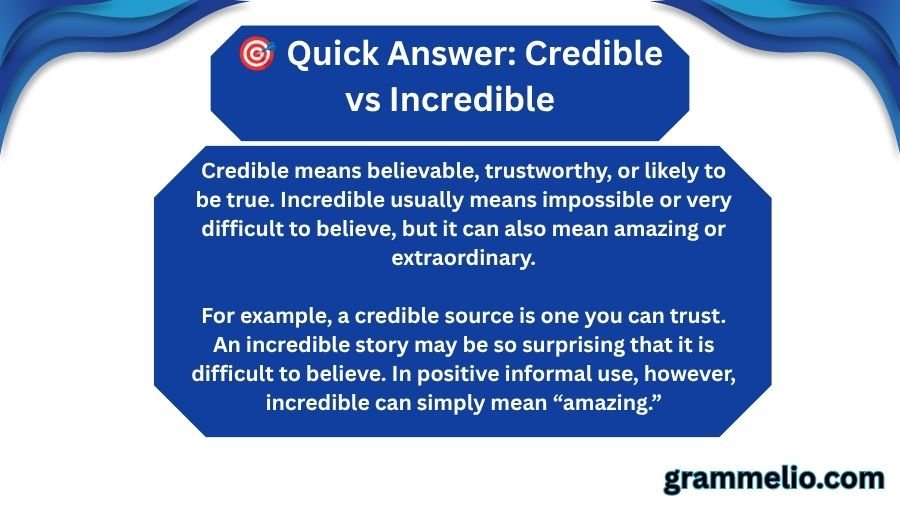
Credible means believable, trustworthy, or likely to be true. Incredible usually means impossible or very difficult to believe, but it can also mean amazing or extraordinary.
For example, a credible source is one you can trust. An incredible story may be so surprising that it is difficult to believe. In positive informal use, however, incredible can simply mean “amazing.”
| Word | Main Meaning | Example |
|---|---|---|
| Credible | Believable or trustworthy | She gave a credible explanation. |
| Incredible | Hard to believe or amazing | He told an incredible story. |
The key is to look at the meaning you want, not just the spelling.
Related Word Forms
Both words have useful related forms. Knowing them can make your writing more accurate because the same basic idea can appear as a noun, adverb, or adjective.
| Form | Type | Example |
|---|---|---|
| Credible | Adjective | The report is credible. |
| Credibility | Noun | The journalist has credibility. |
| Credibly | Adverb | She spoke credibly about the issue. |
| Incredible | Adjective | The view was incredible. |
| Incredibly | Adverb | The movie was incredibly moving. |
| Incredibility | Noun | The claim raised questions about its incredibility. |
Credibility is especially common in professional and academic writing. It describes the quality of being trusted or believed.
Incredibly is also very common in everyday English. It can mean “to an extreme degree,” as in “The test was incredibly difficult.”
🔍 Understanding the Basics of Credible vs Incredible
The simplest difference is this: credible describes something that can be believed, while incredible describes something that is difficult to believe or something extremely impressive.
Think of credible as connected to trust. Think of incredible as connected to surprise.
| Form | Type | Meaning | Example | Correct/Incorrect |
|---|---|---|---|---|
| Credible | Adjective | Believable or trustworthy | The witness gave a credible account. | ✅ Correct |
| Incredible | Adjective | Hard to believe or amazing | The athlete made an incredible comeback. | ✅ Correct |
| Credible | Adjective | Used for something unbelievable | That impossible story was credible. | ❌ Usually incorrect |
| Incredible | Adjective | Used for a trusted source | We need an incredible source. | ❌ Incorrect if you mean trustworthy |
| Credibility | Noun | Trustworthiness | The source has strong credibility. | ✅ Correct |
What Does Credible Mean?
Credible means believable, trustworthy, or convincing.
When I call a person or source credible, I mean there is a good reason to trust what that person or source says.
Consider these examples:
“The doctor gave a credible explanation.”
The doctor’s explanation seems reasonable and trustworthy.
“The newspaper used credible sources.”
The sources can be trusted because they provide reliable information.
“Her account sounded credible.”
Her story seemed believable.
Credible does not always mean that something has been proven beyond doubt. It means that the claim, person, source, or explanation deserves belief based on the available information.
What Does Incredible Mean?
Incredible has two major uses.
The first means hard or impossible to believe.
“The witness made an incredible claim.”
Here, the claim seems difficult to believe.
The second means amazing, extraordinary, or extremely impressive.
“She gave an incredible performance.”
Here, incredible is positive. It means the performance was excellent.
This second meaning is extremely common in modern everyday English.
| Meaning of Incredible | Example | Tone |
|---|---|---|
| Hard to believe | That is an incredible claim. | Doubtful |
| Amazing | You gave an incredible performance. | Positive |
| Extraordinary | They achieved an incredible result. | Positive |
| Very unusual | The storm caused incredible damage. | Strong emphasis |
Is Incredible Always Negative?
No. Incredible can be negative, neutral, or strongly positive depending on context.
Compare:
“The story was incredible because nobody could believe it.” ❌/context-dependent
“The concert was incredible!” ✅
The first sentence suggests doubt. The second expresses strong praise.
That is why context matters when you see the word incredible.
💡 How Can You Remember the Difference?
A simple memory trick is to connect credible with credit. Understanding credible vs incredible becomes much easier when you connect each word with its main idea.
If something is credible, you can give it “credit” as something worth believing.
For incredible, remember the basic idea of not credible in its older or literal sense. Something incredible can be too surprising to believe.
However, do not treat “incredible” as always meaning “not believable.” Modern English often uses it to mean amazing.
| Memory Clue | Word | Basic Idea |
|---|---|---|
| Trust | Credible | Believable |
| Doubt | Incredible | Hard to believe |
| Praise | Incredible | Amazing |
| Reliability | Credibility | Quality of being trusted |
💡 Test Tip
Ask yourself:
“Am I talking about trust or amazement?”
- If you mean trustworthy or believable, choose credible.
- If you mean amazing or extraordinary, choose incredible.
- If you mean difficult to believe, choose incredible.
This quick test works in most everyday situations.
📝 Case Study: Credible vs Incredible in a Workplace Email
Imagine that an employee is preparing a report for a manager. The report includes sales information from several sources.
The employee writes:
“I checked the numbers against three credible sources.”
That is correct because the sources are trustworthy.
Later, the employee writes:
“The company had an incredible 40% increase in sales.”
This may also be correct if the writer means the increase was extraordinary or surprising.
I once edited a business report where the writer used incredible source when they clearly meant trustworthy source. The sentence sounded as if the source itself was unbelievable. Changing it to credible source made the meaning clear immediately.
| Workplace Situation | Better Word | Example |
|---|---|---|
| Trusted research | Credible | We need credible research. |
| Reliable expert | Credible | She is a credible expert. |
| Amazing result | Incredible | The team achieved an incredible result. |
| Surprising claim | Incredible | That is an incredible claim. |
| Reliable evidence | Credible | The evidence appears credible. |
The lesson is simple: choose the word based on the message you want your reader to receive.
📚 Grammar Rules Explanation
Credible and incredible are both adjectives. They can describe people, sources, claims, stories, evidence, results, performances, and other nouns.
The main grammar difference is not their part of speech. Both words can function as adjectives. The difference is their meaning.
Use credible when you mean:
- believable
- trustworthy
- convincing
- reliable enough to accept
Use incredible when you mean:
- difficult to believe
- impossible to believe
- amazing
- extraordinary
- unusually impressive
Most standard English reference sources agree on the basic distinction between the two words. The main challenge comes from the fact that incredible has developed a strong positive everyday use.
Correct vs Incorrect at a Glance
| Sentence | Correct/Incorrect | Why |
|---|---|---|
| The journalist found a credible source. | ✅ Correct | The source is trustworthy. |
| The journalist found an incredible source. | ❌ Incorrect for this meaning | “Incredible” does not normally mean trustworthy. |
| She gave an incredible performance. | ✅ Correct | The performance was amazing. |
| His claim sounded credible. | ✅ Correct | The claim seemed believable. |
| The claim was credible because nobody could believe it. | ❌ Incorrect | The intended meaning conflicts with “credible.” |
The word credible is closely connected to belief. The word incredible can move away from simple disbelief and become a strong word of praise.
⚠️ Common Mistakes With Credible and Incredible
People confuse these words for several reasons.
First, the spelling is nearly identical. Second, the prefix in- can make learners assume that incredible always means “not credible.” Third, everyday speakers often use incredible as a synonym for “amazing.”
Fast typing can make the problem worse. Autocorrect may not catch the mistake because both words are correctly spelled.
A student once wrote, “My teacher is an incredible source of information.” The student meant that the teacher was trustworthy. The sentence was grammatically possible, but the meaning was not as clear as intended. Credible source was the better choice.
Common Confusions in English
| Confusing Pair | First Word | Second Word | Main Difference |
|---|---|---|---|
| Credible / incredible | Believable | Hard to believe or amazing | Trust vs. surprise |
| Its / it’s | Possessive | It is | Ownership vs. contraction |
| Your / you’re | Possessive | You are | Ownership vs. contraction |
| Affect / effect | Usually verb | Usually noun | Influence vs. result |
| Then / than | Time/order | Comparison | Sequence vs. comparison |
Common causes of these mistakes include:
- typing too quickly
- relying on autocorrect
- learning words through sound alone
- not checking the sentence meaning
- assuming a prefix always works in the same way
Specific Wrong Forms and Uses
| Wrong Form or Use | What’s Wrong | Correct Form |
|---|---|---|
| an incredible source, meaning trustworthy | Wrong meaning | a credible source |
| a credible performance, meaning amazing | Wrong meaning | an incredible performance |
| incredibly source | Wrong word form | credible source |
| credable | Misspelling | credible |
| incredable | Misspelling | incredible |
| credibility performance | Wrong noun form | incredible performance |
Remember that a sentence can be grammatically structured correctly while still using the wrong word.
❓ Why Do People Confuse Credible and Incredible?
People confuse these words because they share the same base and differ by only a few letters.
The word credible is related to belief and trust. Incredible adds the prefix in-, but modern English does not always treat the word as a simple opposite of credible.
This is the part that causes the most trouble.
If someone says:
“That source is credible.”
They mean the source is trustworthy.
If someone says:
“That performance was incredible.”
They usually mean the performance was amazing.
The two words can therefore appear in the same conversation while expressing very different ideas.
| Question to Ask | If the Answer Is Yes | Word |
|---|---|---|
| Can I trust it? | Yes | Credible |
| Does it seem believable? | Yes | Credible |
| Is it amazing? | Yes | Incredible |
| Is it unusually impressive? | Yes | Incredible |
| Is it difficult to believe? | Yes | Incredible |
✍️ Credible vs Incredible in Different Contexts
The difference between credible vs incredible becomes clearer when you look at how each word works in real situations.
The correct choice can become easier when you know the setting.
Everyday Conversation
In casual speech, incredible is often used to express excitement.
“That meal was incredible!”
Here, the speaker means the meal was excellent.
Credible is more likely to appear when discussing whether something can be trusted.
“Her explanation sounds credible.”
Professional Writing
Professional writing often uses credible when discussing evidence, experts, reports, or information.
“The report is based on credible data.”
Incredible can appear when describing a very large achievement or unusual result.
“The team made an incredible improvement.”
Creative Writing
Writers can use incredible to create surprise or excitement.
“An incredible silence filled the room.”
Credible may be useful when a character is deciding whether to believe another character.
“His story sounded credible.”
Social Media and Texting
On social media, incredible is common as a positive reaction.
“This photo is incredible!”
Credible is less emotional and more factual.
“Is this source credible?”
| Context | Which Term to Use | Example |
|---|---|---|
| Everyday conversation | Either, depending on meaning | That concert was incredible. |
| Professional writing | Credible for trust | Use credible sources. |
| Creative writing | Either, depending on meaning | Her story seemed credible. |
| Social media | Incredible for praise | Your artwork is incredible! |
🔎 Credible vs Incredible in Common Sentences
Seeing the words in different sentences can make the distinction easier.
| Sentence | Meaning |
|---|---|
| We need credible evidence. | We need trustworthy evidence. |
| She is a credible witness. | She is believable as a witness. |
| The result was incredible. | The result was amazing. |
| His story sounded incredible. | His story was difficult to believe. |
| The scientist is credible. | The scientist is trustworthy. |
| The scientist made an incredible discovery. | The discovery was extraordinary. |
Notice how credible often describes the quality of a source or claim, while incredible often adds emotional force.
🗣️ Common Phrases With Credible
There are several common combinations with credible. These are useful because they show how native speakers naturally use the word.
| Phrase | Meaning |
|---|---|
| Credible source | A source that can be trusted |
| Credible evidence | Evidence that seems trustworthy |
| Credible claim | A claim that appears believable |
| Credible witness | A witness whose account can be trusted |
| Credible explanation | An explanation that makes sense |
| Credible threat | A threat that appears real or serious |
For example:
“The article cites several credible sources.”
This means the sources are considered reliable.
🌟 Common Phrases With Incredible
Incredible also appears in many natural phrases.
| Phrase | Meaning |
|---|---|
| Incredible achievement | An amazing accomplishment |
| Incredible story | A very surprising or amazing story |
| Incredible talent | Exceptional ability |
| Incredible performance | An outstanding performance |
| Incredible opportunity | A very valuable or exciting opportunity |
| Incredible experience | An unusually memorable experience |
The positive meaning is especially common in modern conversational English.
🧠 Synonyms and Alternatives
Sometimes you can replace credible or incredible with another word. The best choice depends on your exact meaning.
For credible, useful alternatives include believable, trustworthy, reliable, and convincing.
For incredible, possible alternatives include amazing, extraordinary, remarkable, and unbelievable.
But these words are not always interchangeable.
| Alternative | Works When | Does Not Work When |
|---|---|---|
| Believable | You mean easy to accept as true | You mean amazing |
| Trustworthy | You mean reliable or honest | You mean surprising |
| Reliable | You mean dependable | You mean extraordinary |
| Amazing | You mean very impressive | You mean trustworthy |
| Remarkable | You mean unusual or impressive | You mean proven or reliable |
For example, credible source can become trustworthy source. But incredible performance should not normally become trustworthy performance because the meaning changes.
❓ Can Incredible Mean Amazing?
Yes. In modern English, incredible very often means amazing, extraordinary, or extremely impressive.
For example:
“She has an incredible voice.”
The speaker is praising her voice.
“We had an incredible vacation.”
The speaker means the vacation was excellent or memorable.
This positive meaning is common in everyday speech, advertising, reviews, and social media.
| Sentence | Meaning of Incredible |
|---|---|
| The view was incredible. | Amazing |
| He showed incredible skill. | Extraordinary |
| That story is incredible. | Hard to believe or very surprising |
| The result was incredible. | Amazing or unusually impressive |
Context tells you which meaning is intended.
❓ Is Credible the Opposite of Incredible?
Not in every modern sentence.
At a basic level, the words can look like opposites because credible relates to belief and incredible can mean difficult to believe. But incredible also commonly means “amazing.”
That means you should not automatically replace one with the other.
For example:
“The source is credible.”
This means the source is trustworthy.
You cannot change it to:
“The source is incredible.”
and expect the same meaning.
The second sentence may suggest that the source is unusual, amazing, or hard to believe.
❓ Can I Say “Incredible Source”?
Yes, but the meaning depends on context.
If you mean a trustworthy source, use credible source.
If you say incredible source, a reader may understand it as an unusually impressive, surprising, or remarkable source. That is not normally what you want in formal research writing.
| Intended Meaning | Best Phrase |
|---|---|
| Trustworthy source | Credible source |
| Reliable information | Credible information |
| Amazing result | Incredible result |
| Extraordinary talent | Incredible talent |
| Hard-to-believe story | Incredible story |
In formal writing, precision is usually better than dramatic language.
❓ Which Is Better for Academic Writing?
Credible is usually the better choice when you are describing sources, evidence, research, or claims that can be trusted.
For example:
“The paper uses credible academic sources.”
This clearly tells the reader that the sources are reliable.
Incredible can sound emotional or informal. It may be appropriate when discussing an extraordinary discovery, but it is less useful when you simply mean “trustworthy.”
❓ Which Word Should I Use for a Trustworthy Person?
Use credible.
You can say:
“She is a credible expert.”
This means people have good reason to trust her knowledge or statements.
You could also use trustworthy, reliable, or reputable, depending on the exact meaning.
Do not use incredible if your only goal is to say that someone is trustworthy.
❓ Which Word Should I Use for an Amazing Experience?
Use incredible.
For example:
“It was an incredible experience.”
Here, incredible means amazing, memorable, or extraordinary.
Using credible would not communicate the same idea.
“It was a credible experience.” ❌
That sentence does not naturally mean “It was an amazing experience.”
❓ Does Incredible Mean Unbelievable?
It can.
Incredible may describe something that seems impossible or extremely difficult to believe.
For example:
“He made an incredible claim.”
This may suggest that the claim is so unusual that the listener doubts it.
However, incredible can also mean “amazing.”
So the sentence around the word matters.
❓ Is “Credible Evidence” Correct?
Yes. Credible evidence is a standard and natural phrase.
It means evidence that appears trustworthy, reliable, or believable.
For example:
“The investigators found credible evidence to support the claim.”
The word credible is appropriate because the sentence focuses on whether the evidence deserves trust.
❓ Is “Incredible Evidence” Correct?
It can be grammatically correct, but the meaning is different.
Incredible evidence may mean evidence that is extraordinary or difficult to believe. It does not automatically mean reliable evidence.
If your intended meaning is “trustworthy evidence,” choose credible evidence.
This small distinction can matter a lot in academic, legal, scientific, and professional writing.
❓ What Is the Easiest Way to Remember Credible vs Incredible?
Use this two-word memory rule:
Credible = trust.
Incredible = surprise.
If you are checking whether a person, claim, source, or explanation deserves belief, choose credible.
If you are reacting to something amazing, extraordinary, or hard to believe, choose incredible.
| Meaning | Correct Choice |
|---|---|
| Trustworthy | Credible |
| Believable | Credible |
| Reliable | Credible |
| Amazing | Incredible |
| Extraordinary | Incredible |
| Hard to believe | Incredible |
⚠️ Why This Difference Matters
Using the right word improves clarity. A reader should not have to guess whether you mean “trustworthy” or “amazing.”
It also improves professionalism. A report that says credible sources sounds precise. A report that says incredible sources may confuse the reader.
Digital communication makes this even more important. A short email or social post gives readers very little context. One wrong word can change the message.
I once caught myself typing incredible evidence in a draft when I meant credible evidence. The sentence sounded dramatic, but it did not say what I actually meant. I changed one word, and the whole sentence became more precise.
A useful writing principle is:
Choose the word that gives your reader the exact meaning you intend.
| Situation | Why Getting It Right Matters |
|---|---|
| Resume | Shows careful word choice |
| Client email | Prevents confusion |
| Published content | Builds clarity and trust |
| Social post | Makes your message easier to understand |
📝 Quick Practice: Choose the Right Word
Try these before looking at the answers.
- The researcher used ______ sources.
- The athlete gave an ______ performance.
- The witness seemed ______.
- We saw an ______ sunset.
- The claim sounded ______ after the facts were checked.
Answers
- credible — the sources are trustworthy.
- incredible — the performance was amazing.
- credible — the witness seemed believable.
- incredible — the sunset was extraordinary.
- credible — the claim seemed believable.
| Question | Answer |
|---|---|
| Is it trustworthy? | Use credible. |
| Is it believable? | Use credible. |
| Is it amazing? | Use incredible. |
| Is it extraordinary? | Use incredible. |
| Is it hard to believe? | Use incredible. |
🔄 How to Check Your Sentence Before Publishing
When you are unsure, stop and ask what the adjective is doing. This quick check is one of the easiest ways to avoid mistakes with credible vs incredible.
Step 1: Find the noun
Look at the word being described.
Is it a:
- source?
- witness?
- claim?
- performance?
- result?
- experience?
- story?
Step 2: Identify your intended meaning
Ask whether you mean:
- trustworthy
- believable
- reliable
- amazing
- extraordinary
- hard to believe
Step 3: Pick the matching adjective
If the meaning is trust or belief, use credible.
If the meaning is surprise or amazement, use incredible.
Step 4: Read the sentence aloud
Hearing the sentence can help you notice whether the meaning sounds natural.
| Step | Question | Action |
|---|---|---|
| 1 | What noun am I describing? | Identify it |
| 2 | What do I mean? | Trust or surprise |
| 3 | Which word matches? | Credible or incredible |
| 4 | Does it sound natural? | Read it aloud |
✅ Quick Recap Checklist
Use this checklist whenever you hesitate.
| Question | If Yes → Use |
|---|---|
| Do I mean trustworthy? | Credible |
| Do I mean believable? | Credible |
| Do I mean reliable? | Credible |
| Do I mean amazing? | Incredible |
| Do I mean extraordinary? | Incredible |
| Do I mean difficult to believe? | Incredible |
Practice Examples
1. We need a ______ source for this report.
Answer: credible ✅
2. She delivered an ______ performance.
Answer: incredible ✅
3. His explanation seemed ______ after we checked the facts.
Answer: credible ✅
The fastest memory trick is:
Credible = “Can I believe it?”
Incredible = “Wow, can I believe that?”
❓ FAQs About Credible vs Incredible
What is the difference between credible and incredible?
Credible means believable or trustworthy. Incredible can mean difficult to believe, but it is also commonly used to mean amazing or extraordinary.
Is credible positive or negative?
Credible is generally positive or neutral. It suggests that something or someone deserves belief or trust.
Is incredible always positive?
No. Incredible can be positive or negative depending on context. It can mean amazing, but it can also mean difficult to believe.
Can incredible mean amazing?
Yes. This is one of its most common modern uses. For example, “She gave an incredible performance” means that her performance was amazing.
Should I say credible source or incredible source?
Use credible source when you mean a source that is trustworthy or reliable. Incredible source can suggest something unusual or amazing and does not clearly communicate trustworthiness.
Is credible evidence correct?
Yes. Credible evidence means evidence that appears trustworthy or believable.
Is incredible evidence correct?
It can be grammatically correct, but it does not normally mean trustworthy evidence. It may suggest evidence that is extraordinary or difficult to believe.
Is credible a synonym for believable?
Yes. Believable can often replace credible, especially when describing a claim, story, or explanation. However, credible can also carry the idea of trustworthiness or reliability.
Is incredible the opposite of credible?
Not always. Incredible can mean difficult to believe, which contrasts with credible. But it also commonly means amazing, so it is not always a direct opposite.
How can I remember the difference?
Remember: credible = trust, while incredible = surprise. If you mean something can be believed, choose credible. If you mean something is amazing or hard to believe, choose incredible.
🎯 Final Takeaway
Credible vs incredible becomes easy once you focus on meaning rather than spelling. Use credible when you mean believable, trustworthy, or reliable. Use incredible when you mean amazing, extraordinary, or difficult to believe. 😊 The biggest trap is assuming that incredible always means the direct opposite of credible. In modern English, it often works as a strong word of praise. If you are writing about sources, evidence, experts, or claims, credible is usually the word you want. If you are praising a performance, achievement, experience, or result, incredible will often fit better. When you are unsure, ask yourself one simple question: Am I talking about trust, or am I talking about surprise? That question will usually point you to the right word. ✨ Master that distinction, and your writing will become clearer, sharper, and much easier for your readers to understand.


[…] mistakes. By the end, you should be able to choose the right word quickly and confidently. ✍️ Credible vs Incredible | Consul vs Council vs Counsel | Comedic vs […]
[…] with simple examples. By the end, the choice should feel much easier. ✍️Demur vs Demure | Credible vs Incredible | Consul vs Council vs […]