
Have you ever typed a sentence and suddenly wondered whether you should write climb vs clime? You are not alone. I have seen this spelling mix-up confuse students, bloggers, and even strong writers. The two words look almost identical, but they do very different jobs.
One describes moving upward, while the other is a rare word connected with a region or climate. That small spelling difference can change the meaning of an entire sentence. ✍️
I want to make this easy for US English readers, so you can spot the right word without stopping to second-guess yourself. Whether you are writing a school paper, a work email, a travel post, or a casual message, knowing the difference will make your writing clearer. 😊
Once you understand the simple rule behind these words, you will have a much easier time choosing the correct one. Casual vs Causal | Biannual vs Biennial | Weary vs Wary
🎯 Quick Answer: Climb vs Clime
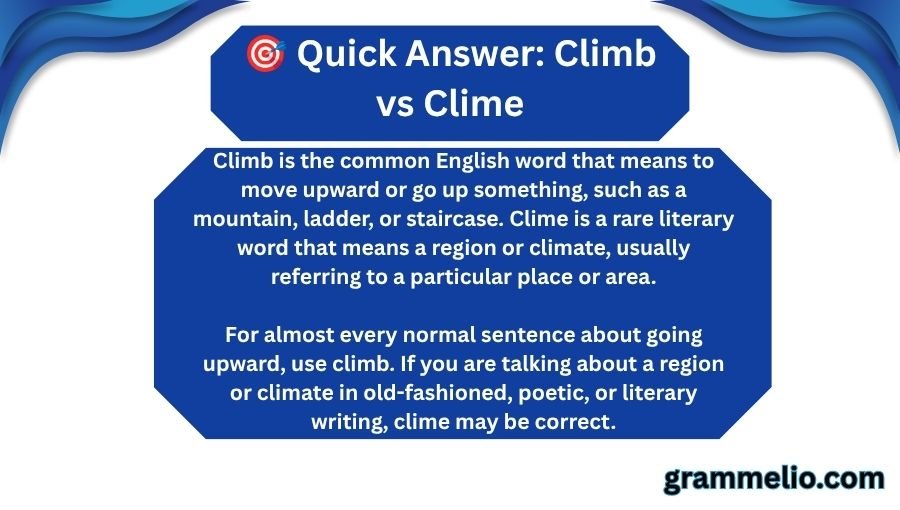
Climb is the common English word that means to move upward or go up something, such as a mountain, ladder, or staircase. Clime is a rare literary word that means a region or climate, usually referring to a particular place or area.
For almost every normal sentence about going upward, use climb. If you are talking about a region or climate in old-fashioned, poetic, or literary writing, clime may be correct.
Easy rule: If someone is going up, choose climb. If you mean a region or climate, choose clime.
📚 Climb vs Clime: Understanding the Basics
The main difference between climb vs clime is meaning. Climb is a common verb and noun. Clime is a much less common noun.
| Form | Type | Meaning | Example | Correct/Incorrect |
|---|---|---|---|---|
| climb | Verb | Move upward | We will climb the hill. | ✅ Correct |
| climb | Noun | An act or effort of moving upward | The climb was difficult. | ✅ Correct |
| clime | Noun | A region or climate | He traveled to a distant clime. | ✅ Correct |
| clime | Verb | Not used in standard modern English | We will clime the mountain. | ❌ Incorrect |
| climb | Verb | Move upward | She climbed the stairs. | ✅ Correct |
The spelling can cause trouble because the words share several letters. However, their meanings are not interchangeable.
What does “climb” mean?
Climb means to move upward, usually with some effort. You can climb a mountain, ladder, staircase, tree, wall, or set of steps.
Examples:
- ✅ Correct: We plan to climb the mountain tomorrow.
- ❌ Incorrect: We plan to clime the mountain tomorrow.
Here, the writer means physical movement upward. Therefore, climb is the right choice.
You can also use climb for numbers, prices, rankings, and other things that increase.
- ✅ Correct: Gas prices continued to climb.
- ❌ Incorrect: Gas prices continued to clime.
The word can also work as a noun:
- ✅ Correct: The climb to the top took three hours.
- ❌ Incorrect: The clime to the top took three hours.
What does “clime” mean?
Clime is a noun that refers to a region, land, or climate. It is uncommon in everyday American English. You are more likely to see it in poetry, literature, older writing, or a deliberately formal style.
For example:
- ✅ Correct: The traveler dreamed of visiting a warmer clime.
- ❌ Incorrect: The traveler dreamed of visiting a warmer climb.
The sentence is talking about a warmer region or climate, not about moving upward.
A simple comparison
| Word | Main Idea | Common Today? | Typical Use |
|---|---|---|---|
| climb | Move upward | Yes | Everyday speech and writing |
| climb | Increase | Yes | Prices, numbers, rankings |
| climb | Upward journey | Yes | Travel and outdoor activities |
| clime | Region or climate | Rare | Literary or formal writing |
If you remember only one thing, remember this: climb involves going up; clime describes a place or climate.
🧗 Why Do People Confuse Climb and Clime?
People confuse these words because they look and sound similar in some forms of speech. Their spelling differs by only one letter, which makes typing errors easy.
I once reviewed a short student essay about hiking. The student repeatedly wrote “clime” when describing a mountain trip. The meaning was clear from context, but the spelling was wrong. Once I explained that climb means moving upward, the student corrected every example in seconds.
Fast typing is another reason this error appears. Your brain often predicts a word before your fingers finish typing it. Autocorrect can also make things worse when a rare word is involved.
Here are the most common reasons:
- Fast typing
- Similar-looking words
- Weak knowledge of rare vocabulary
- Autocorrect suggestions
- Spell-check limitations
- Reading older or literary texts
- Confusing meaning with spelling
The key is not to memorize both spellings separately. Instead, connect each word to its meaning.
Climb = go up.
Clime = region or climate.
🔍 Key Differences Between Climb and Clime
The difference becomes much easier when you compare their grammatical roles. Understanding climb vs clime becomes much easier when you focus on the meaning of each word rather than how similar the spellings look.
| Feature | Climb | Clime |
|---|---|---|
| Part of speech | Verb and noun | Noun |
| Basic meaning | Move upward or an upward effort | Region or climate |
| Everyday use | Very common | Very rare |
| Physical movement | Yes | No |
| Can describe rising prices | Yes | No |
| Can describe a region | No | Yes |
| Common in modern US English | Yes | Rarely |
Climb as a verb
A verb tells us about an action. Climb describes the action of moving upward.
- ✅ Correct: They climbed the stairs quickly.
- ❌ Incorrect: They clime the stairs quickly.
Climb as a noun
As a noun, climb can describe the act or experience of going upward.
- ✅ Correct: The final climb was exhausting.
- ❌ Incorrect: The final clime was exhausting.
Climb for increases
English also uses climb when something rises gradually.
- ✅ Correct: The company’s stock climbed after the announcement.
- ❌ Incorrect: The company’s stock clime after the announcement.
Clime as a noun
Clime refers to a place or climate.
- ✅ Correct: She wanted to escape to a warmer clime.
- ❌ Incorrect: She wanted to escape to a warmer climb.
🧠 How Can You Remember the Difference?
The fastest memory trick is to connect climb with the letter b.
Think:
ClimB = go up.
The b can remind you of a building. You can climb a building, stairs, or mountain.
For clime, think of climate. Both words begin with cli and relate to a region or type of climate.
| Memory Word | Meaning | Related Term |
|---|---|---|
| climb | Go upward | building, mountain, stairs |
| climate | Weather conditions | clime |
| clime | Region or climate | climate |
| climb | Rise or go upward | increase |
💡 Test Tip
Ask yourself:
“Am I talking about going up?”
If yes, use climb.
If the answer is no, ask:
“Am I describing a region or climate?”
If yes, clime may be the correct word.
If neither meaning fits, you probably need a different word.
📝 Case Study: Climb vs Clime in Real Writing
Imagine an employee sends this message to a manager:
- ❌ Incorrect: “The team will clime the stairs to the conference room.”
The intended meaning is physical movement. The corrected version is:
- ✅ Correct: “The team will climb the stairs to the conference room.”
Now consider a travel article:
- ❌ Incorrect: “The poet longed for a warmer climb.”
That sentence suggests an upward journey. If the writer means a warmer region, the better choice is:
- ✅ Correct: “The poet longed for a warmer clime.”
I once caught a similar issue while editing travel copy. The writer wanted an old-fashioned, poetic tone but had accidentally used climb instead of clime. The surrounding sentence was about a warm region, so the context made the correction clear.
The lesson is simple: look at the meaning before looking at the spelling.
📖 Grammar Rules Explanation for Climb vs Clime
The grammar rule is straightforward. Climb functions as both a verb and a noun in modern English. Clime functions as a noun and has a much narrower meaning.
When the sentence describes an action involving upward movement, climb is the correct verb.
- ✅ Correct: Marcus climbed the ladder.
- ❌ Incorrect: Marcus clime the ladder.
When the sentence describes an upward journey as a thing or experience, climb can be a noun.
- ✅ Correct: The climb was steep.
- ❌ Incorrect: The clime was steep.
When a sentence describes a region or climate, clime can be used as a noun.
- ✅ Correct: They moved to a warmer clime.
- ❌ Incorrect: They moved to a warmer climb.
Most modern reference sources treat clime as an uncommon or literary word. That means you should not automatically choose it just because it resembles climb.
Correct vs Incorrect at a Glance
| Sentence | Correct/Incorrect | Why |
|---|---|---|
| We climbed the hill. | ✅ Correct | “Climbed” means moved upward. |
| We clime the hill. | ❌ Incorrect | “Clime” is not the standard verb for moving upward. |
| They visited a distant clime. | ✅ Correct | “Clime” means a region or climate. |
| The clime was difficult. | ❌ Incorrect | A physical upward journey requires “climb.” |
| The climb took four hours. | ✅ Correct | “Climb” is a noun describing an upward journey. |
⚠️ Common Mistakes With Climb and Clime
The easiest way to avoid a climb vs clime mistake is to ask whether the sentence describes upward movement or a region. The biggest mistake is using clime as a spelling variation of climb. It is not simply an alternative spelling.
For example:
- ❌ “I want to clime Mount Rainier.”
- ✅ “I want to climb Mount Rainier.”
Another mistake is using climb when the sentence refers to a region.
- ❌ “He traveled to a warmer climb.”
- ✅ “He traveled to a warmer clime.”
Similar spelling confusions
| Confusion | Correct Choice | Basic Difference |
|---|---|---|
| its / it’s | Depends on meaning | Possession vs contraction |
| your / you’re | Depends on meaning | Possession vs “you are” |
| their / there / they’re | Depends on meaning | Possession, place, contraction |
| affect / effect | Depends on grammar | Influence vs result |
| climb / clime | Depends on meaning | Go upward vs region/climate |
Common wrong forms
| Wrong Form | What’s Wrong | Correct Form |
|---|---|---|
| clime the mountain | “Clime” is not the normal verb for upward movement | climb the mountain |
| clime the stairs | Wrong word for upward movement | climb the stairs |
| a steep clime | “Clime” does not mean an upward journey | a steep climb |
| a warm climb | Wrong word if you mean a warm region | a warm clime |
| climbed climate | The words have been mixed together | climbed / climate |
| climbing clime | Usually an accidental mix-up | climbing / clime |
Why do these errors happen?
Fast typing: You may type the word that looks closest to what you expect.
Autocorrect: A device may suggest or accept a word without checking the intended meaning.
Lack of knowledge: If you have never learned the rare word clime, it is easy to assume it is simply a spelling error or variant.
Context confusion: Older books may use clime, while modern writing usually uses more direct words such as region or climate.
✍️ Climb vs Clime in Different Contexts
The best word depends on what your sentence means.
| Context | Which Term to Use | Example |
|---|---|---|
| Everyday conversation | climb | I need to climb the stairs. |
| Professional writing | climb | Costs continue to climb. |
| Creative writing | climb or clime | He began the long climb. |
| Literary description of a region | clime | She dreamed of a warmer clime. |
| Social media | climb | We climbed to the summit! |
| Travel writing | Usually climb; clime for literary style | We climbed the trail. |
Everyday conversation
Use climb for normal conversations.
- ✅ “Can you climb the ladder?”
- ✅ “We climbed to the top.”
- ✅ “The price keeps climbing.”
Clime will sound unusual in ordinary speech.
Professional writing
In business, school, and workplace writing, climb is usually the natural choice when discussing increases.
- ✅ “Sales climbed by the end of the quarter.”
- ❌ “Sales clime by the end of the quarter.”
If you mean a geographic region, simply using region, area, or climate may be clearer than clime.
Creative writing
Creative writers sometimes choose clime because it has an old-fashioned or poetic feel.
For example:
The traveler dreamed of a distant clime beneath warmer skies.
That style can work well in poetry or literary prose. However, it would feel unusual in a basic business email.
Social media and texting
For casual posts, climb is overwhelmingly more useful.
- “Big climb today! 🏔️”
- “We finally climbed to the summit!”
- “Watching prices climb again.”
If you are writing a poetic caption, clime could appear, but it should be intentional.
🗣️ Common Phrases With Climb
Climb appears in many common expressions. These phrases are useful because they help reinforce the word’s normal meaning.
| Phrase | Meaning |
|---|---|
| climb a mountain | Move upward on a mountain |
| climb the stairs | Move upward using stairs |
| climb the ladder | Move upward on a ladder |
| climb to the top | Reach a higher position |
| climb the ranks | Move into higher positions |
| climb the corporate ladder | Advance in a career |
Notice how all these expressions involve movement upward, either physically or figuratively.
Figurative uses of climb
English often uses climb beyond physical movement.
For example:
- “She climbed the corporate ladder.”
- “The team climbed the rankings.”
- “Demand climbed sharply.”
- “Temperatures climbed during the afternoon.”
These examples do not always involve physical movement. The shared idea is going higher.
🌎 When Is Clime the Better Choice?
Clime works when you intentionally want a noun meaning a region or climate. It is especially suitable in literary or poetic writing.
Consider these examples:
- ✅ “The explorers entered a colder clime.”
- ❌ “The explorers entered a colder climb.”
The first sentence describes a region or climate.
However, if your audience expects plain, modern language, you might choose region or climate instead.
| Intended Meaning | Best Word |
|---|---|
| Go upward | climb |
| Move up stairs | climb |
| Move up a mountain | climb |
| Increase | climb |
| Upward journey | climb |
| Region | clime |
| Climate | clime |
| Everyday weather conditions | climate |
This distinction helps prevent awkward sentences.
🔄 Synonyms and Alternatives
You can sometimes replace climb with another word, depending on the context. You can also replace clime with clearer modern terms.
| Alternative | Works When | Does Not Work When |
|---|---|---|
| ascend | You want a formal word for going up | You need a casual tone |
| rise | Something moves or increases upward | You mean physically climbing with effort |
| scale | Someone climbs a steep surface | You mean a general increase |
| hike | You are walking outdoors | You mean climbing a ladder |
| region | You mean a geographical area | You mean moving upward |
| climate | You mean weather conditions of an area | You mean an upward journey |
For example, ascend can replace climb in formal writing:
- “We climbed the stairs.”
- “We ascended the stairs.”
But region can replace clime more naturally in most modern writing:
- “They moved to a warmer clime.”
- “They moved to a warmer region.”
💼 Why Getting Climb and Clime Right Matters
Correct word choice improves clarity. It also shows readers that you understand the meaning behind the words you use.
A spelling error may seem small, but the wrong word can change your sentence completely.
| Situation | Why Getting It Right Matters |
|---|---|
| Resume | Shows careful writing |
| Client email | Prevents confusion |
| Published content | Builds reader trust |
| Social post | Makes your message polished |
I like to tell writers that good editing is not only about catching big errors. It is also about catching small words that quietly change meaning.
A useful reminder is:
“Clear words make clear thoughts easier to understand.”
If you write about hiking, exercise, prices, rankings, or upward movement, climb is almost certainly the word you need.
If you are describing a region in literary language, clime may be appropriate.
🧩 Is Clime a Common Word in Modern English?
No. Clime is not common in everyday modern US English. It is a real English word, but most people are more likely to use region, area, or climate.
That difference in frequency matters when you choose words for your audience.
For example:
- “They moved to a warmer region.” — natural
- “They moved to a warmer climate.” — natural
- “They moved to a warmer clime.” — literary or poetic
This does not make clime wrong. It simply makes it less common.
When writing for children, customers, coworkers, or a broad online audience, the clearest modern term is often best.
❓ Is Climb the Correct Word for Going Up?
Yes. Climb is the standard word for moving upward.
You can climb:
- a mountain
- a ladder
- stairs
- a tree
- a wall
- a hill
- a rope
You can also use it figuratively for increases or advancement.
- “Prices climbed.”
- “Her ranking climbed.”
- “He climbed the career ladder.”
❓ Is Clime the Correct Spelling of Climb?
No. Clime is not an alternative spelling of climb.
The two words have different meanings. Climb means to move upward or an upward journey. Clime means a region or climate and is uncommon in modern everyday writing.
So this is incorrect:
- ❌ “We will clime the mountain.”
Use:
- ✅ “We will climb the mountain.”
❓ Can Clime Be Used as a Verb?
No, not in standard modern English when you mean “to move upward.”
Do not write:
- ❌ “She will clime the stairs.”
Write:
- ✅ “She will climb the stairs.”
Clime is used as a noun referring to a region or climate.
❓ Does Clime Mean Climate?
Clime can refer to a region or climate, especially in literary or poetic language. However, climate is the normal modern word when you are directly talking about long-term weather conditions.
For example:
- “The region has a dry climate.”
- “The traveler sought a warmer clime.”
The second sentence has a more literary tone.
❓ Is Climb a Verb or a Noun?
Climb can be both a verb and a noun.
As a verb:
“We climb the hill.”
As a noun:
“The climb was difficult.”
This flexibility is one reason climb appears so often in everyday English.
❓ What Is the Easiest Way to Remember Climb vs Clime?
Connect climb with going up.
Think:
climb = go up
Connect clime with climate.
Think:
clime = region or climate
This two-part memory trick is usually enough to prevent the mistake.
❓ Why Is Clime Rare in Everyday English?
The word clime has a literary or old-fashioned feel for many modern readers. People normally choose words such as region, area, or climate instead.
You may still encounter clime in poems, older texts, travel writing, or writing that aims for a traditional style.
❓ Should I Use Clime in Professional Writing?
Usually, no. If you mean a geographical area or climate, region or climate is often clearer in professional writing.
However, clime is not automatically wrong. If the tone is literary or the word is being used intentionally, it can work.
For plain business communication, clarity should usually come first.
❓ Can Climb Mean Increase?
Yes. Climb can describe an increase in prices, numbers, temperatures, rankings, demand, and similar things.
Examples:
- “Costs climbed sharply.”
- “Temperatures climbed into the 90s.”
- “The team’s ranking climbed.”
The idea is that something is moving higher.
❓ What Is the Difference Between Climb and Clime in a Sentence?
The easiest distinction is based on meaning.
Use climb when the sentence involves going upward, rising, or an upward journey.
Use clime when the sentence refers to a region or climate in a less common, often literary style.
Compare:
- ✅ “The climb was steep.”
- ✅ “They moved to a warmer clime.”
The first is about an upward journey. The second is about a region or climate.
📝 Quick Recap Checklist
Use this checklist whenever you are unsure.
| Question | If Yes → Use |
|---|---|
| Does the sentence mean “go upward”? | climb |
| Does someone move up a mountain? | climb |
| Does someone move up stairs? | climb |
| Is a price increasing? | climb |
| Is a ranking getting higher? | climb |
| Does the sentence describe a region? | clime |
| Does the sentence use a literary word for climate? | clime |
| Are you writing a normal modern sentence about a place? | Usually region or climate |
Practice Examples
Try these before checking the answers.
1. We had to ___ a steep hill before reaching the cabin.
Answer: climb ✅
2. The poet wrote about a distant ___ with warm winds.
Answer: clime ✅
3. The company’s costs began to ___.
Answer: climb ✅
🎯 Final Rule to Remember
If you are talking about movement upward, use climb.
If you are talking about a region or climate, especially in literary writing, clime can be correct.
The two words are not interchangeable. Their similar spelling is what creates the confusion, but their meanings give you a reliable way to separate them.
Climb = move up.
Clime = region or climate.
Once you connect each spelling to its meaning, the choice becomes much easier. I recommend reading the whole sentence before making a correction. Do not rely only on how the word looks. Ask what the sentence is trying to say. That one habit can prevent many word-choice mistakes. 🌟
When in doubt, remember the simplest rule: if you are going up, climb; if you mean a region or climate, clime. Master that distinction, and this tricky pair will no longer slow down your writing.



[…] break it down with clear meanings, examples, grammar rules, and practical tips. Climb vs Clime | Casual vs Causal | Biannual vs […]
[…] end, you will know exactly which word to choose when writing or speaking. ✍️ Comedic vs Comic | Climb vs Clime | Casual vs […]