Have you ever seen a meeting, report, event, or review described as biannual vs biennial and wondered which word actually means what? 🤔 I have seen this mix-up many times in emails, school assignments, business plans, and event notices.
The two words look almost the same, but they can describe very different schedules. One generally points to something happening twice in one year, while the other normally describes something happening once every two years.
That small difference can change a deadline, event date, or business plan. 🗓️ If you are a student, writer, teacher, editor, employee, or business owner, knowing the difference can help you communicate with much more confidence.
In this guide, I will explain biannual vs biennial in plain US English, show you how to use both terms, explain why people confuse them, and give you simple tricks for remembering which word belongs in each sentence. Weary vs Wary | Weak vs Week | Ware vs Wear vs Where
🎯 Quick Answer: Biannual vs Biennial
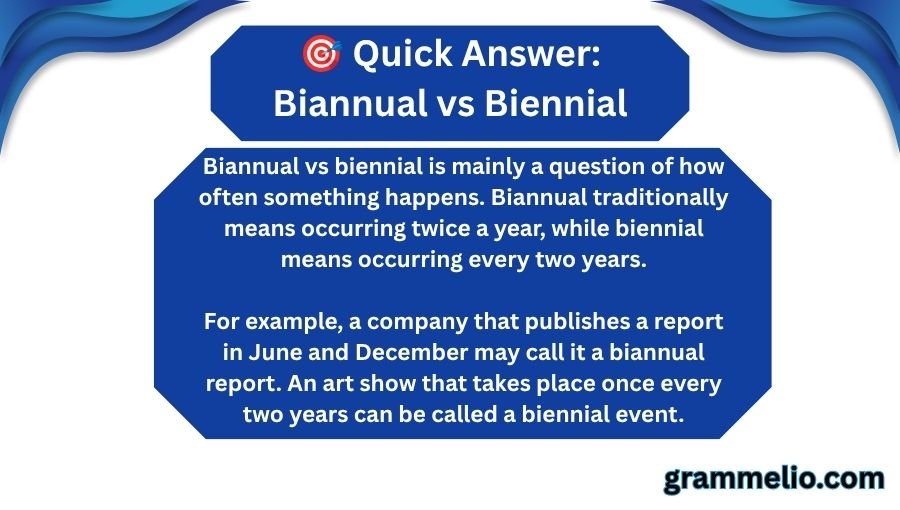
Biannual vs biennial is mainly a question of how often something happens. Biannual traditionally means occurring twice a year, while biennial means occurring every two years.
For example, a company that publishes a report in June and December may call it a biannual report. An art show that takes place once every two years can be called a biennial event.
| Word | Usual Meaning | Simple Memory Aid | Example |
|---|---|---|---|
| Biannual | Twice a year | Bi = two | The company issues biannual reports. |
| Biennial | Every two years | Biennial = two-year interval | The festival is biennial. |
| Semiannual | Twice a year | Semi = half-year | Employees receive semiannual reviews. |
| Every two years | Once in two years | Plain-language option | The event happens every two years. |
Because biannual can sometimes be interpreted differently by readers, clear phrases such as twice a year are often better when exact timing matters.
🔎 Understanding Biannual vs Biennial
The basic difference is simple: biannual generally describes something that happens twice each year, while biennial describes something that happens every two years.
The prefixes help, but they are not always enough to prevent confusion. The safest approach is to look at the entire schedule.
| Form | Type | Meaning | Example | Correct/Incorrect |
|---|---|---|---|---|
| Biannual | Adjective | Happening twice a year | We hold biannual meetings. | ✅ Correct |
| Biennial | Adjective | Happening every two years | The biennial conference returns next year. | ✅ Correct |
| Biannual | Adjective | Happening every two years | The biannual festival occurs once every two years. | ❌ Usually incorrect |
| Biennial | Adjective | Happening twice a year | We have biennial staff meetings in March and September. | ❌ Incorrect |
| Twice a year | Adverbial phrase | Two times each year | The newsletter is published twice a year. | ✅ Correct |
The key is frequency. If something happens two times within one year, biannual is the traditional choice. If it happens once during a two-year period, biennial is the better choice.
Biannual Meaning and Correct Use
Biannual is an adjective that traditionally means happening twice during one year.
For example:
- The school holds biannual parent meetings.
- The company publishes a biannual financial report.
- I receive biannual performance reviews.
Consider this sentence:
The organization holds biannual meetings in April and October.
The word biannual tells us that the organization holds the meetings two times during the year.
Biennial Meaning and Correct Use
Biennial is an adjective that normally means happening once every two years.
For example:
- The museum hosts a biennial art exhibition.
- The organization holds a biennial conference.
- The award is presented at a biennial ceremony.
If an event takes place in 2026 and then again in 2028, calling it biennial makes sense.
What Is the Difference Between Biannual and Biennial?
The most useful distinction is this:
Biannual = twice per year.
Biennial = once every two years.
That gives you an easy mental picture:
2026: January + July → biannual
2026: event → 2028 → biennial
| Meaning | Preferred Word | Example |
|---|---|---|
| Twice every year | Biannual | Biannual meetings occur in May and November. |
| Once every two years | Biennial | The biennial festival returns in 2028. |
| Two times per year | Biannual | The report is released biannually. |
| Every two years | Biennial | The award ceremony is biennial. |
🧠 Is Biannual the Same as Biennial?
No. Biannual and biennial are not normally interchangeable when you need to describe an exact schedule.
Biannual usually means twice a year. Biennial normally means every two years.
This distinction becomes especially important when a date depends on the word.
Imagine a notice that says:
“The next biennial meeting will be held in June.”
If the last meeting was in June 2026, readers would normally expect the next one in June 2028.
Now change the word:
“The next biannual meeting will be held in June.”
That suggests there are two meetings each year, although the sentence does not tell us the second month.
The difference may look small, but it can affect travel plans, budgets, deadlines, and attendance.
📅 When Should You Use Biannual?
Use biannual when you mean that something occurs two times within a year.
Common examples include:
- biannual reviews
- biannual meetings
- biannual reports
- biannual payments
- biannual newsletters
- biannual inspections
| Expression | Meaning | Example |
|---|---|---|
| Biannual report | Report issued twice a year | Our biannual report comes out in June and December. |
| Biannual meeting | Meeting held twice a year | The board has biannual meetings. |
| Biannual review | Review conducted twice a year | Employees receive biannual reviews. |
| Biannual inspection | Inspection done twice a year | The equipment gets a biannual inspection. |
| Biannual publication | Publication released twice a year | The journal produces a biannual issue. |
A Simple Test Tip 💡
Ask yourself:
“Will this happen two times in the same year?”
If the answer is yes, biannual is usually the right word.
For example:
Our team has biannual planning sessions in February and August.
Two sessions happen in one year. Therefore, biannual fits.
If you are worried that your reader may misunderstand the word, write twice a year instead.
That phrase is extremely clear.
🏛️ When Should You Use Biennial?
Use biennial when something happens once every two years.
Common examples include:
- biennial conference
- biennial exhibition
- biennial election
- biennial review
- biennial award
- biennial festival
| Expression | Meaning | Example |
|---|---|---|
| Biennial conference | Conference every two years | The biennial conference returns in 2028. |
| Biennial exhibition | Exhibition every two years | The museum’s biennial exhibition opens next summer. |
| Biennial award | Award given every two years | She won the biennial award. |
| Biennial festival | Festival held every two years | The biennial festival attracts visitors from many places. |
| Biennial review | Review occurring every two years | The policy receives a biennial review. |
A useful test is:
“Is there a two-year gap between events?”
If yes, biennial is generally the correct choice.
✍️ How Do Biannual and Biennial Work in Sentences?
Both words are adjectives. They normally describe nouns related to schedules, events, reports, meetings, or activities.
Examples With Biannual
The company conducts biannual safety checks.
Here, biannual describes safety checks. The checks happen twice each year.
I receive a biannual newsletter from the organization.
The newsletter is sent two times per year.
Examples With Biennial
The museum hosts a biennial photography exhibition.
The exhibition takes place every two years.
The committee conducts a biennial review of the policy.
The review occurs once every two years.
| Sentence | Word | Meaning |
|---|---|---|
| We have biannual meetings. | Biannual | Twice a year |
| The festival is biennial. | Biennial | Every two years |
| The company sends biannual updates. | Biannual | Twice a year |
| The award is biennial. | Biennial | Every two years |
| The school holds two reviews each year. | Neither needed | Plain wording |
📝 Case Study: A Schedule Confusion at Work
I once edited a workplace document that said, “The department will conduct a biennial review every June and December.” The sentence immediately caught my attention because the schedule contained two reviews in one year. The writer had intended to say biannual.
The corrected sentence was:
“The department will conduct a biannual review in June and December.”
That small edit made the schedule much clearer.
Here is another way to avoid the issue entirely:
“The department will conduct reviews twice a year, in June and December.”
For important business documents, I often prefer the second version because nobody has to stop and think about what the adjective means.
| Original Idea | Problem | Better Version |
|---|---|---|
| Review every June and December | Two times per year | Biannual review |
| Review in 2026 and 2028 | Two-year interval | Biennial review |
| Meeting twice per year | Possible ambiguity | Meeting twice a year |
| Festival every two years | Clear two-year interval | Biennial festival |
📚 Grammar Rules Explanation for Biannual vs Biennial
The grammar rule itself is straightforward. Both biannual and biennial function as adjectives. Their main difference is the schedule they describe.
A standard English reference can help confirm usage, but the practical rule is more useful than memorizing a dictionary entry.
Use biannual for something that occurs twice each year.
Use biennial for something that occurs every two years.
There is one important writing point: biannual can sometimes create uncertainty because some readers may not know whether the writer means twice a year or every two years. For that reason, professional writers often replace it with a clearer phrase such as twice a year.
The same idea applies to biennial. If your audience may not know the word, simply say every two years.
Correct vs Incorrect at a Glance
| Sentence | Correct/Incorrect | Why |
|---|---|---|
| The company holds biannual meetings in March and September. | ✅ Correct | The meetings happen twice a year. |
| The museum hosts a biennial exhibition. | ✅ Correct | The exhibition happens every two years. |
| The organization has a biennial meeting every six months. | ❌ Incorrect | Every six months means twice a year. |
| The festival is biannual and returns in 2028 after its 2026 event. | ❌ Usually incorrect | A two-year gap is normally biennial. |
| The school sends newsletters twice a year. | ✅ Correct | The meaning is clear without a confusing adjective. |
⚠️ Why Do People Confuse Biannual and Biennial?
People confuse these words because they share the beginning bi- and both relate to the number two.
The words also sound similar. When someone hears them quickly, the difference can be easy to miss.
I once caught myself rereading a calendar note because I had typed biennial when I meant biannual. The schedule had two meetings that year, so the word clearly needed to describe two events in one year. It was a good reminder that similar-looking words deserve a second check.
Other common reasons include:
- fast typing
- autocorrect
- lack of knowledge
- similar spelling
- similar pronunciation
- unclear workplace schedules
- assuming bi- always means the same thing
Here are some other English pairs that create similar problems:
| Confusing Pair | Difference |
|---|---|
| It’s / its | Contraction vs possessive |
| Your / you’re | Possessive vs contraction |
| Their / there / they’re | Possession, place, and contraction |
| Affect / effect | Usually verb vs noun |
| Then / than | Time/order vs comparison |
| Biannual / biennial | Twice yearly vs every two years |
Common Wrong Forms and Uses
| Wrong Form or Use | What’s Wrong | Correct Form |
|---|---|---|
| Biennial meetings held every six months | Six months means twice yearly | Biannual meetings |
| Biannual event held every two years | Two-year interval normally calls for biennial | Biennial event |
| Biennially twice a year | Confuses two-year timing with twice-yearly timing | Biannually or twice a year |
| Biannual = always every two years | Incorrect assumption | Usually twice a year |
| Biennial = twice a year | Incorrect meaning | Every two years |
| Bi-annual used when exact timing matters | Can create confusion | Twice a year |
🕰️ A Brief History of the Two Terms
The words have long been built around ideas related to two and years. Their modern use is mainly important because English speakers need to describe repeating schedules.
You do not need to memorize a detailed word history to use them correctly. The practical distinction matters more.
| Stage | Form | General Note |
|---|---|---|
| Earlier English usage | Biannual | Connected with something occurring twice in a year |
| Earlier English usage | Biennial | Connected with a two-year interval |
| Modern English | Biannual | Commonly understood as twice yearly |
| Modern English | Biennial | Commonly understood as every two years |
| Modern professional writing | Both | Clear scheduling language is often preferred |
🌎 Biannual vs Biennial in Different Contexts
The best choice depends on the schedule you are describing. The same rule works in everyday speech, professional writing, creative writing, and online communication.
| Context | Which Term to Use | Example |
|---|---|---|
| Everyday conversation | Biannual for twice yearly | We meet biannually for planning. |
| Professional writing | Biannual for twice yearly | The company publishes biannual reports. |
| Creative writing | Either, based on meaning | The town’s biennial festival drew visitors. |
| Social media/texting | Often use plain language | The event happens every two years. |
Everyday Conversation
In casual speech, clarity usually matters more than formal vocabulary.
Instead of saying:
“We meet biannually.”
You can say:
“We meet twice a year.”
That version is easy for everyone to understand.
Professional Writing
Business writing needs especially careful scheduling language.
If a report is released in January and July, write:
“The report is published twice a year.”
Or:
“The report is published biannually.”
If a report appears in 2026 and 2028, write:
“The report is published every two years.”
Or:
“The report is published biennially.”
Creative Writing
Writers can choose either word based on the voice of the text. A formal story might say:
“The village held a biennial celebration.”
A more conversational narrator might say:
“The village held its celebration every two years.”
Social Media and Texting
Shorter language often works better online.
Instead of:
“Our biennial event is returning.”
You might write:
“Our event returns every two years!”
That is especially useful for audiences who may not know the term.
💬 Common Phrases With Biannual and Biennial
These words often appear with nouns connected to events, schedules, reports, and reviews.
| Phrase | Meaning |
|---|---|
| Biannual meeting | Meeting held twice a year |
| Biannual report | Report issued twice a year |
| Biannual review | Review completed twice a year |
| Biennial conference | Conference held every two years |
| Biennial exhibition | Exhibition held every two years |
| Biennial festival | Festival held every two years |
There are no special idioms that you need to memorize. The main skill is matching the word to the schedule.
🔄 Synonyms and Clear Alternatives
Sometimes the best way to avoid confusion is to replace the adjective with a simple phrase.
| Alternative | Works When | Does Not Work When |
|---|---|---|
| Twice a year | You mean two times yearly | You mean every two years |
| Every six months | Events occur about six months apart | The schedule is irregular |
| Every two years | You mean a two-year interval | You mean twice each year |
| Twice yearly | You need a clear formal phrase | You want to describe a two-year cycle |
| Every other year | You mean one event every two years | You mean two events per year |
Why “Twice a Year” Is Often Best
If a deadline, payment, meeting, or report matters, plain language can prevent mistakes.
Compare:
“The review is biannual.”
with:
“The review occurs twice a year, in April and October.”
The second sentence gives the reader exact information.
Similarly:
“The festival is biennial.”
is clear to many readers, but:
“The festival takes place every two years.”
leaves little room for confusion.
💼 Why Does Getting This Difference Right Matter?
Getting biannual vs biennial right matters because frequency words affect real information. A single word can tell a reader whether an event occurs twice in one year or once across two years.
In work settings, that difference can affect planning and deadlines.
In education, it can affect the meaning of an assignment.
In marketing, it can affect event promotion.
In personal communication, it can prevent someone from showing up at the wrong time.
A useful writing principle is:
Clear words make clear plans.
| Situation | Why Getting It Right Matters |
|---|---|
| Resume or professional profile | Shows strong command of English |
| Client email | Prevents scheduling confusion |
| Published content | Improves accuracy and trust |
| Social post | Helps readers understand event timing |
🧩 How to Remember the Difference
A simple memory trick can make this much easier.
Think:
BIannual → twice a year.
The word biannual contains bi, which can remind you of two yearly events.
For biennial, focus on the part that sounds like annual but includes the idea of a longer two-year cycle.
Another trick is to visualize a calendar.
Biannual
Imagine one calendar year:
Spring → meeting → Fall → meeting
Two events happen before the year ends.
Biennial
Imagine:
2026 → event
Then:
2027 → no event
Then:
2028 → event
That is a two-year pattern.
| Calendar Pattern | Correct Word |
|---|---|
| January + July | Biannual |
| March + September | Biannual |
| 2026 + 2028 | Biennial |
| 2027 + 2029 | Biennial |
| Every six months | Biannual |
| Every two years | Biennial |
🎯 A Fast Test for Biannual vs Biennial
When you are unsure, ask one question:
“How long is the gap between events?”
If the answer is roughly six months, biannual is usually right.
If the answer is two years, biennial is right.
Here is the fastest version:
Two times per year → biannual
One time every two years → biennial
If the sentence still feels unclear, use the plain phrase instead.
| Question | If Yes → Use |
|---|---|
| Does it happen twice in one year? | Biannual |
| Does it happen every two years? | Biennial |
| Could readers misunderstand the schedule? | Use a plain phrase |
| Do I mean two events six months apart? | Biannual |
| Do I mean one event with a two-year gap? | Biennial |
Practice Examples
- The company reviews its safety rules every six months.
→ Biannual review ✅ - The international art show returns every two years.
→ Biennial exhibition ✅ - The team meets in January and July.
→ Biannual meetings ✅
⚠️ Special Note About Ambiguity
One reason careful writers sometimes avoid biannual is that readers may interpret it differently.
Although the traditional intended meaning is twice a year, some people may not be certain about the word.
This is why phrases such as twice a year and every two years are excellent choices in contracts, schedules, public notices, and other documents where misunderstanding could cause problems.
For example:
“Payments are made twice a year.”
is clearer than:
“Payments are biannual.”
Likewise:
“The conference occurs every two years.”
is immediately clear.
You do not always need the shortest word. You need the clearest wording.
📋 Quick Recap Checklist
| Question | If Yes → Use |
|---|---|
| Does it happen two times during one year? | Biannual |
| Does it happen once every two years? | Biennial |
| Do you want maximum clarity? | Twice a year |
| Is there a two-year gap between events? | Biennial |
| Are there two scheduled events in one year? | Biannual |
| Could the reader misunderstand the schedule? | Use exact dates or plain language |
❓ FAQs About Biannual vs Biennial
Is biannual twice a year?
Yes. Biannual traditionally means happening twice a year. For maximum clarity, you can also say twice a year.
Does biennial mean every two years?
Yes. Biennial normally means something happens once every two years.
Is biannual the same as semiannual?
In common usage, both terms are generally used to describe something that happens twice a year. Semiannual is often clearer when you want to avoid any possible confusion.
Is biennial the same as every other year?
Yes, when every other year means one occurrence followed by a one-year break, then another occurrence. For example, an event held in 2026 and 2028 can be described as biennial.
Which is correct: biannual meeting or biennial meeting?
It depends on the schedule. Use biannual meeting if the meeting occurs twice each year. Use biennial meeting if it occurs once every two years.
Is “biannually” a real word?
Yes. Biannually is the adverb form used to describe an action that occurs twice a year. However, twice a year is often clearer.
Is “biennially” a real word?
Yes. Biennially is the adverb form of biennial. It means every two years.
How can I remember biannual vs biennial?
Remember the basic schedule: biannual = twice a year, while biennial = every two years. A calendar is an easy way to picture the difference.
Which word should I use in a business email?
Use the word that matches the actual schedule. If there is any chance of confusion, give the exact timing. For example, write “twice a year, in March and September” instead of relying only on biannual.
Can I avoid using both words?
Absolutely. If you want the clearest possible writing, use twice a year for two occurrences each year and every two years for a two-year interval. These phrases are simple and direct.
🏁 Conclusion
Biannual vs biennial becomes much easier when you focus on the schedule rather than the spelling. Biannual generally means something happens twice during a year. Biennial means something happens once every two years. That is the core rule to remember. ✅
When you are writing a casual message, either word can work if your audience knows what it means. In professional writing, however, clarity should come first. If there is any doubt, say twice a year or every two years. Those phrases make your meaning immediately clear. ✨
I recommend using a simple calendar test whenever you hesitate. If you can place two events inside the same year, think biannual. If you need to move from one year to another and then skip a year before the next event, think biennial.
Once you connect each word with its schedule, this common English confusion becomes much easier to avoid. Two times in one year means biannual; one time every two years means biennial.



[…] uses so you can tell these words apart quickly. Let’s make this confusing pair simple. 👍 Biannual vs Biennial | Weary vs Wary | Weak vs […]
[…] behind these words, you will have a much easier time choosing the correct one. Casual vs Causal | Biannual vs Biennial | Weary vs […]