Have you ever written a sentence and stopped because you could not decide between weary vs wary? I see this mix-up often, even in otherwise strong writing. The two words look and sound somewhat alike, but they describe very different ideas.
Weary usually means tired, worn out, or exhausted, while wary means careful because you sense possible trouble or danger. 😅
Once you understand the simple idea behind each word, the choice becomes much easier. In this guide, I will show you how to use both words correctly in everyday speech, school writing, work emails, social posts, and creative writing.
I will also share simple memory tricks, examples, common mistakes, and practice questions. By the end, you should feel confident whenever you face weary vs wary in your writing. ✍️ Weak vs Week | Ware vs Wear vs Where | Waive vs Wave
🎯 Quick Answer: Weary vs Wary
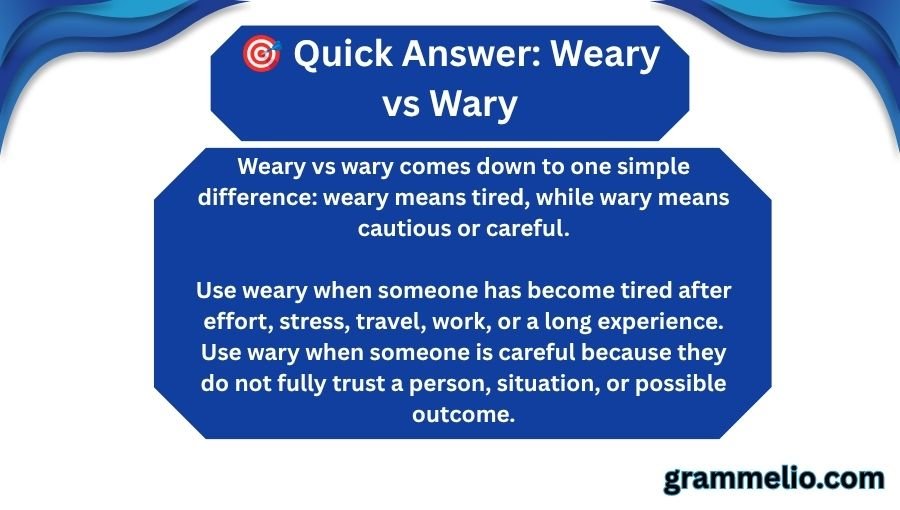
Weary vs wary comes down to one simple difference: weary means tired, while wary means cautious or careful.
Use weary when someone has become tired after effort, stress, travel, work, or a long experience. Use wary when someone is careful because they do not fully trust a person, situation, or possible outcome.
- Weary = tired
- Wary = cautious
Example:
“I was weary after walking ten miles.”
“She was wary of the stranger.”
The first person is tired. The second person is being careful.
What Do Weary and Wary Mean?
The easiest way to understand these words is to connect each one with a different feeling.
Weary describes a lack of energy. A person may be physically tired, mentally tired, or emotionally worn down.
Wary describes caution. A person who is wary has noticed something that makes them careful or suspicious.
Here is the basic difference:
| Word | Type | Meaning | Example | Correct/Incorrect |
|---|---|---|---|---|
| Weary | Adjective | Tired or worn out | I felt weary after the long trip. | ✅ Correct |
| Wary | Adjective | Careful or cautious | I was wary of the unfamiliar website. | ✅ Correct |
| Weary | Adjective | Cautious | I was weary of the stranger. | ❌ Incorrect for this meaning |
| Wary | Adjective | Tired | I was wary after working all day. | ❌ Incorrect for this meaning |
A quick mental picture can help.
Imagine a runner who has just finished a very long race. That runner may be weary.
Now imagine the same runner sees an unknown person approaching with a strange request. The runner may become wary.
One word deals with tiredness. The other deals with caution.
🧠 Weary: Meaning and Correct Use
Weary means tired, especially after a long period of work, effort, travel, stress, or difficulty.
It is an adjective.
You can use it to describe a person, group, or sometimes a person’s attitude or condition.
Weary Means Physically Tired
The most common use of weary is to describe physical tiredness.
For example:
After hiking all afternoon, we were weary.
The people in this sentence have used a lot of physical energy. They need rest.
More examples:
- After the long flight, I felt weary.
- The weary hikers finally reached the cabin.
- She looked weary after cleaning the entire house.
- The workers were weary after a twelve-hour shift.
Weary Can Also Mean Mentally or Emotionally Tired
You do not always need physical exercise to become weary.
A person can become weary because of stress, repeated problems, or a difficult situation.
For example:
He became weary of arguing about the same problem.
Here, weary means emotionally or mentally tired.
Another example:
I grew weary of hearing the same complaint every day.
The speaker is not necessarily physically exhausted. The repeated complaint has made the speaker tired of the situation.
Weary Can Mean Tired of Something
The pattern weary of is especially useful.
Examples:
- She became weary of waiting.
- They were weary of the constant delays.
- I grew weary of making the same mistake.
- He was weary of the endless debate.
The phrase weary of means that something has become tiring or frustrating over time.
💡 Test Tip
When you see weary, replace it with tired.
If the sentence still makes sense, weary may be the correct choice.
“I was weary after the journey.”
Replace the word:
“I was tired after the journey.”
The meaning stays clear.
That is your first quick test.
🛡️ Wary: Meaning and Correct Use
Wary means careful because you think something may be dangerous, dishonest, risky, or unreliable.
It is also an adjective.
A wary person does not necessarily feel tired. Instead, that person is paying attention and avoiding unnecessary risk.
For example:
She was wary of the man offering her a suspicious deal.
She is not saying that she is tired. She is saying that she does not trust the situation.
Wary of People
You can be wary of a person when you do not completely trust that person.
Examples:
- I am wary of strangers who ask for personal information.
- The dog was wary of the new visitor.
- She was wary of his sudden offer.
- He remained wary of the salesperson.
Wary of Situations
You can also be wary of a situation.
Examples:
- We were wary of driving during the storm.
- I am wary of making a decision without more information.
- The team was wary of the sudden change.
- She was wary of the risky plan.
Wary Can Show Healthy Caution
Being wary is not always negative.
Sometimes caution is smart.
For example:
I am wary of clicking links from unknown senders.
That person is being careful. There may be a security risk.
You can also say:
Parents may be wary of unfamiliar websites.
Again, the idea is caution, not tiredness.
💡 Test Tip
When you see wary, replace it with careful or cautious.
“She was wary of the offer.”
Try:
“She was cautious about the offer.”
The basic meaning remains.
That tells you wary is probably correct.
📊 Key Differences Between Weary and Wary
The central difference between the two words is easy to remember once you focus on the feelings they describe.
| Feature | Weary | Wary |
|---|---|---|
| Main meaning | Tired | Cautious |
| Main feeling | Lack of energy | Concern or suspicion |
| Common pattern | Weary after work | Wary of danger |
| Can describe mental state? | Yes | Yes, but as caution |
| Can describe physical tiredness? | Yes | No |
| Common synonym | Tired | Careful |
| Opposite idea | Energetic or refreshed | Trusting or unconcerned |
| Example | She was weary after traveling. | She was wary of the stranger. |
A useful shortcut is:
Weary → energy is low.
Wary → trust is low.
That one distinction can solve most weary vs wary questions.
Is Weary the Same as Wary?
No. Weary and wary are not interchangeable.
Weary describes tiredness. Wary describes caution or suspicion.
Consider these sentences:
I was weary after the marathon.
The person needs rest.
I was wary of the person standing near my car.
The person is being careful.
The words may look similar, but the situations are completely different.
| Sentence | Meaning | Correct/Incorrect |
|---|---|---|
| I was weary after the marathon. | I was tired. | ✅ Correct |
| I was wary of the suspicious email. | I was cautious. | ✅ Correct |
| I was weary of the suspicious email. | I was cautious. | ❌ Incorrect |
| I was wary after the marathon. | I was tired. | ❌ Incorrect |
| She was weary from working all night. | She was tired. | ✅ Correct |
Why Do People Confuse Weary and Wary?
People confuse these words mainly because they have similar spellings and similar sounds.
Both begin with w. Both are short adjectives. Both are often used to describe a person’s reaction to something.
There is another reason. The phrase weary of can sometimes appear near situations where someone has lost patience or trust.
For example:
I am weary of dishonest sales tactics.
The speaker is tired of dealing with them.
Compare:
I am wary of dishonest sales tactics.
The speaker is cautious about them.
The difference is small in appearance but large in meaning.
I once edited a short workplace note where a writer used weary when they meant wary. The sentence described employees being careful around an unreliable process. Once I changed the word to wary, the meaning became immediately clear.
📝 Case Study: A Workplace Email
Imagine that a manager writes:
“Our team is weary of accepting large orders from new suppliers.”
This could mean the team is tired of dealing with those orders.
But suppose the manager actually means that the team does not trust new suppliers.
In that case, the better sentence is:
“Our team is wary of accepting large orders from new suppliers.”
The second version tells the reader that the team is cautious.
Here is the difference:
| Workplace Sentence | Intended Meaning | Best Word |
|---|---|---|
| The team is tired after working late. | Lack of energy | Weary |
| The team is cautious about the new supplier. | Concern | Wary |
| The staff is tired of repeated delays. | Frustration | Weary |
| The staff is cautious about the contract. | Concern about risk | Wary |
This example shows why word choice matters in professional writing. A single letter can change the message.
Grammar Rules Explanation: Weary vs Wary
Both weary and wary are adjectives. The key grammar issue is not their part of speech. It is their meaning.
Use weary when the adjective describes tiredness or being worn down.
Use wary when the adjective describes caution, concern, or distrust.
The common structures are also helpful.
Common Structures With Weary
- be weary
- feel weary
- grow weary
- become weary
- be weary of something
Examples:
She felt weary after the trip.
He grew weary of the repeated questions.
Common Structures With Wary
- be wary
- remain wary
- become wary
- be wary of something
- be wary of someone
Examples:
She remained wary of the offer.
We should be wary of unknown sources.
Most standard English reference sources agree on this core distinction: weary relates to tiredness, while wary relates to caution.
Correct vs Incorrect at a Glance
| Sentence | Correct/Incorrect | Why |
|---|---|---|
| I felt weary after the long walk. | ✅ Correct | The person is tired. |
| She was wary of the unknown caller. | ✅ Correct | She was cautious. |
| They were weary of the dangerous-looking stranger. | ❌ Incorrect for caution | Wary is needed for caution. |
| He was wary after running ten miles. | ❌ Incorrect for tiredness | Weary is needed for tiredness. |
| We grew weary of the endless meetings. | ✅ Correct | The meetings became tiring or frustrating. |
⚠️ Common Mistakes With Weary and Wary
These mistakes happen for several simple reasons.
Fast Typing
When people type quickly, they may remember the general shape of the word but not its meaning.
Autocorrect
Autocorrect can sometimes encourage a nearby spelling without checking the intended meaning.
Lack of Knowledge
Some writers have seen both words but have never learned the difference clearly.
I once caught myself typing wary when I meant weary in a quick note after a long day. I was thinking about being tired, but my fingers chose the wrong word. A quick reread fixed it.
Similar Grammar Confusions
| Confusing Pair | First Word | Second Word |
|---|---|---|
| Weary / Wary | Tired | Cautious |
| Its / It’s | Possessive | It is |
| Your / You’re | Possessive | You are |
| Their / There / They’re | Possessive / Place / They are | Different uses |
| Affect / Effect | Usually verb | Usually noun |
| Then / Than | Time or sequence | Comparison |
Learning these pairs is useful because small spelling differences can carry large meaning changes.
Specific Wrong Uses
| Wrong Form or Use | What’s Wrong | Correct Form |
|---|---|---|
| I am wary after a long day. | Wary does not mean tired. | I am weary after a long day. |
| She was weary of the suspicious stranger. | The intended meaning is caution. | She was wary of the suspicious stranger. |
| He is weary about the risky deal. | If the meaning is cautious, use wary. | He is wary of the risky deal. |
| We were wary from the exhausting hike. | The intended meaning is tired. | We were weary from the exhausting hike. |
| I feel wary after working twelve hours. | The intended meaning is exhaustion. | I feel weary after working twelve hours. |
| They became weary of the repeated delays. | This is actually correct when meaning tired/frustrated. | They became weary of the repeated delays. |
📚 Weary vs Wary in Different Contexts
The right word depends on what you are trying to communicate.
Everyday Conversation
Use weary for tiredness and wary for caution.
“I am weary after shopping all afternoon.”
“I am wary of buying from that seller.”
Professional Writing
Professional writing needs extra care because the wrong word can change the meaning of a message.
“The staff became weary after several hours of overtime.”
“The staff was wary of the proposed change.”
Creative Writing
Writers can use both words to describe characters.
The weary traveler sat beside the fire.
The wary traveler watched the dark road.
These sentences create completely different pictures.
Social Media and Texting
Informal writing still benefits from correct word choice.
“I am so weary after that workout.”
“I am wary of this deal. Something feels wrong.”
| Context | Which Term to Use | Example |
|---|---|---|
| Everyday conversation | Weary for tiredness | I am weary after work. |
| Everyday conversation | Wary for caution | I am wary of that offer. |
| Professional writing | Weary for exhaustion | The staff was weary after overtime. |
| Professional writing | Wary for concern | The staff was wary of the proposal. |
| Creative writing | Either, depending on meaning | The weary traveler met a wary guard. |
| Social media/texting | Either, depending on meaning | I am weary today. / I am wary of that link. |
What Is the Difference Between Weary of and Wary of?
This is one of the most useful patterns to learn.
Weary of means tired of something or no longer interested in dealing with it.
Wary of means cautious about something or someone.
Compare:
I am weary of these arguments.
This means the arguments have become tiring.
I am wary of these arguments.
This means the speaker does not fully trust or feel comfortable with the arguments.
The phrase after of does not automatically tell you which word to choose. You must look at the intended meaning.
| Phrase | Meaning | Example |
|---|---|---|
| Weary of work | Tired of work | She is weary of the same routine. |
| Weary of waiting | Tired or frustrated by waiting | I am weary of waiting. |
| Wary of a person | Cautious about the person | He is wary of the stranger. |
| Wary of a deal | Cautious about the deal | She is wary of the offer. |
| Wary of risk | Careful about risk | Investors may be wary of unnecessary risk. |
How Can You Remember the Difference?
A simple memory trick can make weary vs wary much easier.
Think:
WEARY = WEAK ENERGY
The word weary has an e. Think of energy.
When your energy is low, you are weary.
Now think:
WARY = WATCHFUL
Both ideas begin with the sound of w. A wary person watches carefully.
So:
- Weary → energy is low
- Wary → watch carefully
Another trick is to remember these pairs:
Weary = tired
Wary = careful
If you memorize only those two matching words, you will solve most usage questions.
Common Phrases With Weary and Wary
Both words appear in useful everyday phrases.
| Phrase | Meaning |
|---|---|
| Weary traveler | A traveler who is tired |
| Weary eyes | Eyes that look tired |
| Weary of waiting | Tired or frustrated by waiting |
| Grow weary | Become tired |
| Wary of strangers | Careful around strangers |
| Wary of risk | Careful about possible danger |
Some expressions are especially common because they naturally describe tiredness or caution.
For example:
After years of the same problem, she grew weary of the situation.
And:
Because of previous scams, he was wary of unusual offers.
Synonyms and Alternatives
Synonyms can help you understand the difference, but they do not always work in every sentence.
| Alternative | Works When | Does Not Work When |
|---|---|---|
| Tired | You mean low energy | You mean caution |
| Exhausted | You mean very tired | You mean suspicion |
| Worn out | You mean physically or mentally tired | You mean careful |
| Cautious | You mean careful | You mean tired |
| Careful | You mean avoiding risk | You mean exhaustion |
For example, you can say:
I was weary after the trip.
Or:
I was exhausted after the trip.
The meaning is close.
But you cannot replace wary with tired:
I was wary of the stranger.
This means:
I was cautious about the stranger.
It does not mean:
I was tired of the stranger.
Why Does Getting Weary vs Wary Right Matter?
Correct word choice improves clarity.
When you choose weary, readers understand that someone is tired or worn down.
When you choose wary, readers understand that someone is cautious or concerned.
That distinction matters in school, work, business, and online communication.
“Clear writing helps readers understand your exact meaning.”
A simple word choice can prevent confusion.
| Situation | Why Getting It Right Matters |
|---|---|
| Resume | Shows strong vocabulary and careful editing |
| Client email | Prevents confusion about risks or concerns |
| Published content | Improves accuracy and reader trust |
| Social post | Makes your intended message clear |
A sentence about a tired employee should not accidentally sound like a warning about that employee.
Likewise, a sentence about a risky situation should not accidentally suggest that someone is simply tired.
Can Weary and Wary Be Used in the Same Sentence?
Yes. In fact, using them together can make the contrast very clear.
For example:
The weary traveler became wary when a stranger approached.
Here, the traveler is tired and cautious.
Another example:
The weary workers were wary of the sudden change in schedule.
The workers are tired, and they are also concerned about the change.
| Sentence | Weary Meaning | Wary Meaning |
|---|---|---|
| The weary guard became wary of the stranger. | The guard was tired. | The guard became cautious. |
| The weary hikers were wary of the dark path. | The hikers were tired. | They were cautious about the path. |
| The weary team was wary of another delay. | The team was frustrated or tired. | The team was concerned about another delay. |
This is a great way to see that the words describe two different states.
When Should You Use Weary in a Sentence?
Use weary when you can reasonably answer yes to one of these questions:
- Is the person tired?
- Has the person used a lot of energy?
- Has something become mentally tiring?
- Has someone become frustrated after repeated experiences?
- Does the person need rest?
Examples:
After the hike, I was weary.
She became weary of the constant noise.
The weary workers sat down for lunch.
If the answer is yes, weary is probably your word.
When Should You Use Wary in a Sentence?
Use wary when you can answer yes to questions like these:
- Is the person being careful?
- Does the person sense possible danger?
- Does the person distrust something?
- Is the person unsure about a situation?
- Is the person trying to avoid a possible problem?
Examples:
I am wary of unknown websites.
She was wary of the stranger.
They remained wary of the sudden offer.
If caution is the main idea, choose wary.
🔍 Quick Recap Checklist
Use this checklist whenever you are unsure.
| Question | If Yes → Use |
|---|---|
| Does the sentence mean tired? | Weary |
| Does it mean exhausted? | Weary |
| Does it mean tired of something? | Weary |
| Does it mean careful? | Wary |
| Does it mean suspicious? | Wary |
| Does it involve possible danger? | Wary |
| Can you replace the word with “tired”? | Weary |
| Can you replace the word with “cautious”? | Wary |
Practice Examples
- After studying all night, Maya felt weary.
- Maya was wary of the unfamiliar website.
- The workers grew weary of repeated delays.
Try covering the answers and choosing the word yourself.
Practice: Choose Weary or Wary
Example 1
After walking for eight hours, the hikers were ______.
Answer: weary
They were tired.
Example 2
The hikers were ______ of the unstable bridge.
Answer: wary
They were cautious because the bridge could be dangerous.
Example 3
I grew ______ of hearing the same excuse.
Answer: weary
The repeated excuse became tiring or frustrating.
Example 4
I was ______ of the stranger who kept following me.
Answer: wary
I was cautious because the stranger seemed potentially dangerous.
Example 5
After several hours of work, the team looked ______.
Answer: weary
The team looked tired.
Are Weary and Wary Pronounced the Same Way?
No. They are different words with different meanings and different pronunciations.
However, their similar spelling and sound can make them easy to mix up, especially when typing quickly or writing from memory.
For learners, meaning is usually the best tool for choosing the correct word.
Ask yourself:
Am I talking about tiredness or caution?
That question is more useful than trying to rely only on how the words sound.
Can Weary Describe Emotions?
Yes. Weary can describe emotional or mental tiredness.
For example:
She was weary from dealing with the same problem every day.
This does not necessarily mean she had physically worked hard. The repeated problem made her mentally or emotionally tired.
Similarly:
He grew weary of constant criticism.
The criticism became tiring and frustrating.
By contrast, wary describes a careful attitude.
He was wary of accepting criticism from someone he did not know.
Here, he is cautious about the source of the criticism.
Can Wary Describe a Positive Situation?
Yes, depending on the context.
Being wary simply means being cautious. Caution can be useful even when a situation is not clearly bad.
For example:
I am wary of making a major decision without enough information.
The speaker is not necessarily saying the decision is bad. The speaker wants to be careful.
This is why wary is often useful in professional and academic writing.
FAQs About Weary vs Wary
What is the simple difference between weary and wary?
Weary means tired or worn out. Wary means cautious or careful. If someone needs rest, use weary. If someone needs to be careful because of possible danger or risk, use wary.
Is it weary of or wary of?
Both are correct, but they have different meanings. Weary of means tired of or frustrated by something. Wary of means cautious about someone or something.
Does weary mean cautious?
No. Weary normally means tired, exhausted, or worn down. For caution, use wary.
Does wary mean tired?
No. Wary means careful, cautious, or suspicious. For tiredness, use weary.
What is an easy way to remember weary?
Connect weary with tired. You can also think of your energy being low. When you have little energy, you may feel weary.
What is an easy way to remember wary?
Connect wary with watchful or cautious. A wary person watches carefully because something may be wrong.
Can weary and wary be used together?
Yes. For example: “The weary traveler became wary of the stranger.” The traveler is tired and cautious at the same time.
Is “I am weary of strangers” correct?
It can be grammatically correct, but the meaning is different from “I am wary of strangers.” Weary of strangers suggests being tired of dealing with strangers. Wary of strangers means being cautious around them.
Is “I am wary after work” correct?
It is correct only if you mean you are cautious or concerned after work. If you mean you are tired after work, say, “I am weary after work.”
Which word should I use in formal writing?
Use whichever word matches your intended meaning. Weary is appropriate for tiredness or frustration, while wary is appropriate for caution or concern. Accuracy matters more than choosing one word simply because it sounds more formal.
Final Comparison: Weary vs Wary
| Point | Weary | Wary |
|---|---|---|
| Meaning | Tired or worn out | Careful or cautious |
| Main idea | Low energy | Low trust or concern |
| Common phrase | Weary of waiting | Wary of strangers |
| Typical cause | Work, travel, stress, repetition | Risk, danger, uncertainty |
| Easy synonym | Tired | Cautious |
| Example | I felt weary after work. | I was wary of the offer. |
🏁 Conclusion
Weary vs wary becomes much easier when you remember one simple rule: weary means tired, while wary means cautious. If someone has used a lot of energy, spent too long dealing with a problem, or feels worn out, choose weary. If someone does not fully trust a person or situation and wants to be careful, choose wary. 😊
I recommend using the substitution test whenever you hesitate. Replace weary with “tired.” Replace wary with “cautious.” If the sentence keeps the same meaning, you have probably chosen the right word.
Remember the shortcut: weary = low energy; wary = careful attention. Once that connection becomes familiar, these two words should no longer cause trouble in your emails, essays, conversations, or social posts. Keep your writing clear, choose the word that matches your meaning, and you will avoid one of English’s most common word-choice mix-ups. ✨


[…] confuse them, and give you simple tricks for remembering which word belongs in each sentence. Weary vs Wary | Weak vs Week | Ware vs Wear vs […]
[…] these words apart quickly. Let’s make this confusing pair simple. 👍 Biannual vs Biennial | Weary vs Wary | Weak vs […]