Have you ever written a wedding invitation, text, or social media post and suddenly stopped at the words fiancé vs fiancée? 💍 I have seen this small spelling choice confuse students, writers, and even careful editors because the two words look almost identical and sound very similar in everyday English.
The difference is actually simple once you know what the final -e means. One spelling traditionally refers to an engaged man, while the other refers to an engaged woman. I like to teach this pair with a quick visual trick because it makes the difference easy to remember.
In this guide, I’ll show you how to use each word correctly, explain the grammar behind the spellings, and give you plenty of examples you can use in real life. By the end, fiancé vs fiancée should feel much easier. 😊 Farther vs Father | Extant vs Extent | Exercise vs Exorcise
🎯 Quick Answer: Fiancé vs Fiancée
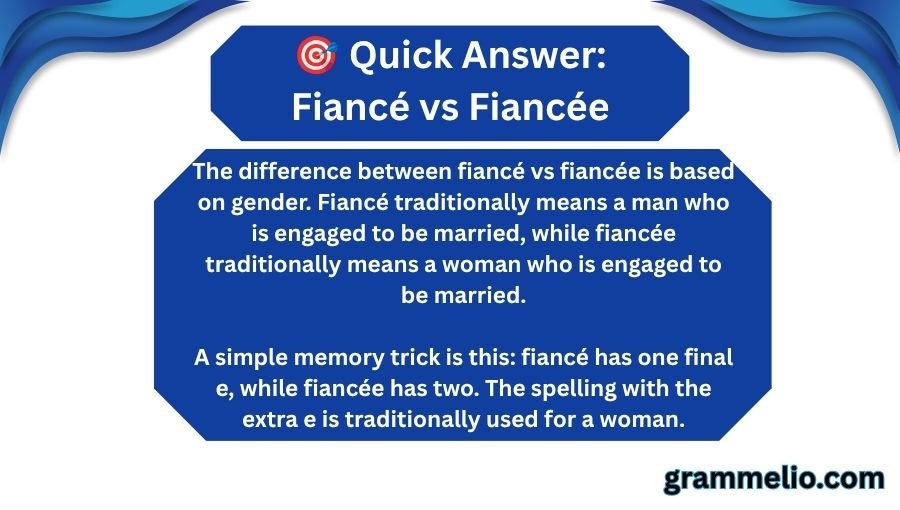
The difference between fiancé vs fiancée is based on gender. Fiancé traditionally means a man who is engaged to be married, while fiancée traditionally means a woman who is engaged to be married.
A simple memory trick is this: fiancé has one final e, while fiancée has two. The spelling with the extra e is traditionally used for a woman.
| Word | Traditional Use | Example |
|---|---|---|
| fiancé | An engaged man | Her fiancé proposed last spring. |
| fiancée | An engaged woman | His fiancée is planning the wedding. |
When comparing fiancé vs fiancée, it also helps to understand the related plural and possessive forms.
These words have a few useful forms, although the two main spellings are the ones that cause most confusion.
| Form | Type | Example |
|---|---|---|
| fiancé | Noun | My fiancé loves hiking. |
| fiancée | Noun | My fiancée loves hiking. |
| fiancés | Plural noun | The two fiancés arrived together. |
| fiancées | Plural noun | The two fiancées compared wedding plans. |
| fiancé’s | Possessive noun | My fiancé’s parents visited us. |
| fiancée’s | Possessive noun | My fiancée’s dress is beautiful. |
The plural forms follow the same spelling distinction. Fiancés traditionally refers to engaged men or a mixed group when the gender is not being separately marked. Fiancées traditionally refers to engaged women.
The possessive forms simply add an apostrophe and s. For example, “my fiancée’s ring” means the ring belonging to my fiancée.
Understanding the Basics of Fiancé vs Fiancée
The main difference is the traditional gender distinction. Fiancé is used for an engaged man, and fiancée is used for an engaged woman.
This distinction comes from French, where masculine and feminine forms are marked differently. English borrowed both spellings and has traditionally kept that distinction in writing.
| Form | Type | Meaning | Example | Correct/Incorrect |
|---|---|---|---|---|
| fiancé | Noun | Engaged man | Her fiancé is named Daniel. | ✅ Correct |
| fiancée | Noun | Engaged woman | His fiancée is named Maya. | ✅ Correct |
| fiancé | Noun | Engaged woman | His fiancé is named Maya. | ⚠️ Traditionally incorrect |
| fiancée | Noun | Engaged man | Her fiancée is named Daniel. | ⚠️ Traditionally incorrect |
| engaged | Adjective | Promised to marry | They are engaged. | ✅ Correct |
The key is not the meaning of “engaged.” Both words describe people who are engaged to be married. The spelling tells you which traditional gender form is intended.
Fiancé: The Traditional Masculine Form
Fiancé traditionally means a man who is engaged to be married.
For example:
Maria introduced her fiancé at dinner.
Here, fiancé refers to the man Maria plans to marry.
Another example:
My fiancé and I booked our venue yesterday.
The speaker is traditionally a woman referring to the man she is engaged to. However, the word itself simply identifies the engaged man.
Fiancée: The Traditional Feminine Form
Fiancée traditionally means a woman who is engaged to be married.
For example:
James introduced his fiancée to his coworkers.
Here, fiancée refers to the woman James plans to marry.
You could also write:
My fiancée and I are getting married in June.
The extra final e is the visual clue that traditionally marks the feminine form.
The Fastest Way to Remember the Difference
I teach this with a very simple rule:
One final E = fiancé.
Two final Es = fiancée.
Think of the second e in fiancée as an extra letter that marks the traditionally feminine form.
| Memory Clue | Word | Meaning |
|---|---|---|
| One final E | fiancé | Engaged man |
| Two final Es | fiancée | Engaged woman |
| No gender distinction | engaged person | Person who plans to marry |
This trick is not a grammar rule by itself. It is simply a memory aid. But it works well when you need to choose quickly.
💡 What Is the Difference Between Fiancé and Fiancée?
The difference between fiancé vs fiancée is traditionally the gender of the engaged person. Fiancé refers to an engaged man, and fiancée refers to an engaged woman.
The words are pronounced very similarly in many varieties of English, which is one reason the spelling can be confusing. When speaking, context usually makes the meaning clear. When writing, the spelling becomes more important.
Consider these examples:
Her fiancé sent the invitations.
The engaged person is a man.
His fiancée sent the invitations.
The engaged person is a woman.
The sentence structure is almost identical. Only the spelling changes.
🧠 Test Tip
When you are unsure, ask yourself:
“Am I talking about an engaged man or an engaged woman?”
- Engaged man → fiancé
- Engaged woman → fiancée
If you do not want to identify the person’s gender, you can simply say fiancé/fiancée only when the intended spelling is known, or use a neutral phrase such as partner, future spouse, or person they are engaged to.
Understanding fiancé vs fiancée becomes easier when you look at how each word works in real sentences.
Although these words are closely connected, their traditional uses are clear.
| Meaning | Word Type | Example Sentence |
|---|---|---|
| Engaged man | Noun | Her fiancé ordered the flowers. |
| Engaged woman | Noun | His fiancée chose the invitations. |
| Person who is engaged | Noun phrase | Their future spouse will attend. |
| State of planning marriage | Adjective phrase | They are engaged. |
Talking About Relationships
The most common use is in everyday relationship conversations.
My fiancé works downtown.
My fiancée works downtown.
The correct form depends on the person being described.
Talking About Weddings
Wedding planning creates many chances to use these words.
My fiancé picked the music.
My fiancée picked the flowers.
Both sentences are grammatically correct when the traditional gender meanings match the person being described.
Talking About Family
You may also use these words when introducing an engaged partner to relatives.
I would like you to meet my fiancé.
I would like you to meet my fiancée.
The word is a noun, so it can appear after possessive words such as my, his, or her.
📝 Case Study: A Wedding Invitation Mix-Up
I once edited a short wedding announcement in which the writer had switched the two spellings. The announcement said that the bride was excited to marry her “fiancée,” but the intended word was fiancé, because the bride was talking about her male partner.
Nothing about the sentence made the meaning impossible to understand. Readers could still tell what the writer meant. But the spelling error stood out because wedding announcements are formal, personal pieces of writing.
A corrected version was:
Sarah is excited to marry her fiancé, Michael, this September.
That small correction made the announcement look polished and professional.
This is a good lesson about fiancé vs fiancée: the difference is small, but the spelling carries information.
Grammar Rules Explanation
The traditional grammar rule is straightforward. Fiancé is the masculine form, and fiancée is the feminine form.
English often borrows words from other languages without preserving every feature of the original language. In this case, however, English has traditionally retained the two spellings.
The ending is the main visual clue:
- fiancé → one final e
- fiancée → two final e letters
Both words function mainly as nouns. They refer to people who are engaged to be married.
Standard English reference works generally recognize the distinction between these two traditional forms.
Why the Extra E Matters
The extra e is not random. It is part of the traditional feminine spelling.
Compare:
Her fiancé is coming.
His fiancée is coming.
The words have nearly the same appearance, but the final spelling tells readers whether the person is traditionally being described as male or female.
Correct vs Incorrect at a Glance
| Sentence | Correct/Incorrect | Why |
|---|---|---|
| My fiancé is helping me plan the wedding. | ✅ Correct | Fiancé traditionally refers to an engaged man. |
| My fiancée is helping me plan the wedding. | ✅ Correct | Fiancée traditionally refers to an engaged woman. |
| Her fiancée proposed last year. | ❌ Incorrect | If the engaged partner is a man, use fiancé. |
| His fiancé is planning the bridal shower. | ❌ Traditionally incorrect | If the engaged partner is a woman, use fiancée. |
| They are engaged to be married. | ✅ Correct | This avoids the gendered noun entirely. |
⚠️ Common Mistakes With Fiancé vs Fiancée
People confuse these words for several understandable reasons.
First, they look almost identical. Second, they sound nearly the same in ordinary speech. Third, many people learn them by seeing them in wedding-related writing rather than through a formal grammar lesson.
Typing also creates problems. Autocorrect may change a word to a different spelling. Fast typing can cause writers to forget the second e. Some people also know that one form is masculine and the other is feminine but cannot remember which is which.
I once caught myself typing fiancée when I meant fiancé in a draft wedding message. I stopped because the extra e looked wrong in context. That quick visual check saved me from sending the error.
Similar Grammar Confusions
| Confusing Pair | Main Difference |
|---|---|
| it’s / its | It’s means “it is”; its shows possession. |
| your / you’re | Your shows possession; you’re means “you are.” |
| their / they’re | Their shows possession; they’re means “they are.” |
| affect / effect | Usually, affect is a verb and effect is a noun. |
| then / than | Then relates to time; than is used in comparisons. |
| fiancé / fiancée | Traditionally, fiancé is masculine and fiancée is feminine. |
Specific Wrong Forms and Corrections
| Wrong Form or Use | What’s Wrong | Correct Form |
|---|---|---|
| fiance | Missing the accent in traditional spelling | fiancé |
| fiancee | Missing the accent in traditional spelling | fiancée |
| fiancée for an engaged man | Uses the traditional feminine form | fiancé |
| fiancé for an engaged woman | Uses the traditional masculine form | fiancée |
| fiance’s | Missing the accent | fiancé’s or fiancée’s, depending on meaning |
| fiancees | Missing the accent | fiancées |
Why Fast Typing Causes Problems
When people type quickly, they often focus on meaning instead of spelling. Because fiancé and fiancée sound so similar, the brain may not notice a missing letter.
Why Autocorrect Can Make It Worse
Autocorrect is helpful, but it does not always understand the intended meaning. If your keyboard does not recognize the accented spelling, it may replace it with an unaccented version.
Why Lack of Familiarity Matters
If you rarely write the words, the difference may not feel automatic. The best solution is to learn one strong memory rule rather than trying to memorize a long grammar explanation.
Word Origin and History
These words entered English from French and preserve a traditional masculine/feminine spelling distinction. The English forms are closely tied to the French words for an engaged man and an engaged woman.
The spellings have remained recognizable in English because the terms are strongly associated with engagement and marriage.
| Period | Form | Note |
|---|---|---|
| Earlier French usage | fiancé / fiancée | Masculine and feminine forms were distinguished. |
| Later English borrowing | fiancé / fiancée | English adopted the two forms. |
| Modern English | fiancé / fiancée | Both spellings remain familiar in formal and everyday writing. |
| Modern inclusive usage | fiancé/fiancée or neutral alternatives | Writers may choose wording based on context and preference. |
The important point is not to memorize the entire history. Remember that English traditionally keeps two forms.
Usage in Different Contexts
The correct choice can appear in many types of writing.
| Context | Which Term to Use | Example |
|---|---|---|
| Everyday conversation | fiancé or fiancée | My fiancé is picking me up. |
| Professional writing | fiancé or fiancée when relevant | My fiancée will attend the event. |
| Creative writing | Either, based on character | Her fiancé waited by the door. |
| Social media/texting | Either, based on meaning | I can’t wait to marry my fiancée! |
Everyday Conversation
In casual speech, the distinction is often less noticeable because the words sound similar. Still, when writing a text, post, or message, use the spelling that matches the person.
Professional Writing
Professional writing may mention a partner in emails, biographies, event information, or personal announcements. Correct spelling helps the writing look careful.
Creative Writing
Authors can use either form depending on the character being described.
Elena smiled when her fiancé walked into the room.
Marcus called his fiancée after work.
Social Media and Texting
Social media posts often use casual language, but correct spelling still improves clarity.
My fiancée said yes! 💍
My fiancé surprised me with flowers today!
Common Phrases With Fiancé and Fiancée
There are no major idioms built around these words, but several common phrases appear frequently in everyday writing.
| Phrase | Meaning |
|---|---|
| my fiancé | The man I am engaged to |
| my fiancée | The woman I am engaged to |
| future husband | A man someone plans to marry |
| future wife | A woman someone plans to marry |
| engaged couple | Two people who are engaged |
| fiancé-to-be | A person expected to become a spouse, though less common |
These phrases can help when you want to vary your writing.
For example:
My fiancée and I are planning the ceremony.
could become:
My future wife and I are planning the ceremony.
The second version changes the meaning slightly because future wife focuses on the expected marriage rather than the current engagement.
How To Remember the Difference
The easiest memory trick is to focus on the number of final e letters.
Fiancé = one final e.
Fiancée = two final e’s.
You can also remember:
He → fiancé
She → fiancée
This is a simple memory aid, not a full rule for every person’s preferred language. In traditional English usage, it is a useful shortcut.
| Question | Answer |
|---|---|
| Is the person an engaged man? | fiancé |
| Is the person an engaged woman? | fiancée |
| Do I want a neutral phrase? | Use “engaged partner” or “future spouse.” |
| Am I writing the possessive form? | Add apostrophe + s. |
| Am I writing the plural? | Use fiancés or fiancées as appropriate. |
Synonyms and Alternatives
Sometimes you may want to avoid the traditional gendered distinction. English gives you several options.
| Alternative | Works When | Does Not Work When |
|---|---|---|
| engaged partner | You want a neutral term | You specifically need the traditional French-derived noun |
| future spouse | Marriage is expected soon | The marriage plan is uncertain |
| partner | The relationship context is already clear | You need to specifically say the person is engaged |
| bride-to-be | Referring to a future bride | Referring to a future groom |
| groom-to-be | Referring to a future groom | Referring to a future bride |
For example:
My engaged partner is helping with the invitations.
This is clear and neutral.
You can also say:
My future spouse is coming with me.
That phrase focuses on the planned marriage.
Why It Matters
Knowing fiancé vs fiancée helps you write clearly and accurately. The mistake may be small, but correct spelling shows attention to detail.
Clarity in Communication
The spelling can tell readers who you mean. In a sentence such as “My fiancée called,” the traditional spelling tells the reader that the engaged person is a woman.
Professionalism
A wedding announcement, workplace email, article, or formal invitation can look more polished when common words are spelled correctly.
Digital Communication
Social media and text messages move quickly. That makes small spelling errors common. Taking one second to check the final e can prevent an easy mistake.
A useful writing principle is:
Small details can make a big difference in clear communication.
| Situation | Why Getting It Right Matters |
|---|---|
| Resume or biography | Shows careful writing |
| Client or workplace email | Creates a polished impression |
| Published content | Protects writing quality |
| Social media post | Makes the message look intentional |
Is Fiancé the Same as Fiancée?
No. In traditional English usage, fiancé and fiancée have different gender forms. Fiancé refers to an engaged man, while fiancée refers to an engaged woman.
They share the same basic meaning of “a person who is engaged to be married.” The difference is the traditional gender marking in the spelling.
Why Do People Confuse Fiancé and Fiancée?
People confuse these words because they look and sound almost identical. The only visible spelling difference is the extra final e in fiancée.
Another reason is that English speakers may hear the words more often than they see them in writing. If you learn the words mainly through conversation, remembering the spelling can take practice.
Can Fiancé and Fiancée Be Used in the Same Sentence?
Yes, if the sentence refers to two different engaged people.
For example:
The two friends introduced their fiancé and fiancée.
However, the sentence can sound awkward without more context. A clearer version might be:
The two friends introduced their partners, a fiancé and a fiancée.
The exact wording depends on the situation.
Can You Use Fiancé for Any Engaged Person?
Traditionally, no. Fiancé is the masculine form, while fiancée is the feminine form.
However, English usage can vary, and some speakers use fiancé more broadly. If gender neutrality is important, engaged partner or future spouse can avoid the issue completely.
Does the Accent Matter?
In traditional spelling, the accents are part of the standard forms: fiancé and fiancée.
In informal digital writing, people sometimes type fiance or fiancee without accents. The intended meaning can still be understood, but the accented spellings are the more polished choices in formal English writing.
| Spelling | Meaning | Best Use |
|---|---|---|
| fiancé | Engaged man | Standard writing |
| fiancée | Engaged woman | Standard writing |
| fiance | Usually intended as fiancé | Informal typing |
| fiancee | Usually intended as fiancée | Informal typing |
Is There a Neutral Alternative to Fiancé and Fiancée?
Yes. You can use phrases such as engaged partner, partner, or future spouse.
These alternatives are useful when you do not want to identify gender or when the person’s preferred terminology is different.
For example:
My partner and I are getting married next year.
This sentence is natural and completely avoids the spelling issue.
Can Fiancé and Fiancée Be Plural?
Yes. The traditional plural forms are fiancés and fiancées.
| Singular | Plural | Meaning |
|---|---|---|
| fiancé | fiancés | Engaged men |
| fiancée | fiancées | Engaged women |
| engaged partner | engaged partners | Neutral |
Examples:
The two fiancés met with the wedding planner.
The two fiancées chose their dresses.
The apostrophe is not used to make these nouns plural.
💡 How Can You Check Your Sentence Quickly?
Use this three-step check:
- Find the person being described.
- Ask whether the traditional masculine or feminine form is intended.
- Check the number of final e letters.
| Check | Result |
|---|---|
| Engaged man | fiancé |
| Engaged woman | fiancée |
| Want neutral wording | engaged partner |
| Showing possession | fiancé’s / fiancée’s |
| More than one person | fiancés / fiancées |
This method takes only a few seconds.
⚠️ Common Sentence Errors to Watch For
Here are some quick examples that show how the spelling changes.
Example 1
❌ My sister’s fiancé is a woman.
✅ My sister’s fiancée is a woman.
Example 2
❌ Her fiancée proposed to her.
✅ Her fiancé proposed to her.
Example 3
❌ I am meeting my fiancee after work.
✅ I am meeting my fiancée after work.
Example 4
❌ His fiance is planning the wedding.
✅ His fiancée is planning the wedding.
The first two examples involve the traditional gender distinction. The last two show the value of standard spelling.
Quick Recap Checklist
Use this checklist whenever you hesitate.
| Question | If Yes → Use |
|---|---|
| Is the engaged person a man? | fiancé |
| Is the engaged person a woman? | fiancée |
| Do you want neutral wording? | engaged partner |
| Are you showing possession? | fiancé’s / fiancée’s |
| Are you talking about multiple people? | fiancés / fiancées |
Practice Examples
Try these before checking the answers:
- Emma introduced her ___ at dinner. Her partner is a man.
- Daniel introduced his ___ at dinner. His partner is a woman.
- We are an ___ couple planning our wedding.
Answers:
- fiancé ✅
- fiancée ✅
- engaged ✅
FAQs About Fiancé vs Fiancée
What is the difference between fiancé and fiancée?
Fiancé traditionally means an engaged man. Fiancée traditionally means an engaged woman. The extra final e in fiancée is the main spelling clue.
Is fiancé male or female?
Traditionally, fiancé is the masculine form. It refers to a man who is engaged to be married.
Is fiancée male or female?
Traditionally, fiancée is the feminine form. It refers to a woman who is engaged to be married.
How do I remember fiancé vs fiancée?
Remember the simple spelling clue: fiancé has one final e, while fiancée has two. You can also associate the extra e with the traditional feminine form.
Can I write fiance without an accent?
People often type fiance without the accent in informal digital communication, and readers usually understand it. However, fiancé is the standard polished spelling.
Can I write fiancee without an accent?
Yes, people sometimes type fiancee without accents in casual writing. The standard spelling is fiancée.
What is the plural of fiancé?
The plural is fiancés when referring traditionally to multiple engaged men or to a group where the masculine form is used.
What is the plural of fiancée?
The plural is fiancées when referring to multiple engaged women.
Is there a gender-neutral word for fiancé or fiancée?
Yes. You can use engaged partner, partner, or future spouse when you want neutral wording.
Which is correct: “my fiancé” or “my fiancée”?
Both can be correct. Use my fiancé for an engaged man and my fiancée for an engaged woman under the traditional distinction.
Final Thoughts on Fiancé vs Fiancée
Fiancé vs fiancée is much easier to remember once you focus on the final e. 💍 Traditionally, fiancé refers to an engaged man, while fiancée refers to an engaged woman. The words are easy to mix up because they look almost the same and sound very similar, but their spellings carry a useful distinction.
When I need to check the spelling, I use one simple question: Who is the engaged person? If the answer is a man, I choose fiancé. If the answer is a woman, I choose fiancée. If I want to avoid the distinction, I can use engaged partner or future spouse instead.
Correct spelling does not need to be difficult. Learn the one-E versus two-E trick, practice it in a few sentences, and the choice will soon become automatic. ✨ When a tiny spelling detail can make your writing clearer, it is worth taking that extra second to get it right.

[…] us break down gourmet vs gourmand in a simple way so you can use both words with confidence. 😊 Fiancé vs Fiancée | Farther vs Father | Extant vs […]
[…] We will look at their meanings, grammar, examples, common mistakes, and simple memory tips. By the end, you should feel confident choosing the right word. ✨📚 Grisly vs Gristly | Gourmet vs Gourmand | Fiancé vs Fiancée […]