Have you ever paused while writing a sentence and wondered whether you should describe someone as blond vs blonde? You are not alone. This small spelling difference causes confusion because both forms look almost identical, sound the same in most English conversations, and are often used differently depending on context.
Many writers, students, and even experienced speakers hesitate when choosing the correct word.
The good news is that the difference is easier than it seems. Once you understand the basic rule, you can confidently choose the right form in emails, articles, stories, and everyday conversations.
I have helped writers edit hundreds of sentences, and this is one of those tiny grammar details that can instantly make writing look more polished. ✨
In this guide, I will explain blond vs blonde with clear examples, simple rules, practical tips, and common mistakes.
You will learn when each spelling works, why people confuse them, and how to remember the difference without stress. 😊Billed vs Build | Biceps vs Bicep | Beside vs Besides
🎯 Quick Answer: Blond vs Blonde
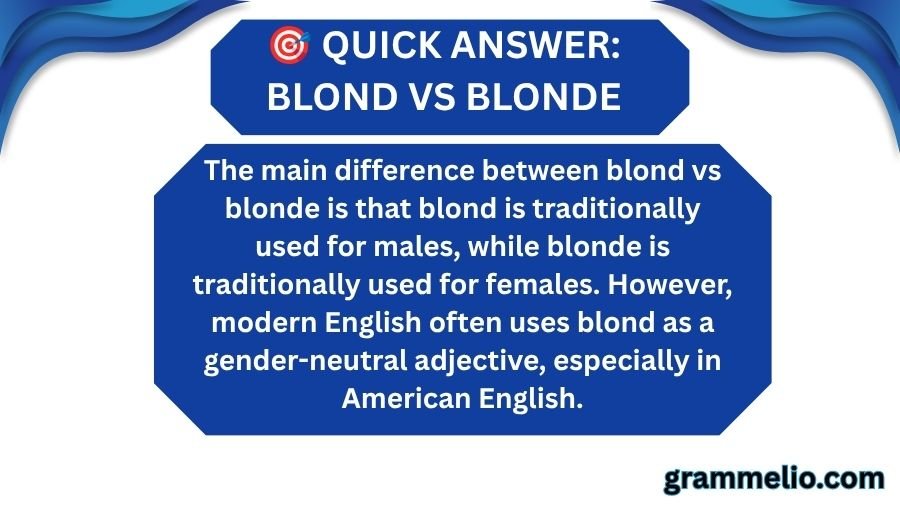
The main difference between blond vs blonde is that blond is traditionally used for males, while blonde is traditionally used for females. However, modern English often uses blond as a gender-neutral adjective, especially in American English.
Examples:
✅ He has blond hair.
✅ She has blonde hair.
✅ The actor is blond.
✅ The actress is blonde.
In modern writing, both forms describe light-colored hair. The choice depends mainly on traditional gender-based usage and the style preference of the writer.
Related Word Forms of Blond and Blonde
Although blond and blonde are the main forms people confuse, they also appear in related forms. Understanding these variations helps you use them naturally.
| Form | Type | Example |
|---|---|---|
| Blond | Adjective / noun | He has blond hair. |
| Blonde | Adjective / noun | She is a blonde woman. |
| Blonds | Plural noun | The group included several blonds. |
| Blondes | Plural noun | The movie featured many blondes. |
| Blondish | Informal adjective | The paint has a blondish shade. |
Understanding the Basics of Blond vs Blonde 💡
The easiest way to understand blond vs blonde is to remember that English borrowed a spelling difference from French. Traditional English usage kept two versions:
- Blond → traditionally masculine
- Blonde → traditionally feminine
Today, many writers use blond as a general adjective for any person because English often moves toward simpler, gender-neutral forms.
Key Differences Between Blond and Blonde
| Form | Type | Meaning | Example | Correct/Incorrect |
|---|---|---|---|---|
| Blond | Adjective | Having light yellow or golden hair | He has blond hair. | Correct |
| Blonde | Adjective | Having light yellow or golden hair, traditionally for females | She has blonde hair. | Correct |
| Blond | Noun | A male person with light hair | He is a blond. | Correct |
| Blonde | Noun | A female person with light hair | She is a blonde. | Correct |
| Blonde for every person in every style | Usage choice | May sound outdated in some contexts | The blonde person arrived. | Depends on style |
Is Blond the Same as Blonde? 🤔
Yes, blond and blonde have the same basic meaning. Both describe hair that is light in color, usually ranging from pale yellow to golden shades.
The difference is mostly about traditional spelling rules.
For example:
- “He is blond.” → Traditional male form.
- “She is blonde.” → Traditional female form.
- “They have blond hair.” → Modern gender-neutral style.
Many modern publications prefer blond when the word is used only as an adjective because it keeps the spelling simple.
Blond: Meaning and Correct Use
Blond describes someone or something with light-colored hair. It can work as an adjective or a noun.
Blond as an Adjective
When describing hair, blond acts as an adjective.
Examples:
✅ The boy has blond hair.
❌ The boy has blonde hair. (Traditional style may prefer blond.)
✅ The singer appeared with blond hair.
❌ The singer appeared with blonde hair. (Depends on the style guide.)
Blond as a Noun
As a noun, blond usually refers to a male with light hair.
Examples:
✅ The blond walked into the room.
❌ The blonde walked into the room. (Traditional grammar prefers blond for males.)
Blonde: Meaning and Correct Use
Blonde has the same meaning but is traditionally linked with females.
Blonde as an Adjective
Examples:
✅ She has blonde hair.
❌ She has blond hair. (Not wrong in modern usage, but blonde is traditional.)
Blonde as a Noun
Examples:
✅ The blonde smiled at the camera.
❌ The blond smiled at the camera. (Traditional usage prefers blonde for females.)
How Do You Remember the Difference Between Blond and Blonde? 🧠
A simple memory trick can help:
- Blonde has an “e” → think “female”
- Blond without “e” → traditional male form
The extra e is often connected with feminine forms in French-based spelling patterns.
However, remember that modern English is flexible. Many people and publications now use blond for everyone.
💡 Test Tip
When you are unsure:
- Ask whether you are describing a woman.
- If yes, blonde may be the traditional choice.
- Ask whether you want a gender-neutral style.
- If yes, blond often works.
- Check whether you are using it as a noun.
- Traditional spelling usually follows:
- male → blond
- female → blonde
- Traditional spelling usually follows:
Common Meanings of Blond and Blonde
| Meaning | Word Type | Example Sentence |
|---|---|---|
| Hair color description | Adjective | She has blonde hair. |
| Person with light hair | Noun | He is a blond. |
| General hair color description | Adjective | The child has blond curls. |
📝 Case Study: Using Blond and Blonde in Real Life
I once edited a company newsletter where a writer described a celebrity interview. The sentence said, “The blonde actor explained his new role.” The writer thought blonde simply meant “someone with light hair.” I changed it to “blond actor” because the publication followed a traditional gender-based style.
In another situation, a lifestyle blogger wrote about hair trends and used “blond hair” for everyone. That choice worked well because the article focused on hair color rather than the person’s gender.
The lesson is simple: both forms can be correct depending on the sentence and writing style.
Grammar Rules Explanation: Why Blond and Blonde Are Different
The difference between blond vs blonde comes from traditional English spelling patterns. The two words describe the same hair color, but their endings historically helped show gender.
Modern English does not always keep these gender differences. Many words have become more neutral over time, and blond is increasingly accepted as a general spelling.
Most standard language references agree that:
- Blond can describe a person with light hair.
- Blonde traditionally describes a female person with light hair.
- Both may appear in modern writing.
The most important rule is consistency. Choose a style and use it throughout your writing.
Correct vs Incorrect at a Glance
| Sentence | Correct/Incorrect | Why |
|---|---|---|
| She has blonde hair. | Correct | Traditional feminine adjective use. |
| He has blond hair. | Correct | Traditional masculine adjective use. |
| The blonde man entered the room. | Incorrect (traditional style) | Blond is preferred for males. |
| The blond woman entered the room. | Correct in modern style | Blond can be gender-neutral. |
| She is a blond. | Incorrect (traditional style) | Blonde is preferred as a feminine noun. |
⚠️ Common Mistakes With Blond and Blonde
Many people mix up blond vs blonde because the words look almost identical. The confusion usually happens because most English speakers pronounce them the same way. When people hear the word, they cannot see the final e, so spelling mistakes are common.
Other reasons include:
- Fast typing when writing messages or articles
- Autocorrect changing the spelling automatically
- Learning the traditional rule without knowing modern usage
- Seeing both forms used online
I once caught myself typing “blonde hair” while editing a general article about hair colors. The sentence was not wrong, but I changed it to “blond hair” because the article used a gender-neutral style throughout. Small choices like this help keep writing consistent.
Similar Grammar Confusions
Just like blond vs blonde, many English words create confusion because they look or sound similar.
| Confusing Words | Difference | Example |
|---|---|---|
| Its / It’s | Possession vs contraction | The dog wagged its tail. / It’s raining. |
| Your / You’re | Possession vs “you are” | Your book is here. / You’re correct. |
| Their / There / They’re | Possession, place, contraction | Their car is there. They’re ready. |
| Affect / Effect | Influence vs result | The noise affected me. |
| Then / Than | Time vs comparison | Then we left. / Taller than him. |
Common Wrong Spellings and Uses of Blond and Blonde
| Wrong Form | What’s Wrong | Correct Form |
|---|---|---|
| Blound | Incorrect spelling | Blond |
| Blonded | Not a standard form | Blond / Blonde |
| Blonde man | Traditional style issue | Blond man |
| Blond woman | Traditional style issue | Blonde woman |
| Blond’s hair | Incorrect possessive use | Blond hair / Blonde hair |
| Blondes hair | Missing possessive mark | Blonde’s hair |
Why Do People Confuse Blond and Blonde? 🤔
The biggest reason people confuse these words is that English does not always keep the same rules as other languages. Some writers learn that adding -e creates a feminine form, while others see blond used everywhere online.
The difference becomes even harder because:
- Both words describe the same color.
- Most speakers pronounce them the same.
- Modern writing often prefers simpler forms.
- Different style guides make different choices.
A student once asked me why a magazine used “blond actress” instead of “blonde actress.” I explained that the publication chose a gender-neutral style. The student realized that grammar rules can change depending on the purpose and audience of the writing.
The best approach is not to memorize one strict rule. Instead, understand the traditional difference and recognize modern usage.
Blond vs Blonde in Different Contexts ✍️
The correct choice can depend on where you are writing.
| Context | Which Term to Use | Example |
|---|---|---|
| Everyday conversation | Either, depending on style | She has blonde hair. |
| Professional writing | Choose one style and stay consistent | The report described the blond employee. |
| Creative writing | Follow the character description | The blonde woman entered the café. |
| Social media/texting | Modern casual use is common | Loving my new blond hair! |
Common Phrases With Blond and Blonde
There are not many fixed expressions using these words, but some common phrases appear often in everyday English.
| Phrase | Meaning |
|---|---|
| Blonde hair | Hair with a light golden color |
| Blond hair | Hair with a light golden color |
| Natural blonde | Someone whose hair is naturally light |
| Bottle blonde | Someone who colors their hair blonde |
| Strawberry blonde | A warm reddish-blonde hair shade |
| Dirty blonde | A darker shade of blonde hair |
Is “Blonde Hair” or “Blond Hair” Correct? 💇
Both blonde hair and blond hair can be correct.
The choice depends on the style you follow.
Traditional usage:
- “She has blonde hair.”
- “He has blond hair.”
Modern gender-neutral usage:
- “She has blond hair.”
- “He has blond hair.”
Many writers prefer blond hair because hair itself does not have gender. The adjective describes the color, not the person.
Usage of Blond and Blonde in Professional Writing
Professional writing requires consistency more than choosing one specific form.
For example, a fashion company may write:
“Our new collection features models with blonde hair.”
A news article may write:
“The blond actor appeared at the event.”
Both choices can work if they match the publication’s style.
When writing professionally:
- Pick one style guide.
- Avoid switching randomly.
- Consider your audience.
- Use the spelling that matches your publication’s tone.
Synonyms and Alternatives for Blond and Blonde
Sometimes you can avoid the spelling issue completely by using another phrase.
| Alternative | Works When | Does Not Work When |
|---|---|---|
| Fair-haired | Describing someone with light hair | Talking about a specific shade |
| Light-haired | General description | You need exact color detail |
| Golden-haired | Describing warm golden tones | Describing very pale blond hair |
| Pale-haired | Talking about very light shades | Describing normal blonde shades |
| Sandy-haired | Describing darker blond tones | Describing all blond shades |
Word Origin and History of Blond and Blonde 📚
The history of blond vs blonde is connected to older European language patterns. The two spellings developed because some languages used different endings to show gender.
Over time, English adopted both forms. Modern English has become more flexible, and many writers now use blond as a general adjective.
| Period | Form | Note |
|---|---|---|
| Earlier European use | Blond/blonde forms | Different endings showed gender. |
| Traditional English use | Blond and blonde | Both forms became common. |
| Modern English | Blond as neutral form | Many writers simplify usage. |
| Current style | Both accepted | Choice depends on preference and audience. |
Special Exception: Modern Gender-Neutral Usage ⭐
The biggest exception is that many modern writers do not separate the words by gender anymore.
For example:
✅ The singer has blond hair.
✅ The singer has blonde hair.
Both may be accepted depending on the publication style.
However, when using the words as nouns, many writers still follow the traditional pattern:
- A blond → male person with light hair
- A blonde → female person with light hair
Why Correct Usage of Blond and Blonde Matters ✅
You may wonder why one extra letter matters. The answer is clarity.
Correct word choice helps readers understand your style and attention to detail.
A small spelling decision can affect:
- Professional image
- Editing quality
- Reader trust
- Writing consistency
“A careful writer respects small details because small details create clear communication.”
| Situation | Why Getting It Right Matters |
|---|---|
| Resume or application | Shows attention to detail |
| Client email | Creates professional communication |
| Published article | Improves reader confidence |
| Social media post | Makes writing look polished |
How To Remember Blond vs Blonde Forever 🧠
Use this simple method:
Remember the Extra “E”
Think:
BlondE → traditionally Female
The extra e helps you remember the traditional feminine form.
Remember the Modern Rule
If you are describing hair color generally, blond is often acceptable.
Examples:
✅ She has blond hair.
✅ She has blonde hair.
✅ He has blond hair.
Quick Recap Checklist ✅
| Question | If Yes → Use |
|---|---|
| Are you describing a male person? | Blond |
| Are you following traditional gender spelling? | Blonde for females, blond for males |
| Are you describing hair color generally? | Blond or blonde depending on style |
| Are you writing professionally? | Choose one style and stay consistent |
| Are you using a noun for a female person? | Blonde |
Practice Examples
- The actress has ______ hair.
Answer: blonde - The actor has ______ hair.
Answer: blond - The article describes a person with ______ hair.
Answer: blond (modern neutral style)
FAQs About Blond vs Blonde
What is the difference between blond and blonde?
The main difference between blond vs blonde is traditional gender usage. Blond is traditionally used for males, while blonde is traditionally used for females.
Examples:
✅ He is blond.
✅ She is blonde.
However, modern English often uses blond as a gender-neutral adjective, especially when describing hair color.
Is blond or blonde correct for hair?
Both spellings can be correct.
Traditional usage:
- He has blond hair.
- She has blonde hair.
Modern usage:
- She has blond hair.
- He has blond hair.
The best choice depends on the style of writing you follow. Many modern writers use blond when talking about hair color because hair itself does not have a gender.
Is a woman called blond or blonde?
Traditionally, a woman with light-colored hair is called a blonde.
Example:
✅ She is a blonde.
However, some modern writers prefer blond as a neutral spelling:
✅ She is blond.
Both may appear in current English, but blonde remains the traditional feminine noun form.
Is a man called blond or blonde?
A man with light-colored hair is traditionally called a blond.
Example:
✅ He is a blond.
Using blonde for a man is usually considered nontraditional.
Why do blond and blonde have different spellings?
The different spellings came from older language patterns where endings were sometimes used to show gender. English kept both versions, but modern usage has become more flexible.
Today, the difference is mainly a matter of style and tradition.
Should I write blond hair or blonde hair?
Both are accepted, but blond hair is becoming more common in gender-neutral writing.
Examples:
✅ The child has blond hair.
✅ The child has blonde hair.
If you are writing for a publication, follow that publication’s preferred style.
Is blonde only for women?
Traditionally, yes. Blonde was mainly used for women, while blond was used for men.
However, modern English often does not strictly follow this distinction. Many writers use blond for anyone with light-colored hair.
Can blond be used as a noun?
Yes, but it is less common today.
Traditional example:
✅ The blond entered the room.
This means a male person with blond hair.
For a female person, traditional usage uses:
✅ The blonde entered the room.
Which spelling should I use in professional writing?
Choose one style and use it consistently.
For formal writing:
- Use blond as a general adjective if you prefer gender-neutral language.
- Use blonde for traditional feminine references.
- Avoid switching between forms without a reason.
Consistency matters more than choosing only one “correct” option.
Conclusion 🌟
Blond vs blonde can seem confusing because both words describe the same light hair color, but their traditional uses are slightly different. Blond is traditionally used for males and general descriptions, while blonde is traditionally used for females. Modern English, however, often accepts blond as a gender-neutral adjective.
The easiest way to remember the traditional rule is simple: the extra “e” in blonde is often linked with feminine usage. When writing, always think about your audience, your style, and your need for consistency. ✨
I have found that the best writers are not the ones who memorize every tiny rule. They are the ones who understand why a choice works and use it with confidence. Whether you choose blond or blonde, clear communication should always come first.
Small spelling choices create strong writing. Master this difference, and you will avoid one more common English mistake with ease. 😊

[…] and common mistakes so you can confidently use both words in everyday and professional writing. Blond vs Blonde | Blond vs Blonde | Blond vs […]
[…] situations so you can confidently choose the right word every time. 😊 Bloody vs Bloodied | Blond vs Blonde | Billed vs […]