Have you ever written a sentence and stopped because you were unsure whether to use beside vs besides? You are not alone. These two words look almost identical, sound closely related, and are often mixed up even by strong writers.
The confusion happens because both words can connect ideas, but they do not always serve the same purpose.
I have helped students and writers improve their everyday English, and this is one of the small grammar points that can make a big difference in clear communication.
The key is understanding whether you are talking about a position next to something or adding extra information.
In this guide, I will explain beside vs besides with simple rules, examples, tables, and practical tips. 😊
Whether you are writing an email, creating content, completing school work, or improving your English skills, knowing the difference will help your sentences sound more natural and accurate. Beau vs Bow | Beach vs Beech | Barbarous vs Barbaric
🎯 Quick Answer: Beside vs Besides
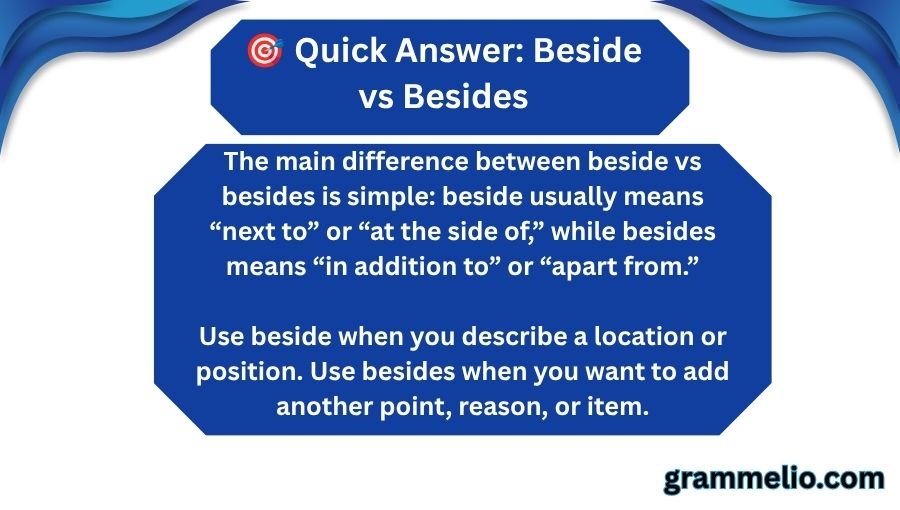
The main difference between beside vs besides is simple: beside usually means “next to” or “at the side of,” while besides means “in addition to” or “apart from.”
Use beside when you describe a location or position. Use besides when you want to add another point, reason, or item.
Examples:
✅ The chair is beside the window.
(The chair is next to the window.)
✅ Besides English, she studies Spanish.
(She studies Spanish in addition to English.)
Understanding the Basics of Beside vs Besides 📚
The words beside and besides have similar spelling, but their meanings are different. The extra “s” changes the role of the word.
| Form | Type | Meaning | Example | Correct/Incorrect |
|---|---|---|---|---|
| Beside | Preposition | Next to or at the side of something | My bag is beside the desk. | ✅ Correct |
| Besides | Preposition/Adverb | In addition to; also; except for | Besides coffee, I drink tea. | ✅ Correct |
| Beside | Used for adding ideas | Not normally used to mean “also” | Beside that, I like the movie. | ❌ Incorrect |
| Besides | Used for physical location | Not normally used to mean “next to” | The lamp is besides the sofa. | ❌ Incorrect |
A simple memory trick:
- Beside = by the side 📍
- Besides = extra information ➕
Is Beside the Same as Besides? 🤔
No, beside and besides are not the same. Although they look similar, they perform different jobs in a sentence.
Beside focuses on physical position. It answers the question “Where?”
Besides focuses on adding information. It answers questions like “What else?” or “What more?”
Examples:
✅ The dog slept beside the fireplace.
(Where did the dog sleep?)
✅ Besides the fireplace, the room has a large bookshelf.
(What other thing does the room have?)
Beside: Meaning and Correct Use 📍
Beside is mainly used as a preposition that means “next to” or “near.”
It describes the position of one person, object, or thing compared with another.
When to Use Beside
Use beside when you are talking about:
- Physical location
- Someone sitting or standing next to another person
- Objects placed near each other
Examples:
✅ She sat beside her friend during the meeting.
❌ She sat besides her friend during the meeting.
The correct word is beside because the sentence describes a physical position.
Common Uses of Beside
1. Showing Location
Beside tells us where something is placed.
Examples:
✅ The keys are beside the phone.
✅ The hotel is beside the beach.
✅ He parked beside my car.
2. Showing Someone’s Position
Beside can describe people being near each other.
Examples:
✅ I stood beside my brother in the photo.
✅ The teacher sat beside the student.
Beside Meaning Summary Table
| Meaning | Word Type | Example Sentence |
|---|---|---|
| Next to an object | Preposition | The book is beside the laptop. |
| Near a person | Preposition | She walked beside her mother. |
| At someone’s side | Preposition | He remained beside his friend. |
Besides: Meaning and Correct Use ➕
Besides has two common uses. It can mean “in addition to” or “also.”
It is often used when adding another reason, fact, or item.
When to Use Besides
Use besides when you mean:
- In addition to
- As well as
- Apart from
- Another reason or point
Examples:
✅ Besides math, he enjoys science.
(He enjoys science in addition to math.)
✅ I do not want to go. Besides, I have work tomorrow.
(Another reason is that I have work tomorrow.)
Besides as a Preposition
When besides comes before a noun, it means “in addition to.”
Examples:
✅ Besides coffee, we bought some snacks.
✅ Besides her job, she runs a small business.
Besides as an Adverb
When used alone, besides means “also” or “moreover.”
Examples:
✅ I do not need help. Besides, I can finish it myself.
✅ The movie was too long. Besides, the ending was disappointing.
Besides Meaning Summary Table
| Meaning | Word Type | Example Sentence |
|---|---|---|
| In addition to something | Preposition | Besides writing, she enjoys painting. |
| Also or another reason | Adverb | Besides, we already tried that idea. |
Key Differences Between Beside and Besides 🔑
The easiest way to separate these words is to focus on their purpose.
| Question | Use | Example |
|---|---|---|
| Are you describing a place? | Beside | The lamp is beside the bed. |
| Are you adding information? | Besides | Besides the lamp, we bought a table. |
| Are you giving another reason? | Besides | Besides, I was tired. |
| Are two things physically close? | Beside | She stood beside me. |
💡 Test Tip: How to Remember the Difference
Here is a quick test I teach learners:
Ask yourself:
Does the sentence answer “Where?”
If yes, use beside.
Example:
“Where is the phone?”
➡ The phone is beside the computer.
If the sentence answers “What else?” use besides.
Example:
“What else do you like?”
➡ Besides reading, I enjoy music.
A Real-Life Case Study: Workplace Writing 📝
I once edited a workplace email where an employee wrote:
❌ “Besides the manager, I sat during the meeting.”
The writer wanted to say that the employee sat next to the manager. The correct sentence was:
✅ “I sat beside the manager during the meeting.”
The word besides changed the meaning. It suggested that the manager was an additional person, not someone sitting nearby.
Small word choices can completely change a message.
Grammar Rules Explanation: Why Beside and Besides Are Different
The grammar rule is based on meaning and function.
Beside works as a preposition that shows a relationship between two things in space.
Example:
“The notebook is beside the computer.”
The word “beside” connects the notebook and computer by showing their location.
Besides can act as a preposition or adverb. It adds information or gives another point.
Example:
“Besides English, she speaks French.”
Here, “besides” introduces an additional language.
Standard grammar references agree that these two words have different meanings even though their spellings are closely related.
Correct vs Incorrect at a Glance
| Sentence | Correct/Incorrect | Why |
|---|---|---|
| The dog is sleeping beside the chair. | ✅ Correct | Shows location. |
| Besides the chair, there is a table. | ✅ Correct | Adds another item. |
| She walked besides her father. | ❌ Incorrect | Physical position requires beside. |
| Besides, I forgot my wallet. | ✅ Correct | Adds another reason. |
| The book is besides the notebook. | ❌ Incorrect | Location requires beside. |
⚠️ Common Mistakes With Beside and Besides
Many people confuse beside vs besides because the two words are almost identical in spelling. The only visible difference is the extra “s”, but that small letter changes the meaning completely.
A common reason for mistakes is that writers remember the sound or appearance of the word but forget its purpose in the sentence. Good grammar depends on meaning, not just spelling.
Why Do People Confuse Beside and Besides? 🤔
People often mix up these words because:
- They look almost the same.
- They are pronounced similarly.
- Both can appear before nouns.
- Many learners memorize spelling but not meaning.
- Autocorrect may replace one word with the other.
I once reviewed a student’s essay where they wrote:
❌ “Besides the window, there was a beautiful garden.”
The student wanted to describe the garden’s location. The correct sentence was:
✅ “Beside the window, there was a beautiful garden.”
The extra s completely changed the meaning.
Similar Grammar Confusions Table
| Confused Words | Difference | Example |
|---|---|---|
| Beside vs Besides | Location vs addition | The chair is beside the desk. / Besides coffee, I drink tea. |
| It’s vs Its | Contraction vs possession | It’s raining. / The dog wagged its tail. |
| Your vs You’re | Possession vs “you are” | Your book is here. / You’re correct. |
| Their vs There vs They’re | Ownership, place, contraction | Their car is there. They’re late. |
| Affect vs Effect | Influence vs result | The noise affected me. / The effect was clear. |
Common Wrong Uses of Beside and Besides 🚫
The table below shows mistakes writers commonly make.
| Wrong Form | What’s Wrong | Correct Form |
|---|---|---|
| She stood besides me. | “Besides” does not show physical position. | She stood beside me. |
| Besides the house is a tree. | The sentence describes location. | Beside the house is a tree. |
| Beside that, I enjoyed the movie. | Adding an extra idea requires besides. | Besides, I enjoyed the movie. |
| He works beside teaching. | The meaning is “in addition to.” | He works besides teaching. |
| The lamp is besides the sofa. | The sofa is a location, not an added item. | The lamp is beside the sofa. |
How To Remember The Difference Between Beside and Besides 🧠
A simple memory trick can help:
Think of “side” in beside.
Beside = by the side
Example:
✅ The child sat beside his mother.
The child is physically next to his mother.
Think of the extra “s” in besides as “something extra.”
Besides = extra information
Example:
✅ Besides chocolate, she likes vanilla.
Chocolate is one thing. Vanilla is an additional thing.
Word Origin and History of Beside and Besides 📖
The history of these words is connected to older forms of English. Both developed from the idea of being “by” or “near” something, but their meanings slowly separated over time.
The word beside kept its main meaning of being next to something. The word besides developed an additional meaning connected with adding another point or idea.
Simple Timeline
| Period | Form | Note |
|---|---|---|
| Older English | beside | Connected with being near or by something |
| Later English use | besides | Developed the sense of “in addition” |
| Modern English | beside | Mainly shows location |
| Modern English | besides | Adds information or another reason |
The important point for modern writers is not the history but the meaning difference today.
Usage of Beside and Besides in Different Contexts 🌎
The right choice depends on the situation. Both words appear in everyday speech and writing, but they do different jobs.
| Context | Which Term to Use | Example |
|---|---|---|
| Everyday conversation | Both, depending on meaning | Sit beside me. / Besides, I agree. |
| Professional writing | Both, carefully | The report is beside the file. |
| Creative writing | Beside for scenes; besides for added thoughts | She stood beside the river. |
| Social media/texting | Besides for casual additions; beside for location | Besides that, the trip was fun. |
Beside vs Besides in Everyday Conversation 💬
In casual speech, people often use these words quickly and may not notice the difference.
Examples:
✅ “Come sit beside me.”
This means:
“Come sit next to me.”
✅ “Besides, we have plenty of time.”
This means:
“Also, we have plenty of time.”
Using the wrong word may not always stop understanding, but it can make your English sound less natural.
Beside vs Besides in Professional Writing 💼
Professional writing requires accuracy because small grammar mistakes can affect clarity.
Examples:
✅ “The document is beside the printer.”
This gives a location.
✅ “Besides the original report, I attached the updated version.”
This adds another item.
A business email, report, or proposal should use these words carefully because readers expect clear communication.
Beside vs Besides in Creative Writing ✍️
Writers use these words to create clear images and smooth ideas.
Example with beside:
✅ “She sat beside the quiet lake and watched the sunset.”
The reader imagines a physical location.
Example with besides:
✅ “Besides the beautiful view, the peaceful sound of birds made the place special.”
The writer adds another detail.
Common Phrases With Beside and Besides
Both words appear in common expressions, although besides has more fixed uses.
| Phrase | Meaning |
|---|---|
| Beside the point | Not related or not important to the main topic |
| Beside oneself | Extremely emotional |
| Besides that | In addition to that |
| Besides the fact that | Adding another reason or point |
| Besides the point | Outside the main issue |
Examples of Common Expressions
Beside the Point
This means something is unrelated to the main issue.
Example:
✅ “Whether he likes the color is beside the point. The design must work.”
Beside Oneself
This means someone has very strong emotions.
Example:
✅ “She was beside herself with excitement.”
Besides That
This adds another reason.
Example:
✅ “I cannot attend. Besides that, I have another appointment.”
Synonyms and Alternatives for Beside and Besides 🔄
Sometimes another word or phrase can replace these terms.
| Alternative | Works When | Does Not Work When |
|---|---|---|
| Next to | Showing location | Adding an idea |
| Near | Describing closeness | Introducing extra information |
| In addition to | Adding information | Showing physical position |
| Also | Adding another point | Describing location |
| Apart from | Meaning “except for” or “besides” | Showing where something sits |
How Synonyms Change the Meaning
Compare:
✅ The lamp is next to the sofa.
This matches beside.
❌ The lamp is in addition to the sofa.
This does not describe location.
Another example:
✅ Besides studying, he plays sports.
Possible replacement:
✅ In addition to studying, he plays sports.
The meaning stays the same.
Why Using Beside and Besides Correctly Matters ⭐
Correct word choice improves communication. A single letter can change the meaning of a sentence.
Clear grammar helps with:
- School assignments
- Workplace communication
- Online writing
- Personal messages
A sentence should guide readers, not make them stop and guess.
“Good writing is not only about big ideas. It is also about choosing the right small words.”
Why Accuracy Matters in Different Situations
| Situation | Why Getting It Right Matters |
|---|---|
| Resume | Shows attention to detail |
| Client email | Prevents confusion |
| Published content | Builds trust with readers |
| Social post | Makes your message clearer |
How To Use Beside vs Besides Correctly Every Time ✅
Before choosing a word, ask one question:
Am I talking about a place or adding information?
If you mean a place:
➡ Use beside
Example:
✅ My phone is beside my computer.
If you mean extra information:
➡ Use besides
Example:
✅ Besides my phone, I brought my charger.
Quick Recap Checklist ✅
| Question | If Yes → Use |
|---|---|
| Am I describing something next to another thing? | Beside |
| Am I adding another item or idea? | Besides |
| Does the sentence answer “Where?” | Beside |
| Does the sentence answer “What else?” | Besides |
Practice Examples
- The teacher stood ___ the student.
Answer: beside ✅
- ___ English, she knows French.
Answer: Besides ✅
- The park is ___ the school.
Answer: beside ✅
FAQs About Beside vs Besides
What is the main difference between beside and besides?
Beside means “next to,” while besides means “in addition to” or “also.” The correct choice depends on whether you describe location or add information.
Is beside a synonym for besides?
No. They are related but not interchangeable. Beside describes position, while besides adds another point or item.
Can besides be used at the beginning of a sentence?
Yes. Besides can start a sentence when it introduces another reason or idea.
Example:
✅ “Besides, we already finished the project.”
Can I use beside to mean “also”?
No. Beside is not normally used to add information.
Incorrect:
❌ “Beside, I like the movie.”
Correct:
✅ “Besides, I like the movie.”
Is “sit besides me” correct?
No. The correct sentence is:
✅ “Sit beside me.”
The sentence describes someone sitting next to another person.
Is “besides that” correct English?
Yes. “Besides that” is a common phrase used to add another point.
Example:
✅ “The hotel was affordable. Besides that, it was close to the beach.”
How can I remember beside vs besides easily?
Remember:
Beside = by the side
Besides = something extra
This simple trick works in most situations.
Do native English speakers confuse beside and besides?
Yes, some speakers make mistakes because the words look similar. However, careful writers use them differently based on meaning.
Which word should I use in formal writing?
Both words are acceptable in formal writing. Choose beside for location and besides for additional information.
Conclusion 🌟
Beside vs besides becomes easy once you remember the basic rule: beside means next to, while besides means in addition to or also. These small words may look almost identical, but they create different meanings in your sentences.
When you describe where something is located, choose beside. When you add another idea, reason, or item, choose besides. This simple difference can improve your writing in emails, essays, articles, and daily conversations. 😊
I have seen many writers improve quickly once they stop memorizing spelling and start focusing on meaning. The goal of grammar is not to memorize endless rules. It is to communicate clearly.
Remember this final shortcut:
📍 Beside = by the side
➕ Besides = add something extra
Master this difference, and you will never hesitate between these two words again.

[…] difference in simple US English, show correct examples, and help you remember which word to choose. Beside vs Besides | Beau vs Bow | Beach vs […]