Have you ever searched for the right word to describe something cruel, violent, or lacking kindness and stopped between two similar choices? Many English learners and even native speakers wonder about barbarous vs barbaric because both words sound alike and both can describe harsh behavior.
However, they are not always used in the same way. Choosing the wrong word can slightly change the meaning of your sentence.
I have helped writers improve their word choice for years, and I often see this pair create confusion in essays, articles, and professional writing.
Understanding the difference between barbarous vs barbaric can make your writing clearer and more precise. ✍️
These words share a connection with ideas of cruelty and lack of civilization, but their modern uses have developed different shades of meaning.
In this guide, I will explain the difference, show examples, and provide simple memory tips so you can confidently choose the right word every time. 😊 Band vs Banned | Baleful vs Baneful | Baited vs Bated
🎯 Quick Answer: Barbarous vs Barbaric
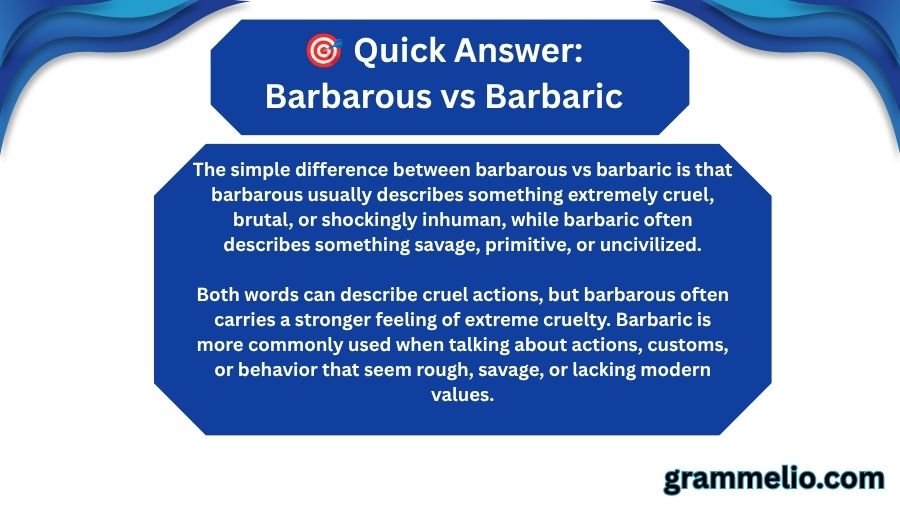
The simple difference between barbarous vs barbaric is that barbarous usually describes something extremely cruel, brutal, or shockingly inhuman, while barbaric often describes something savage, primitive, or uncivilized.
Both words can describe cruel actions, but barbarous often carries a stronger feeling of extreme cruelty. Barbaric is more commonly used when talking about actions, customs, or behavior that seem rough, savage, or lacking modern values.
Examples:
✅ The soldiers committed a barbarous act against innocent people.
✅ The ancient ritual was considered barbaric by modern society.
Understanding the Basics of Barbarous vs Barbaric
The main difference between these words comes from their focus. Barbarous focuses more on cruelty and extreme harshness. Barbaric focuses more on something being savage, uncivilized, or lacking refinement.
| Form | Type | Meaning | Example | Correct/Incorrect |
|---|---|---|---|---|
| Barbarous | Adjective | Extremely cruel or brutal | The attack was a barbarous crime. | ✅ Correct |
| Barbaric | Adjective | Savage, primitive, or uncivilized | The practice seemed barbaric to outsiders. | ✅ Correct |
| Barbarous | Adjective | Pleasant or gentle | The peaceful song was barbarous. | ❌ Incorrect |
| Barbaric | Adjective | A modern polite action | His kindness was barbaric. | ❌ Incorrect |
Is Barbarous the Same as Barbaric?
No, barbarous and barbaric are closely related but not exactly the same. Both can describe cruel or harsh things, but they emphasize different ideas.
Barbarous suggests extreme cruelty, violence, or a lack of human feeling.
Barbaric suggests something savage, rough, uncultured, or outside accepted social standards.
For example:
✅ The criminal showed barbarous cruelty toward his victims.
❌ The criminal showed barbaric cruelty toward his victims. (Possible, but less focused on extreme cruelty.)
✅ The ancient tradition was viewed as barbaric by modern observers.
❌ The ancient tradition was viewed as barbarous by modern observers. (Possible, but stronger and more emotional.)
Barbarous: Meaning and Correct Use
Barbarous is an adjective used to describe actions, people, or situations that are extremely cruel, violent, or lacking compassion.
It often appears in serious contexts, such as:
- war
- crimes
- abuse
- unfair treatment
- extreme violence
Examples of Barbarous
1. Describing cruel actions
A barbarous action is one that causes serious harm and shows a lack of humanity.
Example:
✅ The king punished his enemies with barbarous methods.
❌ The king punished his enemies with friendly methods.
The word tells readers that the punishment was not just harsh. It was shockingly cruel.
2. Describing cruel behavior
A person’s behavior can be called barbarous when it shows extreme violence or cruelty.
Example:
✅ The attacker displayed barbarous behavior during the conflict.
❌ The attacker displayed cheerful behavior during the conflict.
3. Describing harsh treatment
Barbarous can describe unfair or cruel treatment toward others.
Example:
✅ The workers suffered under barbarous conditions.
This means the conditions were extremely bad and lacked basic care.
💡 Test Tip: How to Remember Barbarous
Think of barbarous = brutal.
Both words begin with a strong “B” sound and both suggest serious cruelty.
If the sentence feels like it describes something shocking, violent, or deeply cruel, barbarous may be the better choice.
| Meaning | Word Type | Example Sentence |
|---|---|---|
| Extremely cruel | Adjective | The ruler used barbarous punishment. |
| Brutal behavior | Adjective | The attack was barbarous. |
| Inhuman treatment | Adjective | They protested against barbarous actions. |
Barbaric: Meaning and Correct Use
Barbaric is an adjective that describes something savage, primitive, or considered unacceptable by modern standards.
It is often used for:
- old customs
- violent traditions
- rude behavior
- uncivilized actions
Examples of Barbaric
1. Describing savage customs
Barbaric is often used when a practice seems cruel or outdated.
Example:
✅ Many people considered the old punishment barbaric.
The focus is on the practice being savage or unacceptable.
2. Describing rough behavior
Barbaric can describe behavior that appears wild or uncontrolled.
Example:
✅ The crowd became barbaric after the announcement.
This suggests the crowd acted in a savage or uncontrolled way.
3. Describing uncivilized actions
The word can show that something does not match modern ideas of acceptable behavior.
Example:
✅ The treatment of animals was called barbaric.
Key Differences Between Barbarous and Barbaric
Although these words overlap, their emotional focus is different.
| Feature | Barbarous | Barbaric |
|---|---|---|
| Main idea | Extreme cruelty | Savage or uncivilized behavior |
| Common use | Violence and brutal actions | Customs, habits, behavior |
| Emotional strength | Usually stronger | Usually broader |
| Example | A barbarous attack | A barbaric tradition |
| Tone | Very negative | Negative but sometimes descriptive |
Why Do People Confuse Barbarous and Barbaric?
People confuse these words because they come from the same general idea and have similar sounds. Both words are linked with the idea of something being savage or lacking civilization.
I once edited a history article where a writer used “barbarous” to describe an old cultural tradition. The sentence was grammatically correct, but the meaning became much harsher than intended. The writer wanted to describe something unfamiliar and outdated, so “barbaric” was a better choice.
The confusion usually happens because:
- both are adjectives
- both can describe cruel things
- both appear in serious writing
- their meanings overlap
Grammar Rules Explanation
The grammar rules behind barbarous vs barbaric are based on meaning, tone, and context rather than spelling alone.The correct choice depends on what you want to emphasize.
Use barbarous when the main idea is:
- extreme cruelty
- brutal treatment
- shocking violence
Use barbaric when the main idea is:
- savage behavior
- primitive customs
- lack of civilization
Standard English references generally recognize both words as valid adjectives, but they carry different shades of meaning.
Correct vs Incorrect at a Glance
| Sentence | Correct/Incorrect | Why |
|---|---|---|
| The soldiers committed a barbarous crime. | ✅ Correct | The sentence emphasizes extreme cruelty. |
| The ancient practice seemed barbaric. | ✅ Correct | The sentence focuses on an outdated custom. |
| The gentle child had a barbarous personality. | ❌ Incorrect | Gentle behavior does not match the meaning. |
| The peaceful ceremony was barbaric. | ❌ Incorrect | Peaceful actions are not savage or cruel. |
| The attack was described as barbarous. | ✅ Correct | The word highlights brutal violence. |
Case Study: Choosing the Right Word in Real Life 📝
Imagine a journalist writing about a violent event.
Original sentence:
“The attackers used barbaric methods.”
This sentence works because it suggests savage and unacceptable behavior.
However, if the journalist wants to emphasize the shocking cruelty, the sentence could become:
“The attackers used barbarous methods.”
The second version creates a stronger emotional reaction.
I once caught a similar issue while reviewing a business report. The writer described a company policy as “barbarous” when they meant “old-fashioned and unfair.” I changed it to “barbaric” because the original word sounded like an accusation of extreme cruelty.
Common Mistakes With Barbarous and Barbaric ⚠️
Many learners struggle with barbarous vs barbaric because both adjectives describe negative ideas, but they are used in different situations. Many mistakes with barbarous vs barbaric happen because both words describe things that are cruel, harsh, or unpleasant. Writers often choose them based only on sound instead of meaning.
Here are the most common reasons people mix them up:
- Fast typing: People may type the first similar-looking word that comes to mind.
- Autocorrect: Some devices replace words with incorrect suggestions.
- Lack of knowledge: Many people know both words are negative but do not know the difference in strength and meaning.
- Overlapping meanings: Since both words can describe cruelty, the difference can feel small.
Similar Grammar Confusions
| Confusing Words | Difference | Example |
|---|---|---|
| Affect vs Effect | Affect is usually an action; effect is usually a result | The news affected me. The effect was surprising. |
| Compliment vs Complement | Compliment means praise; complement means something that completes | She gave me a compliment. |
| Principal vs Principle | Principal means main; principle means a rule or belief | The principal rule was fairness. |
| Historic vs Historical | Historic means important in history; historical means related to history | It was a historic event. |
| Barbarous vs Barbaric | Barbarous means extremely cruel; barbaric means savage or uncivilized | The attack was barbarous. The custom was barbaric. |
Common Wrong Uses of Barbarous and Barbaric
| Wrong Form | What’s Wrong | Correct Form |
|---|---|---|
| The beautiful garden looked barbarous. | A beautiful place does not show cruelty or harshness. | The beautiful garden looked peaceful. |
| The old tradition was barbarous because it was unusual. | Being unusual does not always mean extremely cruel. | The old tradition was barbaric. |
| His kindness was barbaric. | Kindness cannot be savage or cruel. | His kindness was admirable. |
| The brutal attack was barbaric and extremely cruel. | Possible, but barbarous may better show extreme cruelty. | The brutal attack was barbarous. |
| The modern invention was barbarous. | Modern does not usually connect with this meaning. | The modern invention was innovative. |
How To Remember The Difference Between Barbarous and Barbaric 💡
Understanding barbarous vs barbaric becomes easier when you connect each word with its main meaning. Remember that barbarous focuses on extreme cruelty, while barbaric often describes savage or uncivilized behavior. A simple memory trick can help:
Barbarous = brutal
Barbaric = basic or savage
Think about the extra “-ous” ending in barbarous as something that feels intense and emotional. It often points toward terrible cruelty.
Think about barbaric as describing something that appears rough, wild, or less developed.
Memory Examples
✅ The enemy committed a barbarous crime.
(The crime was extremely cruel.)
✅ The ancient punishment system was barbaric.
(The system seemed savage and outdated.)
Word Origin and History 📚
The history of these two words is connected to the old idea of describing people or cultures viewed as unfamiliar or uncivilized. Over time, English speakers developed more specific meanings for each form. The history of barbarous vs barbaric shows how two similar words developed different uses in modern English. Both words are connected with ideas of harshness, but writers now choose them based on the exact meaning they want to express.
Today, the words are mainly used to describe cruelty, harsh behavior, or actions that seem outside accepted standards.
| Period | Form | Note |
|---|---|---|
| Early language use | Related forms describing outsiders | Words were linked with ideas of unfamiliar cultures. |
| Later English use | Barbarous | Developed a strong meaning connected with cruelty and brutality. |
| Later English use | Barbaric | Became associated with savage or uncivilized behavior. |
| Modern English | Both words remain in use | Writers choose based on the intended meaning. |
Usage in Different Contexts
Knowing how to use barbarous vs barbaric in different contexts helps writers choose the correct tone for conversations, professional writing, and creative work.
Choosing between barbarous vs barbaric depends on the situation and the feeling you want to create.
| Context | Which Term to Use | Example |
|---|---|---|
| Everyday conversation | Barbaric | That treatment of animals was barbaric. |
| Professional writing | Barbarous or Barbaric depending on meaning | The report described a barbarous attack. |
| Creative writing | Both | The villain showed barbarous cruelty. |
| Social media/texting | Barbaric is more common | People called the action barbaric. |
Common Phrases With Barbarous and Barbaric
These words do not have many fixed idioms, but they commonly appear in certain expressions.
| Phrase | Meaning |
|---|---|
| Barbarous act | An extremely cruel action |
| Barbarous treatment | Very harsh or inhuman treatment |
| Barbaric behavior | Savage or unacceptable behavior |
| Barbaric practice | A cruel or outdated custom |
| Barbaric conditions | Extremely rough or unpleasant conditions |
Synonyms and Alternatives
When choosing alternatives for barbarous vs barbaric, consider whether you want to emphasize extreme cruelty, savage behavior, or general harshness. Sometimes another word may fit better depending on the situation.
| Alternative | Works When | Does Not Work When |
|---|---|---|
| Brutal | You want to describe extreme violence or cruelty | The issue is only old-fashioned behavior |
| Cruel | You want a simple word for causing pain | You need the idea of being primitive |
| Savage | You want to describe wild or uncontrolled actions | You are describing a formal situation |
| Inhumane | You want to emphasize lack of compassion | You only mean unusual or unfamiliar |
| Harsh | You mean severe or unpleasant | You need to show extreme cruelty |
Why It Matters: Using the Right Word Improves Communication ✨
Choosing between barbarous vs barbaric helps readers understand exactly what you mean. A small word choice can change the emotional strength of your writing. The difference between barbarous vs barbaric matters because the wrong choice can change the emotional meaning of your sentence.
Using the wrong term may make your message sound too strong or too weak.
A good writer does not only choose words that are correct. A good writer chooses words that match the exact message.
“Clear words create clear thoughts.”
| Situation | Why Getting It Right Matters |
|---|---|
| Resume | Professional writing requires accurate word choices. |
| Client email | The wrong word can create an unintended tone. |
| Published content | Readers trust clear and careful writing. |
| Social post | Short messages need precise language. |
Special Exception Section
There is no major spelling exception or special grammar rule for barbarous vs barbaric. Both are standard adjectives, and both can be correct depending on the context.
However, remember that replacing one with the other can slightly change the feeling:
- Barbarous often sounds more severe.
- Barbaric often sounds more descriptive.
Quick Recap Checklist ✅
Use this checklist whenever you are unsure.
| Question | If Yes → Use |
|---|---|
| Am I describing extreme cruelty or brutal violence? | Barbarous |
| Am I describing a savage or outdated custom? | Barbaric |
| Does the sentence focus on shocking harm? | Barbarous |
| Does the sentence focus on something uncivilized? | Barbaric |
| Do I want a broader negative description? | Barbaric |
Practice Examples
- The dictator ordered a ______ punishment against prisoners.
✅ Answer: barbarous - The villagers rejected the ______ tradition after learning about its harm.
✅ Answer: barbaric - The attack was one of the most ______ events in recent memory.
✅ Answer: barbarous
FAQs About Barbarous vs Barbaric
What is the main difference between barbarous and barbaric?
Barbarous usually means extremely cruel, brutal, or inhuman. Barbaric usually means savage, primitive, or unacceptable by modern standards.
Can barbarous and barbaric be used interchangeably?
Sometimes they can overlap, especially when describing cruelty. However, they are not always interchangeable because barbarous often sounds stronger and focuses on extreme cruelty.
Is barbarous more negative than barbaric?
Usually, yes. Barbarous often suggests a higher level of cruelty or brutality, while barbaric can simply describe something savage or uncivilized.
Is barbaric always related to violence?
No. Barbaric can describe customs, habits, or behavior that seem rough, outdated, or uncivilized even if they are not directly violent.
Can I use barbarous to describe a person?
Yes. A person or their actions can be described as barbarous if they behave with extreme cruelty.
Example:
✅ The ruler was known for barbarous actions.
Can I use barbaric in professional writing?
Yes. Barbaric can appear in professional writing when discussing social issues, history, ethics, or unacceptable practices.
Example:
✅ The report criticized the barbaric treatment of workers.
Which word should I use for a cruel crime?
Usually, barbarous is the stronger choice because it emphasizes extreme cruelty.
Example:
✅ The attack was a barbarous crime.
Which word should I use for an old tradition?
Usually, barbaric is better because it focuses on a custom being savage or outdated.
Example:
✅ Many people viewed the ritual as barbaric.
Why do people confuse barbarous and barbaric?
People confuse them because they look and sound similar, share related meanings, and both describe negative situations.
Is barbaric an insult?
It can be. Calling something barbaric suggests that it is cruel, savage, or unacceptable. The tone depends on the context.
Conclusion
Barbarous vs barbaric is a common English confusion, but the difference becomes simple once you focus on the meaning. Barbarous describes extreme cruelty, brutal actions, and behavior that seems deeply inhuman. Barbaric describes savage, primitive, or unacceptable actions and customs.
When you write about a shocking crime or violent act, barbarous is often the stronger choice. When you describe an outdated practice or rough behavior, barbaric is usually more natural.
I have found that the best way to remember these words is to connect them with their strongest ideas: barbarous means brutal, while barbaric means savage. ✍️
Good word choices make your writing clearer, stronger, and easier to understand. Once you know the difference between these two similar adjectives, you can use them with confidence in essays, articles, conversations, and professional communication. 😊

[…] correct examples, share memory tips, and help you confidently choose the right word every time. Barbarous vs Barbaric | Band vs Banned | Baleful vs […]