Have you ever typed a sentence and stopped because you were unsure whether to use attendant or attendance? The difference between attendant vs attendance is simple once you know what each word refers to.
You are not alone. These words look and sound related, but they do very different jobs in a sentence.
One usually refers to a person, while the other usually refers to the act or record of being present. That small difference can change the meaning of an entire sentence.
As an editor and English teacher, I often see this mix-up in school assignments, workplace emails, and online writing. The good news is that the rule is simple once you know what each word points to. 😊
This guide explains attendant vs attendance in plain US English. I will show you their meanings, grammar roles, examples, common mistakes, memory tricks, and real-life uses.
By the end, you should be able to choose the right word with confidence. ✨ Assay vs Essay | Appose vs Oppose | Amend vs Emend
🎯 Quick Answer: Attendant vs Attendance
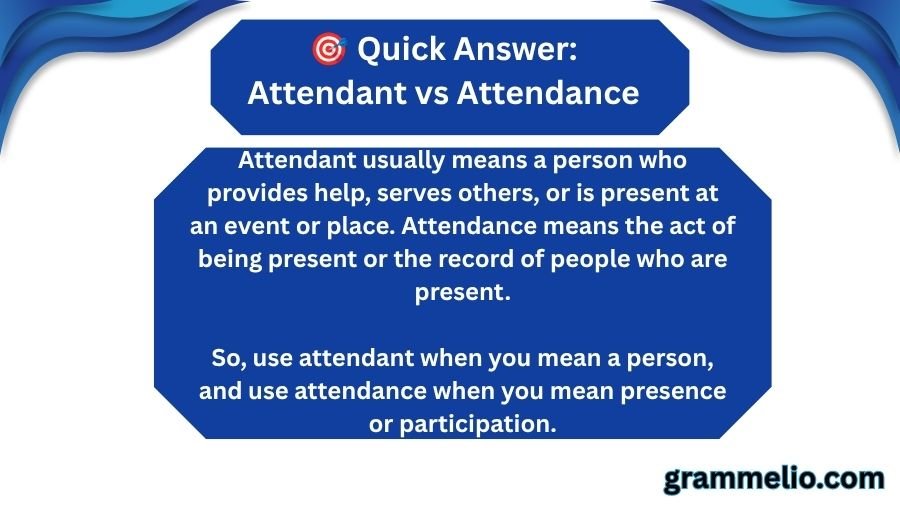
Attendant usually means a person who provides help, serves others, or is present at an event or place. Attendance means the act of being present or the record of people who are present.
So, use attendant when you mean a person, and use attendance when you mean presence or participation.
| Word | Basic Meaning | Example |
|---|---|---|
| Attendant | A person who serves, helps, or is present | The hotel attendant helped us with our bags. |
| Attendance | The act or record of being present | Her attendance at school was excellent. |
🔤 Related Word Forms of Attendant and Attendance
The two words have several related forms. Knowing them can make the difference much easier to understand.
| Form | Type | Example |
|---|---|---|
| attendant | noun/adjective | The attendant opened the door. |
| attendants | plural noun | Several attendants greeted the guests. |
| attendant’s | singular possessive | The attendant’s desk was near the entrance. |
| attendants’ | plural possessive | The attendants’ uniforms were clean. |
| attendance | noun | Attendance is required today. |
| attend | verb | Students must attend class. |
| attended | past-tense verb | Maya attended the meeting. |
| attending | present participle | He is attending the conference. |
The verb attend is especially useful because it connects the two ideas. You attend an event, and your attendance is your presence at that event. An attendant, however, is a person.
📚 Understanding the Basics of Attendant vs Attendance
The main difference between attendant and attendance is what each word represents. Attendant normally identifies a person. Attendance identifies presence, participation, or a record of who was present.
Here is the basic rule I use when teaching this pair:
Person = attendant. Presence = attendance.
Attendant
Attendant is commonly a noun for someone whose job is to serve, assist, supervise, or help people. It can also describe someone who is present or connected with an event or situation.
Examples include:
- a hotel attendant
- a parking attendant
- a flight attendant
- a store attendant
- an event attendant
Attendance
Attendance is a noun that refers to the act of being present or the number of people who are present.
You might talk about:
- school attendance
- meeting attendance
- employee attendance
- event attendance
- attendance records
Comparison Table
| Form | Type | Meaning | Example | Correct/Incorrect |
|---|---|---|---|---|
| attendant | Noun | A person who helps or serves | The attendant helped me. | ✅ Correct |
| attendance | Noun | Being present or a record of presence | Attendance was high. | ✅ Correct |
| attendant | Noun | Used to mean presence | My attendant was perfect at school. | ❌ Incorrect |
| attendance | Noun | Used to mean a worker | The attendance helped the customer. | ❌ Incorrect |
| attend | Verb | To go to or be present at something | I will attend the meeting. | ✅ Correct |
The easiest way to remember attendant vs attendance is to ask, “Am I talking about a person or presence?”
👤 What Does Attendant Mean?
Attendant usually means a person who helps, serves, watches, or takes care of something. The exact meaning depends on the setting.
For example, a parking attendant helps manage parking. A flight attendant serves and assists passengers on an airplane. A hotel attendant may help guests or care for hotel areas.
Attendant as a Person
When attendant is a noun, it often identifies someone’s role.
Example:
The flight attendant brought us some water.
Here, the word refers to a person who works on the flight.
Another example:
The parking attendant directed us to an open space.
Again, attendant names a person.
Attendant as an Adjective
The word can also work as an adjective in some expressions. In that use, it means something connected with or resulting from another thing.
For example:
The project created several attendant problems.
Here, attendant describes problems that came along with the project.
This use is less common in everyday speech, but it is still standard English.
Meanings of Attendant
| Meaning | Word Type | Example Sentence |
|---|---|---|
| A person who helps | Noun | The attendant helped the visitor. |
| A worker who serves customers | Noun | The gas station attendant checked the pump. |
| A person present at an event | Noun | Every attendant received a name tag. |
| Connected with another situation | Adjective | The attendant risks were discussed. |
💡 Test Tip
If you can replace the word with “worker,” “helper,” or “person,” you probably need attendant.
For example:
The attendant helped me.
Ask:
Did a person help me?
Yes. Therefore, attendant works.
🏫 What Does Attendance Mean?
Attendance means the act of being present or the number of people present. It is especially common in schools, workplaces, meetings, classes, and events.
For example:
Good attendance is required in this class.
This means students are expected to be present regularly.
Another example:
Attendance at the concert reached a record high.
Here, attendance means the number of people who were there.
Attendance in School
Schools often track attendance.
You may hear phrases such as:
- daily attendance
- perfect attendance
- poor attendance
- attendance record
- attendance policy
- attendance requirement
Example:
Her attendance improved after she changed her schedule.
The sentence is about her pattern of being present, not about a person who helped her.
Attendance at Events
Attendance is also common when discussing public events.
The conference had an attendance of more than 500 people.
The word does not identify one of those people. It describes the total presence of people at the conference.
Meanings of Attendance
| Meaning | Example | What It Describes |
|---|---|---|
| Being present | Attendance is required. | Presence |
| Number of people present | Attendance reached 1,000. | Group size |
| Official record of presence | The teacher checked attendance. | Record |
| Participation by being present | His attendance mattered. | Participation |
❓ Is Attendant the Same as Attendance?
No. Attendant and attendance are not interchangeable. Attendant generally refers to a person, while attendance refers to being present or the record or number of people present.
Compare these sentences:
The attendant helped the guests. ✅
The attendance helped the guests. ❌
The first sentence makes sense because a person can help guests. Attendance cannot perform that action.
Now compare:
Attendance at the meeting was excellent. ✅
Attendant at the meeting was excellent. ❌
The second sentence does not work because the sentence needs a word describing the level of presence.
🔍 Attendant vs Attendance at a Glance
The difference becomes clearer when you look at their grammar roles.
| Feature | Attendant | Attendance |
|---|---|---|
| Main idea | Person | Presence |
| Common word class | Noun | Noun |
| Can refer to a worker? | Yes | No |
| Can refer to presence? | No | Yes |
| Common with “record”? | Less common | Yes |
| Common with “school”? | School attendant | School attendance |
| Common with “flight”? | Flight attendant | Flight attendance is uncommon |
| Example | The attendant smiled. | Attendance was low. |
❓ Why Do People Confuse Attendant and Attendance?
People confuse these words because they share the same beginning and are connected to the verb attend. Their spelling also makes them look as if they might have the same meaning.
But their endings help signal different meanings.
- -ant can form a noun referring to a person who performs a role.
- -ance often forms a noun referring to an action, state, or condition.
This is not a rule that works for every English word, but it is a useful clue here.
I once edited a school notice that said, “The attendant of every student will be checked.” The writer meant the students’ presence, so I changed it to “The attendance of every student will be checked.” That single word changed the sentence from talking about a person to talking about presence.
Memory Shortcut
Think:
Attendant = person
Attendance = presence
That simple pair will solve most cases.
🧠 Key Differences Between Attendant and Attendance
The words differ in meaning, sentence function, and context.
1. Attendant Names a Person
The museum attendant answered my question. ✅
The attendant is a person.
2. Attendance Names Presence
Museum attendance increased this year. ✅
Attendance refers to the number of visitors who were present.
3. Attendant Can Describe a Role
She works as a flight attendant. ✅
The word identifies her job.
4. Attendance Can Be Measured
Class attendance fell during the winter. ✅
Attendance can be high, low, regular, or poor.
| Question | Answer |
|---|---|
| Does it refer to a person? | Attendant |
| Does it refer to presence? | Attendance |
| Is it a job title? | Attendant |
| Can it be high or low? | Attendance |
| Can it be recorded? | Attendance |
| Can it help a customer? | Attendant |
📝 Case Study: Attendant vs Attendance in the Workplace
Imagine that a company is holding a training session.
The manager sends this email:
“Please make sure your attendance is recorded before the training begins.”
This is correct because the manager is talking about employees being present.
Now imagine an employee needs help at the front desk. The employee says:
“The attendant showed me where the training room was.”
That is also correct. Here, attendant means the person who provided help.
Now consider an incorrect sentence:
“The attendance showed me where the training room was.” ❌
That does not work because attendance cannot physically show someone a room.
A better sentence is:
“The attendant showed me where the training room was.” ✅
The distinction is simple once you identify the subject.
| Workplace Situation | Correct Word | Example |
|---|---|---|
| Tracking employees present | Attendance | Employee attendance is recorded daily. |
| Talking about a helper | Attendant | The attendant helped visitors. |
| Talking about a job | Attendant | She is a flight attendant. |
| Discussing presence at training | Attendance | Training attendance was high. |
📏 Grammar Rules Explanation
The main grammar rule is based on meaning. The key grammar rule for attendant vs attendance is based on meaning: one usually identifies a person, while the other describes presence or the act of being present.
Attendant is generally a countable noun when it refers to a person. You can say an attendant, one attendant, or several attendants.
Attendance is generally an uncountable noun when it refers to the state or act of being present. You normally say good attendance, poor attendance, or high attendance rather than treating the word like the name of a person.
The verb attend connects the ideas:
Students attend class.
Their presence is:
Student attendance is recorded.
A person who provides a service may be:
A classroom attendant.
Standard English reference works agree on the basic distinction between these words. The safest approach is still to focus on what your sentence means rather than trying to memorize a complicated rule.
Correct vs Incorrect at a Glance
| Sentence | Correct/Incorrect | Why |
|---|---|---|
| The attendant helped the customer. | ✅ Correct | Attendant refers to a person. |
| Attendance was required at the meeting. | ✅ Correct | Attendance refers to being present. |
| The attendance opened the door. | ❌ Incorrect | Attendance is not a person. |
| The attendant at the event was high. | ❌ Incorrect | The sentence likely needs “attendance.” |
| Her attendance at school was excellent. | ✅ Correct | The sentence refers to her presence. |
⚠️ Common Mistakes With Attendant and Attendance
These mistakes often happen because the words look similar. They also become easier to make when people type quickly.
Three common causes are:
- Fast typing: You know the difference but choose the wrong form without thinking.
- Autocorrect: Your device may suggest a related word.
- Lack of knowledge: You may know both words but not know how their meanings differ.
Other English pairs create similar problems.
| Confusing Pair | Correct Difference |
|---|---|
| it’s / its | “It’s” = it is; “its” = possession |
| your / you’re | “Your” = possession; “you’re” = you are |
| affect / effect | Usually verb vs. noun, depending on use |
| advice / advise | Noun vs. verb |
| accept / except | Receive/agree vs. exclude |
| principal / principle | Person or main item vs. rule or belief |
Specific Wrong Forms
| Wrong Form or Use | What’s Wrong | Correct Form |
|---|---|---|
| Attendance helped the customer. | Presence cannot help a person. | Attendant helped the customer. |
| The attendant was high. | Usually wrong when meaning event turnout. | Attendance was high. |
| Please check the attendant. | Wrong if you mean presence records. | Please check the attendance. |
| The attendance opened the door. | Attendance is not a person. | The attendant opened the door. |
| The flight attendance served us. | Job title is “flight attendant.” | The flight attendant served us. |
| Her attendant was excellent at school. | Wrong if referring to her presence. | Her attendance was excellent. |
❓ How Can You Remember the Difference?
Use the person-versus-presence test.
Ask yourself:
“Am I talking about a person?”
If yes, use attendant.
The attendant brought extra towels.
Now ask:
“Am I talking about being present?”
If yes, use attendance.
My attendance at the meeting was required.
Another Memory Trick
Think of familiar compounds:
- flight attendant → a person
- parking attendant → a person
- school attendance → presence
- meeting attendance → presence
- attendance record → record of presence
If you remember just these examples, you can often work out the correct word in a new sentence.
💬 Usage in Different Contexts
Both words appear in everyday and professional English, but they occur in different situations. Knowing the difference between attendant vs attendance helps you choose the right word in everyday, professional, creative, and digital communication.
| Context | Which Term to Use | Example |
|---|---|---|
| Everyday conversation | Either, depending on meaning | The attendant helped us. |
| Professional writing | Either, depending on meaning | Attendance is required. |
| Creative writing | Either, depending on meaning | The attendant waited by the door. |
| Social media/texting | Either, depending on meaning | Great attendance at the event! |
Everyday Conversation
You might say:
Ask the attendant for help.
Or:
The event had great attendance.
Both are natural, but they communicate different ideas.
Professional Writing
Attendance is common in:
- employee policies
- school reports
- meeting records
- event reports
- workplace notices
Attendant is common when naming a job or service role.
Creative Writing
Writers may use attendant for a person standing nearby or serving someone.
An attendant waited quietly outside the room.
Attendance can describe the size or presence of a group.
The ceremony drew a large attendance.
Social Media and Texting
Informal writing often shortens sentences, but the distinction still matters.
Huge attendance at tonight’s game! 🎉
is different from:
The attendant helped us find our seats.
📌 Common Phrases With Attendant
Attendant appears in many job and service phrases.
| Phrase | Meaning |
|---|---|
| flight attendant | A person who serves and assists passengers on a flight |
| parking attendant | A person who manages or assists with parking |
| hotel attendant | A person who provides services in a hotel |
| gas station attendant | A person who assists customers at a gas station |
| store attendant | A person who assists customers in a store |
| attendant on duty | A person currently assigned to help or supervise |
These phrases make the person meaning easy to spot.
📋 Common Phrases With Attendance
Attendance also appears in many familiar expressions.
| Phrase | Meaning |
|---|---|
| school attendance | Being present at school |
| perfect attendance | Being present every required time |
| attendance record | A record showing when someone was present |
| attendance policy | Rules about being present |
| attendance rate | The level or percentage of presence |
| attendance sheet | A document used to record who is present |
When you see words such as record, rate, sheet, or policy, attendance is often the right choice.
🔄 Synonyms and Alternatives
Sometimes you can replace these words with simpler alternatives. However, the replacement depends on the exact meaning.
| Alternative | Works When | Does Not Work When |
|---|---|---|
| worker | Talking about an attendant’s job | Referring to presence |
| helper | Talking about someone providing help | Referring to an attendance record |
| staff member | Referring to a person working at a place | Referring to event turnout |
| presence | Talking about being there | Naming a service worker |
| participation | Talking about taking part | Naming a person who assists |
For example:
The attendant helped me.
could become:
The staff member helped me.
But:
Attendance was excellent.
cannot normally become:
Staff member was excellent.
The meaning changes completely.
❓ Can Attendant Mean Someone Who Attends an Event?
Yes, attendant can sometimes refer to a person who is present at an event or gathering. However, in modern everyday US English, the word often suggests a person serving, assisting, or performing a role.
For example:
Every attendant received a program.
This can mean every person present received a program.
However, if you simply mean the number of people who attended, attendance is more natural:
Attendance at the ceremony was 300.
This distinction depends on context, so always look at what the sentence is trying to say.
❓ Can Attendance Refer to a Person?
No, attendance does not normally refer to a person. It refers to presence, participation by being present, or a record or measure of presence.
You should not write:
The attendance helped me with my luggage. ❌
Instead:
The attendant helped me with my luggage. ✅
The first sentence treats attendance like a person. The second correctly names the person providing help.
❓ Is “Flight Attendant” or “Flight Attendance” Correct?
Flight attendant is the correct expression when you mean a person who serves and assists passengers on an airplane.
For example:
The flight attendant helped us find our seats. ✅
Flight attendance does not normally mean the crew member who serves passengers.
If you are talking about how many people were present on a flight-related event, you would need a different sentence and context.
❓ Is “Good Attendance” Correct?
Yes. Good attendance is a standard and natural phrase.
For example:
The class had good attendance this semester.
It means many students were present regularly.
You can also say:
- excellent attendance
- poor attendance
- regular attendance
- perfect attendance
- high attendance
- low attendance
Do not replace attendance with attendant in these expressions.
She has excellent attendance. ✅
She has excellent attendant. ❌
❓ What Is the Difference Between Attend and Attendance?
Attend is a verb, while attendance is a noun.
You attend a meeting.
Your attendance at the meeting is your presence there.
Examples:
I will attend the meeting. ✅
My attendance at the meeting is required. ✅
The first describes an action. The second describes the state or fact of being present.
❓ What Is the Plural of Attendant?
The plural of attendant is attendants.
For example:
Several attendants helped the guests.
The plural of attendance is generally not used when you mean the general state of being present. Attendance is usually treated as an uncountable noun in that meaning.
You would normally say:
Attendance was high.
rather than:
Attendances were high.
However, in specialized contexts, plural attendances can occur when referring to separate instances or visits. For normal school, workplace, and event writing, attendance is the safer and more natural form.
❓ Why Does Getting Attendant vs Attendance Right Matter?
Correct word choice makes your meaning clear. This matters in school work, professional communication, published content, and digital writing.
A reader should immediately know whether you mean a person or presence.
As a writer, I think of word choice as giving the reader a clear signpost. When the wrong word appears, the reader has to stop and figure out what you meant.
I once caught a similar mistake while reviewing a workplace announcement. The writer had used a person word where the sentence needed a record of presence. The meaning was easy to fix, but the error could have caused confusion for employees.
Why Accuracy Matters
| Situation | Why Getting It Right Matters |
|---|---|
| Resume | Shows strong language skills |
| Client email | Prevents confusion |
| Published content | Improves clarity and trust |
| Social post | Makes the message easier to understand |
A useful rule is:
Clear words create clear messages.
🧩 How the Words Work in Real Sentences
Look at these examples and focus on the role of each word.
Example 1
The attendant cleaned the room. ✅
Why? A person is performing the action.
Example 2
Room attendance was low. ✅
This could refer to how many people were present in a room or event, depending on context.
Example 3
The teacher recorded attendance. ✅
The teacher is recording who is present.
Example 4
The attendant recorded attendance. ✅
This sentence contains both words correctly. The attendant is the person, while attendance is what the person records.
This is an excellent sentence for remembering the difference.
🎯 How to Choose the Right Word Quickly
When you are writing quickly, use this three-step test.
Step 1: Find the Meaning
Ask whether you mean:
- a person
- presence
- a record of presence
- the number of people present
Step 2: Use the Person Test
If the word could be replaced with person, worker, or helper, choose attendant.
Step 3: Use the Presence Test
If the word could be replaced with presence, turnout, or record of who was present, choose attendance.
| If You Mean… | Choose |
|---|---|
| A person who helps | attendant |
| A service worker | attendant |
| A person at an event | attendant, depending on context |
| Being present | attendance |
| Number of people present | attendance |
| A record of presence | attendance |
| The action of going somewhere | attend |
✏️ Practice Examples
Try choosing the correct word before reading the answer.
Example 1
The school tracks student ______ every day.
Answer: attendance ✅
The sentence is about whether students are present.
Example 2
The hotel ______ brought us extra towels.
Answer: attendant ✅
The sentence describes a person.
Example 3
The conference had excellent ______.
Answer: attendance ✅
The sentence describes the number or level of people present.
Example 4
The parking ______ directed us to another space.
Answer: attendant ✅
A person performed the action.
Example 5
Poor ______ can affect a student’s progress.
Answer: attendance ✅
The sentence concerns being present at school.
🧾 Quick Recap Checklist
Use this checklist whenever you are unsure.
| Question | If Yes → Use |
|---|---|
| Am I talking about a person who helps or serves? | attendant |
| Am I naming a worker’s role? | attendant |
| Am I talking about being present? | attendance |
| Am I talking about a record of presence? | attendance |
| Am I talking about how many people were present? | attendance |
| Am I talking about the action of going to an event? | attend |
Practice
- The flight ______ helped the passengers.
Answer: attendant ✅ - Student ______ is checked every morning.
Answer: attendance ✅ - The event had record ______.
Answer: attendance ✅
The fastest memory rule remains:
Attendant = person. Attendance = presence.
❓ Why Is Attendant Used for a Person?
Attendant is used for a person because it can name someone whose role involves helping, serving, supervising, or being present in a particular setting.
Examples include:
- flight attendant
- parking attendant
- hotel attendant
- store attendant
The exact job changes, but the basic idea stays connected to a person.
❓ Why Is Attendance Used for Presence?
Attendance is used for the fact, act, record, or level of being present. It can describe one person’s regular presence or the number of people at an event.
For example:
Her attendance was excellent.
This means she was present regularly.
Attendance at the game was high.
This means many people were present.
❓ Which Word Should I Use in a School Sentence?
Use attendance when you mean a student’s presence at school.
Correct examples include:
The teacher checked attendance. ✅
His attendance improved this semester. ✅
The school has a strict attendance policy. ✅
Use attendant only if you are actually talking about a person serving or helping in a role.
❓ Which Word Should I Use in a Workplace Email?
Use attendance when discussing whether employees are present, absent, or meeting workplace presence rules.
Use attendant when identifying a person whose job involves assisting or serving people.
For example:
Please review your attendance record. ✅
The event attendant will greet visitors. ✅
Both are correct because they refer to different things.
❓ Can One Sentence Use Both Attendant and Attendance?
Yes. In fact, this can be a helpful way to understand the difference.
The event attendant recorded attendance.
Here:
- attendant = the person
- attendance = the record or fact of who was present
Another example:
The school attendant helped the teacher record attendance.
Again, the first word identifies a person. The second refers to presence.
❓ What Is the Easiest Way to Remember Attendant vs Attendance?
Remember one short phrase:
Attendant = person; attendance = presence.
If you are naming someone who works, helps, or serves, choose attendant.
If you are talking about being there, how many people were there, or a record of who was there, choose attendance.
This rule will handle most everyday cases.
❓ Is Attendant or Attendance Used After “Good”?
Both can appear after good, but the meaning changes.
She is a good attendant. ✅
This means she is a good person in an attendant role.
She has good attendance. ✅
This means she is regularly present.
The words are both grammatical, but they describe different things.
❓ Is Attendant or Attendance Used After “High”?
Attendance is normally used when describing a high number or level of people present.
The event had high attendance. ✅
Attendant does not normally describe the number of people at an event.
The event had high attendant. ❌
If you mean the number of people present, use attendance.
❓ Is “Attendance Record” Correct?
Yes. Attendance record is a common phrase for a record showing when someone was present or absent.
For example:
Please check your attendance record before the end of the semester.
Here, attendance describes the type of record.
You would not normally use attendant record for this meaning.
❓ What Is the Difference in One Sentence?
Attendant refers to a person who helps, serves, supervises, or is present in a particular role, while attendance refers to being present or the number or record of people present.
That is the core distinction to remember.
FAQs About Attendant vs Attendance
What is the main difference between attendant and attendance?
Attendant usually refers to a person who helps, serves, or works in a specific role. Attendance refers to being present, the number of people present, or a record of presence.
Is “good attendance” correct?
Yes. Good attendance is correct when you mean that someone is present regularly or that many people are present at an event.
Is “flight attendant” correct?
Yes. Flight attendant is the standard phrase for a person who assists and serves passengers during a flight.
Can attendance refer to a person?
No. Attendance normally refers to presence or a record or measure of presence. A person who helps or serves may be called an attendant.
What is the difference between attend and attendance?
Attend is a verb meaning to go to or be present at something. Attendance is a noun referring to the act, fact, record, or level of being present.
Is “attendance record” correct?
Yes. An attendance record is a record of when a person was present or absent.
Which is correct: “the attendant was high” or “attendance was high”?
If you mean that many people were present, attendance was high is correct. Attendant refers to a person, so it does not describe the level of event participation.
Which word should I use for school presence?
Use attendance. For example: “The school monitors student attendance.”
Can attendant and attendance appear in the same sentence?
Yes. For example: “The event attendant recorded attendance.” The attendant is the person, while attendance refers to the record or fact of who was present.
What is an easy trick for remembering attendant and attendance?
Remember: Attendant = person. Attendance = presence. If you can replace the word with “person” or “worker,” use attendant. If you mean “being present” or “the number of people present,” use attendance.
✅ Conclusion
Attendant vs attendance becomes much easier when you focus on one question: Are you talking about a person or about presence? If you mean a person who helps, serves, or works in a specific role, use attendant. If you mean being present, the number of people present, or a record of presence, use attendance.
For example, a flight attendant helps passengers, while flight attendance would not normally describe that worker. A teacher can check attendance, while an attendant can be the person doing the work. The verb attend connects the ideas because people attend events, and their presence is their attendance.
When you are unsure, remember the simplest rule: attendant = person; attendance = presence. This quick test works in school assignments, workplace emails, reports, social media posts, and everyday conversations. 😊
Once you learn to spot whether your sentence needs a person or an idea, the choice becomes almost automatic. Keep that one rule in mind, and you will rarely confuse these two words again. ✨


[…] the end, you should be able to choose the right word quickly and confidently. ✨ Attendant vs Attendance | Assay vs Essay | Appose vs […]