Have you ever typed a word that looked almost right, only to wonder if you chose the wrong one? Aversion vs version is one of those confusing word pairs. The two words look and sound somewhat similar, but they have completely different meanings.
One describes a strong dislike, while the other refers to a form, form of something, or particular form of an idea or product. ✨
As an editor and English teacher, I have seen this mix-up appear in school writing, emails, online posts, and even polished business documents.
The good news is that the difference is easy to learn once you connect each word with its main idea. 📝
In this guide, I will explain aversion and version in simple US English. You will learn their meanings, grammar rules, common uses, related forms, mistakes, examples, and memory tricks.
By the end, you should be able to choose the right word without stopping to second-guess yourself. Avenge vs Revenge | Augur vs Auger | Attendant vs Attendance
🎯 Quick Answer: Aversion vs Version
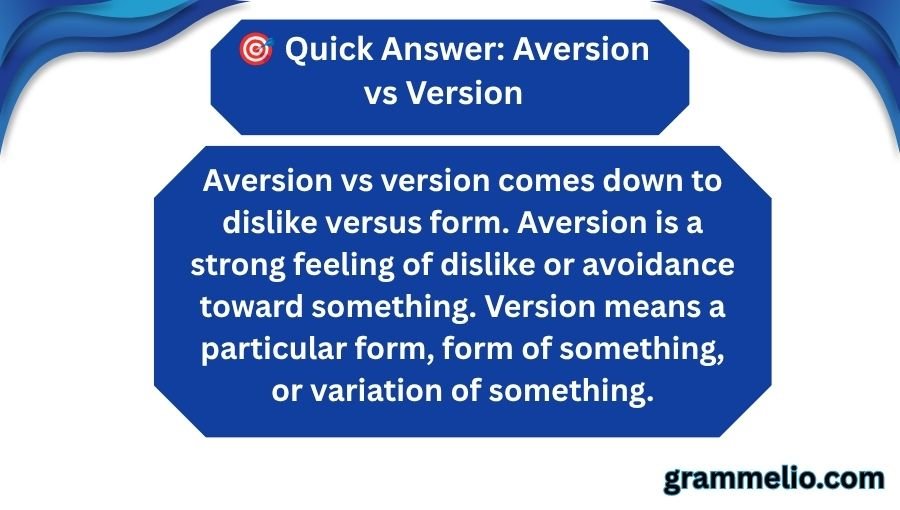
Aversion vs version comes down to dislike versus form. Aversion is a strong feeling of dislike or avoidance toward something. Version means a particular form, form of something, or variation of something.
For example:
- ✅ She has an aversion to loud music.
- ✅ This is the newest version of the software.
A simple memory trick is: aversion = dislike; version = form.
Related Word Forms of Aversion and Version
Both words have related forms that are useful in everyday English. Learning these forms can make the difference easier to recognize in sentences.
| Form | Type | Example |
|---|---|---|
| aversion | noun | He has an aversion to conflict. |
| aversions | plural noun | People can have different aversions. |
| averse | adjective | She is averse to unnecessary risk. |
| version | noun | I read the latest version. |
| versions | plural noun | Several versions are available. |
| versioned | verb form | The files were versioned for tracking. |
| versioning | noun/gerund | Versioning helps teams manage changes. |
The most common forms you will need are aversion, averse, version, and versions. Do not assume that averse and version are related simply because they look somewhat alike. They serve different roles and meanings.
🔎 What Is the Difference Between Aversion and Version?
The central difference between aversion and version is meaning.
Aversion describes a strong dislike, resistance, or desire to avoid something. It is a feeling or attitude.
Version describes a particular form of something. It may refer to a book, product, software release, story, document, idea, or other item that exists in more than one form.
| Form | Type | Meaning | Example | Correct/Incorrect |
|---|---|---|---|---|
| aversion | noun | Strong dislike or avoidance | She has an aversion to spiders. | ✅ Correct |
| version | noun | A particular form of something | I downloaded the newest version. | ✅ Correct |
| aversion | noun | A particular edition of a product | I installed the newest aversion. | ❌ Incorrect |
| version | noun | Strong dislike | He has a version to crowds. | ❌ Incorrect |
The easiest question to ask yourself is:
Am I talking about dislike or a form of something?
If you mean dislike, choose aversion. If you mean a particular form, choose version.
📘 Aversion: Meaning and Correct Use
Aversion is a noun meaning a strong dislike or strong desire to avoid something.
It often appears with to:
aversion to + noun or gerund
Examples include:
- ✅ He has an aversion to crowded places.
- ✅ She developed an aversion to driving at night.
- ✅ I have always had an aversion to unnecessary arguments.
Notice that aversion describes a feeling. It does not identify a copy, edition, or form of something.
Common Uses of Aversion
Aversion can describe dislike toward many things:
- food
- smells
- situations
- people
- habits
- activities
- risks
- conflict
- certain ideas
| Meaning | Word Type | Example Sentence |
|---|---|---|
| Strong dislike | Noun | She has an aversion to seafood. |
| Desire to avoid something | Noun | His aversion to conflict affects his work. |
| Strong negative feeling | Noun | The child showed an aversion to the medicine. |
Aversion in Everyday Speech
You might say:
I have an aversion to extremely spicy food.
This means you strongly dislike or tend to avoid extremely spicy food.
You could also say:
She has an aversion to public speaking.
This means public speaking makes her uncomfortable or is something she strongly dislikes or avoids.
💡 Test Tip
Try replacing aversion with strong dislike.
If the sentence still makes sense, aversion is probably the correct choice.
For example:
He has an aversion to flying.
Replace it:
He has a strong dislike of flying.
The basic idea remains clear, so aversion works.
📗 Version: Meaning and Correct Use
Version is a noun that means a particular form of something.
A version can be an updated form, an older form, a different form, or one person’s form of a story or account.
For example:
- ✅ I need the latest version of the report.
- ✅ She gave me her version of what happened.
- ✅ The company released a new version of the app.
Version is common in technology, writing, publishing, business, entertainment, and everyday conversation.
Common Meanings of Version
| Meaning | Word Type | Example Sentence |
|---|---|---|
| Particular form of something | Noun | This is the final version. |
| Updated form | Noun | Download the newest version. |
| Person’s account | Noun | I heard his version of the story. |
| Adapted form | Noun | The film is a modern version of the novel. |
Version in Technology
Technology provides some of the most common uses of version.
You might hear:
- software version
- app version
- operating system version
- beta version
- latest version
- previous version
- updated version
For example:
Make sure you have the latest version of the app.
Here, version means a particular release or form of the app.
Version in Stories and Events
Version can also mean someone’s account of an event.
For example:
That is his version of what happened.
This does not mean he dislikes the event. It means he is presenting his particular account or interpretation.
🧠 Aversion vs Version at a Glance
The quickest way to understand aversion vs version is to compare their meanings and typical sentence patterns.
| Feature | Aversion | Version |
|---|---|---|
| Main meaning | Strong dislike | Particular form |
| Part of speech | Noun | Noun |
| Common pattern | aversion to | version of |
| Example | aversion to noise | version of the story |
| Main idea | Avoidance or dislike | Form or variation |
| Common field | Feelings and attitudes | Writing, technology, products, stories |
Another useful clue is the word that often follows each noun.
Aversion commonly appears with to:
an aversion to crowds
Version commonly appears with of:
a version of the story
This pattern is not an absolute grammar rule, but it is a useful memory aid.
❓ Is Aversion the Same as Version?
No. Aversion and version do not mean the same thing.
Aversion means a strong dislike or tendency to avoid something. Version means a particular form, variation, edition, or account of something.
Compare:
- ✅ She has an aversion to dogs.
- ❌ She has a version to dogs.
The first sentence describes a feeling of dislike. The second does not make sense in standard English.
Now compare:
- ❌ I downloaded the latest aversion of the software.
- ✅ I downloaded the latest version of the software.
The second sentence correctly identifies a particular release of the software.
❓ Why Do People Confuse Aversion and Version?
People confuse these words mainly because they have similar spelling patterns and share several letters.
Both words end in -sion, and both can appear in formal writing. When someone is typing quickly, the brain may recognize the general shape of the word before carefully checking each letter.
I once edited a short workplace memo where the writer had typed “new aversion of the policy” instead of “new version of the policy.” The meaning was clear from context, but the wrong word changed the sentence into something that sounded like the policy itself was disliked.
The mistake was easy to fix, but it shows why spelling alone is not enough. You must check meaning. Understanding aversion vs version becomes much easier when you focus on meaning rather than spelling.
| Confusion | Intended Meaning | Correct Word |
|---|---|---|
| aversion/version | Strong dislike | aversion |
| aversion/version | Particular form | version |
| aversion/version | Updated software | version |
| aversion/version | Strong avoidance | aversion |
| aversion/version | Different account of an event | version |
❓ How Can You Remember Aversion vs Version?
Use a simple meaning test.
Aversion = dislike.
Version = variation or form.
You can also remember these two common patterns:
- aversion to something
- version of something
For example:
She has an aversion to flying.
This is a new version of the book.
| Memory Clue | Word | Example |
|---|---|---|
| Dislike | aversion | aversion to noise |
| Avoidance | aversion | aversion to conflict |
| Form | version | version of the plan |
| Edition | version | latest version |
| Account | version | his version of events |
If you remember only one rule, remember this:
Aversion is about how you feel. Version is about what form something takes.
📝 Case Study: A Workplace Email
Imagine that a manager sends this email:
❌ Please review the latest aversion of the employee handbook.
The reader can probably guess what the writer means. However, aversion is wrong because the manager is referring to a particular form of the handbook.
The corrected sentence is:
✅ Please review the latest version of the employee handbook.
Now imagine a different email:
❌ The employee has a version to working late.
That sentence needs aversion:
✅ The employee has an aversion to working late.
Here, the writer is describing a strong dislike or tendency to avoid something.
This small distinction can make workplace writing look much more polished.
📚 Grammar Rules Explanation
The grammar rule is based on the different meanings and functions of the two nouns.
Aversion names a feeling of strong dislike or avoidance. It often takes to when identifying the thing that causes the negative feeling.
Examples:
- an aversion to noise
- an aversion to risk
- an aversion to conflict
Version, on the other hand, names a particular form of something. It commonly appears with of when identifying the thing being described.
Examples:
- a version of the report
- a version of the story
- a version of the software
Standard English references agree on this basic distinction. The key is not simply spelling. The meaning of the sentence determines the correct word.
Correct vs Incorrect at a Glance
| Sentence | Correct/Incorrect | Why |
|---|---|---|
| She has an aversion to heights. | ✅ Correct | It describes strong dislike or avoidance. |
| She has a version to heights. | ❌ Incorrect | Version does not mean dislike. |
| I downloaded the newest version. | ✅ Correct | Version means a particular form or release. |
| I downloaded the newest aversion. | ❌ Incorrect | Aversion does not mean software release. |
| He gave his version of the story. | ✅ Correct | Version can mean someone’s account. |
⚠️ Common Mistakes With Aversion and Version
These errors usually happen because the words look similar.
1. Fast typing
When people type quickly, they may produce a familiar-looking word without checking its meaning.
2. Autocorrect
Autocorrect can sometimes make a word look polished even when it is not the word you intended.
3. Lack of knowledge
If someone has never learned the difference, aversion and version can easily blend together.
I once caught myself typing “aversion” when I meant “version” while reviewing a software guide. I noticed the error because the sentence was about an update, not a feeling. That quick meaning check saved the sentence.
Similar Grammar Confusions
| Confusing Pair | Correct Distinction |
|---|---|
| it’s / its | contraction / possession |
| your / you’re | possession / you are |
| their / they’re | possession / they are |
| affect / effect | influence / result |
| accept / except | receive / excluding |
| advice / advise | noun / verb |
The same lesson applies here: do not choose a word only because it looks right. Check what the sentence means.
Common Wrong Forms for This Specific Pair
| Wrong Form | What’s Wrong | Correct Form |
|---|---|---|
| latest aversion | Uses dislike instead of form | latest version |
| aversion of the app | Uses the wrong noun | version of the app |
| version to crowds | Uses form instead of dislike | aversion to crowds |
| a version to conflict | Wrong noun and pattern | an aversion to conflict |
| new aversion of the report | Wrong word for an updated form | new version of the report |
| strong version to risk | Wrong noun for strong dislike | strong aversion to risk |
🕰️ Word History and Development
The two words have different histories even though their modern spellings can look similar.
Aversion is connected with the idea of turning away or having a strong dislike. Its history is tied to older Latin-based word forms associated with turning away.
Version has a different history and is connected with the idea of turning, changing, or presenting something in another form. Over time, the word became common for describing a particular form or account of something.
The important lesson is that similar spelling does not mean similar meaning.
| Period | Form | General Note |
|---|---|---|
| Older English usage | aversion | Developed around the idea of turning away or dislike |
| Older English usage | version | Developed around the idea of a form or rendering |
| Later usage | aversion | Became established as a noun for strong dislike |
| Later usage | version | Became common for forms, editions, and accounts |
| Modern English | aversion/version | Both remain common but have separate meanings |
You do not need to memorize the history to use these words correctly. The modern meaning is what matters most.
🌎 Usage in Different Contexts
Both words appear in many forms of communication, but they serve different purposes.Context is one of the easiest ways to understand aversion vs version and choose the correct word.
| Context | Which Term to Use | Example |
|---|---|---|
| Everyday conversation | aversion | I have an aversion to scary movies. |
| Professional writing | version | Please use the latest version of the contract. |
| Creative writing | either, depending on meaning | She had an aversion to the old house. |
| Social media/texting | either, depending on meaning | Here’s my version of the story. |
Everyday Conversation
Use aversion when discussing strong dislike:
I have an aversion to very crowded restaurants.
Use version when discussing a form or account:
That’s not my version of what happened.
Professional Writing
Version is especially common in professional documents:
Please review version three before the meeting.
Aversion can appear when discussing attitudes:
The client has an aversion to high-risk investments.
Creative Writing
Writers may use both words:
Her aversion to the dark had started when she was young.
Or:
The director created a darker version of the original story.
Social Media and Texting
People often use version when telling their side of an event:
Okay, here’s my version of what happened.
Aversion can appear in casual posts about strong dislikes:
My lifelong aversion to early mornings is real.
💬 Common Phrases With Aversion
There are several natural expressions that commonly use aversion.
| Phrase | Meaning |
|---|---|
| aversion to risk | Strong dislike of taking risks |
| aversion to conflict | Desire to avoid conflict |
| aversion to change | Strong dislike of change |
| aversion to crowds | Strong dislike or avoidance of crowds |
| strong aversion | Very strong dislike |
| natural aversion | A natural tendency to avoid something |
These phrases are useful because they make the word easier to recognize in real sentences.
🔤 Common Phrases With Version
Version also appears in many common expressions.
| Phrase | Meaning |
|---|---|
| latest version | Most recent form |
| previous version | Earlier form |
| new version | Newly changed form |
| original version | First or earlier form |
| updated version | Changed or improved form |
| version of the story | Particular account of events |
For example:
Please send me the updated version.
And:
I have a different version of the story.
🔄 Synonyms and Alternatives
Knowing similar words can help you choose the right expression.
For aversion, possible alternatives include dislike, distaste, reluctance, and discomfort, although they are not always exact replacements.
For version, possible alternatives include form, edition, variant, and account, depending on context.
| Alternative | Works When | Does Not Work When |
|---|---|---|
| dislike | You mean a negative feeling | You mean a particular form |
| distaste | You mean strong dislike | You mean an edition |
| reluctance | You mean unwillingness | You mean a software release |
| form | You mean a particular shape or type | You mean strong dislike |
| edition | You mean a published or released form | You mean an emotional reaction |
Choosing a synonym should depend on the exact meaning. Version is not always interchangeable with form, and aversion is not always identical to dislike.
❓ Can Aversion Be Used for a Version of Something?
No. Aversion should not be used to mean a version or edition.
For example:
❌ The company released a new aversion of its software.
Correct:
✅ The company released a new version of its software.
The first sentence suggests a strong dislike, which is not the intended meaning.
❓ Can Version Mean Strong Dislike?
No. Version does not normally mean strong dislike or avoidance.
For example:
❌ She has a version to loud music.
Correct:
✅ She has an aversion to loud music.
If you mean a negative feeling, aversion is the appropriate noun.
❓ What Is the Difference Between an Aversion and a Dislike?
An aversion is a strong dislike or tendency to avoid something. Dislike is a broader and often less intense word.
For example:
I dislike coffee.
This simply says you do not like coffee.
I have an aversion to coffee.
This can suggest a stronger negative reaction or a strong desire to avoid it.
❓ What Is the Difference Between a Version and an Edition?
A version is a particular form of something. An edition often refers to a particular release of a published work, product, or document.
For example:
the latest version of the software
and:
the second edition of the textbook
The words overlap in some situations, but they are not always interchangeable.
❓ Should I Say “Aversion To” or “Aversion Of”?
In standard usage, aversion to is the common pattern when you identify the thing that someone dislikes or avoids.
Examples:
- an aversion to noise
- an aversion to conflict
- an aversion to risk
So, when describing the object of the dislike, aversion to is the safest and most natural choice.
❓ Should I Say “Version Of” or “Version To”?
The usual pattern is version of when you identify what the version belongs to or represents.
Examples:
- a version of the report
- a version of the movie
- a version of the story
This makes version of an excellent pattern to remember.
❓ Is “Aversion” a Verb?
No. Aversion is a noun.
The related adjective is averse, as in:
She is averse to unnecessary risk.
Do not treat aversion as a verb.
❓ Is “Version” a Verb?
Version is primarily used as a noun in everyday English, but it can also appear as a verb in specialized technical contexts, especially when discussing version control or managing different versions of files and software.
For ordinary writing, however, the noun version is by far the more common form.
❓ What Is an Easy Trick for Remembering Aversion vs Version?
Use this short rule:
Aversion = dislike. Version = form.
Then check the common patterns:
aversion to something
version of something
If the sentence is about a feeling, think aversion. If it is about a form, edition, release, or account, think version.
🎯 How to Remember the Difference
Here is a simple two-word memory trick:
AVERSION = AVOID
Both ideas are connected to staying away from something.
VERSION = VARIATION
A version is one form or variation of something.
| Word | Memory Word | Meaning |
|---|---|---|
| aversion | avoid | Strong dislike or avoidance |
| version | variation | A particular form |
Try saying the pair aloud:
Aversion = avoid.
Version = variation.
This small connection can make the distinction much easier to remember.
📱 Why the Difference Matters in Digital Communication
Word choice matters even in short messages.
A typo such as “aversion” instead of “version” can make a sentence sound strange or change its meaning.
Imagine a software support message:
❌ Please install the newest aversion.
The reader may understand what you meant, but the sentence looks unprofessional.
The corrected sentence is:
✅ Please install the newest version.
In digital communication, small errors are highly visible because people often read messages quickly. Correct word choice helps your writing look clear and trustworthy.
⭐ Why Getting Aversion and Version Right Matters
Using the correct word helps readers understand your exact meaning without stopping to decode the sentence.
| Situation | Why Getting It Right Matters |
|---|---|
| Resume | Shows careful writing |
| Client email | Prevents confusion |
| Published content | Improves accuracy |
| Social post | Makes the message clearer |
A useful writing principle is:
Clear words make clear ideas.
That rule applies to every kind of writing, from a two-line text message to a formal report.
❓ Why Does Context Matter So Much?
Context tells readers whether you are describing a feeling or a form.
Consider:
She has an aversion to the new policy.
The context shows that she strongly dislikes or avoids the policy.
Now consider:
She reviewed the new version of the policy.
The context shows that the policy has a particular form or revision.
The surrounding words make the intended meaning clear.
🧩 Practice With Real Examples
Let’s test the difference with several short examples.
Example 1
I have an ___ to bitter foods.
The answer is aversion.
✅ I have an aversion to bitter foods.
Why? The sentence describes strong dislike.
Example 2
Please download the latest ___.
The answer is version.
✅ Please download the latest version.
Why? The sentence refers to a particular release or form.
Example 3
He gave his ___ of the events.
The answer is version.
✅ He gave his version of the events.
Why? He is giving his particular account.
Example 4
She has an ___ to confrontation.
The answer is aversion.
✅ She has an aversion to confrontation.
Why? The sentence describes a strong tendency to avoid something.
| Sentence Clue | Answer | Reason |
|---|---|---|
| strong dislike | aversion | Feeling |
| latest software | version | Release/form |
| account of events | version | Particular account |
| desire to avoid | aversion | Negative feeling |
| updated document | version | New form |
❓ Which Word Should You Use in a Sentence?
Ask yourself what you are describing.
If you are describing a strong dislike, use aversion.
If you are describing a particular form, use version.
This simple question solves most cases.
| Question | If Yes → Use |
|---|---|
| Does the sentence describe strong dislike? | aversion |
| Does it describe avoidance? | aversion |
| Does it describe an updated form? | version |
| Does it describe an edition or release? | version |
| Does it describe someone’s account? | version |
📝 Quick Recap Checklist
The key to remembering aversion vs version is simple: one describes dislike, while the other describes a particular form. Before publishing or sending your sentence, ask:
- Am I describing a strong dislike?
- Am I describing a form, release, or account?
- Does aversion to fit the sentence?
- Does version of fit the sentence?
Remember:
- Aversion = strong dislike or avoidance.
- Version = particular form or variation.
- Aversion to is a common pattern.
- Version of is a common pattern.
Practice Examples
1. She has an ___ to public speaking.
✅ aversion
2. Please send the newest ___ of the document.
✅ version
3. That is his ___ of what happened.
✅ version
❓ Is “Aversion vs Version” Easy to Remember?
Yes. Once you connect each word with its main meaning, the difference becomes simple.
Aversion is about a strong negative feeling or desire to avoid something.
Version is about a particular form, release, edition, or account.
The words may look similar, but their jobs are different.
FAQs About Aversion vs Version
What does aversion mean?
Aversion means a strong dislike or a strong tendency to avoid something. It is a noun and commonly appears in the phrase “aversion to.”
What does version mean?
Version means a particular form, variation, edition, release, or account of something. For example, you can have a new version of software or a different version of a story.
Is aversion the opposite of version?
No. They are not opposites. They simply have different meanings. Aversion refers to dislike or avoidance, while version refers to a particular form of something.
Is it “aversion to” or “version to”?
Use aversion to when describing something that a person strongly dislikes or avoids.
Example:
He has an aversion to conflict.
Use version of when identifying a particular form or account.
Example:
She gave her version of the story.
Is it “version of” or “aversion of”?
For a particular form, edition, release, or account, use version of.
Example:
This is the latest version of the report.
Aversion should not replace version in this sentence.
Can aversion mean avoidance?
Yes. Aversion can describe a strong dislike that leads someone to avoid something.
For example:
Her aversion to crowds means she prefers quiet places.
Can version mean an opinion?
Sometimes version can refer to someone’s account or presentation of events. It does not directly mean “opinion,” but a person’s version of events may reflect their understanding or interpretation.
What is the easiest way to remember aversion and version?
Remember:
Aversion = avoid or dislike.
Version = variation or form.
Also remember the common patterns aversion to and version of.
Which is correct: “new aversion” or “new version”?
If you mean a new form, release, or edition, use new version.
✅ The company released a new version of the app.
New aversion would mean a new strong dislike, which is a very different idea.
Why do people confuse aversion and version?
They look and sound somewhat similar, especially when typed quickly. Autocorrect and unfamiliarity can also contribute to the mistake. Checking the meaning of the sentence is the best way to avoid confusion.
🎯 Conclusion
Aversion vs version is easy to understand once you remember the main difference: aversion means strong dislike or avoidance, while version means a particular form, variation, release, or account of something. ✨
Use aversion when you are talking about a feeling, especially with the common pattern aversion to. Use version when you are talking about a particular form, edition, release, or account, often with version of.
For example:
✅ She has an aversion to crowded places.
✅ I downloaded the latest version of the app.
The words may look alike, but their meanings are far apart. When you are unsure, stop and ask one simple question: Am I talking about dislike or a form of something?
If the answer is dislike, choose aversion. If the answer is a form, choose version.
Remember: aversion is about what you avoid; version is about what form something takes.

[…] you connect each spelling with its meaning, the confusion becomes much easier to avoid. Aversion vs Version | Avenge vs Revenge | Augur vs […]
[…] the end, you should never have to guess between them again. ✍️ Awful vs Offal |Aversion vs Version | Avenge vs […]