Have you ever typed a word that sounded right but looked completely wrong on the screen? That can easily happen with awful vs offal.
The two words look and sound similar, but they have very different meanings. One describes something very bad, unpleasant, or shocking.
The other refers to edible animal organs and other parts that are commonly used as food. 😅
As an English editor, I often see these words confused because they differ by only one letter and can sound close in fast speech.
Yet using the wrong one can completely change a sentence. If you are writing a restaurant review, discussing food, describing an experience, or simply trying to improve your spelling, knowing the difference is useful.
The good news is that the rule is simple. Awful describes something extremely bad or unpleasant. Offal is a food-related noun for certain edible animal parts.
Once you connect each spelling with its meaning, the confusion becomes much easier to avoid. Aversion vs Version | Avenge vs Revenge | Augur vs Auger
🎯 Quick Answer: What Is the Difference Between Awful vs Offal?
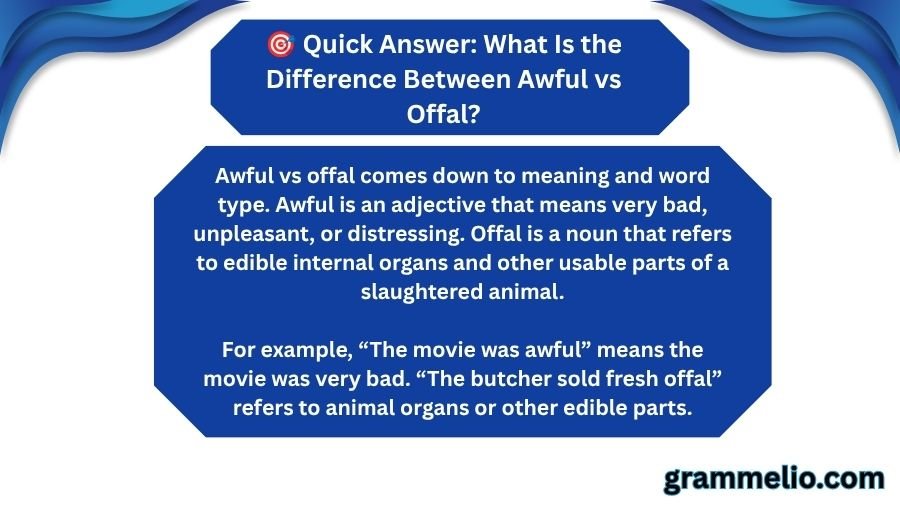
Awful vs offal comes down to meaning and word type. Awful is an adjective that means very bad, unpleasant, or distressing. Offal is a noun that refers to edible internal organs and other usable parts of a slaughtered animal.
For example, “The movie was awful” means the movie was very bad. “The butcher sold fresh offal” refers to animal organs or other edible parts.
| Word | Word Type | Meaning | Example |
|---|---|---|---|
| awful | Adjective | Very bad or unpleasant | The weather was awful. |
| offal | Noun | Edible animal organs or other parts | The butcher prepared the offal. |
🔎 Related Word Forms of Awful and Offal
The two words have different related forms because they belong to different parts of speech. Awful is an adjective, while offal is mainly used as a noun.
| Form | Type | Example |
|---|---|---|
| awful | Adjective | That was an awful mistake. |
| awfully | Adverb | The room was awfully cold. |
| awfulness | Noun | The awfulness of the situation surprised everyone. |
| offal | Noun | Some recipes include offal. |
| offals | Plural noun, uncommon | Different offals may be prepared in different ways. |
The form awfully can mean “very” in informal modern English, as in “I am awfully sorry.” It can also mean “in an awful manner,” depending on context.
Offal is normally treated as a mass noun when talking about animal organs as food. You will most often see it without a plural ending.
📚 Understanding the Basics of Awful vs Offal
The easiest way to remember the difference is to ask what the sentence is talking about.
If the word describes something that is very bad, choose awful.
If the word refers to edible animal organs or parts, choose offal.
| Form | Type | Meaning | Example | Correct/Incorrect |
|---|---|---|---|---|
| awful | Adjective | Very bad or unpleasant | The smell was awful. | ✅ Correct |
| offal | Noun | Edible animal organs or parts | The chef prepared the offal. | ✅ Correct |
| awful | Noun for animal organs | Not the standard meaning | The butcher sold awful. | ❌ Incorrect |
| offal | Adjective meaning bad | Not the standard meaning | It was an offal movie. | ❌ Incorrect |
| awful | Adjective | Extremely unpleasant | We had an awful experience. | ✅ Correct |
| offal | Noun | Animal parts used as food | The recipe calls for offal. | ✅ Correct |
What Does Awful Mean?
Awful is an adjective used to describe something very bad, unpleasant, harmful, upsetting, or unpleasant to experience.
It can describe:
- a bad experience
- terrible weather
- an unpleasant smell
- poor behavior
- a serious situation
- something that causes distress
- something of very poor quality
For example:
The traffic was awful.
Here, awful describes the traffic. It tells us that the traffic was extremely unpleasant or difficult.
Another example is:
She felt awful after hearing the news.
Here, awful describes how she felt.
What Does Offal Mean?
Offal is a noun for edible internal organs and certain other parts of an animal that are used as food.
Depending on the food tradition, offal can include items such as:
- liver
- kidneys
- heart
- tongue
- tripe
- other edible organs or animal parts
For example:
The restaurant serves dishes made with offal.
Here, offal is the name of a type of food.
The key point is that offal is a food-related noun, while awful describes something.
❓ Is Awful the Same as Offal?
No. Awful and offal are not interchangeable. Awful describes something very bad or unpleasant, while offal refers to edible animal organs and related parts.
| Question | Answer |
|---|---|
| Does it describe something bad? | Use awful. |
| Is it an animal food product? | Use offal. |
| Is it an adjective? | Usually awful. |
| Is it a noun? | Offal. |
| Is it about cooking or butchery? | Offal may be the correct word. |
Awful in Everyday Sentences
Awful is common in everyday English. It can describe both physical situations and emotional reactions.
Consider these examples:
The coffee tasted awful. ✅
The speaker thinks the coffee tasted very bad.
I had an awful headache. ✅
The headache was extremely unpleasant.
That was an awful thing to say. ✅
The speaker strongly disapproves of the comment.
We had awful weather during our trip. ✅
The weather was very unpleasant.
❌ The chef cooked awful for dinner.
This sentence is incorrect if the writer means animal organs. The intended word would be offal, although the sentence would still need a suitable structure, such as “The chef cooked offal for dinner.”
Offal in Food and Cooking
Offal appears most often in discussions about food, farming, butchery, cooking, and traditional cuisine.
For example:
The market sells fresh offal. ✅
The recipe uses beef liver and other offal. ✅
Some diners enjoy dishes made from offal. ✅
The word does not describe whether the food is good or bad. Offal can be prepared well or badly.
That distinction matters.
The offal was delicious. ✅
Here, offal identifies the food, while delicious tells us what it tasted like.
The offal was awful. ✅
This sentence is also grammatically correct. It means the offal tasted or seemed very bad.
Notice how both words can appear in the same sentence while keeping completely different jobs.
💡 Test Tip: How Can You Tell Which Word to Use?
Try replacing the word with terrible.
If “terrible” makes sense, you probably need awful.
The service was terrible.
The service was awful.
Both work.
Now try replacing the word with animal organs.
The butcher sells animal organs.
The butcher sells offal.
Both ideas work.
| Replacement Test | If It Works | Use |
|---|---|---|
| Replace it with “terrible” | Yes | awful |
| Replace it with “very bad” | Yes | awful |
| Replace it with “animal organs” | Yes | offal |
| Replace it with “edible animal parts” | Yes | offal |
| Talking about a bad experience | Yes | awful |
| Talking about food from animal organs | Yes | offal |
📝 Awful vs Offal in a Real-Life Case Study
Imagine you are writing an email after visiting a restaurant.
You want to say that the restaurant served an animal-organ dish, but you did not enjoy it.
You might write:
“The restaurant served offal, but unfortunately, I found the dish awful.” ✅
This sentence is useful because it shows the difference perfectly.
Offal identifies what was served.
Awful gives the writer’s opinion about the food.
I once edited a short food review where the writer used awful when discussing a traditional organ-meat dish. The writer did not mean that the food was terrible. They meant the food category itself. Changing the word to offal completely fixed the meaning.
| Sentence | Intended Meaning | Correct Word |
|---|---|---|
| The meal was very bad. | Negative opinion | awful |
| The chef prepared animal organs. | Type of food | offal |
| The smell was terrible. | Bad smell | awful |
| The recipe includes liver and kidneys. | Animal food parts | offal |
| The offal tasted terrible. | Bad opinion about offal | Both |
📖 Grammar Rules Explanation
The basic grammar rule is straightforward.
Awful is an adjective. It modifies or describes a noun.
Examples:
an awful smell
an awful mistake
an awful movie
an awful experience
Offal is a noun. It names a type of food or animal material.
Examples:
fresh offal
cooked offal
beef offal
offal dishes
Because the words have different grammatical jobs, they cannot normally replace each other.
Most standard English reference sources agree on this basic distinction. The safest approach is to focus on meaning rather than pronunciation.
Correct vs Incorrect at a Glance
| Sentence | Correct/Incorrect | Why |
|---|---|---|
| The weather was awful. | ✅ Correct | Awful describes the weather. |
| The butcher sold fresh offal. | ✅ Correct | Offal names animal food parts. |
| The movie was offal. | ❌ Incorrect | Offal does not mean terrible. |
| The chef prepared awful for dinner. | ❌ Incorrect | Awful is not the noun for animal organs. |
| The offal tasted awful. | ✅ Correct | The two words have different meanings and roles. |
⚠️ Common Mistakes With Awful and Offal
The spelling similarity makes awful vs offal a common problem for writers who type quickly. People confuse these words mainly because they look and sound similar. The first two letters are identical, and both words are short.
Fast typing can make the problem worse. Autocorrect may also fail to catch the mistake because awful and offal are both real English words.
A lack of knowledge can create the same problem. If someone has only seen one of these words in writing, they may guess the spelling when they need the other.
I once caught myself typing offal when I meant awful in a quick editing note. I was moving too fast and had the sound of the word in my head instead of checking the meaning. A five-second reread caught it.
Similar English Confusions
| Confusing Pair | Correct Difference |
|---|---|
| its / it’s | its shows possession; it’s means “it is” or “it has.” |
| your / you’re | your shows possession; you’re means “you are.” |
| their / they’re | their shows possession; they’re means “they are.” |
| affect / effect | Usually affect is a verb and effect is a noun, with exceptions. |
| advice / advise | Advice is a noun; advise is a verb. |
| then / than | Then relates to time or sequence; than is used in comparisons. |
Specific Wrong Forms and Uses
| Wrong Form | What’s Wrong | Correct Form |
|---|---|---|
| offal experience | Usually does not mean a terrible experience | awful experience |
| awful from the butcher | Does not name animal organs | offal from the butcher |
| an offal movie | Offal does not mean bad | an awful movie |
| cooked awful | Wrong noun if referring to animal organs | cooked offal |
| awful meat parts | Awful describes quality, not the food category | offal |
| the food was offal | Incorrect if the intended meaning is “terrible” | the food was awful |
❓ Why Do People Confuse Awful and Offal?
People confuse awful vs offal because the spellings are almost identical. They share the letters a/o + ff + al, and their sounds can be easy to mix up in quick conversation.
There is also a strong visual similarity.
| Feature | Awful | Offal |
|---|---|---|
| Starts with | Aw | Of |
| Contains double f | Yes | Yes |
| Ends with | -ful | -fal |
| Part of speech | Adjective | Noun |
| Main topic | Quality or condition | Animal food parts |
| Describes something bad | Yes | No |
The difference becomes much easier when you attach an image to each word.
Think:
Awful = terrible.
Offal = animal food parts.
That simple mental pair can prevent most mistakes.
🧠 How to Remember the Difference
A useful memory trick is to connect awful with awful experiences. This simple trick can help you remember awful vs offal whenever you are unsure which word to choose.
If something makes you say:
“That was terrible!”
you need awful.
For offal, think about a butcher shop, meat market, or kitchen.
If you are naming animal organs or other edible animal parts, use offal.
| Memory Clue | Word |
|---|---|
| Terrible | awful |
| Very bad | awful |
| Unpleasant | awful |
| Animal organs | offal |
| Butcher shop | offal |
| Food made from animal parts | offal |
Another useful trick is to remember that offal is a thing, while awful is a description.
That is not a perfect grammar rule for every sentence, but it is a very helpful beginner’s test.
❓ Can Awful and Offal Appear in the Same Sentence?
Yes. They can easily appear together because they perform different jobs.
For example:
The offal was awful. ✅
Here, offal tells us what the food was. Awful tells us the speaker disliked it.
Another example:
The chef prepared an offal dish, but the final result was awful. ✅
Again, the first word identifies the food. The second describes its quality.
| Sentence | Role of Awful | Role of Offal |
|---|---|---|
| The offal was awful. | Describes the food | Names the food |
| The awful smell came from the offal. | Describes the smell | Identifies the source |
| She disliked the awful offal dish. | Describes the dish | Identifies the dish type |
🌎 Usage in Different Contexts
The right word depends on the subject of the sentence. Knowing awful vs offal is especially useful when writing about food, reviews, recipes, or everyday experiences.
| Context | Which Term to Use | Example |
|---|---|---|
| Everyday conversation | awful | That was an awful day. |
| Professional writing | awful | The company faced an awful situation. |
| Creative writing | Either, depending on meaning | The awful smell came from the offal. |
| Social media/texting | awful | That movie was awful! |
| Cooking | offal | The recipe uses beef offal. |
| Butchery | offal | The shop sells fresh offal. |
In normal conversation, awful is much more common because people frequently use it to describe bad experiences.
Offal is more specialized. You are more likely to encounter it in cooking, food writing, farming, butchery, or discussions of traditional dishes.
🍽️ Common Phrases With Awful
Unlike offal, awful appears in many everyday phrases.
| Phrase | Meaning |
|---|---|
| an awful lot | A very large amount |
| feel awful | Feel very bad physically or emotionally |
| look awful | Look very bad or unwell |
| smell awful | Have a very unpleasant smell |
| sound awful | Seem very unpleasant |
| an awful experience | A very unpleasant experience |
For example:
I feel awful about what happened.
Here, awful describes the speaker’s emotional state.
Another common expression is an awful lot, which means a large amount.
She has an awful lot of work to finish.
In this expression, awful does not literally mean terrible. It strengthens the idea of “a lot.”
🥩 Common Uses of Offal
Offal is commonly used when talking about food made from animal organs or certain other edible animal parts.
| Expression | Meaning |
|---|---|
| fresh offal | Recently prepared animal food parts |
| cooked offal | Offal that has been prepared as food |
| beef offal | Offal from cattle |
| offal dishes | Foods prepared with offal |
| offal market | A market where such products are sold |
The word can appear in both casual and technical food writing.
For example:
The restaurant specializes in traditional offal dishes.
The sentence is clear because the topic is food.
❓ Which Word Should You Use in Professional Writing?
Use awful when you need an adjective that describes something as very bad or unpleasant. Use offal when the subject is animal food parts.
Professional writing requires extra care because a spelling error can change the meaning completely.
For example:
The company had an awful quarter.
This means the quarter was very bad.
But:
The company had an offal quarter.
This would be confusing and almost certainly incorrect unless Offal were part of a proper name or unusual context.
When editing professional work, I recommend checking the word’s role in the sentence before checking its spelling.
✍️ Awful vs Offal in Creative Writing
Creative writers can use both words effectively.
An author might write:
An awful smell drifted from the kitchen where the chef was preparing offal.
This sentence creates a clear image.
The writer could also create humor by placing the words together:
The offal was not awful at all.
That sentence is grammatically correct and uses the similar sounds for wordplay.
| Creative Purpose | Suitable Word |
|---|---|
| Describe a frightening scene | awful |
| Describe a bad smell | awful |
| Name a food ingredient | offal |
| Create a wordplay joke | Both |
| Describe a character’s reaction | awful |
| Describe traditional organ-based food | offal |
❓ Is Offal Always Bad Food?
No. Offal does not mean bad food.
The word simply identifies a category of animal food parts. Whether the dish tastes good or bad depends on preparation, ingredients, cooking skill, and personal taste.
For example:
The offal was carefully seasoned and delicious. ✅
This sentence shows why the distinction matters.
Offal tells us what was served.
Delicious tells us that the writer liked it.
Similarly:
The offal was awful. ✅
This means the writer thought the offal was very unpleasant.
🔄 Synonyms and Alternatives
You can sometimes replace awful with other words, but the best choice depends on the exact meaning.
| Alternative | Works When | Does Not Work When |
|---|---|---|
| terrible | Something is very bad | You mean animal organs |
| horrible | Something is very unpleasant | You need a food noun |
| dreadful | Something is very unpleasant | You are naming offal |
| unpleasant | Something causes discomfort | You specifically mean animal organs |
| poor | Quality is low | You need the specific meaning of offal |
There are fewer simple replacements for offal because it names a specific category of food. Depending on context, you might say animal organs or organ meat, but those phrases may not cover every use of offal exactly.
❓ Why Does Getting Awful and Offal Right Matter?
Correct word choice makes your writing easier to understand. A small spelling difference can create a completely different meaning.
Imagine a food blogger writing:
“This restaurant serves awful dishes.”
That means the dishes are very bad.
Now imagine:
“This restaurant serves offal dishes.”
That means the restaurant serves dishes made with offal.
One letter changes the message.
A clear writer checks not only spelling but also meaning. This is especially useful in emails, articles, menus, reviews, recipes, and social media posts.
Clear words create clear messages.
| Situation | Why Getting It Right Matters |
|---|---|
| Resume | Shows careful writing |
| Client email | Prevents confusing messages |
| Published content | Protects meaning and credibility |
| Social post | Makes the message clear |
| Food article | Prevents incorrect descriptions |
🎯 A Simple Three-Second Test
When you are unsure, stop and ask:
- Am I describing something as very bad?
- Am I talking about animal organs or related edible parts?
- Which replacement makes sense: terrible or animal organs?
If the answer is terrible, choose awful.
If the answer is animal organs, choose offal.
| If You Mean… | Choose |
|---|---|
| very bad | awful |
| terrible | awful |
| unpleasant | awful |
| animal organs | offal |
| edible animal parts | offal |
| organ-based food | offal |
🧩 Practice Examples
Try choosing the correct word before reading the answers.
Example 1
“The weather was ___ yesterday.”
Answer: awful. ✅
The sentence describes the weather as very bad.
Example 2
“The butcher prepared fresh ___.”
Answer: offal. ✅
The sentence refers to animal food parts.
Example 3
“I felt ___ after hearing the news.”
Answer: awful. ✅
The word describes an emotional state.
Example 4
“The recipe includes liver and other ___.”
Answer: offal. ✅
The sentence names food made from animal organs.
Example 5
“The restaurant’s ___ dish was surprisingly delicious.”
Answer: offal. ✅
The word identifies the type of dish.
❓ What Is the Easiest Way to Remember Awful vs Offal?
The easiest method is to memorize one simple pair:
Awful = terrible.
Offal = animal food parts.
If you remember those two meanings, you can solve almost every common usage problem.
You do not need a complicated grammar rule. You simply need to identify what the sentence means.
❓ Can “Awfully” Replace “Awful”?
Not always. Awfully is an adverb, while awful is an adjective.
Compare:
The movie was awful. ✅
The movie was awfully long. ✅
In the first sentence, awful describes the movie.
In the second, awfully modifies the adjective long.
This is another reason to avoid changing a word based only on how it sounds.
❓ Is “Offals” a Common Plural?
Offal is normally used as a mass noun, so the singular-looking form is common when discussing the food category generally.
For example:
The market sells offal.
You may encounter offals in specialized contexts when different kinds or categories are being discussed, but it is much less common in everyday English.
For most general writing, offal is the natural choice.
❓ Is “Awful” Only Used for Negative Situations?
Mostly, awful is associated with negative ideas, but English has some expressions where it works as an intensifier.
For example:
I have an awful lot of work.
Here, awful strengthens lot rather than directly describing something as terrible.
Still, when you are learning the basic distinction between the two words, remembering awful = very bad is the safest approach.
❓ Which Is Correct: “The Food Was Awful” or “The Food Was Offal”?
Both can be grammatically correct, but they mean different things.
“The food was awful” means the food was very bad or unpleasant.
“The food was offal” means the food consisted of offal, although a more natural sentence would often be “The food was made with offal” or “The dish contained offal.”
So, choose based on what you want to say.
❓ Are Awful and Offal Homophones?
They are not exact homophones in standard English. They have similar-looking spellings and can sound somewhat alike in some accents or fast speech, but they are distinct words.
That difference in sound is another reason why spelling alone should not guide your choice.
❓ What Is a Good Memory Trick for Awful vs Offal?
Use the terrible test.
If you can replace the word with terrible, choose awful.
If you can replace it with animal organs, choose offal.
For example:
The service was terrible.
Therefore:
The service was awful. ✅
And:
The recipe uses animal organs.
Therefore:
The recipe uses offal. ✅
This quick test works well when proofreading.
❓ How Do You Use Awful and Offal in a Sentence?
Use awful as an adjective:
That was an awful mistake.
Use offal as a noun:
The chef prepared the offal carefully.
You can also use both:
The offal smelled awful.
This sentence is a perfect example because each word has a different grammatical role.
❓ What Is the Main Difference Between Awful and Offal?
The main difference is simple:
Awful means very bad, unpleasant, or distressing.
Offal means edible animal organs and certain other animal parts used as food.
They look similar, but they belong to different word categories and describe completely different ideas.
✅ Quick Recap Checklist
Use this checklist whenever you are unsure.
| Question | If Yes → Use |
|---|---|
| Does the word mean very bad? | awful |
| Does it describe an unpleasant experience? | awful |
| Does it describe a bad smell? | awful |
| Are you discussing edible animal organs? | offal |
| Are you talking about organ-based food? | offal |
| Are you discussing butchery or certain meat products? | offal |
Practice
- “That was an ___ movie.” → awful ✅
- “The recipe includes beef ___.” → offal ✅
- “The ___ tasted ___.” → offal / awful ✅
The third example is especially useful because it shows that the words can work together.
❓ How Can You Avoid This Mistake in the Future?
Build a meaning-based habit rather than relying only on sound.
Before typing the word, ask what you are trying to say.
If you mean terrible, write awful.
If you mean animal food parts, write offal.
Then read the whole sentence once. This is especially helpful when using autocorrect or typing quickly on a phone.
I recommend this method to students because it takes only a few seconds. It also works for many other confusing word pairs.
FAQs About Awful vs Offal
These questions cover the most common problems people have with awful vs offal.What does awful mean?
Awful is an adjective that usually means very bad, unpleasant, or distressing. For example, “The weather was awful” means the weather was very unpleasant.
What does offal mean?
Offal is a noun referring to edible internal organs and certain other usable parts of an animal. Liver, kidneys, and heart can be examples of foods described as offal.
Is offal the same as terrible?
No. Offal does not mean terrible. Awful is the word that usually means very bad or unpleasant.
Is awful a noun or an adjective?
Awful is primarily an adjective. It describes nouns, as in “an awful smell,” “an awful mistake,” or “an awful experience.”
Is offal a noun or an adjective?
Offal is a noun. It names a category of animal food parts.
Can you use awful and offal together?
Yes. For example, “The offal was awful” is grammatically correct. Offal names the food, while awful describes it.
How do you remember the difference between awful and offal?
Remember: awful = terrible, while offal = animal food parts. The “terrible test” and “animal organs test” make the distinction easy.
Is “The food was awful” correct?
Yes. It means the food was very bad, unpleasant, or disappointing.
Is “The food was offal” correct?
It can be grammatically possible, but it is often clearer to say “The food contained offal” or “The dish was made with offal” when you mean the ingredients.
Why are awful and offal easy to confuse?
They have very similar spellings and sounds. Fast typing, autocorrect, and unfamiliarity with one of the words can make the confusion more likely.
🎯 Final Takeaway
Awful vs offal is an easy distinction once you connect each word with its meaning. Awful is an adjective that describes something very bad, unpleasant, or distressing. Offal is a noun that refers to edible animal organs and certain other animal parts used as food.
When you are unsure, use the simple replacement test. If terrible fits, choose awful. If animal organs fits, choose offal. You can even use both words in one sentence, as in “The offal was awful,” because each word performs a different job.
I have found that meaning-based memory works better than trying to memorize spelling alone. Once you picture awful as a terrible experience and offal as a food category, the two words become much easier to separate. 🧠
So remember the rule: awful describes something bad; offal names certain animal foods. Keep that simple distinction in mind, and you will rarely mix them up again. ✨ Conclusion ke first sentence mein keyword already hai, isliye last paragraph mein add karein:

[…] the end, you should never have to guess between them again. ✍️ Awful vs Offal |Aversion vs Version | Avenge vs […]
[…] you will know how these two words work and how to avoid common mistakes. 😊 Baited vs Bated | Awful vs Offal | Aversion vs […]