Have you ever written a sentence and suddenly wondered whether you meant gamble vs gambol? I have seen this mix-up many times, especially because the two words look and sound somewhat alike. Yet their meanings are very different. Gamble is about taking a risk, often with money or an uncertain result.
Gambol means to jump, skip, or play in a lively way. One word is about risk; the other is about playful movement. 😊
As an English teacher and editor, I like to teach word pairs by focusing on meaning first and spelling second.
Once you understand the picture each word creates, choosing the right one becomes much easier.
In this guide, I’ll walk you through gamble vs gambol, show you simple examples, explain common mistakes, and give you easy memory tricks you can use in school, work, texting, and everyday writing. Gait vs Gate | Gaff vs Gaffe | Freeze vs Frieze
🎯 Quick Answer: Gamble vs Gambol
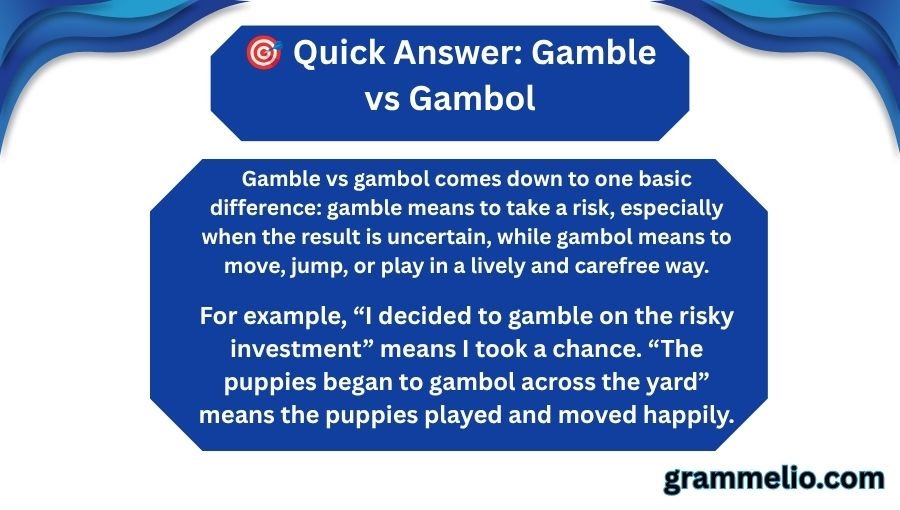
Gamble vs gambol comes down to one basic difference: gamble means to take a risk, especially when the result is uncertain, while gambol means to move, jump, or play in a lively and carefree way.
For example, “I decided to gamble on the risky investment” means I took a chance. “The puppies began to gambol across the yard” means the puppies played and moved happily.
| Word | Basic Meaning | Typical Use | Example |
|---|---|---|---|
| Gamble | Take a risk | Money, choices, uncertain results | She decided to gamble on the new business. |
| Gambol | Play or move energetically | People, animals, playful movement | The lambs gambol in the field. |
The easiest rule is simple: risk = gamble; playful movement = gambol.
What Is the Difference Between Gamble and Gambol?
The main difference between gamble and gambol is meaning. Although the words look similar, they describe completely different actions.
Gamble can be a verb or a noun. As a verb, it means to risk something on an uncertain result. As a noun, it means a risky action or decision.
Gambol is mainly a verb meaning to skip, jump, or move in a playful way. It can also be used as a noun for a playful movement or leap.
Think of the two words as creating two very different pictures:
- 🎲 Gamble: Someone risks money on a game.
- 🐇 Gambol: A rabbit jumps happily through a field.
- 💼 Gamble: Someone takes a chance on a new career.
- 🐕 Gambol: A puppy runs and jumps around the yard.
Gamble as a Verb
As a verb, gamble means to take a chance on an uncertain result.
For example:
She decided to gamble on the new restaurant.
The person does not know exactly what will happen. The restaurant might succeed, or it might fail. She is taking a risk.
Other examples include:
He gambled all his savings on the business.
I would not gamble on getting a seat without a reservation.
They gambled that the weather would improve.
In each case, the idea of risk or uncertainty is present.
Gamble as a Noun
Gamble can also be a noun.
Starting the company was a gamble.
Here, gamble names the risky decision itself.
Another example is:
Buying that old house was a huge gamble.
The word does not have to involve a casino or betting. People can gamble with money, time, careers, plans, or opportunities.
Gambol as a Verb
Gambol means to move in a playful, energetic way. It often describes children or animals.
The puppies gambol around the garden.
This tells us that the puppies are happily jumping, running, or playing.
You might also see:
The children gambolled across the grass.
In US English, gambol can be written in the past tense as gambolled or, depending on style and dictionary preference, you may encounter related spelling forms in broader English usage. In ordinary US writing, the base form is the key word to remember.
Gambol as a Noun
Gambol can also function as a noun.
The foal made a playful gambol across the field.
Here, gambol refers to the playful movement itself.
| Word | Part of Speech | Meaning | Example Sentence |
|---|---|---|---|
| Gamble | Verb | Take a risk | We may gamble on the new plan. |
| Gamble | Noun | A risky choice | The decision was a gamble. |
| Gambol | Verb | Move playfully | The puppies gambol in the grass. |
| Gambol | Noun | A playful movement | The lamb gave a joyful gambol. |
💡 How Can You Remember Gamble vs Gambol?
A simple memory trick can make gamble vs gambol much easier.
Associate gamble with risk.
Think:
Gamble = game + risk. 🎲
Now associate gambol with playful movement.
Think:
Gambol = go, jump, and play. 🐾
You can also remember the middle vowel:
- gamble → e → think event with an uncertain result
- gambol → o → think outdoor playful movement
This is not a formal grammar rule. It is simply a memory aid.
A Fast Test
Ask yourself:
Is someone taking a chance?
If yes, choose gamble.
Is someone or something jumping, skipping, or playing happily?
If yes, choose gambol.
| Question | Answer | Word |
|---|---|---|
| Is there a risk? | Yes | Gamble |
| Is money or an uncertain result involved? | Often | Gamble |
| Is someone playing energetically? | Yes | Gambol |
| Is an animal jumping around happily? | Yes | Gambol |
| Is the sentence about a risky decision? | Yes | Gamble |
Is Gamble the Same as Gambol?
No. Gamble and gambol are not synonyms.
Gamble is connected to risk, chance, or uncertainty. Gambol is connected to playful movement.
Consider these two sentences:
The investor gambled on the new company.
The puppies gambolled in the garden.
The first sentence describes a risky decision. The second describes playful movement.
The spelling is close enough to cause confusion, but the meaning is not close at all.
| Feature | Gamble | Gambol |
|---|---|---|
| Main idea | Risk or chance | Playful movement |
| Common subjects | People, investors, players | Animals, children, people |
| Can be a noun? | Yes | Yes |
| Can be a verb? | Yes | Yes |
| Often linked to money? | Yes | No |
| Often linked to movement? | No | Yes |
Why Do People Confuse Gamble and Gambol?
People often confuse gamble and gambol because their spellings are nearly identical. Both begin with “gamb-,” and both are short words with similar letter patterns.
I once reviewed a short school paragraph in which a student wrote that a group of puppies “gambled across the lawn.” The student clearly meant that the puppies were running and playing. The spelling looked believable, but the meaning completely changed the sentence. Once we replaced gambled with the intended word, the sentence made sense immediately.
There are several reasons this mistake happens:
- Similar spelling — The words differ by only one vowel.
- Similar appearance — Both begin with “gamb.”
- Fast writing — Writers may type the first word that looks familiar.
- Autocorrect — Software may not understand the intended meaning.
- Limited exposure — Some readers see gambol less often.
- Sound-based spelling — Writers sometimes remember the sound but not the exact word.
| Common Confusion | Correct Choice | Reason |
|---|---|---|
| Taking a financial risk | Gamble | The action involves risk. |
| Puppies jumping around | Gambol | The action is playful movement. |
| Risky career decision | Gamble | The result is uncertain. |
| Lambs playing in a field | Gambol | The lambs are moving playfully. |
| Betting on an outcome | Gamble | Betting involves chance or risk. |
📝 Gamble vs Gambol in a Real-Life Case Study
Imagine that a manager sends an email to a team after launching a new product.
The manager writes:
“We decided to gamble on a new marketing strategy.”
That sentence works because the company took a risk. The strategy might succeed or fail.
Now imagine the manager writes:
“The children gambled across the park.”
That sentence sounds strange because children are not necessarily taking a risk. If the intended meaning is that they were skipping, jumping, and playing, the better word is gambol.
I once caught myself making a similar kind of mistake while editing a sentence about animals. I had read the sentence quickly and understood the meaning, but when I looked closely at the word, I saw that the writer had used gamble instead of gambol. The context made the intended meaning obvious, but the spelling still needed correction.
The lesson is useful: read the whole sentence, not just the word.
| Situation | Likely Word | Example |
|---|---|---|
| Business decision | Gamble | The company gambled on a new market. |
| Sports prediction | Gamble | Betting on that team is a gamble. |
| Children playing | Gambol | The children gambol across the lawn. |
| Animals at play | Gambol | The goats gambol on the hillside. |
| Risky investment | Gamble | Buying the stock was a gamble. |
What Are the Grammar Rules for Gamble and Gambol?
The grammar rule is based on meaning and sentence function. Gamble describes risking something or making a choice with an uncertain result. Gambol describes playful movement.
Both words can act as verbs and nouns, so grammar alone does not always tell you which one to choose. Meaning does.
Using Gamble Correctly
Use gamble when the sentence involves:
- risk
- chance
- uncertain results
- betting
- risky choices
- taking a chance
Examples:
She gambled on the new business.
His career was a gamble.
They gambled that prices would fall.
Using Gambol Correctly
Use gambol when the sentence involves:
- jumping
- skipping
- lively movement
- playful movement
- carefree activity
Examples:
The lambs gambol in the meadow.
The puppies gambol around the yard.
The children gambol through the grass.
Most standard English reference works distinguish the two words clearly. The key is not memorizing a long rule. The key is matching the word to the action.
Correct vs Incorrect at a Glance
| Sentence | Correct/Incorrect | Why |
|---|---|---|
| The puppies gambol across the lawn. | ✅ Correct | The puppies are moving playfully. |
| The puppies gamble across the lawn. | ❌ Incorrect | Gamble means taking a risk. |
| She gambled on the new investment. | ✅ Correct | She took a financial risk. |
| She gambolled on the new investment. | ❌ Incorrect | Gambol does not mean taking a risk. |
| The children gambol through the field. | ✅ Correct | The movement is playful. |
⚠️ Common Mistakes With Gamble and Gambol
The most common mistake is choosing the word based on spelling instead of meaning.
A writer may see gamb- and quickly type whichever ending feels familiar. That can create a sentence that looks grammatical but communicates the wrong idea.
For example:
The young deer gambled through the meadow.
The sentence is grammatically shaped correctly, but the word choice is wrong if the writer means that the deer were jumping and playing.
The correct version is:
The young deer gambol through the meadow.
Why These Mistakes Happen
Fast typing: When people type quickly, they often skip the meaning check.
Autocorrect: Spell-check tools may accept both words because both are real English words.
Lack of knowledge: A person who rarely sees gambol may assume it is a spelling mistake.
Context blindness: Readers may focus on individual words instead of the entire sentence.
| Similar Confusion | Word 1 | Word 2 | Main Difference |
|---|---|---|---|
| Possession vs contraction | Its | It’s | Possession vs “it is” |
| Possession vs contraction | Your | You’re | Possession vs “you are” |
| Place vs direction | There | Their | Location vs possession |
| Risk vs playful movement | Gamble | Gambol | Risk vs playful movement |
| Advice vs verb | Advice | Advise | Noun vs verb |
Specific Gamble and Gambol Errors
| Wrong Form or Use | What’s Wrong | Correct Form |
|---|---|---|
| The puppies gamble in the yard. | Wrong meaning if they are playing. | The puppies gambol in the yard. |
| She gambolled her savings. | Gambol does not mean risk. | She gambled her savings. |
| He decided to gambol on the investment. | The intended idea is risk. | He decided to gamble on the investment. |
| The lambs gambled through the field. | The word suggests risk. | The lambs gambol through the field. |
| It was a gambol to invest early. | A risky choice is a gamble. | It was a gamble to invest early. |
| The children gambled happily across the grass. | The intended action is playful movement. | The children gambolled happily across the grass. |
How Does the History of Gamble and Gambol Help?
The histories of the two words developed separately, which helps explain why their meanings are unrelated even though their spellings look similar.
Gamble became associated with games of chance and risk. Over time, its use expanded beyond betting. Today, people can gamble on many kinds of uncertain outcomes.
Gambol developed as a word for lively, playful movement. It is especially useful when describing animals, children, or people moving in a cheerful way.
You do not need to memorize detailed historical dates to use these words correctly. The modern meanings are what matter most.
| Stage | Gamble | Gambol |
|---|---|---|
| Earlier use | Connected with games and chance | Connected with lively movement |
| Later development | Expanded to general risk-taking | Continued to describe playful movement |
| Modern noun use | A risky action or choice | A playful movement |
| Modern verb use | To take a risk | To move or play energetically |
How Should You Use Gamble vs Gambol in Different Contexts?
Context makes the difference very clear. Gamble works naturally in situations involving risk, while gambol works naturally in descriptions of playful movement.
Everyday Conversation
People often use gamble in everyday speech:
I wouldn’t gamble on the weather.
Gambol is less common in casual speech, but it works well when describing animals or playful movement:
The puppies were gambolling around the yard.
Professional Writing
Gamble is useful in business, finance, leadership, and planning.
The company gambled on a new product line.
Gambol may appear in creative or descriptive professional writing, especially in education, nature writing, or publishing.
Creative Writing
Both words can be useful in creative writing.
A writer might say:
The young goats gambolled across the hillside.
Or:
The captain gambled everything on one final decision.
These words help create very different images.
Social Media and Texting
Gamble is more likely to appear in casual digital writing.
“Taking a gamble on this new restaurant 😂”
Gambol may appear when someone describes animals:
“Look at these puppies gambolling around! 🐶”
| Context | Which Term to Use | Example |
|---|---|---|
| Everyday conversation | Gamble | I wouldn’t gamble on that plan. |
| Professional writing | Gamble | The company gambled on expansion. |
| Creative writing | Gambol | The deer gambolled through the forest. |
| Social media | Either, depending on meaning | We took a gamble / The puppies gambolled. |
What Common Phrases Use Gamble?
Gamble appears in several common expressions. These phrases usually involve risk, chance, or uncertain results.
| Phrase | Meaning |
|---|---|
| Take a gamble | Take a risk |
| Gamble on something | Risk something based on an uncertain result |
| A risky gamble | A risky choice |
| A calculated gamble | A risk taken after considering the possible results |
| Gamble everything | Risk everything on one decision |
Examples:
Starting my own business was a gamble.
She took a gamble on the new job.
They made a calculated gamble.
These phrases all connect to the central idea of risk.
Are There Common Fixed Expressions With Gambol?
Gambol does not have as many common fixed expressions as gamble. It is mainly used as a descriptive word for playful movement.
You may see phrases such as:
| Phrase | Meaning |
|---|---|
| Gambol through the grass | Move playfully through grass |
| Gambol across the field | Move with lively, playful steps |
| Gambol about | Move around playfully |
| A playful gambol | A lively or playful movement |
Because gambol is more descriptive than idiomatic, it often appears in nature writing and creative descriptions.
What Synonyms Can Replace Gamble or Gambol?
Choosing a synonym depends on the exact meaning.
For gamble, useful alternatives include risk, bet, chance, and speculate in certain contexts.
For gambol, alternatives include frolic, skip, romp, and play.
However, these words are not always perfect replacements.
| Alternative | Works When | Does Not Work When |
|---|---|---|
| Risk | You mean exposure to possible loss | You mean playful movement |
| Bet | Money or a prediction is involved | You mean general physical play |
| Frolic | Someone is playing happily | You mean a financial risk |
| Romp | Energetic, playful movement is meant | You mean a risky decision |
| Skip | Light, bouncing movement is meant | You mean betting or risk |
For example, frolic can often replace gambol:
The puppies frolicked in the yard.
But you cannot replace gamble with frolic:
❌ The investor frolicked on the new company.
The meaning changes completely.
Why Does Getting Gamble and Gambol Right Matter?
Correct word choice improves clarity. It also makes your writing sound more polished and confident.
Imagine reading:
The company gambolled on a risky investment.
You might understand the writer’s general idea from context, but the word choice is wrong.
Now compare:
The company gambled on a risky investment.
The meaning is immediately clear.
Good writing is not only about avoiding grammar errors. It is also about choosing the exact word that communicates your idea.
“The right word makes the intended picture easier to see.”
| Situation | Why Getting It Right Matters |
|---|---|
| Resume | Shows careful word choice |
| Client email | Prevents confusion |
| Published content | Builds reader trust |
| Social post | Keeps the message clear |
Can Gamble and Gambol Ever Be Interchangeable?
No. Gamble and gambol should not be treated as interchangeable words.
Even when a sentence seems understandable, replacing one with the other can change the meaning.
Compare:
The children gambled through the park.
This suggests an unusual idea involving risk. It does not naturally mean that the children were playing.
Now:
The children gambolled through the park.
This clearly creates a picture of lively, playful movement.
The same pattern applies to animals:
The horses gambolled in the pasture.
That means they moved around in a playful way.
But:
The horses gambled in the pasture.
That would suggest something very different and would usually be incorrect if playful movement is intended.
How Can You Avoid the Gamble and Gambol Mistake?
Use a three-step check.
Step 1: Identify the Action
Ask what the subject is doing.
Is the subject taking a risk?
Use gamble.
Is the subject moving playfully?
Use gambol.
Step 2: Replace the Word
Try replacing the word with a simple synonym.
If risk works, choose gamble.
If play, skip, or frolic works, choose gambol.
Step 3: Read the Sentence Again
Read the entire sentence aloud.
If the sentence creates the wrong picture, check the word again.
| Step | Question | Choice |
|---|---|---|
| 1 | Is there risk? | Gamble |
| 2 | Is there playful movement? | Gambol |
| 3 | Can “risk” replace it? | Gamble |
| 4 | Can “frolic” or “play” replace it? | Gambol |
🎯 A Simple Memory Trick for Gamble vs Gambol
Here is the trick I recommend to students:
Gamble = risk. 🎲
Gambol = play. 🐕
If you remember only those two words, you can solve most gamble vs gambol questions.
Picture a person placing a bet. That is a gamble.
Now picture a puppy jumping through the grass. That is a gambol.
The mental images are completely different. That is why this method works better than simply staring at the spelling.
What Should You Choose in a Sentence?
Try these practice examples before looking at the answers.
Practice 1
The investors decided to ______ on the new company.
The answer is gamble because the investors are taking a risk.
Practice 2
The puppies began to ______ across the lawn.
The answer is gambol because the puppies are moving playfully.
Practice 3
Buying the old building was a ______.
The answer is gamble because the decision involved risk.
Practice 4
The lambs ______ around the meadow.
The answer is gambol because the lambs are playing and moving energetically.
| Practice Sentence | Answer | Reason |
|---|---|---|
| They decided to ___ on the plan. | Gamble | They took a risk. |
| The puppies ___ across the yard. | Gambol | They played and moved. |
| The investment was a ___. | Gamble | It was a risky decision. |
| The foals ___ in the field. | Gambol | They moved playfully. |
✅ Quick Recap Checklist
Use this checklist whenever you are unsure about gamble vs gambol.
| Question | If Yes → Use |
|---|---|
| Does the sentence involve risk? | Gamble |
| Does someone risk money? | Gamble |
| Is there an uncertain outcome? | Gamble |
| Is someone jumping or skipping playfully? | Gambol |
| Is an animal playing energetically? | Gambol |
| Does “frolic” fit the meaning? | Gambol |
| Does “risk” fit the meaning? | Gamble |
Three Final Practice Examples
1. The company decided to ______ on a new advertising campaign.
Answer: Gamble. ✅
2. The young goats ______ across the hillside.
Answer: Gambol. ✅
3. Starting a business without a backup plan can be a ______.
Answer: Gamble. ✅
FAQs About Gamble vs Gambol
What is the difference between gamble and gambol?
Gamble means to take a risk or make a choice with an uncertain result. Gambol means to move, jump, or play in a lively and playful way.
Is gamble a verb or a noun?
Gamble can be both a verb and a noun. As a verb, it means to take a risk. As a noun, it means a risky action or decision.
Is gambol a verb or a noun?
Gambol can also be a verb or a noun. As a verb, it means to move playfully. As a noun, it refers to a playful movement.
What does gamble mean in a sentence?
Gamble means to risk something because the result is uncertain. For example, “She gambled on the new business” means she took a chance on the business.
What does gambol mean in a sentence?
Gambol means to move around in a playful, energetic way. For example, “The puppies gambol across the lawn” means the puppies playfully run and jump.
Is “gambol” the same as “frolic”?
They are close in some contexts. Both can describe playful activity or movement. However, gambol often focuses on lively physical movement, while frolic can describe broader playful behavior.
Can you gamble on something?
Yes. Gamble on is a common construction. It means to take a chance on something uncertain.
Example:
We gambled on the new marketing strategy.
Can animals gambol?
Yes. Animals are common subjects of gambol because the word describes lively, playful movement.
Example:
The lambs gambolled across the field.
Is “gambled across the field” correct?
Usually not if you mean that someone or an animal moved playfully across a field. In that situation, gambolled is the better word.
What is an easy way to remember gamble vs gambol?
Remember:
Gamble = risk. 🎲
Gambol = play. 🐾
If the sentence involves a risky choice, use gamble. If it describes playful movement, use gambol.
Why Gamble vs Gambol Is Easy Once You Focus on Meaning
The spelling of gamble and gambol can make these words look like close relatives. But their meanings are far apart. Gamble deals with risk, chance, betting, and uncertain decisions. Gambol deals with playful movement, jumping, skipping, and lively activity.
The best way to remember gamble vs gambol is to avoid relying only on spelling. Instead, picture the action. If you see someone risking money or making a risky choice, think gamble. 🎲 If you picture puppies, children, lambs, or other subjects moving happily through a space, think gambol. 🐾
As an editor, I find that this meaning-first method works much better than memorizing isolated spelling rules. Once the meaning becomes clear, the correct word usually follows naturally.
So remember the simple rule: gamble means risk, while gambol means playful movement. Use that rule whenever these two words compete for a place in your sentence, and you will have a reliable way to keep them apart. ✨
When in doubt, picture the action: risk it, gamble; play it, gambol.

[…] and common mistakes. By the end, you should be able to choose the right word with confidence. 🎯 Gamble vs Gambol | Gait vs Gate | Gaff vs […]
[…] gibe vs jibe becomes much easier to remember and use correctly. Genteel vs Gentile vs Gentle | Gamble vs Gambol | Gait vs […]