I have seen even strong English writers pause over genteel vs gentile vs gentle because the three words look and sound closely related. Yet they point to very different ideas.
If you are writing an email, editing an article, helping a student, or simply trying to choose the right word, one small spelling change can alter the meaning of an entire sentence.
I often tell my students to slow down and ask what they actually want to describe: a polished social style, a person connected with Judaism, or a kind and mild manner.
Once you see that difference, these words become much easier to handle. 😊
In this guide, I will break down genteel, gentile, and gentle with simple definitions, examples, memory tips, tables, and common mistakes. By the end, you should be able to choose the right word with confidence. 🎯 Gamble vs Gambol | Gait vs Gate | Gaff vs Gaffe
🎯 Quick Answer: Genteel vs Gentile vs Gentle
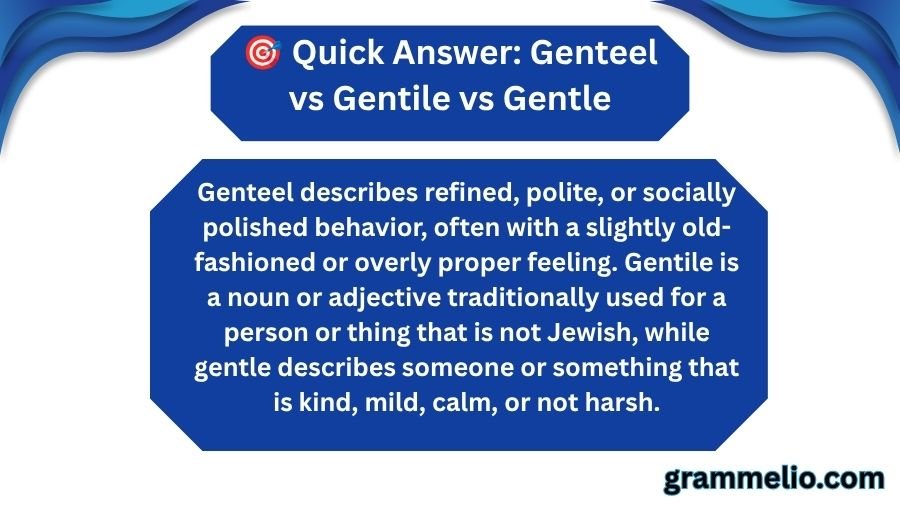
Genteel describes refined, polite, or socially polished behavior, often with a slightly old-fashioned or overly proper feeling. Gentile is a noun or adjective traditionally used for a person or thing that is not Jewish, while gentle describes someone or something that is kind, mild, calm, or not harsh.
A simple way to remember genteel vs gentile vs gentle is:
- Genteel = socially refined or polished.
- Gentile = not Jewish, especially in Jewish religious or cultural contexts.
- Gentle = kind, mild, soft, or calm.
| Word | Basic Meaning | Part of Speech | Simple Example |
|---|---|---|---|
| Genteel | Polished, refined, socially proper | Adjective | She had a genteel manner. |
| Gentile | A non-Jewish person; relating to non-Jews | Noun/Adjective | The text discusses Gentile communities. |
| Gentle | Kind, mild, calm, or soft | Adjective/Verb | Please be gentle with the puppy. |
📚 Understanding Genteel vs Gentile vs Gentle
The main difference is meaning, not just spelling. Genteel relates to social behavior or appearance, gentile relates to Jewish and non-Jewish identity or context, and gentle relates to kindness, softness, or mildness.
| Form | Type | Meaning | Example | Correct/Incorrect |
|---|---|---|---|---|
| Genteel | Adjective | Refined or socially proper | The room had a genteel charm. | ✅ Correct |
| Gentile | Noun/Adjective | Non-Jewish person or related to non-Jews | The article compares Jewish and Gentile traditions. | ✅ Correct |
| Gentle | Adjective/Verb | Mild, kind, or soft | He gave the child a gentle smile. | ✅ Correct |
| Gentle | For social refinement | Refined or upper-class | She had a gentle manner meaning socially refined. | ❌ Incorrect use |
| Genteel | For kindness | Kind or soft | The nurse was genteel with the patient. | ❌ Usually incorrect |
The words overlap visually, but their jobs are different.
Genteel: Refined or Socially Polished
Genteel is an adjective. It describes a person, place, manner, style, or activity that seems refined, respectable, elegant, or socially proper.
For example:
The old hotel had a quiet, genteel atmosphere.
The speaker is not saying the hotel is kind or soft. The point is that it feels polished, respectable, and perhaps slightly formal or old-fashioned.
Genteel can sometimes carry a mild negative tone. A person may seem too concerned with appearing respectable.
| Meaning | Word Type | Example Sentence |
|---|---|---|
| Refined | Adjective | They enjoyed a genteel dinner. |
| Polished | Adjective | His genteel manners impressed the guests. |
| Socially proper | Adjective | She grew up in a genteel household. |
| Slightly overly proper | Adjective | His genteel attitude felt a little forced. |
Gentile: A Non-Jewish Person or Related to Non-Jews
Gentile has a different meaning entirely. As a noun, it traditionally refers to a person who is not Jewish. As an adjective, it can describe something associated with non-Jews.
The word often appears in religious, historical, cultural, or academic writing.
For example:
The book examines relations between Jewish and Gentile communities.
Here, Gentile has nothing to do with manners, kindness, or social elegance.
Because the word concerns religious and cultural identity, writers should use it carefully and in the right context. In some settings, more specific wording such as “non-Jewish” may be clearer.
| Use | Example | Meaning |
|---|---|---|
| Noun | He was a Gentile visitor. | A non-Jewish person |
| Adjective | The text mentions Gentile communities. | Related to non-Jews |
| Historical context | The Roman world included Jewish and Gentile groups. | Non-Jewish groups |
| Religious context | The passage discusses Gentile believers. | Non-Jewish believers |
Gentle: Kind, Mild, Soft, or Calm
Gentle is the everyday word most people already know. It describes a person, action, sound, movement, touch, or object that is mild rather than rough or harsh.
Examples include:
She gave the dog a gentle pat.
Please use a gentle voice.
The wind was gentle this morning.
Gentle can also be a verb. As a verb, it can mean to make something less severe or to guide something carefully.
| Meaning | Example |
|---|---|
| Kind | He was gentle with the frightened child. |
| Soft | She used a gentle soap. |
| Mild | We had a gentle breeze. |
| Calm | His gentle voice helped everyone relax. |
| Careful | She gently moved the vase. |
🤔 Is Genteel the Same as Gentle?
No. Genteel and gentle are different words with different meanings, although their spelling makes them easy to confuse.
Gentle usually describes kindness, softness, or mild behavior. Genteel describes social refinement, politeness, elegance, or a polished style.
Compare these:
She was gentle with the injured bird. ✅
She had a genteel manner at the formal dinner. ✅
The first sentence focuses on kindness. The second focuses on social style.
| Word | Main Idea | Typical Examples |
|---|---|---|
| Genteel | Social refinement | genteel manners, genteel society |
| Gentle | Kindness or mildness | gentle touch, gentle voice |
| Gentile | Non-Jewish identity | Gentile community, Gentile believer |
💡 Test Tip
Ask yourself:
Am I describing kindness or softness?
Use gentle.
Am I describing refined social behavior or an elegant old-fashioned style?
Use genteel.
Am I talking about someone who is not Jewish or something related to non-Jews?
Use Gentile.
That three-question test solves most cases.
🧠 Why Do People Confuse Genteel, Gentile, and Gentle?
People confuse these words because they share several letters and have related-looking forms. Their sounds can also feel similar in fast speech.
The easiest mistake is replacing gentle with genteel. Both can appear near words describing people or behavior, but their meanings are not the same.
I once reviewed a student’s short story in which she described a character as having a “gentile voice” when she meant that the character spoke softly. We changed it to gentle voice. The original sentence accidentally changed a description of personality into a statement about religious identity.
That is a good example of why spelling alone is not enough. You need to check meaning.
| Confused Pair | What Causes Confusion | Correct Question |
|---|---|---|
| Genteel / Gentle | Similar spelling | Is the person refined or kind? |
| Gentile / Gentle | Similar beginning | Is the sentence about religion or behavior? |
| Genteel / Gentile | Similar letters and sound | Is the idea social style or non-Jewish identity? |
| Your / You’re | Similar sound | Is it possession or “you are”? |
| Its / It’s | Similar spelling | Is it possession or “it is”? |
✍️ Genteel vs Gentile vs Gentle at a Glance
The fastest way to understand genteel vs gentile vs gentle is to compare their core meanings side by side.
| Feature | Genteel | Gentile | Gentle |
|---|---|---|---|
| Main idea | Social refinement | Non-Jewish identity | Kindness or mildness |
| Part of speech | Adjective | Noun/Adjective | Adjective/Verb/Adverb form |
| Common setting | Social or literary writing | Religious, cultural, historical writing | Everyday English |
| Describes kindness | ❌ No | ❌ No | ✅ Yes |
| Describes refinement | ✅ Yes | ❌ No | ❌ Not normally |
| Refers to non-Jews | ❌ No | ✅ Yes | ❌ No |
| Common everyday word | Less common | Context-dependent | Very common |
✅ Correct Meanings and Uses
Each word becomes easy when you connect it with one central idea.
Genteel in Sentences
Use genteel when describing refined manners, social behavior, appearance, surroundings, or activities.
The guests enjoyed a genteel afternoon of tea and conversation. ✅
The puppy was very genteel when I touched its paw. ❌
The second sentence probably needs gentle, because the writer is describing calm or careful behavior.
Gentile in Sentences
Use Gentile when discussing a non-Jewish person or non-Jewish people in an appropriate religious, historical, or cultural context.
The historian studied Jewish and Gentile communities. ✅
Please be gentile with the glass. ❌
The second sentence is a spelling mistake. The intended word is gentle.
Gentle in Sentences
Use gentle for mild, kind, soft, calm, or careful actions.
Please be gentle with the kitten. ✅
Please be genteel with the kitten. ❌
The kitten does not need socially refined behavior. It needs careful treatment.
📝 A Workplace Case Study
Imagine that an editor receives this sentence in a company newsletter:
“The manager used a gentile tone when explaining the new policy.”
The editor should stop and ask what the writer means.
If the manager spoke kindly and calmly, the correct sentence is:
“The manager used a gentle tone when explaining the new policy.” ✅
If the writer means the manager behaved in a refined and socially polished way, genteel could work, although “polished” or “formal” might be more natural.
If the sentence is discussing a non-Jewish manager in a historical or religious context, Gentile could be relevant.
This shows why genteel vs gentile vs gentle is more than a spelling issue. Context controls the choice.
| Intended Meaning | Best Word | Example |
|---|---|---|
| Kind voice | Gentle | She used a gentle voice. |
| Refined manners | Genteel | He displayed genteel manners. |
| Non-Jewish group | Gentile | The text refers to Gentile groups. |
| Soft touch | Gentle | Use a gentle touch. |
| Elegant social setting | Genteel | They attended a genteel gathering. |
📏 Grammar Rules Explanation
The grammar rule is simple: choose the word based on the meaning you need.
Genteel is an adjective. It modifies nouns connected with refinement, manners, style, or social behavior.
Gentile can function as a noun or adjective. Its meaning is tied to someone or something that is non-Jewish.
Gentle is commonly an adjective. It describes a person or thing as mild, kind, soft, or calm. Its related adverb is gently.
The three words cannot normally replace one another simply because they look similar. Standard English reference works and dictionaries distinguish their meanings clearly.
Correct vs Incorrect at a Glance
| Sentence | Correct/Incorrect | Why |
|---|---|---|
| She spoke in a gentle voice. | ✅ Correct | The voice was soft or kind. |
| She spoke in a genteel voice. | ⚠️ Possible but unusual | It suggests refined or socially polished speech. |
| The study compares Jewish and Gentile groups. | ✅ Correct | The context concerns Jewish and non-Jewish groups. |
| Please be gentile with the baby. | ❌ Incorrect | The intended word is gentle. |
| The mansion had a genteel atmosphere. | ✅ Correct | The atmosphere seemed refined and polished. |
⚠️ Common Mistakes With These Three Words
Most mistakes happen because writers type quickly, depend on autocorrect, or remember the sound but not the meaning.
Fast typing can turn gentle into gentile with one extra letter. Autocorrect may not always catch the mistake because gentile is a real English word. Lack of knowledge can cause another problem: a writer may know that both words exist but not know what separates them.
I once caught myself typing gentile in a note when I meant gentle. I was writing quickly and noticed the error only when I reread the sentence. That small check saved me from sending the wrong word.
| Mistake Type | Example | Better Habit |
|---|---|---|
| Fast typing | gentile touch | Reread the sentence |
| Autocorrect | genteel instead of gentle | Check meaning, not spelling alone |
| Lack of knowledge | gentile manners | Learn the core meaning |
| Sound-based spelling | gentle/gentile confusion | Look at the context |
| Overthinking | genteel kindness | Choose the simplest accurate word |
❌ Specific Wrong Forms to Watch
| Wrong Form or Use | What’s Wrong | Correct Form |
|---|---|---|
| gentile touch | Wrong meaning | gentle touch |
| gentile person who is not Jewish | Awkward if context does not require the term | non-Jewish person or Gentile, depending on context |
| gentle social elegance | Wrong word for refinement | genteel social elegance |
| genteel with the puppy | Wrong meaning if kindness is intended | gentle with the puppy |
| gentile manners | Usually wrong if refinement is intended | genteel manners |
| gentle society | Usually unclear if social refinement is intended | genteel society |
🕰️ The History Behind the Three Words
The three words look similar because they have a shared historical association with ideas around being “gentle,” but their meanings developed in different directions. Gentle developed into the common English word for mildness and kindness. Genteel became associated with refined or socially proper behavior. Gentile developed a separate use for people outside a particular Jewish religious community.
You do not need to memorize the full history to use the words correctly. Meaning is much more useful than dates.
| Stage | Form | General Development |
|---|---|---|
| Earlier English use | Gentle | Connected with ideas of mildness and social rank |
| Later English use | Genteel | Became linked with refined social behavior |
| Religious usage | Gentile | Used for people outside the Jewish community |
| Modern English | Gentle | Common everyday word |
| Modern English | Genteel/Gentile | More specialized or context-based words |
🌎 How Are Genteel, Gentile, and Gentle Used in Different Contexts?
Context makes the choice much easier. Gentle is common in everyday speech. Genteel often appears in literary, descriptive, or formal writing. Gentile is most useful when the religious or cultural context clearly calls for it.
| Context | Which Term to Use | Example |
|---|---|---|
| Everyday conversation | Gentle | Be gentle with the dog. |
| Professional writing | Genteel or gentle, depending on meaning | The room had a genteel style. |
| Religious writing | Gentile | The passage discusses Gentile communities. |
| Creative writing | Any, depending on meaning | She moved with a gentle grace. |
| Social media/texting | Usually gentle | Please be gentle! |
| Historical writing | Gentile or genteel | The text describes Jewish and Gentile groups. |
Everyday Conversation
You will probably use gentle far more often than genteel or Gentile in ordinary conversation.
Common examples include:
- gentle voice
- gentle touch
- gentle breeze
- gentle person
- gentle reminder
Professional Writing
In professional writing, precision matters. Use gentle for a mild action or tone:
This is a gentle reminder about tomorrow’s meeting. ✅
Use genteel only when social refinement is actually part of the meaning:
The restaurant has a genteel atmosphere. ✅
Creative Writing
Creative writing gives genteel a useful role because it can help create a particular social mood.
The genteel neighborhood seemed frozen in another era. ✅
Gentle can create a softer emotional image:
A gentle rain tapped against the window. ✅
Social Media and Texting
Most casual messages need gentle.
Be gentle with my new plant! 🌱
Genteel may appear as a humorous or dramatic choice:
What a genteel little dinner party! 😂
Gentile should not be used casually when you simply mean “kind” or “gentle.”
💬 Common Phrases With Genteel and Gentle
There are several natural phrases that make the distinction easier to remember.
| Phrase | Meaning |
|---|---|
| Genteel manners | Refined, socially proper manners |
| Genteel society | A socially refined group or setting |
| Genteel atmosphere | Elegant or socially polished feeling |
| Gentle touch | Soft and careful touch |
| Gentle reminder | A polite, mild reminder |
| Gentle breeze | A light, mild breeze |
Notice how genteel manners and gentle manners are not exact substitutes. “Gentle manners” could suggest kind or mild behavior, while “genteel manners” suggests social refinement.
🔄 Synonyms and Better Alternatives
Sometimes another word is clearer than any of these three. If you mean refinement, “polished” may be more direct. If you mean kindness, “kind” may be simpler. If you mean religious identity, “non-Jewish” may be clearer for some audiences.
| Alternative | Works When | Does Not Work When |
|---|---|---|
| Refined | You mean socially polished | You mean physically gentle |
| Polished | You mean socially skilled or elegant | You mean soft or mild |
| Kind | You mean caring behavior | You mean social class or style |
| Mild | You mean not harsh | You mean religious identity |
| Non-Jewish | You need a clear descriptive term | You specifically need the traditional term Gentile |
The best choice is not always the most sophisticated word. Clear writing usually wins.
🎯 How To Remember the Difference
I use three simple memory links when teaching this topic:
Genteel → elegance
Think of a polished social setting.
Gentile → religious identity
Think of Jewish and non-Jewish communities.
Gentle → kindness
Think of a soft touch or calm voice.
| Memory Word | Connect It With | Example |
|---|---|---|
| Genteel | Elegant | genteel manners |
| Gentile | Non-Jewish | Gentile community |
| Gentle | Kind | gentle person |
| Genteel | Social style | genteel party |
| Gentle | Softness | gentle rain |
💡 A Three-Word Memory Trick
Try this sentence:
Genteel is polished, Gentile is religious, Gentle is kind.
It is short enough to remember and covers the main difference.
🧩 When Should You Use “Gentle” Instead?
Use gentle when the sentence involves softness, kindness, care, calmness, or a lack of force.
| Situation | Correct Choice | Example |
|---|---|---|
| Talking to a child | Gentle | Use a gentle voice. |
| Touching an animal | Gentle | Be gentle with the cat. |
| Describing wind | Gentle | A gentle breeze cooled the room. |
| Describing a person | Gentle | He is a gentle man. |
| Describing a reminder | Gentle | This is a gentle reminder. |
🏛️ When Should You Use “Genteel” Instead?
Use genteel when the focus is on refined social behavior, elegance, manners, or a respectable old-fashioned style.
| Situation | Correct Choice | Example |
|---|---|---|
| Social manners | Genteel | Her genteel manners were noticeable. |
| Refined setting | Genteel | The house had a genteel charm. |
| Social group | Genteel | He came from a genteel background. |
| Old-fashioned elegance | Genteel | The story has a genteel mood. |
✡️ When Is “Gentile” the Right Choice?
Use Gentile when the sentence is specifically about a non-Jewish person or a non-Jewish group in a suitable religious, cultural, historical, or academic context.
| Context | Example |
|---|---|
| Religious discussion | The text addresses Gentile believers. |
| History | Jewish and Gentile communities lived in the region. |
| Cultural study | The researcher examined Jewish and Gentile traditions. |
| Academic writing | The paper explores relations between Jewish and Gentile groups. |
If the religious meaning is not relevant, do not choose Gentile simply because it looks like gentle.
⚠️ Why the Wrong Word Can Change the Meaning
A spelling error involving these words can create more than a small grammar problem. It can change what the reader thinks you are discussing.
Compare:
The teacher used a gentle approach. ✅
This means the teacher was calm, kind, or not harsh.
Now compare:
The teacher used a Gentile approach. ❌
That sentence appears to introduce a religious or cultural idea. It does not mean “kind.”
Likewise:
They enjoyed a genteel evening. ✅
This suggests refinement or elegance.
The three words therefore need careful handling.
| Intended Idea | Wrong Choice | Correct Choice |
|---|---|---|
| Kind treatment | Gentile | Gentle |
| Refined manners | Gentle | Genteel |
| Non-Jewish group | Gentle | Gentile |
| Soft sound | Genteel | Gentle |
| Elegant social setting | Gentile | Genteel |
📱 Why Getting Genteel vs Gentile vs Gentle Right Matters
Correct word choice helps readers understand you without stopping to guess what you meant.
This matters in resumes, client emails, school papers, published content, and social posts. A wrong word may make your sentence sound strange or may introduce a meaning you never intended.
| Situation | Why Getting It Right Matters |
|---|---|
| Resume | Shows careful language skills |
| Client email | Prevents confusing or awkward wording |
| Published article | Protects accuracy and clarity |
| Social post | Prevents avoidable misunderstandings |
| School assignment | Demonstrates vocabulary knowledge |
A useful writing principle is:
The best word is the one that makes your meaning clear.
You do not need the fanciest word. You need the right one.
🧪 Practice: Can You Choose the Right Word?
Try these before looking at the answers.
- Please be ___ with the glass.
- The novel describes a ___ social gathering.
- The historian wrote about Jewish and ___ communities.
- She spoke in a ___ voice to calm the child.
- The house had a ___ old-world charm.
| Number | Answer | Reason |
|---|---|---|
| 1 | Gentle | The glass needs careful handling. |
| 2 | Genteel | The gathering is socially refined. |
| 3 | Gentile | The context concerns non-Jewish communities. |
| 4 | Gentle | The voice is calm and mild. |
| 5 | Genteel | The house has refined charm. |
✅ Quick Recap Checklist
Use this checklist whenever you hesitate over one of the three words.
| Question | If Yes → Use |
|---|---|
| Does it mean kind, soft, calm, or mild? | Gentle |
| Does it mean socially refined or polished? | Genteel |
| Does it refer to a non-Jewish person or group? | Gentile |
| Am I describing a soft touch? | Gentle |
| Am I describing refined manners? | Genteel |
| Am I discussing Jewish and non-Jewish groups? | Gentile |
📝 Three Final Practice Examples
1. “Use a ___ touch when handling the old book.”
Answer: gentle ✅
2. “The writer describes a ___ dinner party.”
Answer: genteel ✅
3. “The study examines Jewish and ___ communities.”
Answer: Gentile ✅
❓ FAQs About Genteel vs Gentile vs Gentle
What is the difference between genteel, gentile, and gentle?
Genteel means socially refined or polished. Gentile refers to a non-Jewish person or something related to non-Jews. Gentle means kind, mild, soft, or calm.
Is genteel the same as gentle?
No. Genteel focuses on social refinement or polished behavior. Gentle focuses on kindness, softness, calmness, or mildness.
What does genteel mean in simple English?
Genteel means refined, polite, elegant, or socially proper. It can sometimes suggest behavior that feels overly formal or concerned with appearances.
What does Gentile mean?
Gentile traditionally refers to a person who is not Jewish. It can also be used as an adjective for something relating to non-Jews.
What does gentle mean?
Gentle means kind, mild, soft, calm, or careful. Examples include gentle touch, gentle voice, and gentle breeze.
Is it “gentile touch” or “gentle touch”?
The correct phrase is gentle touch. A gentle touch is soft and careful. Gentile has a different meaning connected with non-Jewish identity.
Is it “genteel manners” or “gentle manners”?
Both can be grammatical in different contexts, but they do not mean exactly the same thing. Genteel manners suggests refined or socially proper manners. Gentle manners can suggest kind, mild, or calm behavior.
Can genteel have a negative meaning?
Yes. Depending on context, genteel can suggest that someone is overly proper, affected, or too concerned with social respectability. The exact tone depends on the sentence.
Is Gentile always capitalized?
When Gentile is used as a noun or adjective for a non-Jewish person or group, it is commonly capitalized in modern English. Capitalization can vary by style and context, so follow the style guide you are using.
What is an easy way to remember these three words?
Remember: genteel = refined, Gentile = non-Jewish, gentle = kind or mild. If you memorize those three ideas, most usage questions become easy.
🏁 Conclusion
Genteel vs gentile vs gentle becomes much easier when you focus on meaning instead of spelling. Genteel describes refined, polished, or socially proper behavior. Gentile refers to a non-Jewish person or something related to non-Jews. Gentle describes kindness, softness, calmness, or mildness. 😊
When I am editing, I use one quick test: ask what the sentence is really trying to say. If the idea is kindness, choose gentle. If it is social refinement, choose genteel. If it is about Jewish and non-Jewish identity, Gentile may be the right word.
These distinctions are small on the page but large in meaning. A single extra letter can take a sentence in a completely different direction. Once you connect each word with its core idea, you will no longer need to guess.
Genteel is refined. Gentile is about non-Jewish identity. Gentle is kind and mild. Keep that simple rule in mind, and your word choice will stay clear, accurate, and confident. ✨



[…] you understand the meanings, gibe vs jibe becomes much easier to remember and use correctly. Genteel vs Gentile vs Gentle | Gamble vs Gambol | Gait vs […]
[…] every time you write. By the end, choosing the right word should feel easy. ✍️ Gibe vs Jibe | Genteel vs Gentile vs Gentle | Gamble vs […]