Have you ever typed a sentence and suddenly wondered whether you need whit vs wit? These two words look almost the same, and in some accents they can sound alike.
Yet their meanings are completely different. One word refers to a tiny amount. The other refers to cleverness, mental skill, or clever humor. That small extra h can make a big difference. ✍️
I have seen this confusion in student essays, emails, online posts, and casual messages. The good news is that you do not need a complicated grammar rule to remember the difference.
You only need to connect each spelling with its main meaning. In this guide, I will explain when to use whit, when to use wit, how the words work in common expressions, and how to avoid the most common mistakes.
I will also give you simple tests, examples, tables, and practice sentences. By the end, choosing the right word should feel almost automatic. 😊 Waiver vs Waver | Venous vs Venomous | Turbid vs Turgid
🎯 Quick Answer: Whit vs Wit
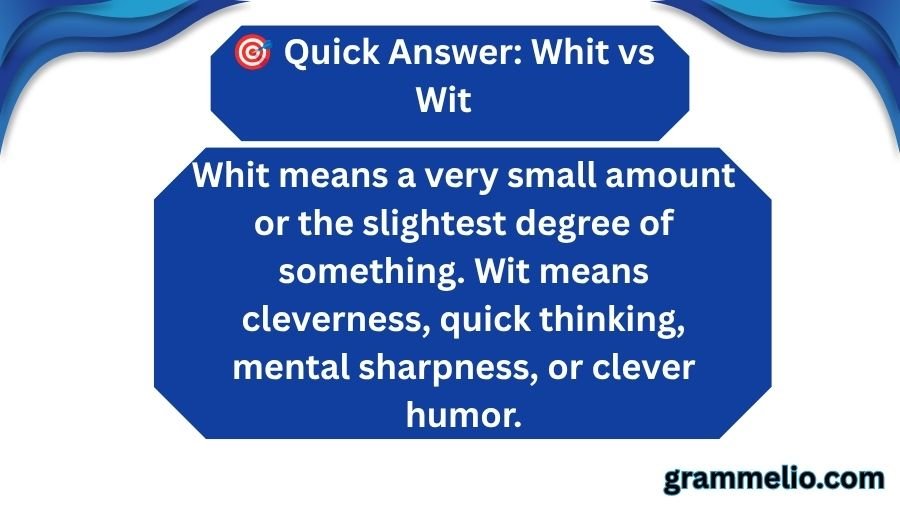
Whit means a very small amount or the slightest degree of something. Wit means cleverness, quick thinking, mental sharpness, or clever humor.
A quick memory rule is:
Whit = a tiny bit.
Wit = clever thinking.
| Word | Meaning | Example |
|---|---|---|
| whit | A tiny amount or degree | “It did not help a whit.” |
| wit | Cleverness or mental sharpness | “Her quick wit impressed everyone.” |
Related Word Forms of Whit and Wit
Both words have related forms that can appear in different sentences. Learning these forms can help you recognize the correct word more quickly.
For whit, the base noun is usually the form you will see. It is especially common in phrases such as not a whit and not one whit.
For wit, several related forms are much more common in modern English. The adjective witty describes someone or something that shows clever humor or intelligence.
| Form | Type | Example |
|---|---|---|
| whit | Noun | “It did not matter a whit.” |
| whits | Plural noun, uncommon | “Not even two whits were given.” |
| wit | Noun | “Her wit was obvious.” |
| wits | Plural noun | “He kept his wits about him.” |
| witty | Adjective | “She gave a witty answer.” |
| wittily | Adverb | “He replied wittily.” |
The forms wit, wits, and witty are much more common in everyday English than the forms related to whit.
What Is the Core Difference Between Whit and Wit?
The core difference is simple: whit refers to amount, while wit refers to mental ability or cleverness.
If you can replace the word with “a tiny amount,” you probably need whit.
If you can replace it with “cleverness,” “quick thinking,” or “clever humor,” you need wit.
| Form | Type | Meaning | Example | Correct/Incorrect |
|---|---|---|---|---|
| whit | Noun | Tiny amount | “It did not change a whit.” | ✅ Correct |
| wit | Noun | Cleverness | “His wit made us laugh.” | ✅ Correct |
| wit | Noun | Tiny amount | “It did not change a wit.” | ❌ Incorrect |
| whit | Noun | Cleverness | “Her quick whit was impressive.” | ❌ Incorrect |
This distinction is the key to understanding whit vs wit. The words are close in spelling but not in meaning.
Is Whit the Same as Wit?
No. Whit and wit are different words with different meanings.
Whit describes a small amount or degree. Wit describes cleverness, mental skill, or clever humor.
Consider these examples:
“The new policy is not a whit better.” ✅
The writer means the policy is not even slightly better.
“The new policy is not a wit better.” ❌
This does not use the standard word for a tiny degree.
Now compare:
“Her quick wit made the meeting more enjoyable.” ✅
Here, wit refers to clever and quick humor.
“Her quick whit made the meeting more enjoyable.” ❌
The spelling is wrong because whit does not mean cleverness.
Whit: Meaning and Correct Use
Whit is a noun meaning a very small amount, part, or degree of something. It often appears in negative expressions.
The most familiar expression is “not a whit.” This means not at all or not even slightly.
Using Whit to Mean a Tiny Amount
Consider this sentence:
“The explanation did not help a whit.”
The sentence means the explanation did not help even a little.
The word can also describe a tiny difference:
“The second version was not one whit clearer.”
The meaning is that the second version was not even slightly clearer.
Using Whit With “Not”
One of the easiest ways to recognize whit is to look for the word not.
Examples include:
- not a whit
- not one whit
- not a whit better
- not a whit different
- not a whit concerned
| Expression | Meaning | Example Sentence |
|---|---|---|
| not a whit | Not at all | “It did not bother him a whit.” |
| not one whit | Not even slightly | “The change did not help one whit.” |
| a whit | A tiny amount | “It did not matter a whit.” |
| every whit | Completely or in every respect | “She is every whit as capable.” |
💡 Test Tip for Whit
Ask yourself:
“Am I talking about a tiny amount?”
If the answer is yes, whit is the word you want.
Try replacing it with bit:
“It did not help a bit.”
“It did not help a whit.”
Both sentences express the idea of a very small amount.
Wit: Meaning and Correct Use
Wit is a noun that refers to cleverness, mental sharpness, quick thinking, or clever humor.
It is much more common in modern English than whit.
Wit as Cleverness
“Her wit helped her answer the difficult question.”
Here, wit means she was mentally quick and clever.
Wit as Humor
Wit can also describe clever and often amusing speech.
“The writer is known for his dry wit.”
The sentence means the writer uses clever, understated humor.
Wit as Mental Ability
The word also appears in expressions connected with awareness and mental control.
For example:
“Keep your wits about you.”
This means stay alert and pay attention.
Another familiar expression is:
“I was at my wits’ end.”
This means the speaker did not know what to do next because of worry, stress, or frustration.
| Meaning | Word Type | Example Sentence |
|---|---|---|
| Cleverness | Noun | “Her wit was impressive.” |
| Clever humor | Noun | “His dry wit was memorable.” |
| Mental ability | Noun | “He relied on his wits.” |
| Alertness | Noun in a fixed phrase | “Keep your wits about you.” |
Why Do People Confuse Whit and Wit?
Understanding whit vs wit becomes easier when you focus on what each word actually means and how it functions in a sentence.
People confuse these words because they differ by only one letter. The words can also sound very similar in speech.
Another problem is that wit is familiar to most English speakers, while whit is less common. Someone who has never seen the phrase “not a whit” may assume that wit is the correct spelling.
I once reviewed a student’s paper in which the phrase “not a wit” appeared several times. The student clearly understood the meaning but had never learned the less common spelling. Once we connected whit with “tiny bit,” the mistake disappeared from the rest of the paper.
Why the Mistake Happens
- The words look almost identical.
- Their sounds can be very similar.
- Wit is much more common.
- Autocorrect can encourage the familiar spelling.
- Fast typing can remove the h.
- Writers may know the meaning but not the spelling.
The important lesson is that spelling alone is not enough. You need to look at the meaning of the sentence.
How Can You Remember the Difference?
A simple memory trick makes whit vs wit easier.
Think of this:
WHIT = a tiny bit.
The h helps you notice that you are dealing with a small amount.
Then remember:
WIT = clever thinking.
The word witty gives you another clue. If someone is witty, that person shows cleverness or clever humor. The base word is wit.
| Memory Clue | Word | Meaning |
|---|---|---|
| Tiny bit | whit | Small amount |
| Clever thinking | wit | Mental sharpness |
| Clever humor | wit | Amusing cleverness |
| Witty comment | wit | Clever speech |
| “Not a ___” meaning “not at all” | whit | Tiny amount |
The Three-Second Rule
When you are unsure, ask two questions:
- Does the word mean a tiny amount?
→ Use whit. - Does it mean cleverness or mental sharpness?
→ Use wit.
That quick test works in most situations.
Can Whit Be Used in Everyday Conversation?
Yes, but whit is less common in casual conversation. Many speakers prefer simpler expressions such as a bit, a little, or at all.
For example:
“It did not bother me a bit.”
is more natural in casual speech than:
“It did not bother me a whit.”
The second sentence is still correct. It simply sounds more formal or literary.
Wit, on the other hand, is common in both spoken and written English.
| Situation | More Natural Choice | Example |
|---|---|---|
| Casual speech about amount | bit | “It did not help a bit.” |
| Formal writing about amount | whit | “It did not help a whit.” |
| Conversation about humor | wit | “I love her wit.” |
| Professional writing about cleverness | wit | “His wit helped during the interview.” |
📝 Case Study: Whit and Wit in a Workplace Email
Imagine that an editor sends this email to a coworker:
“I reviewed the revised report. Unfortunately, it is not a whit clearer than the original.”
The editor means the new report is not even slightly clearer.
Now imagine another email:
“Jordan’s quick wit helped keep the client meeting relaxed.”
Here, wit refers to Jordan’s ability to make clever comments and respond quickly.
These two sentences show why context matters.
I once caught myself typing “not a wit” while editing a business message. I knew the sentence meant “not even slightly,” so I paused and checked the word. The correct form was whit. That tiny proofreading step prevented a simple spelling error from appearing in a professional email.
| Workplace Example | Correct Word | Reason |
|---|---|---|
| “The revision did not help a whit.” | Whit | Tiny amount |
| “Her quick wit impressed the client.” | Wit | Cleverness |
| “The new plan is not one whit better.” | Whit | Tiny degree |
| “His dry wit made the meeting easier.” | Wit | Clever humor |
Grammar Rules Explanation
The basic grammar rule is based on meaning. Whit and wit are separate nouns, so one cannot normally replace the other.
Use whit when the sentence refers to a tiny amount, degree, or difference. It often appears in phrases such as not a whit and not one whit.
Use wit when the sentence refers to cleverness, mental sharpness, quick thinking, or clever humor. It also appears in fixed expressions such as quick wit, sharp wit, and at your wits’ end.
Standard English reference sources distinguish these words as separate terms. The safest way to choose between them is to identify the intended meaning before checking the spelling.
Correct vs Incorrect at a Glance
| Sentence | Correct/Incorrect | Why |
|---|---|---|
| “The delay did not bother me a whit.” | ✅ Correct | Whit means not even a little. |
| “The delay did not bother me a wit.” | ❌ Incorrect | Wit does not mean a tiny amount. |
| “Her quick wit impressed everyone.” | ✅ Correct | Wit means cleverness. |
| “Her quick whit impressed everyone.” | ❌ Incorrect | Whit does not mean cleverness. |
| “The new plan is not one whit better.” | ✅ Correct | Whit refers to a tiny degree. |
Common Mistakes With Whit and Wit
Many common spelling mistakes involving whit vs wit happen because the two words look and sound similar. Most mistakes with these words come from spelling rather than grammar. A writer usually knows what they want to say but chooses the wrong spelling.
Fast typing is one cause. Autocorrect is another. A third cause is simply not knowing that whit is a separate word.
I once edited a short article where every use of “not a whit” had been changed to “not a wit” by an automatic spelling check. The writer had trusted the software instead of checking the meaning. The lesson was simple: spell-check tools can catch typing errors, but they cannot always understand your intended meaning.
Similar Grammar Confusions
| Confusing Words | Meaning of First | Meaning of Second |
|---|---|---|
| its / it’s | Possessive | It is |
| your / you’re | Possessive | You are |
| their / there / they’re | Possession / place / they are | Different uses |
| affect / effect | Usually influence | Result |
| accept / except | Receive | Exclude |
| than / then | Comparison | Time or sequence |
| advice / advise | Noun | Verb |
| loose / lose | Not tight | Misplace or fail to win |
The pattern is worth learning. English has many words that sound alike or look similar but carry different meanings.
Common Wrong Spellings and Uses
| Wrong Form | What’s Wrong | Correct Form |
|---|---|---|
| not a wit | Wrong word for a tiny amount | not a whit |
| not one wit | Wrong noun in this expression | not one whit |
| quick whit | Wrong spelling for cleverness | quick wit |
| sharp whit | Wrong spelling for cleverness | sharp wit |
| dry whit | Wrong spelling for clever humor | dry wit |
| whitty | Incorrect spelling | witty |
What Are the Common Phrases With Whit?
Whit has fewer fixed expressions than wit, but several useful phrases are worth remembering.
| Phrase | Meaning |
|---|---|
| not a whit | Not at all |
| not one whit | Not even slightly |
| a whit | A tiny amount |
| every whit | Completely or in every respect |
| without a whit | Without even a small amount |
Examples
“The criticism did not affect her a whit.” ✅
“The second version is not one whit better.” ✅
“He was every whit as determined as before.” ✅
These phrases all connect whit with amount or degree.
What Are the Common Phrases With Wit?
Wit appears in many familiar English expressions.
| Phrase | Meaning |
|---|---|
| quick wit | Fast and clever thinking |
| sharp wit | Strong cleverness |
| dry wit | Subtle or understated humor |
| keep your wits about you | Stay alert |
| at your wits’ end | Not know what to do |
| frighten someone out of their wits | Scare someone badly |
These phrases are especially useful because they make the meaning of wit clear.
For example:
“Her quick wit saved the conversation.”
The word wit means cleverness.
“Keep your wits about you.”
Here, wits refers to your mental awareness and ability to think clearly.
Is Whit Formal or Old-Fashioned?
Whit is a standard English word, but it is less common in casual modern speech. It can sound formal, literary, or old-fashioned.
That does not make it wrong. It simply means that another expression may sound more natural in everyday conversation.
Compare:
“It did not matter a whit.”
with:
“It did not matter at all.”
Both are correct. The second is more common in casual speech.
Wit is much more common and does not usually sound old-fashioned.
| Word | Frequency in Modern Use | Typical Tone |
|---|---|---|
| whit | Less common | Formal or literary |
| wit | Common | Neutral |
| witty | Common | Neutral |
| bit | Very common | Casual |
| cleverness | Common | Neutral |
Whit vs Wit in Different Contexts
The context does not change the basic rule. Choose the word according to its meaning. When comparing whit vs wit, the context usually makes the correct choice clear.
| Context | Which Term to Use | Example |
|---|---|---|
| Everyday conversation | Wit for cleverness; whit for a tiny amount | “Her wit is amazing.” |
| Professional writing | Either, based on meaning | “It did not improve a whit.” |
| Creative writing | Either, based on meaning | “His sharp wit filled the room.” |
| Social media/texting | Usually wit for cleverness | “That reply showed real wit.” |
In casual digital writing, you may also choose a simpler word such as bit instead of whit.
Does Witty Come From Wit?
Yes. Witty is the adjective related to wit. It describes someone or something that is clever, amusing, or mentally sharp.
For example:
“She gave a witty response.” ✅
The response was clever or amusing.
You should not write:
“She gave a whitty response.” ❌
The correct spelling is witty.
| Word | Part of Speech | Meaning | Example |
|---|---|---|---|
| wit | Noun | Cleverness | “His wit was impressive.” |
| witty | Adjective | Clever or amusing | “She made a witty comment.” |
| wittily | Adverb | In a clever way | “He replied wittily.” |
| whit | Noun | Tiny amount | “It did not matter a whit.” |
This relationship gives you a strong memory clue: wit → witty.
How Does the History of Whit and Wit Help?
The two words have separate histories, even though their modern spellings are similar. Their similarity today does not mean that they have the same meaning.
Whit developed as a word for a very small amount or the smallest bit of something. Wit has a long history connected with knowing, understanding, and mental ability. Over time, wit became strongly associated with cleverness and humorous intelligence.
Because the words developed separately, it is best to treat them as two different vocabulary items rather than as alternate spellings.
| Broad Stage | Whit | Wit |
|---|---|---|
| Earlier English use | Connected with a small amount | Connected with knowing or mental ability |
| Later development | Continued as a word for a tiny amount | Developed strong links to intelligence and clever humor |
| Modern English | Less common, often formal | Common in speech and writing |
| Related modern form | Whit remains mostly a noun | Witty, wits, and other forms are common |
The history is useful mainly because it shows why changing or removing the h does not simply create a different spelling of the same word.
What Are Good Alternatives to Whit and Wit?
When choosing alternatives, understanding whit vs wit first makes it easier to select a word that matches your intended meaning.
Sometimes you can replace these words with simpler terms. However, the replacement must keep the same meaning.
| Alternative | Works When | Does Not Work When |
|---|---|---|
| bit | You mean a small amount | You mean cleverness |
| a little | You mean a small amount | You mean mental skill |
| at all | You mean “not even slightly” | You mean humor |
| cleverness | You mean mental ability | You mean a tiny amount |
| humor | You mean amusing cleverness | You mean general intelligence |
For example:
“It did not help a whit.”
can become:
“It did not help at all.”
But:
“Her wit was impressive.”
cannot become:
“Her bit was impressive.”
The meaning changes completely.
Why Does Correct Word Choice Matter?
Correct word choice helps readers understand you without stopping to guess what you mean. A one-letter spelling difference can sometimes change an entire sentence.
This matters in schoolwork, professional communication, websites, social posts, and published content.
A reader may understand a mistake from context, but that does not mean the mistake should remain. Clean writing shows care and makes your message easier to trust.
“Good word choice makes clear writing easier to read.”
I use that idea whenever I proofread. If two words look similar, I check the meaning before I check the spelling.
| Situation | Why Getting It Right Matters |
|---|---|
| Resume | Shows attention to detail |
| Client email | Builds a professional impression |
| Published content | Improves accuracy and trust |
| Social post | Prevents unnecessary confusion |
How Can You Avoid Whit and Wit Errors?
The best method is to make meaning your first check.
Choose Whit When:
- You mean a tiny amount.
- You mean the slightest degree.
- You are using “not a whit.”
- You are using “not one whit.”
- You want a formal or literary expression for “not at all.”
Choose Wit When:
- You mean cleverness.
- You mean quick thinking.
- You mean clever humor.
- You use “quick wit.”
- You use “sharp wit.”
- You use “witty.”
A useful proofreading habit is to stop whenever a word looks familiar but does not feel right. Ask yourself what the sentence is actually saying.
Practice: Choose Whit or Wit
Try these sentences before checking the answers.
Practice 1
“The change did not help a ___.”
Answer: whit ✅
The sentence means the change did not help even a little.
Practice 2
“Her quick ___ made everyone laugh.”
Answer: wit ✅
The word means cleverness and humor.
Practice 3
“The new version is not one ___ better.”
Answer: whit ✅
The sentence means it is not even slightly better.
Practice 4
“Everyone admired his dry ___.”
Answer: wit ✅
The word refers to clever humor.
Practice 5
“She is known for her sharp ___.”
Answer: wit ✅
The sentence describes her cleverness.
| Sentence | Answer | Reason |
|---|---|---|
| “It did not matter a ___.” | whit | Tiny amount |
| “His quick ___ was impressive.” | wit | Cleverness |
| “It was not one ___ different.” | whit | Tiny degree |
| “Her dry ___ made us laugh.” | wit | Clever humor |
| “Keep your ___ about you.” | wits | Mental alertness |
Quick Recap Checklist
Use this checklist when you are unsure which word belongs in your sentence.
| Question | If Yes → Use |
|---|---|
| Do you mean a tiny amount? | Whit |
| Do you mean “not even slightly”? | Whit |
| Does the phrase contain “not a ___”? | Whit |
| Do you mean cleverness? | Wit |
| Do you mean clever humor? | Wit |
| Does the sentence use “witty”? | Wit |
| Does the phrase say “keep your ___ about you”? | Wits |
Three Final Practice Examples
- “The criticism did not bother her a ___.”
Answer: whit ✅ - “His quick ___ made the presentation fun.”
Answer: wit ✅ - “The new plan is not one ___ more useful.”
Answer: whit ✅
FAQs About Whit vs Wit
These quick answers will help you review the main differences between whit vs wit before you finish the article.
What is the difference between whit and wit?
Whit means a tiny amount or the slightest degree. Wit means cleverness, mental sharpness, quick thinking, or clever humor.
Is “not a wit” correct?
If you mean “not even a little,” the standard expression is “not a whit.” For example, “The change did not help a whit” means the change did not help at all.
What does “not a whit” mean?
“Not a whit” means “not at all” or “not even slightly.” It is often used to describe something that made no difference.
What does wit mean?
Wit means cleverness, mental sharpness, or the ability to make clever and often amusing comments. For example, “Her wit made the conversation lively.”
Is whit still used in English?
Yes. Whit is still a valid English word, although it is less common in casual modern speech. It often appears in formal or literary writing.
Is whit the same as bit?
Not exactly. Whit can mean a very small amount, so it can be similar to bit in some sentences. However, the words are not interchangeable in every expression.
How do you remember whit vs wit?
Remember “whit = tiny bit” and “wit = clever thinking.” You can also connect wit with witty, which means clever or amusing.
What does “quick wit” mean?
Quick wit means the ability to think and respond quickly in a clever or amusing way. A person with quick wit can often produce smart or funny responses without much delay.
What does “at your wits’ end” mean?
“At your wits’ end” means that you are so worried, frustrated, or confused that you do not know what to do next.
What is a witty person?
A witty person is someone who makes clever, quick, or amusing comments. The adjective witty comes from wit, not whit.
Conclusion
Whit vs wit is easy to understand once you remember the meanings behind the two spellings. Whit means a tiny amount or the slightest degree, especially in phrases such as “not a whit.” Wit means cleverness, mental sharpness, quick thinking, or clever humor. ✨
The simplest memory trick is to think “whit = tiny bit” and “wit = clever thinking.” If you are talking about something that did not change, help, or matter even slightly, whit is usually the right choice. If you are describing someone’s clever response, humor, or mental skill, choose wit.
When proofreading, do not depend only on how a word sounds. Stop and ask what you mean. That one small habit can prevent many common word-choice errors.
Remember the rule: tiny amount = whit; cleverness = wit. Once that connection becomes familiar, you will be able to choose the right word quickly and write with confidence. 📝

[…] to write wrack and when to write rack, without having to stop and second-guess yourself. ✍️ Whit vs Wit | Waiver vs Waver | Venous vs […]
[…] when to use each word. Let’s make this confusing pair easy to remember. ✍️ Wrack vs Rack | Whit vs Wit | Waiver vs […]