Have you ever stopped while writing because you could not decide whether to use wrack vs rack? You are not alone. These two words look and sound close, but they do not always mean the same thing.
The confusion gets worse because both can appear in expressions about pain, damage, strain, or suffering. As an editor, I have seen this mix-up in emails, essays, blog posts, and even polished business documents.
The good news is that the difference becomes much easier once you connect each word with its most common uses.
In this guide, I will explain the meanings, grammar, common phrases, mistakes, and practical examples in plain US English.
By the end, you should know when to write wrack and when to write rack, without having to stop and second-guess yourself. ✍️ Whit vs Wit | Waiver vs Waver | Venous vs Venomous
🎯 Quick Answer: Wrack vs Rack
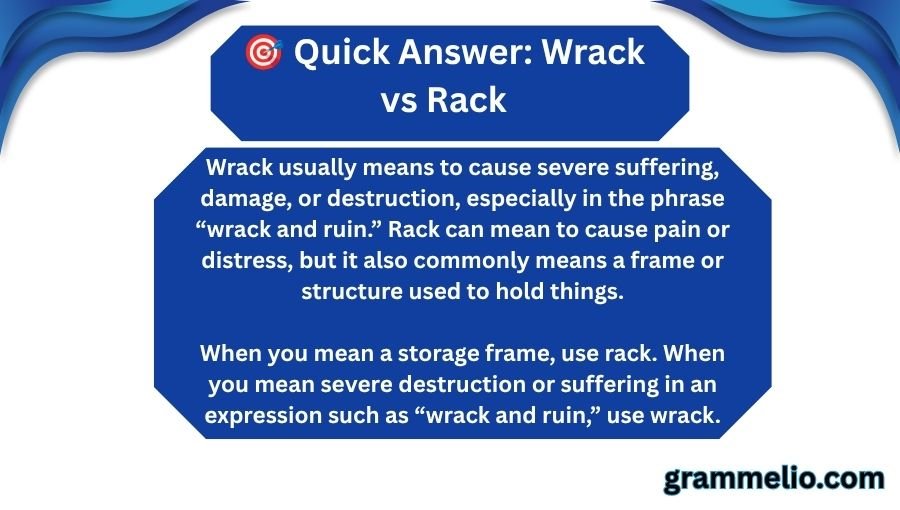
Wrack usually means to cause severe suffering, damage, or destruction, especially in the phrase “wrack and ruin.” Rack can mean to cause pain or distress, but it also commonly means a frame or structure used to hold things.
When you mean a storage frame, use rack. When you mean severe destruction or suffering in an expression such as “wrack and ruin,” use wrack.
Related Word Forms
Both words have related forms, but they do not behave exactly the same way. Knowing their common forms can help you recognize them in different sentences.
| Form | Type | Example |
|---|---|---|
| wrack | noun/verb | The storm left the coast in wrack and ruin. |
| wracked | past tense/past participle | She was wracked with guilt. |
| wracking | present participle | He was wracking his brain for an answer. |
| rack | noun/verb | Put the dishes on the rack. |
| racked | past tense/past participle | The pain racked his body. |
| racking | present participle | She was racking her brain for ideas. |
| racks | plural/third-person singular | The store has several clothing racks. |
A useful point is that wracked and racked can sometimes appear in very similar expressions. For example, both wracked with guilt and racked with guilt can be found in English. However, racked with pain and racked with worry are especially common modern uses.
Understanding Wrack vs Rack
The simplest way to understand wrack vs rack is to look at the job each word normally performs.
Rack has many everyday uses. It can describe a frame that holds objects, an act of stretching or straining something, or severe physical or mental suffering.
Wrack is much less common in everyday writing. It is strongly associated with destruction, ruin, and certain traditional expressions.
| Form | Type | Meaning | Example | Correct/Incorrect |
|---|---|---|---|---|
| rack | noun | A frame for holding things | Hang the coats on the rack. | ✅ Correct |
| rack | verb | Cause pain or distress | The illness racked his body. | ✅ Correct |
| wrack | noun | Destruction or ruin in established uses | The ship was left to wrack and ruin. | ✅ Correct |
| wrack | verb | Cause severe suffering or destruction | The storm wracked the coastline. | ✅ Correct |
| wrack | noun | A general storage frame | Put the shoes on the wrack. | ❌ Incorrect |
The key is context. Rack is the normal choice for a physical holder or frame. Wrack is mainly seen in expressions connected with ruin and destruction.
Is Wrack the Same as Rack?
No, wrack and rack are not simply interchangeable. They overlap in a few expressions, but each has its own common uses.
Think of rack as the more useful everyday word. You can have a shoe rack, coat rack, bike rack, or dish rack. You can also rack your brain or be racked with pain.
Think of wrack as a less common word linked to ruin or severe damage. It often appears in set phrases rather than ordinary conversation.
I once edited a short article about home organization. The writer repeatedly called a storage shelf a “wrack.” The meaning was clear, but the spelling made the article look careless. Changing it to rack fixed the problem immediately.
| Situation | Best Choice | Why |
|---|---|---|
| A frame holding coats | rack | This is a standard everyday use. |
| A frame holding bicycles | rack | “Bike rack” is the normal expression. |
| Severe mental distress | rack/wrack depending on phrase | Context determines the traditional form. |
| Destruction or ruin | wrack in fixed expressions | “Wrack and ruin” is an established phrase. |
| Searching for an answer | rack | “Rack your brain” is the standard expression. |
Wrack: Meaning and Correct Use
Wrack is mainly used when talking about severe damage, ruin, destruction, or intense suffering. It is not normally the word you want for a physical storage structure.
Wrack and Ruin
The best-known expression containing wrack is “wrack and ruin.”
It means a state of complete destruction, decay, or collapse.
For example:
The abandoned building fell into wrack and ruin.
Here, wrack is connected with serious destruction. The phrase is fixed enough that changing the spelling can make the sentence look unusual or incorrect.
Wrack as a Verb
Wrack can also be used as a verb to describe severe physical or emotional effects.
For example:
The storm wracked the coastline.
This means the storm caused serious damage.
Another example is:
Guilt wracked him after the accident.
The sentence presents guilt as causing intense emotional suffering.
Common Uses of Wrack
| Meaning | Word Type | Example Sentence |
|---|---|---|
| Severe destruction | Noun | The town was left in wrack and ruin. |
| Cause severe damage | Verb | The hurricane wracked the coast. |
| Cause intense suffering | Verb | Fear wracked her during the crisis. |
💡 Test Tip for Wrack
When you see wrack, ask yourself:
“Am I talking about ruin, destruction, or severe suffering?”
If the answer is yes, wrack may be the correct choice, especially in a traditional phrase such as wrack and ruin.
However, do not assume that every sentence involving pain requires wrack. Modern English often uses rack in expressions such as racked with pain and racked with worry.
Rack: Meaning and Correct Use
Rack has several common meanings. It can be a noun for a frame or support, and it can also be a verb for causing pain, strain, or distress.
Rack as a Storage Frame
This is probably the easiest use to remember.
A rack is a structure designed to hold, organize, display, or support something.
Examples include:
- coat rack
- shoe rack
- bike rack
- luggage rack
- dish rack
- spice rack
- server rack
- drying rack
Consider this sentence:
I put my shoes on the rack.
The word refers to a physical object. Therefore, rack is correct.
Rack as a Verb
Rack can also mean to cause pain, distress, or strain.
For example:
The headache racked her all afternoon.
The verb shows that the headache caused severe discomfort.
You can also say:
Doubt racked his mind.
The idea is that doubt caused strong mental distress.
Rack Your Brain
One of the most useful fixed expressions is “rack your brain” or, more commonly in the plural, “rack your brains.”
It means to think very hard about something.
I racked my brains trying to remember her name.
This expression uses rack, not wrack.
I often use this phrase when teaching editing skills because it provides a simple memory anchor: You rack your brain when you are trying hard to think.
What Does “Rack Your Brain” Mean?
“Rack your brain” means to think very hard in an attempt to remember, solve, or understand something.
For example:
I racked my brain for an hour trying to solve the puzzle.
The person is not physically damaging a brain. The phrase describes intense mental effort.
| Expression | Meaning | Example |
|---|---|---|
| rack your brain | Think very hard | I racked my brain for an answer. |
| rack your brains | Think very hard | We racked our brains for a solution. |
| rack of clothes | Clothing display/storage | She browsed the rack of dresses. |
| bike rack | Frame for holding bikes | He locked his bike to the rack. |
| dish rack | Holder for dishes | The plates are drying in the rack. |
Why Do People Confuse Wrack and Rack?
People confuse these words because they are pronounced similarly and sometimes appear in similar contexts.
Both can also be connected with pain, strain, or suffering. That makes the difference harder to spot.
Another reason is that English contains many old expressions whose spelling does not always match what modern speakers expect. Writers may remember the sound of a phrase without remembering which spelling belongs to it.
Fast typing also plays a role. If you type quickly, your fingers may produce wrack when you intended rack. Autocorrect can make things worse when it accepts both words as valid English.
A student once showed me a sentence that said, “I had to wrack my brain before the test.” The sentence sounded natural to the student because wrack and rack sound so similar. We changed it to rack my brain, and I gave the student a simple rule: You rack your brain when you think hard.
How Can You Remember the Difference?
A few memory tricks can make the distinction much easier. A simple way to remember wrack vs rack is to connect rack with things you can physically see and use, such as a coat rack or shoe rack. Connect wrack with ruin and destruction, especially in the phrase “wrack and ruin.”
Remember Rack for Racks
If you can physically put something on it, it is probably a rack.
Think:
coat rack → shoe rack → bike rack → dish rack
Remember Rack Your Brain
If you are thinking very hard, you rack your brain.
Think of your brain as being under pressure from intense thought.
Remember Wrack and Ruin
If the sentence talks about destruction or ruin, remember:
wrack and ruin
The phrase is a strong anchor for the less common spelling.
| Memory Clue | Word | Example |
|---|---|---|
| Holds clothes | rack | coat rack |
| Holds shoes | rack | shoe rack |
| Holds dishes | rack | dish rack |
| Thinks hard | rack | rack your brains |
| Destruction | wrack | wrack and ruin |
| Severe damage | wrack | The storm wracked the coast. |
📝 Case Study: Wrack vs Rack in a Workplace Email
Imagine that an employee writes:
“Please put the new files on the wrack beside the printer.”
The intended meaning is clear. The employee means a physical holder or frame. But wrack is the wrong spelling.
The corrected sentence is:
“Please put the new files on the rack beside the printer.”
Now imagine a different email:
“I had to wrack my brain to find the missing report.”
That spelling is also wrong in the standard expression.
The better sentence is:
“I had to rack my brain to find the missing report.”
This example shows why context matters. A person can know both words and still choose the wrong one if they rely only on sound.
| Workplace Sentence | Correct Form | Reason |
|---|---|---|
| Put the folders on the rack. | rack | Physical holder |
| I racked my brain for the answer. | rack | Fixed thinking expression |
| The storm wracked the building. | wrack | Severe damage |
| The old factory fell into wrack and ruin. | wrack | Fixed expression |
| Hang the coats on the wrack. | rack | Storage frame |
Grammar Rules Explanation
The main rule is based on meaning and established usage. The main rule in wrack vs rack is to choose the spelling based on the meaning and the established expression being used.
Rack is the normal spelling for a structure that holds things. It is also widely used as a verb for causing pain, strain, or distress, and it appears in common expressions such as rack your brain.
Wrack is less common. It is strongly associated with destruction, ruin, and severe effects. It appears especially in phrases such as wrack and ruin.
Standard English reference works recognize both words as legitimate, but they do not make them interchangeable in every situation.
One point deserves special attention: you may see both racked with guilt and wracked with guilt in published English. Usage can vary in some expressions. For ordinary writing, however, choosing the established form that best fits the phrase is the safest approach.
Correct vs Incorrect at a Glance
| Sentence | Correct/Incorrect | Why |
|---|---|---|
| Put the coats on the rack. | ✅ Correct | A rack holds objects. |
| Put the coats on the wrack. | ❌ Incorrect | “Wrack” is not the normal spelling for a coat holder. |
| I racked my brain for an answer. | ✅ Correct | “Rack your brain” is the established expression. |
| I wracked my brain for an answer. | ❌ Incorrect | The standard expression uses “rack.” |
| The storm wracked the coastline. | ✅ Correct | “Wracked” can describe severe damage. |
⚠️ Common Mistakes With Wrack and Rack
Most wrack vs rack mistakes happen because the two words sound alike. Writers may know both words but still choose the wrong one when typing quickly or relying on autocorrect. The most common errors come from sound rather than meaning.
Mistake 1: Using Wrack for a Storage Frame
Wrong:
The towels are on the bathroom wrack.
Correct:
The towels are on the bathroom rack.
A storage frame is a rack.
Mistake 2: Writing “Wrack Your Brain”
Wrong:
I need to wrack my brain.
Correct:
I need to rack my brain.
The fixed expression uses rack.
Mistake 3: Assuming Wrack Is Always the Stronger Version
Some writers think wrack automatically means greater pain. That is not a reliable rule. The spelling depends on the word’s established use and the context.
Mistake 4: Trusting Autocorrect
Both rack and wrack are real English words. Spell-check software may not know which meaning you intended.
I once caught myself making this exact kind of error while editing a fast draft. The spell-checker had no warning because the word I typed was a valid word. The sentence itself revealed the mistake. That is why meaning matters more than spell-check alone.
| Similar Confusion | Correct Choice | Example |
|---|---|---|
| its / it’s | depends on meaning | The dog wagged its tail. |
| your / you’re | depends on meaning | You’re ready. |
| their / there / they’re | depends on meaning | They’re over there. |
| affect / effect | depends on function | The noise affected me. |
| rack / wrack | depends on meaning | Put it on the rack. |
Specific Wrong Forms to Avoid
| Wrong Form | What’s Wrong | Correct Form |
|---|---|---|
| wrack your brain | Wrong fixed expression | rack your brain |
| wrack your brains | Wrong fixed expression | rack your brains |
| coat wrack | Wrong spelling for holder | coat rack |
| shoe wrack | Wrong spelling for holder | shoe rack |
| dish wrack | Wrong spelling for holder | dish rack |
| bike wrack | Wrong spelling for holder | bike rack |
Word History and Development
The history of these two words is one reason their modern uses can feel confusing. They have overlapping histories and have been used in related ways over time. Their forms and meanings have also influenced one another.
For modern writers, however, the historical details are less useful than the current patterns.
The safest approach is to learn the common modern expressions rather than trying to build the entire distinction from word history.
| Period | Form | General Note |
|---|---|---|
| Earlier English | related forms of rack/wrack | Several related spellings and uses developed. |
| Later English | rack | Became common in uses involving frames, strain, and distress. |
| Later English | wrack | Continued in expressions involving ruin and destruction. |
| Modern English | rack | Very common in everyday vocabulary. |
| Modern English | wrack | Less common and often tied to traditional expressions. |
This history also helps explain why you may occasionally encounter spelling variation in older writing. Modern usage is the better guide for current communication.
Usage in Different Contexts
Context can make the correct choice much easier. The correct choice in wrack vs rack often depends on the context. Everyday writing usually calls for rack, while wrack appears in more specific expressions involving destruction or ruin.
| Context | Which Term to Use | Example |
|---|---|---|
| Everyday conversation | rack | Put your jacket on the rack. |
| Professional writing | rack or wrack, depending on meaning | The storm wracked the facility. |
| Creative writing | either, depending on meaning | Grief racked his heart. |
| Social media/texting | rack for common everyday uses | My brain is racked trying to solve this. |
In casual conversation, rack will appear far more often because of common words such as rack of clothes, bike rack, and rack your brains.
In professional writing, precision matters. If you are describing damage, check whether wrack fits the intended meaning. If you are describing equipment or storage, rack is almost certainly the correct choice.
Common Phrases With Rack
Rack appears in many everyday expressions and compound words.
| Phrase | Meaning |
|---|---|
| rack your brain | Think very hard |
| rack your brains | Think very hard |
| coat rack | Frame for hanging coats |
| shoe rack | Storage structure for shoes |
| bike rack | Structure for holding bicycles |
| dish rack | Structure for holding dishes |
These phrases provide excellent memory tools because they are common and easy to picture.
Common Phrases With Wrack
Wrack is much less common, but a few expressions are worth knowing.
| Phrase | Meaning |
|---|---|
| wrack and ruin | Complete destruction or decay |
| go to wrack and ruin | Become badly damaged or neglected |
| lie in wrack and ruin | Remain in a destroyed or ruined state |
| wracked with pain | Experiencing severe pain; spelling varies in some usage |
| wracked with guilt | Experiencing intense guilt; spelling varies in some usage |
The strongest fixed expression to remember is wrack and ruin.
For other expressions involving suffering, modern usage often favors rack, although wrack appears in some established variants. When writing for a formal audience, check the specific phrase rather than applying a blanket rule.
Synonyms and Alternatives
Sometimes you can avoid the spelling issue altogether by choosing another word. This can also make your writing clearer.
| Alternative | Works When | Does Not Work When |
|---|---|---|
| shelf | You mean a flat surface for storage | You mean a frame with hooks or bars |
| holder | You mean something that supports an item | You need a specific object such as a bike rack |
| frame | You mean a supporting structure | You mean the fixed phrase “rack your brains” |
| torment | You mean severe mental or physical suffering | You mean a physical storage structure |
| damage | You mean physical harm or destruction | You need the exact expression “wrack and ruin” |
Choosing a synonym is not always better. If rack is the natural word, use it. Simple words usually make the clearest writing.
Why Does Getting Wrack and Rack Right Matter?
Correct word choice helps readers understand your meaning without stopping. Understanding wrack vs rack helps prevent errors that spell-check programs may not catch because both words are legitimate English words.
A spelling mistake between two valid words can be especially tricky. Spell-check software may not catch it because wrack is not a misspelled word. It is simply the wrong word for that sentence.
Clear writing also builds trust. This matters in resumes, client emails, websites, school assignments, and published articles.
A useful rule is:
Choose the word that matches the meaning, not just the sound.
That small habit can prevent many confusing errors.
| Situation | Why Getting It Right Matters |
|---|---|
| Resume | Shows care and strong writing skills |
| Client email | Keeps instructions clear |
| Published content | Protects credibility and readability |
| Social post | Prevents avoidable spelling confusion |
How Does Context Decide Between Wrack and Rack?
Context is the strongest test because both words are valid English words.
If you are talking about a physical holder, choose rack.
If you are talking about thinking hard, choose rack in the phrase rack your brain(s).
If you are describing ruin or destruction, wrack may be appropriate, especially in wrack and ruin.
If you are describing severe pain or emotional distress, the choice can depend on the expression. Rack is common in modern phrases such as racked with pain, while wrack also appears in some established variants.
| Meaning | Preferred Word | Example |
|---|---|---|
| Storage frame | rack | The books are on the rack. |
| Think hard | rack | I racked my brain. |
| Destruction/ruin | wrack | The building fell into wrack and ruin. |
| Severe damage | wrack | The storm wracked the area. |
| Pain or distress | often rack | The pain racked his body. |
How Do You Use Rack in a Sentence?
Use rack when you mean a frame, holder, or structure. You can also use it as a verb in expressions involving mental effort, pain, or distress.
Examples:
The restaurant has a rack for umbrellas.
I racked my brains to remember the password.
The injury racked his body with pain.
She looked through the rack of jackets.
The word works in several grammatical roles, so context is essential.
How Do You Use Wrack in a Sentence?
Use wrack mainly when you mean ruin, destruction, or severe damage, especially in established expressions.
Examples:
The abandoned house fell into wrack and ruin.
The hurricane wracked the coastline.
Years of neglect left the property in wrack and ruin.
If you are writing a common phrase, check its established form rather than choosing based on pronunciation.
Can You Use Both Wrack and Rack for Pain?
Yes, but this is one of the areas where usage can vary.
You may encounter racked with pain, racked with guilt, and similar forms. You may also see wracked with pain or wracked with guilt.
The safest strategy is to learn common phrases as complete units.
For example:
- rack your brain
- racked with pain
- racked with worry
- wrack and ruin
Do not assume that one spelling should replace the other in every expression.
💡 Test Tip: Replace the Word
If you are unsure, temporarily replace the word with a simpler description.
Ask:
Does it mean a holder or frame?
→ Use rack.
Does it mean thinking very hard?
→ Use rack.
Does it describe ruin or destruction in a traditional expression?
→ Consider wrack.
Does it describe severe pain or distress?
→ Check the established phrase. Rack is common in modern usage.
This test works better than trying to remember the pronunciation because the two words sound so similar.
Practice Examples
Try these before looking at the answers.
Example 1
I left my keys on the ___ near the door.
Answer: rack.
The word describes a physical holder.
Example 2
I had to ___ my brains to remember the address.
Answer: rack.
The expression is rack your brains.
Example 3
The old building had fallen into ___ and ruin.
Answer: wrack.
This is the established phrase wrack and ruin.
| Practice Sentence | Answer | Reason |
|---|---|---|
| Hang the towels on the ___. | rack | Physical holder |
| I had to ___ my brain. | rack | Fixed expression |
| The estate fell into ___ and ruin. | wrack | Established phrase |
Quick Recap Checklist
Use these questions whenever you hesitate.
| Question | If Yes → Use |
|---|---|
| Is it a frame or holder? | rack |
| Am I talking about a coat, shoe, bike, or dish holder? | rack |
| Am I saying “rack your brain(s)”? | rack |
| Am I describing ruin in “wrack and ruin”? | wrack |
| Am I describing severe damage? | wrack may fit |
| Am I describing pain or distress? | Check the established phrase; rack is common |
Practice
- The bicycles are locked to the ___ outside the store.
Answer: rack ✅ - She ___ her brains trying to solve the puzzle.
Answer: racked ✅ - The abandoned factory fell into ___ and ruin.
Answer: wrack ✅
FAQs About Wrack vs Rack
What is the difference between wrack and rack?
Rack is the more common word. It can mean a frame for holding things or can describe severe pain, strain, or mental effort. Wrack is less common and is strongly associated with destruction, ruin, and expressions such as wrack and ruin.
Is it rack your brain or wrack your brain?
The standard expression is rack your brain. The plural form rack your brains is also very common.
Correct:
I had to rack my brain for an answer. ✅
Incorrect in the standard expression:
I had to wrack my brain for an answer. ❌
Is it rack or wrack your brains?
Use rack: rack your brains.
The phrase means to think very hard about something.
Is “wrack and ruin” correct?
Yes. Wrack and ruin is an established expression meaning complete destruction, decay, or neglect.
Is “racked with pain” correct?
Yes. Racked with pain is a standard modern expression. It means experiencing severe pain.
Is “wracked with pain” also correct?
You may see wracked with pain in published writing. Usage varies in some expressions involving suffering. For clear modern writing, racked with pain is a well-established choice.
Should I write rack or wrack for a coat holder?
Use rack.
The standard phrase is coat rack, not coat wrack.
Is it rack your brain or rack your brains?
Both forms occur, but rack your brains is very common when referring to intense thinking. The singular rack your brain is also widely understood and used.
Why do people confuse wrack and rack?
They sound very similar, and both can appear in contexts involving suffering or strain. Fast typing, autocorrect, and unfamiliarity with fixed expressions can also cause mistakes.
Can wrack be a verb?
Yes. Wrack can be used as a verb for causing severe damage or suffering. For example, you can say that a storm wracked a coastline.
Conclusion
Wrack vs rack becomes much easier when you focus on meaning instead of sound. Rack is the everyday choice for a frame or holder, as in a coat rack, shoe rack, or bike rack. It is also the standard choice in rack your brain(s) and common expressions involving pain or distress. Wrack is less common and is strongly linked with destruction and ruin, especially in wrack and ruin. ✨
When I edit a sentence containing one of these words, I first ask what the writer means. If the word refers to something that holds an object, I choose rack. If the sentence uses the traditional expression wrack and ruin, I choose wrack. Keeping wrack vs rack straight becomes much easier when you learn the common phrases and connect each word with its meaning. For pain and distress, I check the phrase rather than relying on a simple spelling rule. Keep those patterns in mind, and you will avoid one of English’s easiest word-choice traps. When the meaning is clear, the spelling usually follows.

[…] will know exactly when to use each word. Let’s make this confusing pair easy to remember. ✍️ Wrack vs Rack | Whit vs Wit | Waiver vs […]