Have you ever typed a word that looked right, only to wonder a second later if you had spelled it correctly? I see this often when I help people polish their English. One pair that causes surprising confusion is gaff vs gaffe.
The two words look almost the same, but they do not mean the same thing. One is mainly a noun connected with a tool, a hook, or a fishing pole, while the other describes an embarrassing mistake.
I know the difference can feel small when you are reading quickly. 🙂 But once you connect each spelling with its meaning, the choice becomes much easier.
In this guide, I’ll show you how to use both words correctly in everyday speech, work emails, creative writing, and online posts.
By the end, you should be able to spot the difference instantly. 🧠 Freeze vs Frieze | Foul vs Fowl | Forth vs Fourth
🎯 Quick Answer: Gaff vs Gaffe
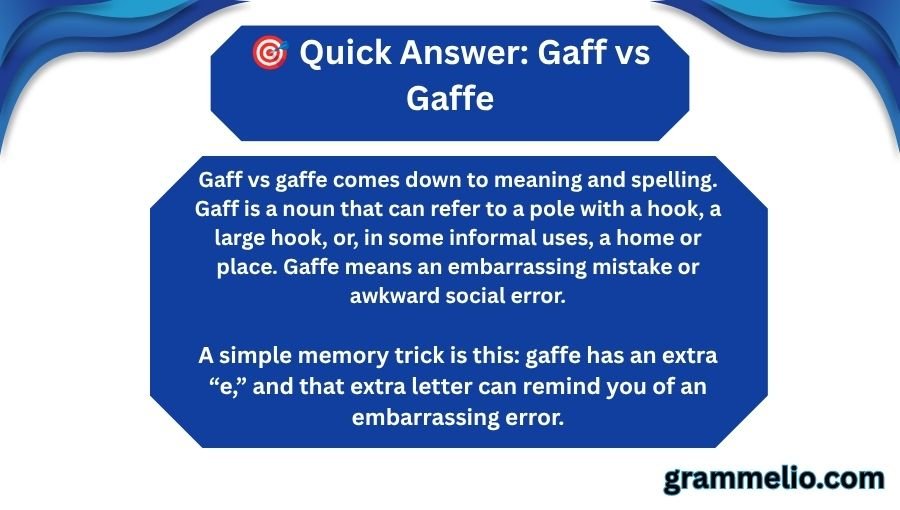
Gaff vs gaffe comes down to meaning and spelling. Gaff is a noun that can refer to a pole with a hook, a large hook, or, in some informal uses, a home or place. Gaffe means an embarrassing mistake or awkward social error.
A simple memory trick is this: gaffe has an extra “e,” and that extra letter can remind you of an embarrassing error.
What Does Gaff Mean?
Gaff is a real English word with several uses. Its most familiar meaning is a tool with a long handle and a hook, often used to catch or move large fish. It can also refer to a large hook itself.
In some informal British usage, gaff can mean a home or place where someone lives or spends time.
The meaning depends on context. When you see words such as fish, boat, hook, or pole, gaff is probably the word you need.
Gaff as a Fishing Tool
A fishing gaff is a pole with a strong hook at the end. It helps a person bring a large fish aboard a boat.
For example:
- “The captain reached for the gaff when the fish came close to the boat.”
- “He kept the gaff beside the fishing gear.”
- “The crew used a gaff to bring the large fish aboard.”
Here, gaff is a concrete noun. It names a physical object.
Gaff as a Place or Home
In informal British English, gaff can also mean a home, apartment, or place.
For example:
- “Come over to my gaff after work.”
- “They were having a party at his gaff.”
This use is informal. It may sound unusual in formal American English.
Gaff Meanings at a Glance
| Meaning | Word Type | Example Sentence |
|---|---|---|
| Fishing tool | Noun | The fisherman grabbed the gaff. |
| Large hook | Noun | The gaff had a sharp hook. |
| Home or place in informal British English | Noun | We met at his gaff. |
What Does Gaffe Mean?
A gaffe is an embarrassing mistake, especially one made in public or during a social situation.
The word often describes a mistake that makes a person feel awkward or embarrassed.
For example:
- “I made a gaffe when I called her by the wrong name.”
- “His comment was a serious gaffe.”
- “She apologized for the gaffe during the meeting.”
Unlike gaff, gaffe does not normally name a tool or object. It describes an error or awkward action.
Gaffe in Social Situations
A gaffe can happen when someone says something inappropriate, forgets an important detail, or misunderstands a situation.
Imagine introducing two people and getting both names wrong. That could be a gaffe.
Imagine thanking someone for a gift and accidentally revealing that you already own the same item. That could also be a gaffe.
Gaffe in Professional Situations
A gaffe can also happen at work.
For example:
- “The manager made a gaffe during the presentation.”
- “Sending the private file to the whole team was an unfortunate gaffe.”
- “I caught the mistake before it became a public gaffe.”
The word usually carries a sense of embarrassment. It is more than simply saying mistake in many contexts.
Gaffe Meaning Summary
| Meaning | Word Type | Example |
|---|---|---|
| Embarrassing mistake | Noun | His comment was a gaffe. |
| Social error | Noun | She made a gaffe at dinner. |
| Public mistake | Noun | The interview included an awkward gaffe. |
Is Gaff the Same as Gaffe?
No. Gaff and gaffe are different words with different meanings.
Gaff commonly refers to a hook or hooked pole. Gaffe refers to an embarrassing mistake.
Think about the subject of your sentence. If you are talking about fishing equipment, a tool, or an informal word for a home, choose gaff. If you are talking about an embarrassing error, choose gaffe.
Gaff vs Gaffe at a Glance
| Form | Type | Meaning | Example | Correct/Incorrect |
|---|---|---|---|---|
| gaff | Noun | Hooked pole or tool | He picked up the gaff. | Correct |
| gaffe | Noun | Embarrassing mistake | She made a gaffe. | Correct |
| gaff | Noun | Embarrassing mistake | She made a gaff at dinner. | Usually incorrect |
| gaffe | Noun | Fishing tool | He grabbed the gaffe. | Incorrect |
| gaff | Informal noun | Home or place in some British usage | We went to his gaff. | Correct |
🔍 Why Do People Confuse Gaff and Gaffe?
People confuse these words because they look and sound very similar. The extra e is easy to overlook, especially when typing quickly.
I once edited a short article where the writer used gaff three times when describing an embarrassing interview mistake. The writer clearly knew the intended meaning. The problem was simply the missing e. Once I explained that gaffe means an embarrassing mistake, the correction made immediate sense.
Several factors can cause this confusion:
- The words differ by only one letter.
- Both are pronounced similarly in ordinary speech.
- Spell-check tools may not flag the wrong word because both spellings are legitimate.
- People often learn the words through speech before seeing them in writing.
- Fast typing can make a small spelling difference easy to miss.
This is a good example of why spelling alone is not always enough. You need to check the meaning too.
🧩 Key Differences Between Gaff and Gaffe
The easiest way to separate the words is to connect each one with a different idea.
Gaff → think hook, pole, fishing, or home.
Gaffe → think mistake, embarrassment, or awkward moment.
| Feature | Gaff | Gaffe |
|---|---|---|
| Main idea | Tool or object | Embarrassing mistake |
| Common part of speech | Noun | Noun |
| Extra “e” | No | Yes |
| Fishing connection | Yes | No |
| Social mistake connection | No | Yes |
| Can describe an awkward error? | No | Yes |
A Fast Mental Test
Ask yourself:
“Am I talking about a thing, or an embarrassing mistake?”
If you mean a thing such as a fishing tool, use gaff.
If you mean an embarrassing mistake, use gaffe.
This test is simple, but it works well.
💡 Test Tip: Replace the Word With “Mistake”
Here is one of my favorite ways to check the spelling.
Take your sentence and replace the questionable word with mistake.
If the sentence still makes sense, you probably need gaffe.
For example:
“His comment was an embarrassing ___.”
“His comment was an embarrassing mistake.”
That works, so gaffe is the correct choice.
Now try:
“The fisherman grabbed the ___.”
“ The fisherman grabbed the mistake.”
That clearly does not work. The sentence needs gaff.
| Test Sentence | Replacement | Best Word |
|---|---|---|
| She made an embarrassing ___ | mistake | gaffe |
| He grabbed the fishing ___ | mistake | gaff |
| The politician apologized for the ___ | mistake | gaffe |
| The crew stored the ___ on the boat | mistake | gaff |
📝 Case Study: A Small Word Caused a Big Editing Problem
Consider a workplace newsletter about a company event. The writer wants to say that a speaker accidentally announced the wrong date.
The original sentence says:
“The speaker made a gaff during the presentation.”
The intended meaning is an embarrassing mistake. Therefore, the sentence should use gaffe:
“The speaker made a gaffe during the presentation.”
Now imagine a different article about deep-sea fishing:
“The crew prepared the gaff before bringing the fish aboard.”
Here, gaff is correct because the word names a fishing tool.
The surrounding words give you a strong clue. Speaker, presentation, and wrong date point toward gaffe. Crew, fish, boat, and tool point toward gaff.
Grammar Rules Explanation
The basic rule is based on meaning, not simply spelling.
Gaff is generally used as a noun for a hooked pole or similar tool. It also has some informal regional uses, including a word for a home or place.
Gaffe is a noun for an embarrassing mistake or awkward social error.
Neither spelling is simply a “wrong version” of the other. Both are real words. The mistake happens when a writer chooses the correct spelling for the wrong meaning.
Standard English references recognize gaff and gaffe as separate words. That is why spell-check software may not save you. A program can recognize both words as correctly spelled while still missing the meaning problem.
Correct vs Incorrect at a Glance
| Sentence | Correct/Incorrect | Why |
|---|---|---|
| The fisherman lifted the gaff. | ✅ Correct | A gaff can be a fishing tool. |
| She made an embarrassing gaffe. | ✅ Correct | A gaffe is an embarrassing mistake. |
| He made a gaff during the interview. | ❌ Incorrect | The intended meaning is an embarrassing mistake. |
| The crew grabbed the gaffe. | ❌ Incorrect | The intended word for the fishing tool is gaff. |
| His comment was a political gaffe. | ✅ Correct | The comment was an embarrassing error. |
⚠️ Common Mistakes With Gaff and Gaffe
One of the most common gaff vs gaffe mistakes is choosing the shorter spelling when the sentence actually needs gaffe. Both words are valid, so context matters.
The biggest mistake is treating the words as interchangeable. They are not.
Another problem is relying completely on spell-check. Since gaff and gaffe are both valid English words, a spelling program may accept either one.
I once caught myself typing gaff in a sentence about an embarrassing mistake while editing a draft late in the afternoon. I knew the rule, but my fingers followed the shorter spelling automatically. That small error reminded me how easily a familiar word can slip into the wrong sentence.
Here are some common causes:
| Cause | Why It Creates Errors | Helpful Fix |
|---|---|---|
| Fast typing | One letter gets skipped | Read the sentence slowly |
| Autocorrect | Both words may be valid | Check meaning yourself |
| Lack of knowledge | The meanings seem interchangeable | Learn one example for each |
| Speech-first learning | The extra “e” may not be obvious | Study the written forms |
| Poor proofreading | Small errors are easy to overlook | Search for both forms |
Specific Wrong Uses to Watch
| Wrong Form | What’s Wrong | Correct Form |
|---|---|---|
| He made a gaff at dinner. | Wrong spelling for an embarrassing mistake | gaffe |
| The fisherman grabbed the gaffe. | Wrong spelling for the fishing tool | gaff |
| That was an embarrassing gaff. | Missing the final “e” | gaffe |
| The boat’s gaffe was sharp. | The tool should be spelled gaff | gaff |
| She apologized for the gaff. | The sentence describes a social mistake | gaffe |
Why Does the Extra E Matter?
The extra e matters because it separates two different words.
Compare:
gaff = a tool, hook, or certain informal uses such as a home
gaffe = an embarrassing mistake
You can think of the extra e as standing for error. This is not a formal spelling rule. It is simply a memory trick.
When I teach confusing word pairs, I prefer memory links that connect spelling to meaning. They are easier to remember than a long grammar explanation.
| Word | Memory Link | Meaning |
|---|---|---|
| gaff | G = gear | Hooked tool or other established uses |
| gaffe | E = error | Embarrassing mistake |
🗣️ Usage in Different Contexts
Understanding gaff vs gaffe is especially useful when writing for different audiences. The correct word depends on whether you are discussing a tool, an informal place, or an embarrassing mistake.
The correct choice can become obvious when you look at the context.
In everyday conversation, gaffe is useful when talking about an awkward mistake. Gaff may appear in fishing discussions or informal British speech.
In professional writing, gaffe is more likely when discussing an embarrassing statement or public error.
In creative writing, either word can appear, but the meaning must still match the scene.
On social media, users may type quickly and confuse the two. A careful writer should still use the correct form.
| Context | Which Term to Use | Example |
|---|---|---|
| Everyday conversation | gaffe for an embarrassing mistake | That was a funny gaffe. |
| Professional writing | gaffe for a public error | The statement caused a political gaffe. |
| Creative writing | Depends on meaning | The fisherman reached for the gaff. |
| Social media/texting | Depends on meaning | I just made a huge gaffe! |
Can Gaff Be Used in Casual English?
Yes. Gaff has informal uses beyond its fishing-related meaning.
In some varieties of British English, gaff can mean someone’s home or place. For example:
“We’re meeting at Jake’s gaff tonight.”
This use is informal and regional. It is not the best choice for a formal American business document.
For a US audience, readers are more likely to understand gaff in a fishing or tool-related context. If you use the informal home meaning, the surrounding context should make your meaning clear.
Can Gaffe Be Used as a Verb?
In standard everyday US English, gaffe is mainly used as a noun.
You would normally say:
“She made a gaffe.”
You would not normally use gaffe as the ordinary verb meaning “to make a mistake.” Better choices include make a mistake, mess up, or say something embarrassing, depending on the context.
| Intended Meaning | Natural Expression |
|---|---|
| Make an embarrassing mistake | make a gaffe |
| Make a normal mistake | make a mistake |
| Say something embarrassing | make an awkward comment |
| Cause an embarrassing moment | create an awkward situation |
Common Phrases With Gaffe
Unlike some common word pairs, gaffe does not have a huge collection of fixed idioms. However, several natural combinations appear often.
| Phrase | Meaning |
|---|---|
| make a gaffe | Make an embarrassing mistake |
| embarrassing gaffe | An awkward public or social error |
| political gaffe | An embarrassing mistake by a politician or public figure |
| public gaffe | A mistake made in front of others |
| major gaffe | A serious or noticeable mistake |
Examples include:
- “The speaker made a gaffe during the interview.”
- “The comment became a public gaffe.”
- “The article described the statement as a political gaffe.”
🔄 Synonyms and Alternatives
Sometimes you do not need gaffe at all. Another word may fit your sentence better.
The best alternative depends on how serious or embarrassing the mistake is.
| Alternative | Works When | Does Not Work When |
|---|---|---|
| Mistake | You mean any kind of error | You specifically want social embarrassment |
| Blunder | The error is serious or careless | The mistake is tiny or harmless |
| Error | You want neutral language | You want a strong social meaning |
| Slip | The mistake is small or accidental | The error had major consequences |
| Misstep | The action was poor or unwise | You mean a technical error |
For example, mistake is broader than gaffe. A math error can be a mistake, but it would not normally be called a gaffe.
A gaffe usually has a social or public side.
Why It Matters to Get Gaff and Gaffe Right
Choosing the correct word improves clarity. It also makes your writing look more polished.
If you write:
“The CEO made a gaff during the interview.”
A reader may understand your meaning, but the spelling is wrong if you mean an embarrassing mistake.
The correct sentence is:
“The CEO made a gaffe during the interview.”
This matters even more in professional writing, published content, and public communication.
Clear words make clear ideas easier to trust.
| Situation | Why Getting It Right Matters |
|---|---|
| Resume | Shows careful writing |
| Client email | Builds a professional impression |
| Published content | Prevents avoidable language errors |
| Social post | Makes the message look polished |
How To Remember the Difference
A simple way to remember gaff vs gaffe is to connect each spelling with its meaning. Think of gaff as a tool or hook, and gaffe as an embarrassing error.
The easiest method is to build a visual connection.
Picture a fisherman holding a long pole with a hook. That is a gaff.
Now picture someone accidentally calling their boss by the wrong name during a meeting. That is a gaffe.
The meanings are very different, even though the spellings are close.
Here is another quick trick:
GAFF = gear
GAFFE = error
Again, this is only a memory device. It is not a formal grammar rule. But it can help you recall the spelling when you are writing quickly.
Gaff vs Gaffe: A Simple Decision Guide
When you are unsure, follow these steps.
- Read the entire sentence.
- Identify what the word is describing.
- Ask whether it means a tool, hook, or established informal use.
- If yes, choose gaff.
- Ask whether it means an embarrassing mistake.
- If yes, choose gaffe.
- Read the sentence once more before publishing.
| Question | If Yes → Use |
|---|---|
| Am I talking about a fishing tool? | gaff |
| Am I talking about a hooked pole? | gaff |
| Am I using an informal British word for a home or place? | gaff |
| Am I describing an embarrassing mistake? | gaffe |
| Am I describing an awkward public error? | gaffe |
Practice Examples
1. The fisherman stored the ___ on the boat.
Answer: gaff
2. I made a terrible ___ when I forgot her name.
Answer: gaffe
3. The reporter described the comment as a public ___.
Answer: gaffe
Is Gaff Ever Used for an Embarrassing Mistake?
In careful standard English, if you mean an embarrassing mistake, gaffe is the safer and correct choice.
You may occasionally see gaff used where gaffe was intended. That is usually a spelling error or a confusion between the two words.
Because gaff is already a real word, readers may not immediately recognize the mistake as a typo. That makes proofreading especially useful.
Is Gaffe Ever Used for a Fishing Tool?
No, not in standard usage. If you mean the hooked fishing tool, gaff is the correct spelling.
For example:
“The crew brought the fish aboard with a gaff.”
Using gaffe would create the wrong word.
Which Is Correct: “Make a Gaff” or “Make a Gaffe”?
When you mean an embarrassing mistake, make a gaffe is correct.
For example:
“I made a gaffe during the meeting.”
The phrase make a gaff does not express that meaning in standard English.
Which Is Correct in American English?
For an American audience, use gaffe when you mean an embarrassing mistake.
Use gaff when referring to the fishing tool or another established meaning.
The distinction is the same regardless of whether the sentence is spoken or written, but written English makes the spelling difference visible.
How Does Gaff vs Gaffe Affect Professional Writing?
The difference may seem tiny, but small word errors can affect how polished your writing appears.
A client may not stop reading because of one incorrect letter. Still, repeated word-choice mistakes can reduce confidence in a document.
That is why I recommend checking confusing word pairs during proofreading rather than relying only on automatic spell-check.
FAQs About Gaff vs Gaffe
What is the difference between gaff and gaffe?
Gaff usually refers to a hooked pole or tool, especially one used in fishing. Gaffe means an embarrassing mistake or awkward social error.
Is “gaff” a real word?
Yes. Gaff is a real English word. It can refer to a fishing tool or large hook, and it also has some informal regional uses.
Is “gaffe” a real word?
Yes. Gaffe is a real word meaning an embarrassing mistake, especially one made in a social or public setting.
Is it “make a gaff” or “make a gaffe”?
When you mean an embarrassing mistake, the correct phrase is make a gaffe.
Can gaff mean mistake?
Not in the standard meaning of the word. If you mean an embarrassing mistake, gaffe is the correct choice.
Can gaffe mean a fishing tool?
No. The fishing tool is spelled gaff.
Why is gaffe spelled with an extra e?
The extra e is part of the standard spelling of the noun gaffe, which means an embarrassing mistake. It helps distinguish the word from gaff.
How can I remember gaff vs gaffe?
Use the memory trick “gaffe has E for error.” If the word means an embarrassing error, choose gaffe. If it means a fishing tool or another established use of gaff, choose gaff.
Is gaff used in British English?
Yes. In addition to its tool-related meaning, gaff can have informal regional uses in British English, including referring to someone’s home or place.
Which word should I use for an embarrassing comment?
Use gaffe. For example: “His comment was an embarrassing gaffe.”
✅ Quick Recap Checklist
| Question | If Yes → Use |
|---|---|
| Is it a hooked fishing tool? | gaff |
| Is it a large hook? | gaff |
| Is it an informal word for a home or place? | gaff |
| Is it an embarrassing mistake? | gaffe |
| Is it an awkward public error? | gaffe |
| Does “mistake” fit the sentence? | Usually gaffe |
Remember these three examples:
- “The fisherman grabbed the gaff.” ✅
- “She made an embarrassing gaffe.” ✅
- “The politician apologized for the gaffe.” ✅
Conclusion
Gaff vs gaffe becomes easy once you connect each spelling with its meaning. Gaff is commonly used for a hooked pole or fishing tool, while gaffe means an embarrassing mistake or awkward social error. The extra e in gaffe can be your reminder that you are dealing with an error. 🧠
When I proofread, I never rely on spelling alone for confusing word pairs. I check the meaning of the sentence first. That habit works especially well here because both words are valid English words. Your spell-checker may accept either one, even when only one fits the sentence.
So, if someone drops a fishing tool, think gaff. If someone says the wrong thing at the wrong time, think gaffe. 🎯
Learn the meaning, check the context, and the spelling will follow. Once you make that connection, this small but common word pair becomes much easier to handle.

[…] simple memory tricks and examples. By the end, choosing the right word should feel natural. ✍️ Gaff vs Gaffe | Freeze vs Frieze | Foul vs […]
[…] you easy memory tricks you can use in school, work, texting, and everyday writing. Gait vs Gate | Gaff vs Gaffe | Freeze vs […]