Have you ever typed a sentence and stopped because you were unsure whether you needed moral vs morale? I see this mix-up often, even in otherwise strong writing. The two words look and sound similar, but they do very different jobs. Moral usually relates to right and wrong, good behavior, or a lesson about behavior. Morale describes the confidence, spirit, or emotional energy of a person or group.
If you are a student, teacher, writer, job seeker, or professional communicator, knowing this difference can make your writing much clearer. I use a simple meaning test whenever I see these words in a draft. 😊
Once you learn that test, choosing the right word becomes much easier. In this guide, I will show you the meanings, grammar rules, common mistakes, examples, and easy memory tricks you can use right away. Miner vs Minor | Mettlesome vs Meddlesome | Medal vs Metal vs Meddle vs Mettle
🎯 Quick Answer: Moral vs Morale
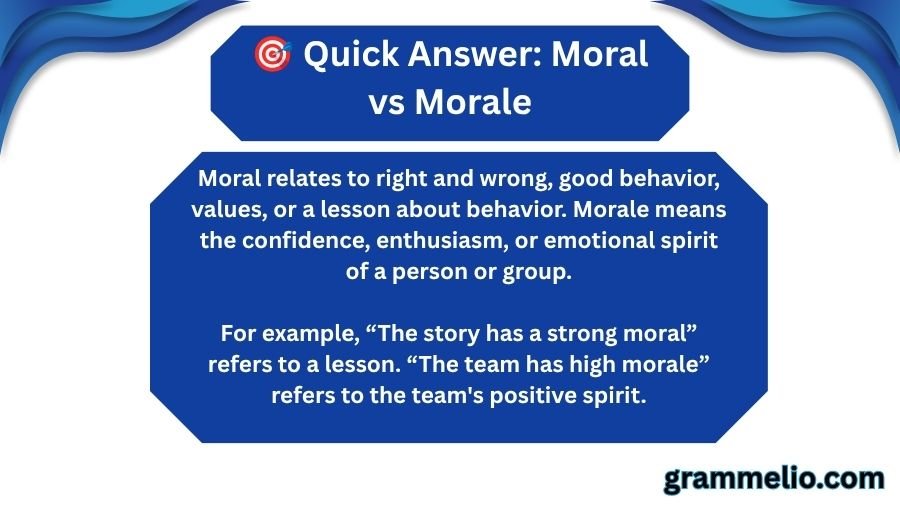
Moral relates to right and wrong, good behavior, values, or a lesson about behavior. Morale means the confidence, enthusiasm, or emotional spirit of a person or group.
For example, “The story has a strong moral” refers to a lesson. “The team has high morale” refers to the team’s positive spirit.
| Word | Main Meaning | Typical Use | Example |
|---|---|---|---|
| Moral | A principle about right and wrong or a lesson | Values, behavior, stories | The moral of the story was simple. |
| Morale | Confidence, spirit, or enthusiasm | Teams, workers, groups | The manager worked to improve morale. |
A quick rule is this: moral is about values or lessons, while morale is about mood and confidence.
Related Word Forms
Both words have useful related forms, but their forms do not mean the same thing. Understanding these forms can prevent errors when you change a sentence from singular to plural or from a noun into an adjective.
| Form | Type | Example |
|---|---|---|
| moral | Noun/Adjective | The moral was clear. |
| morals | Plural noun | Her morals guide her choices. |
| morally | Adverb | He acted morally. |
| morality | Noun | The book explores morality. |
| morale | Noun | Employee morale improved. |
| morale-boosting | Compound adjective | The event was morale-boosting. |
Notice that morale does not normally become morales when you mean group spirit. The word is usually treated as a noun describing the general emotional state of a person or group.
🎯 Understanding the Basics of Moral vs Morale
The main difference is simple: moral concerns principles, right and wrong, or lessons, while morale concerns confidence, enthusiasm, and group spirit.
I tell students to imagine two questions:
- What is right or wrong? → Think moral.
- How confident or positive does someone feel? → Think morale.
Moral as a Noun
As a noun, moral can mean a lesson about behavior or a principle that guides conduct.
For example:
The moral of the story is that honesty matters.
Here, moral means the lesson the reader should learn.
It can also refer to a person’s standards or principles:
His morals would not allow him to cheat.
In this case, morals means beliefs about right and wrong.
Moral as an Adjective
Moral can also describe something connected with right and wrong.
She made a moral choice.
The adjective moral describes the type of choice. It tells us that the choice involves ethical behavior.
Morale as a Noun
Morale is a noun. It describes the confidence, enthusiasm, or emotional spirit of a person or group.
The team’s morale improved after the victory.
The sentence is not discussing right or wrong. It is discussing how the team feels.
Key Differences at a Glance
| Form | Type | Meaning | Example | Correct/Incorrect |
|---|---|---|---|---|
| moral | Noun | A lesson or principle | The moral of the story was kindness. | ✅ Correct |
| moral | Adjective | Related to right and wrong | She made a moral decision. | ✅ Correct |
| morale | Noun | Confidence or group spirit | Employee morale is high. | ✅ Correct |
| morale | Noun | A story lesson | The morale of the story was honesty. | ❌ Incorrect |
| moral | Noun | Team confidence | The team’s moral was low. | ❌ Incorrect |
The last two examples show the most common problem. A story has a moral, while a team has morale.
Is Moral the Same as Morale?
No. Moral and morale have different meanings and should not be used as interchangeable words.
The confusion comes from their similar spelling and pronunciation. Both begin with “mor-,” and both can appear in discussions about people and behavior. But the ideas behind them are different.
Compare these sentences:
The moral of the movie was to forgive others.
The players had high morale after winning the game.
The first sentence is about a lesson. The second is about confidence.
Here is another useful contrast:
| Question | Correct Word | Example |
|---|---|---|
| What lesson should I learn? | moral | The moral was to tell the truth. |
| What is right or wrong? | moral | The decision raised moral concerns. |
| How does the team feel? | morale | Team morale was excellent. |
| How confident are the workers? | morale | Worker morale dropped after the layoffs. |
💡 Test Tip
Replace the word in your sentence with lesson, values, or right and wrong.
If one of those ideas fits, use moral.
If you can replace it with confidence, spirit, enthusiasm, or team mood, use morale.
This test works in most everyday situations.
What Does Moral Mean in a Sentence?
Moral can describe a lesson, a principle, or behavior connected with right and wrong.
It has more than one common use, so context matters.
Moral Meaning “Lesson”
Stories often end with a moral. This is the message or lesson readers are expected to take away.
The moral of the fable was that greed can cause trouble.
The word refers to the lesson, not the emotional state of the characters.
Moral Meaning “Related to Right and Wrong”
You may also see moral before words such as:
- responsibility
- choice
- duty
- issue
- question
- behavior
- standard
- principle
For example:
The company faced a moral question about how it treated its workers.
The sentence concerns what is right or wrong.
Moral Meaning Personal Principles
The plural form morals often refers to a person’s beliefs about proper behavior.
Her strong morals influenced her decision.
Here, morals are personal standards.
| Meaning | Word Type | Example Sentence |
|---|---|---|
| Lesson | Noun | The moral of the story was clear. |
| Right and wrong | Adjective | This is a moral issue. |
| Personal principles | Plural noun | His morals guide his choices. |
What Does Morale Mean in a Sentence?
Morale means the confidence, enthusiasm, or emotional spirit of a person or group.
It is especially common when discussing workplaces, schools, sports teams, military units, clubs, and other groups.
For example:
The new schedule improved employee morale.
The sentence means employees felt more positive or confident.
You can also describe morale as high or low:
- high morale
- low morale
- strong morale
- poor morale
- declining morale
- improving morale
- boost morale
- raise morale
These combinations are very common.
| Phrase | Meaning | Example |
|---|---|---|
| high morale | Strong confidence or enthusiasm | The staff has high morale. |
| low morale | Poor confidence or enthusiasm | Low morale affected productivity. |
| boost morale | Make people feel more positive | The coach gave a speech to boost morale. |
| improve morale | Make group spirit better | The manager introduced new benefits to improve morale. |
| team morale | Emotional spirit of a team | Team morale remained strong. |
📝 Case Study: Moral vs Morale in the Workplace
Imagine a manager sends an email to employees after a difficult month.
The manager wants to say that employees need encouragement. She writes:
“We need to improve the team’s moral.”
That sentence uses the wrong word.
The correct sentence is:
“We need to improve the team’s morale.”
Why? The manager is talking about confidence and group spirit. She is not talking about a lesson or a principle of right and wrong.
Now imagine a different email:
“The company needs to consider the moral impact of this decision.”
Here, moral is correct because the manager is discussing whether the decision is right or wrong.
I once edited a short workplace memo that used moral when the writer clearly meant morale. The rest of the memo was excellent. The writer simply remembered the sound of the word but not its meaning. After changing one word, the message became much clearer.
| Workplace Situation | Correct Word | Example |
|---|---|---|
| Employee confidence | morale | Employee morale is improving. |
| Team enthusiasm | morale | The victory raised team morale. |
| Ethical concern | moral | The issue has a moral side. |
| Company values | moral | The company faced a moral question. |
| Lesson from a story | moral | The moral was easy to understand. |
How Do Grammar Rules Explain the Difference?
The grammar rule is based mainly on meaning and part of speech. Moral can work as a noun or adjective, while morale is normally used as a noun referring to confidence or spirit.
Moral as an adjective modifies a noun:
a moral choice
Moral as a noun can identify a lesson:
the moral of the story
Morale acts as a noun:
high morale
low morale
employee morale
A helpful grammar pattern is:
moral + decision/issue/lesson/behavior/principle
morale + team/staff/employees/group/confidence/spirit
Standard English reference sources consistently distinguish these meanings. The safest approach is still to focus on the meaning of the sentence rather than trying to remember the spelling alone.
Correct vs Incorrect at a Glance
| Sentence | Correct/Incorrect | Why |
|---|---|---|
| The moral of the story was honesty. | ✅ Correct | A story has a lesson. |
| The team’s morale improved after the win. | ✅ Correct | Morale means confidence or spirit. |
| The manager wanted to raise employee morale. | ✅ Correct | The manager wanted better group spirit. |
| The morale of the story was to be kind. | ❌ Incorrect | The correct word is moral. |
| The team’s moral was high after the victory. | ❌ Incorrect | The correct word is morale. |
Why Do People Confuse Moral and Morale?
People confuse these words because they look almost alike and can both appear in sentences about people.
Another reason is that both words can be connected to behavior or social situations. A story may teach a moral, while a workplace may have a morale problem. If someone remembers only the sound, it is easy to select the wrong spelling.
I once caught myself typing morale when writing about the lesson of a short story. I noticed that I was asking, “What is the lesson?” That question immediately pointed me back to moral.
The confusion usually comes from three simple causes:
- Fast typing — You may type the familiar-looking word without checking its meaning.
- Autocorrect — Software may not understand the meaning you intended.
- Lack of knowledge — If you have never learned the difference, both words can seem interchangeable.
Common Grammar Confusions
| Confusion | Correct Difference |
|---|---|
| moral / morale | values or lesson / confidence or spirit |
| affect / effect | influence / result |
| advice / advise | recommendation / recommend |
| accept / except | receive or agree / excluding |
| its / it’s | possessive / it is |
| your / you’re | possessive / you are |
Learning these pairs works best when you focus on meaning rather than spelling alone.
⚠️ Common Mistakes With Moral vs Morale
The biggest mistake is using morale when you mean moral, or using moral when you mean morale.
Here are some common incorrect forms and their fixes.
| Wrong Form | What’s Wrong | Correct Form |
|---|---|---|
| the morale of the story | A story has a lesson | the moral of the story |
| high moral among workers | Workers have confidence or spirit | high morale among workers |
| raise the team’s moral | The team needs better spirit | raise the team’s morale |
| a morale issue about right and wrong | The issue concerns ethics | a moral issue |
| strong moral after the victory | The group has confidence | strong morale after the victory |
| the moral was low | Confidence cannot be called “moral” | morale was low |
A useful habit is to pause whenever you see one of these words. Ask what the sentence is actually discussing.
A Simple Memory Trick for Moral and Morale
The easiest memory trick is to connect moral with lesson and morale with team spirit.
Think:
Moral = lesson
Morale = spirit
The extra e in morale can remind you of energy or enthusiasm. This is not a grammar rule. It is simply a memory aid.
Another trick is to picture two scenes.
📖 Moral: You are reading a story and asking, “What should I learn?”
🏆 Morale: You are watching a team and asking, “How confident do they feel?”
| Memory Question | Answer | Word |
|---|---|---|
| What lesson does the story teach? | A lesson | moral |
| What is right or wrong? | A value issue | moral |
| How does the group feel? | Group spirit | morale |
| Does the team feel confident? | Confidence | morale |
Usage in Different Contexts
Knowing how moral vs morale works in each context can help you choose the right word more quickly. The correct word depends on what you are trying to describe. Moral works well in discussions about values, ethics, lessons, and behavior. Morale works best when you discuss confidence, enthusiasm, or emotional spirit.
Everyday Conversation
In casual speech, you might say:
What was the moral of that story?
Or:
The team’s morale is much better now.
Professional Writing
Workplace writing often uses morale when discussing employees or teams.
The company introduced flexible schedules to improve employee morale.
Moral is more likely when the subject is ethics:
The committee discussed the moral concerns surrounding the proposal.
Creative Writing
Writers often use moral when a story has a lesson.
The moral was that kindness can change a person’s life.
They may use morale when describing how a group reacts to events.
After three difficult days, the explorers’ morale began to fall.
Social Media and Texting
Both words can appear online, but the same meanings apply.
That movie had a powerful moral.
Our team’s morale is finally back!
| Context | Which Term to Use | Example |
|---|---|---|
| Everyday conversation | Depends on meaning | The moral was easy to understand. |
| Professional writing | moral or morale | Low morale hurt the team’s spirit. |
| Creative writing | Often moral for story lessons | The moral was to stay honest. |
| Social media/texting | Depends on meaning | The team’s morale is amazing! |
Common Phrases With Moral and Morale
Both words appear in several common expressions.
| Phrase | Meaning |
|---|---|
| moral of the story | Main lesson from a story or event |
| moral values | Principles about right and wrong |
| moral responsibility | Duty connected to right and wrong |
| moral dilemma | Difficult choice involving values |
| high morale | Strong confidence or enthusiasm |
| low morale | Poor confidence or enthusiasm |
These phrases can help you recognize the correct word quickly.
For example, moral dilemma is about choosing between difficult ethical options. Low morale is about people feeling discouraged or less confident.
How Can You Replace Moral or Morale?
Sometimes another word can make your meaning even clearer. However, alternatives do not always work in every sentence.
| Alternative | Works When | Does Not Work When |
|---|---|---|
| lesson | You mean the message of a story | You mean team confidence |
| principle | You mean a personal or ethical rule | You mean group enthusiasm |
| ethics | You mean standards of right and wrong | You mean emotional energy |
| confidence | You mean belief in ability | You mean a story’s lesson |
| spirit | You mean group enthusiasm | You mean an ethical principle |
For example, “The moral of the story” can often become “the lesson of the story.” But “team morale” cannot always become “team lesson.”
Why Does Getting the Difference Right Matter?
Correct word choice makes your writing easier to understand. A single missing or added letter can change the meaning of a sentence.
This matters in school essays, professional emails, resumes, published articles, and online posts.
Imagine writing:
“We need to improve employee moral.”
A reader may understand what you mean, but the wording is incorrect. The professional version is:
“We need to improve employee morale.”
Likewise, writing “the morale of the story” may make your reader pause because the expected phrase is “the moral of the story.”
A useful writing principle is:
Choose the word that matches your meaning, not the word that merely looks familiar.
That habit will help with many confusing word pairs.
| Situation | Why Getting It Right Matters |
|---|---|
| Resume | Shows strong language skills |
| Client email | Prevents confusion |
| Published content | Improves credibility |
| Social post | Makes the message clear |
Does Moral Always Relate to Right and Wrong?
Usually, moral relates to principles, behavior, or a lesson. However, the exact meaning depends on the sentence.
For example:
The moral of the story was to be patient.
Here, it means a lesson.
But:
The decision raised moral concerns.
Here, it relates to right and wrong.
And:
He has strong morals.
Here, it refers to personal principles.
So do not limit moral to only one meaning. Instead, look at the surrounding words.
Does Morale Always Describe a Group?
No. Morale can describe an individual’s confidence or emotional spirit as well as the general spirit of a group. However, it is especially common when discussing groups.
For example:
Her morale improved after receiving positive feedback.
You can also say:
The team’s morale improved after the win.
The important idea is confidence, enthusiasm, or emotional spirit.
| Subject | Example | Correct Word |
|---|---|---|
| One person | His morale improved. | morale |
| A team | Team morale was high. | morale |
| Employees | Employee morale dropped. | morale |
| A story | The moral was clear. | moral |
| Personal values | Her morals are strong. | moral |
How To Remember the Difference
Use the Lesson-or-Spirit Test.
Ask yourself:
1. Am I talking about a lesson, value, or right and wrong?
If yes, choose moral.
2. Am I talking about confidence, enthusiasm, or emotional spirit?
If yes, choose morale.
Here are three quick examples:
The moral of the fable was to avoid greed.
The answer is moral because this is a lesson.
The coach gave a speech to boost morale.
The answer is morale because the coach wanted the team to feel confident.
The committee faced a moral question.
The answer is moral because the question involves right and wrong.
| Question | If Yes → Use |
|---|---|
| Is it a lesson from a story? | moral |
| Is it about right and wrong? | moral |
| Is it about personal principles? | moral |
| Is it about confidence? | morale |
| Is it about team spirit? | morale |
| Is it about enthusiasm? | morale |
Practice Examples
- The teacher asked us to explain the ___ of the story.
Answer: moral ✅ - The long losing streak damaged the team’s ___.
Answer: morale ✅ - The board discussed the ___ responsibility of the company.
Answer: moral ✅
FAQs About Moral vs Morale
What is the difference between moral and morale?
Moral refers to right and wrong, personal values, or a lesson. Morale refers to confidence, enthusiasm, or emotional spirit.
Is it moral of the story or morale of the story?
The correct phrase is “moral of the story.” It means the lesson or message that the story teaches.
Is it team moral or team morale?
The correct phrase is “team morale.” It describes the team’s confidence, enthusiasm, or spirit.
What does high morale mean?
High morale means that people feel confident, positive, enthusiastic, or encouraged.
For example:
The employees had high morale after the company announced the bonus.
What does low morale mean?
Low morale means that people feel discouraged, unhappy, less confident, or less enthusiastic.
For example:
Low morale made it harder for the team to stay motivated.
Is moral a noun or an adjective?
Moral can be both a noun and an adjective. As a noun, it can mean a lesson or principle. As an adjective, it describes something related to right and wrong.
Is morale a noun or an adjective?
Morale is a noun. It refers to confidence, enthusiasm, or emotional spirit.
For example:
Employee morale is improving.
Can moral and morale be used interchangeably?
No. They have different meanings. Using one in place of the other can change the meaning of a sentence or make the sentence incorrect.
How can I remember moral vs morale?
Remember moral = lesson or values and morale = spirit or confidence. If you are talking about what someone should learn or what is right, use moral. If you are talking about how confident or enthusiastic someone feels, use morale.
Which word is correct for workplace confidence?
Use morale when you mean workplace confidence, enthusiasm, or team spirit.
For example:
The manager introduced new benefits to improve employee morale.
Final Takeaway
Moral vs morale becomes easy once you connect each word to its main idea: moral is about lessons, values, and right or wrong, while morale is about confidence, enthusiasm, and spirit. 📚 If you are discussing the message of a story, choose moral. If you are discussing how a team or person feels, choose morale. I recommend using the Lesson-or-Spirit Test whenever you hesitate. Ask whether the sentence is about a value or lesson, or whether it is about confidence and emotional energy. That one question can prevent most mistakes. With a little practice, these two similar-looking words will stop causing trouble in your schoolwork, professional writing, emails, and everyday communication. ✨ Remember: moral teaches a lesson; morale lifts the spirit. Keep that simple contrast in mind, and you will choose the right word with confidence.

[…] you simple memory tricks. By the end, you should be able to choose the right word with confidence. Moral vs Morale | Miner vs Minor | Mettlesome vs […]
[…] and practice questions so you can choose the right word with confidence. ✍️ Oar vs Or vs Ore | Moral vs Morale | Miner vs […]