Have you ever stopped while writing an email because you were unsure whether personal vs personnel was the right choice? I have seen this mix-up often, especially in workplace writing, resumes, reports, and everyday messages.
The two words look and sound similar, but they have very different jobs in a sentence. Personal usually describes something related to an individual or private life, while personnel refers to the people who work for an organization. Once you see that difference, the choice becomes much easier.
In this guide, I’ll break down personal vs personnel with simple rules, examples, memory tricks, and common mistakes. Whether you are a student, job seeker, employee, manager, or content writer, you’ll learn how to choose the right word with confidence. ✍️
Let’s make this confusing pair simple. 😊 Patience vs Patients | Passed vs Past | Overdo vs Overdue
🎯 Quick Answer: Personal vs Personnel
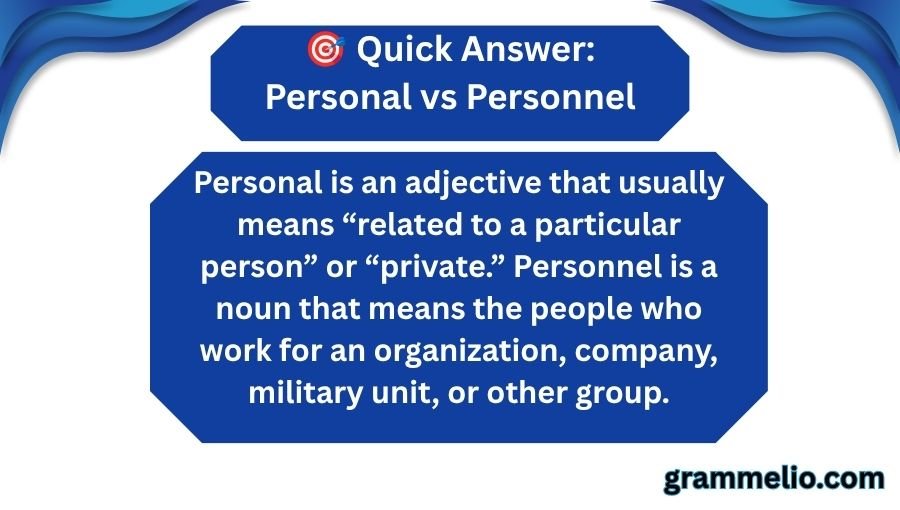
Personal is an adjective that usually means “related to a particular person” or “private.” Personnel is a noun that means the people who work for an organization, company, military unit, or other group.
Quick trick: If you mean private or individual, use personal. If you mean employees or staff, use personnel.
| Word | Part of Speech | Basic Meaning | Example |
|---|---|---|---|
| Personal | Adjective | Related to an individual or private life | This is my personal opinion. |
| Personnel | Noun | Employees or staff | All personnel must attend the meeting. |
What Is the Difference Between Personal and Personnel?
The main difference between personal vs personnel is their meaning and grammatical role. Personal describes something connected with a person, while personnel names a group of people who work for an organization.
Think of these examples:
- Personal information = information about an individual.
- Personnel information = information about employees or staff.
The words may appear similar, but you cannot normally swap them.
Personal
Personal is usually an adjective. It describes a noun.
Examples:
- I keep a personal journal.
- She gave me her personal number.
- That is a personal decision.
- He has a personal reason for leaving.
Here, the word describes something connected to one person.
Personnel
Personnel is a noun. It refers to employees, workers, or members of an organization.
Examples:
- The company needs more personnel.
- Military personnel arrived at the base.
- Hospital personnel responded quickly.
- All personnel must wear identification badges.
Here, the word refers to people who work in a particular organization or setting.
Personal vs Personnel at a Glance
| Form | Type | Meaning | Example | Correct/Incorrect |
|---|---|---|---|---|
| Personal | Adjective | Private or related to one person | I have a personal question. | ✅ Correct |
| Personnel | Noun | Employees or staff | The personnel are ready. | ✅ Correct |
| Personal | Noun meaning staff | Employees or staff | The personal are ready. | ❌ Incorrect |
| Personnel | Adjective meaning private | Private or individual | This is my personnel opinion. | ❌ Incorrect |
| Personal | Adjective | Individual/private | Keep your personal files safe. | ✅ Correct |
Why Do People Confuse Personal and Personnel?
People confuse these words because they look almost identical and are closely connected to the idea of people. Their similar spelling makes the problem worse.
I once reviewed a workplace notice that said, “All personal must report to the office.” The writer meant employees, so the correct word was personnel. The mistake was small, but it changed the meaning of the sentence.
There is also a pronunciation difference in normal speech, but spelling is usually the bigger problem for writers. When people type quickly, they may remember the general shape of the word rather than its exact meaning.
Here are three common reasons for the confusion:
- Fast typing: You know what you mean but type the first word that looks right.
- Autocorrect: Your device may not recognize the intended meaning.
- Lack of knowledge: You may never have learned that the two words belong to different word classes.
Similar Grammar Confusions
| Confusing Pair | First Word | Second Word | Main Difference |
|---|---|---|---|
| Personal / Personnel | Personal | Personnel | Private/individual vs. employees |
| Your / You’re | Your | You’re | Possession vs. “you are” |
| Its / It’s | Its | It’s | Possession vs. “it is” |
| Their / They’re | Their | They’re | Possession vs. “they are” |
| Affect / Effect | Affect | Effect | Usually verb vs. noun |
| Advice / Advise | Advice | Advise | Noun vs. verb |
How Can You Remember Personal vs Personnel?
A simple memory trick can help you remember personal vs personnel.
Think:
Personal = person + private
If something belongs to you, concerns you, or relates to your private life, personal is usually the right choice.
Examples:
- personal goal
- personal opinion
- personal belongings
- personal email
- personal choice
For personnel, think:
Personnel = people employed somewhere
Examples:
- office personnel
- hospital personnel
- military personnel
- security personnel
- support personnel
💡 Test Tip
Ask yourself:
Am I talking about something private or individual?
If yes, choose personal.
Then ask:
Am I talking about employees or staff?
If yes, choose personnel.
This two-question test works in most everyday situations.
| Question | If Yes | Use |
|---|---|---|
| Is it about one person’s private life? | Yes | Personal |
| Does it describe an individual? | Yes | Personal |
| Does it mean employees? | Yes | Personnel |
| Does it mean staff members? | Yes | Personnel |
| Does it describe a private opinion? | Yes | Personal |
Personal: Meaning and Correct Use
Personal describes something connected to a particular person, especially that person’s private life, feelings, choices, or belongings.
It can appear before nouns and can also be used in several common expressions.
Personal Information
Personal information is information about an individual.
Examples include:
- your phone number
- your home address
- your preferences
- your name
- your private contact details
Example:
Please do not share my personal information.
The word personal describes the type of information.
Personal Opinion
A personal opinion is an individual’s own view.
This is my personal opinion, not the company’s official position.
The word tells us that the opinion belongs to the individual.
Personal Choice
A personal choice is a decision made by an individual.
Choosing to work remotely is a personal choice.
Again, personal describes the noun “choice.”
Personal Belongings
Personal belongings are things owned or used by an individual.
Please take all personal belongings with you.
Here, the word refers to items connected to a particular person.
Personal Relationships
A personal relationship is a relationship between individuals that is not simply a business or professional relationship.
She prefers to keep her personal relationships private.
Personal Uses Summary
| Meaning | Word Type | Example Sentence |
|---|---|---|
| Private | Adjective | I keep my personal life private. |
| Individual | Adjective | Everyone has personal goals. |
| Belonging to someone | Adjective | He packed his personal belongings. |
| Based on one’s own view | Adjective | That is my personal opinion. |
| Related to someone’s life | Adjective | She shared a personal story. |
Personnel: Meaning and Correct Use
Personnel is a noun that refers to people who work for an organization or group. Depending on the context, it can mean employees, staff, workers, or service members.
For example:
Hospital personnel helped move the patient safely.
Here, personnel means the workers at the hospital.
Another example:
Only authorized personnel may enter this area.
This means only authorized workers or staff may enter.
Workplace Personnel
In business writing, personnel often refers to employees.
The manager met with company personnel.
This means the manager met with employees.
Military Personnel
The word is also common when talking about members of the armed forces.
Military personnel were given new safety instructions.
The phrase refers to people serving in the military.
Security Personnel
Security personnel are workers responsible for security.
Security personnel checked every visitor’s identification.
Personnel Department
A personnel department is a department that deals with employees. In modern workplaces, the term human resources department is often more common.
Personnel Uses Summary
| Meaning | Example | What It Means |
|---|---|---|
| Employees | Company personnel attended. | Company workers |
| Staff | Hospital personnel responded. | Hospital workers |
| Military members | Military personnel arrived. | Military workers/service members |
| Workers in a special role | Security personnel intervened. | Security workers |
| Organization members | Authorized personnel entered. | Authorized workers |
📝 Case Study: Personal vs Personnel in a Workplace Email
Imagine that a manager wants to send this message:
Please make sure all personnel submit their personal information before Friday.
At first, the sentence may look complicated, but it actually uses both words correctly.
Personnel means the employees.
Personal information means information belonging to those individual employees.
So the sentence means:
All employees must submit information about themselves.
This is an excellent example of why personal vs personnel can be confusing. Both words can appear in the same sentence, but they perform completely different jobs.
I once caught myself typing “personal” when I meant “personnel” in a staff announcement. I stopped before sending it and changed the word. That quick pause saved me from sending a message that looked careless.
Case Study Breakdown
| Part of Sentence | Word | Meaning |
|---|---|---|
| All personnel | Personnel | All employees |
| Their personal information | Personal | Information about each employee |
| Submit | Verb | Give or provide |
| Before Friday | Time phrase | Deadline |
What Grammar Rule Separates Personal and Personnel?
The grammar rule is simple: personal normally functions as an adjective, while personnel functions as a noun referring to workers or staff.
An adjective modifies a noun.
For example:
personal documents
The adjective personal describes “documents.”
A noun can function as the name of people or things.
For example:
Personnel arrived at noon.
Here, personnel refers to workers.
The words therefore cannot normally replace each other.
Most standard English reference works agree on this basic distinction, so you can safely use the adjective-versus-noun rule as your main guide.
Correct vs Incorrect at a Glance
| Sentence | Correct/Incorrect | Why |
|---|---|---|
| Please protect your personal information. | ✅ Correct | “Personal” describes information. |
| All personnel must wear badges. | ✅ Correct | “Personnel” means employees or staff. |
| The personnel decision was private. | ❌ Incorrect | “Personal” is needed for an individual/private decision. |
| All personal must attend the meeting. | ❌ Incorrect | “Personnel” is needed for employees. |
| She shared a personal story. | ✅ Correct | “Personal” describes the story. |
Personal vs Personnel in Everyday English
In everyday conversation, personal is much more common because people often talk about their own lives, choices, feelings, and belongings.
You might say:
- “That’s a personal matter.”
- “It’s my personal choice.”
- “I have a personal question.”
- “Don’t take it personally.”
Personnel is more common in workplaces, government settings, military contexts, hospitals, and formal communication.
You might hear:
- “Office personnel will contact you.”
- “Only authorized personnel can enter.”
- “Emergency personnel arrived quickly.”
This difference in context can help you choose the right word.
How Are Personal and Personnel Used in Different Contexts?
The context often gives you a strong clue. Personal works naturally when discussing individual matters. Personnel works naturally when discussing workers or staff.
| Context | Which Term to Use | Example |
|---|---|---|
| Everyday conversation | Personal | That’s a personal question. |
| Professional writing | Either, depending on meaning | Please contact personnel. |
| Creative writing | Personal | He revealed a personal secret. |
| Social media/texting | Personal | That’s my personal account. |
| Workplace policy | Personnel | All personnel must follow the policy. |
| Employee information | Personal | Employees must protect personal data. |
Common Phrases With Personal
Personal appears in many common phrases. Learning these phrases makes the word easier to recognize.
| Phrase | Meaning |
|---|---|
| Personal information | Information about an individual |
| Personal opinion | One person’s view |
| Personal choice | A decision made by an individual |
| Personal belongings | Items belonging to someone |
| Personal life | Life outside one’s public or work role |
| Personal experience | Something an individual experienced |
These phrases are common in both casual and professional English.
Common Phrases With Personnel
Personnel is also used in several standard workplace and organizational phrases.
| Phrase | Meaning |
|---|---|
| Personnel department | Department dealing with employees |
| Personnel manager | Manager responsible for employee matters |
| Military personnel | People serving in the military |
| Security personnel | Workers responsible for security |
| Authorized personnel | Workers who have permission |
| Emergency personnel | Workers who respond to emergencies |
When you see personnel in one of these phrases, think staff or workers.
Can Personal and Personnel Ever Mean the Same Thing?
No. In standard English, personal and personnel are not interchangeable.
They can appear together because one can describe information belonging to workers while the other identifies the workers themselves.
For example:
Personnel must protect personal information.
This sentence contains both words correctly.
- Personnel = employees.
- Personal information = information about individuals.
That distinction is one of the best ways to understand personal vs personnel.
What Are the Most Common Mistakes With Personal and Personnel?
The most common mistake is using personal when you mean employees.
For example:
❌ All personal must report to the manager.
This sentence sounds as if “personal” is being used as a noun meaning employees. That is not the standard use.
Correct it to:
✅ All personnel must report to the manager.
Another common mistake is using personnel when you mean private or individual.
❌ Please keep your personnel matters private.
If you mean matters concerning your private life, write:
✅ Please keep your personal matters private.
Specific Wrong Forms and Uses
| Wrong Form | What’s Wrong | Correct Form |
|---|---|---|
| All personal must attend. | “Personal” does not mean employees here. | All personnel must attend. |
| My personnel opinion | “Personnel” does not mean private or individual. | My personal opinion |
| Personal department | If referring to an employee department, the intended term is usually personnel department or human resources department. | Personnel department |
| Personnel belongings | “Personnel” does not describe private belongings. | Personal belongings |
| Personal are required to sign. | “Personal” is incorrectly used as a noun for workers. | Personnel are required to sign. |
| Personnel information about my private life | “Personnel” changes the meaning to employee-related information. | Personal information about my private life |
Why Do Fast Typing and Autocorrect Cause Problems?
Typing quickly can make similar words especially difficult. When your brain already knows the sentence, your fingers may produce a familiar spelling without checking the meaning.
Autocorrect can add another layer of confusion. A device may recognize both words as correctly spelled, so it may not flag the wrong one.
For example, both of these are spelled correctly:
- personal
- personnel
The problem is not spelling. The problem is meaning.
That is why a spell checker may fail to catch the mistake.
A Better Editing Habit
Before sending an important message, scan for words that:
- look similar
- sound similar
- have different meanings
- are often confused
For personal vs personnel, ask whether you mean private/individual or employees/staff.
How Can You Use Personal and Personnel in Professional Writing?
Professional writing requires extra care because the wrong word can change the meaning of a policy, email, report, or instruction.
Consider:
All personal must complete the training.
A reader may wonder what “personal” means.
Now compare:
All personnel must complete the training.
The second sentence clearly tells employees that they must complete the training.
On the other hand:
Employees should protect their personnel information.
This could suggest information about personnel as a group or employee records. If you mean private information about each employee, personal information is usually clearer.
Professional Examples
| Situation | Correct Sentence | Reason |
|---|---|---|
| Staff training | All personnel must complete training. | Personnel = employees |
| Privacy | Employees must protect personal information. | Personal = private/individual |
| Workplace choice | This is a personal decision. | Personal = individual |
| Staff access | Authorized personnel may enter. | Personnel = authorized workers |
Can Personal Be Used as a Noun?
In standard modern English, personal is mainly used as an adjective when it has the meaning discussed here. You should not normally use it as a noun to mean employees.
So avoid:
❌ The personal are waiting outside.
Use:
✅ The personnel are waiting outside.
However, personal can appear in other grammatical uses or expressions, such as the adverb personally. That does not change the basic distinction between these two words.
Can Personnel Be Singular?
Personnel generally refers to a group of people and is commonly treated as a collective noun. The exact verb choice can depend on the variety of English and the intended meaning, but in US English, sentences often use personnel as a collective group.
For example:
Personnel are available to help.
You will often see personnel followed by a plural verb when the focus is on the individual workers.
The key point remains the same: personnel means staff or employees, not one private matter belonging to a person.
Personal vs Personnel in Resumes and Job Applications
Job seekers should pay special attention to these words.
You might write:
I developed strong personal communication skills.
Here, personal describes the skills.
But you could also write:
I worked with hospital personnel.
Here, personnel means hospital workers.
In a resume, confusing the words can make a sentence look careless.
Resume Examples
| Intended Meaning | Correct Example |
|---|---|
| Individual strength | I developed strong personal communication skills. |
| Staff | I worked closely with hospital personnel. |
| Private goal | I set a personal career goal. |
| Employees | I trained new personnel. |
Personal vs Personnel in Social Media and Text Messages
Social media usually uses personal more often than personnel.
Examples include:
This is my personal account.
I don’t share personal details online.
That’s a personal decision.
Personnel may appear when a post discusses employees or workers:
Emergency personnel responded to the scene.
Even in casual writing, the basic rule does not change.
What Are Good Alternatives to Personal and Personnel?
Sometimes you can replace one of these words with another expression. However, the replacement must preserve the original meaning.
For personal, possible alternatives include:
- private
- individual
- one’s own
- private-life
For personnel, possible alternatives include:
- employees
- staff
- workers
- team members
Synonyms and Alternatives
| Alternative | Works When | Does Not Work When |
|---|---|---|
| Private | You mean personal or not public | You mean employees |
| Individual | You mean one person’s own matter | You mean an entire staff |
| Employees | You mean people employed by an organization | You mean private information |
| Staff | You mean workers in an organization | You mean someone’s private choice |
| Workers | You mean people who work | You mean personal belongings |
Why Does Getting Personal vs Personnel Right Matter?
Choosing the correct word improves clarity. It also makes your writing look more polished.
A small word mistake can create a large meaning problem. In a workplace notice, confusing employees with private matters can make an instruction unclear.
A useful writing principle is:
Clear words make clear messages.
That rule applies whether you are writing an email, resume, school assignment, website article, or social media post.
Why Accuracy Matters
| Situation | Why Getting It Right Matters |
|---|---|
| Resume | Shows attention to detail |
| Client email | Prevents confusion |
| Published content | Builds trust with readers |
| Social post | Makes your message easier to understand |
| Workplace policy | Gives employees clear instructions |
Good grammar is not only about passing a test. It helps people understand exactly what you mean.
Is There a Special Exception to the Personal vs Personnel Rule?
There is no major exception that makes personal and personnel interchangeable. The safest approach is to keep their normal meanings separate.
One useful edge case is the phrase personnel department. In older or formal workplace language, this refers to a department that handles employee matters. Many organizations today use human resources or HR instead.
Another useful distinction is personal data versus personnel data.
- Personal data generally means information relating to an individual.
- Personnel data generally means employee-related information.
The context determines exactly what information is being discussed.
How Can You Check Your Sentence Quickly?
When editing, don’t stare at the spelling. Look at the meaning.
Try this process:
- Find the word.
- Ask what it describes or names.
- Replace it mentally with private.
- If “private” works, choose personal.
- Replace it mentally with employees.
- If “employees” works, choose personnel.
For example:
All ___ must wear badges.
“Employees must wear badges” makes sense.
So:
All personnel must wear badges.
Now try:
Please protect your ___ information.
“Private information” makes sense.
So:
Please protect your personal information.
🧠 How to Remember the Difference Forever
I recommend remembering one short pair:
Personal = private.
Personnel = people.
The two words become much easier when you connect each one to a simple idea.
Memory Chart
| Word | Memory Word | Think About |
|---|---|---|
| Personal | Private | Your life, choices, belongings |
| Personnel | People | Employees, staff, workers |
If you remember only one thing from this article, remember that chart.
Can One Sentence Use Both Words?
Yes. In fact, using both words in the same sentence can make their difference very clear.
Personnel should keep personal information secure.
Here:
- Personnel means employees.
- Personal means information belonging to individuals.
Another example:
Company personnel should not share customers’ personal information.
Again, both words are correct because they have different jobs.
This is a useful test. If you can explain what each word means in a sentence, you probably have the usage right.
⚠️ Common Mistakes to Watch For
Here are the mistakes I would check first when editing workplace or academic writing:
- Using personal to mean employees.
- Using personnel to mean private.
- Writing “personal department” when referring to an employee department.
- Writing “personnel opinion” instead of “personal opinion.”
- Writing “personnel belongings” instead of “personal belongings.”
- Assuming spell-check will catch the problem.
I once edited a short training document where the writer used personal several times to mean “staff.” Every word was spelled correctly, so the spell checker found nothing wrong. The issue only became obvious when I read the sentences for meaning. That is a good reminder that grammar checking requires more than spelling checks.
Quick Recap Checklist
Use this checklist whenever you are unsure.
| Question | If Yes → Use |
|---|---|
| Does the word mean private? | Personal |
| Does it describe one person’s life? | Personal |
| Does it describe someone’s belongings? | Personal |
| Does it mean employees? | Personnel |
| Does it mean staff members? | Personnel |
| Does it refer to workers in an organization? | Personnel |
Practice Examples
1. The company asked all ___ to attend the meeting.
Answer: personnel ✅
2. Please do not share my ___ information.
Answer: personal ✅
3. That is a ___ decision, so I will make it myself.
Answer: personal ✅
Try creating your own sentence with each word. If you can use personal with “private” and personnel with “employees,” you have learned the core rule.
FAQs About Personal vs Personnel
What is the difference between personal and personnel?
Personal is usually an adjective meaning private, individual, or related to a particular person. Personnel is a noun meaning employees, staff, or workers in an organization.
Is personnel the plural of personal?
No. Personnel is not the plural form of personal. The two words have different meanings and grammatical roles.
Personal describes something, while personnel refers to people who work for an organization.
Should I write personal or personnel for employees?
Use personnel when you mean employees or staff.
✅ All personnel must attend the meeting.
❌ All personal must attend the meeting.
Should I say personal information or personnel information?
Usually, use personal information when you mean information about an individual, such as contact details or private information.
Personnel information can refer to information related to employees or employee records, so the intended meaning matters.
Is “personal department” correct?
If you mean a department that handles employees, personnel department is the traditional term. Human resources department or HR department is also widely used in modern workplaces.
Is “personnel opinion” correct?
No, not if you mean an individual’s opinion. The correct phrase is personal opinion.
✅ That is my personal opinion.
❌ That is my personnel opinion.
Is “personal” a noun for workers?
No. You should not normally use personal as a noun to mean workers or employees. Use personnel, staff, or employees instead.
Can personal and personnel appear in the same sentence?
Yes. They often can.
For example:
Company personnel must protect customers’ personal information.
Personnel means employees, while personal describes information related to individuals.
How do I remember personal vs personnel?
Remember:
Personal = private.
Personnel = people.
If you can replace the word with private, choose personal. If you can replace it with employees, choose personnel.
Final Thoughts on Personal vs Personnel
Personal vs personnel becomes easy when you remember one simple rule: personal describes something private or connected to an individual, while personnel refers to employees, staff, or workers. The words may look similar, but their grammatical jobs are different. ✨
When I edit a sentence containing one of these words, I first ignore the spelling and ask what the writer actually means. If the idea is private, individual, or connected to one person, I choose personal. If the idea is about workers or employees, I choose personnel.
With that habit, you can avoid most mistakes in emails, resumes, reports, workplace notices, and everyday writing. You do not need a complicated grammar rule. Just remember the shortcut: personal means private, and personnel means people.
Once that distinction becomes automatic, this confusing word pair stops being a problem. Keep the rule simple, check the meaning, and your writing will stay clear. 🚀

[…] and incorrect examples, and give you practical tips for using each word with confidence. ✍️ Personal vs Personnel | Patience vs Patients | Passed vs […]