Have you ever written a sentence about a large group of people and suddenly stopped because you were unsure whether to use populace vs populous? I see this confusion often, especially when writers want to describe a city, country, or community.
The two words look and sound similar, but they do very different jobs in a sentence. One is a noun that refers to a group of people. The other is an adjective that describes a place with many people.
✍️ Once you learn that basic difference, the choice becomes much easier. In this guide, I’ll explain the meanings, grammar rules, common mistakes, examples, and memory tricks you can use in everyday and professional writing.
By the end, you should be able to choose the right word with confidence. 😊 Persecute vs Prosecute | Perquisite vs Prerequisite | Personal vs Personnel
🎯 Quick Answer: Populace vs Populous
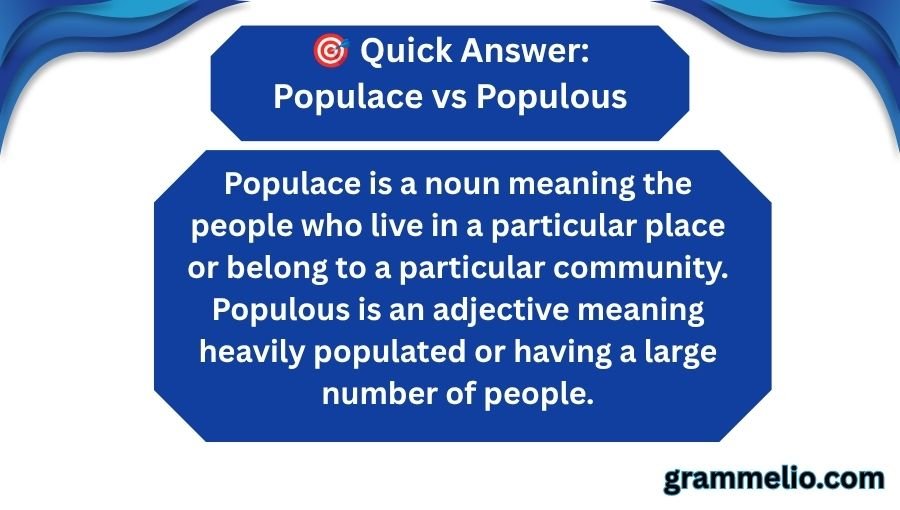
Populace is a noun meaning the people who live in a particular place or belong to a particular community. Populous is an adjective meaning heavily populated or having a large number of people.
A simple way to remember the difference is:
- Populace = the people
- Populous = full of people
For example:
- The populace supported the new plan.
- Tokyo is a populous city.
So, if you are naming the people, use populace. If you are describing a place, use populous.
📚 Related Word Forms
The two words belong to the same general word family, but they do not function in the same grammatical way. Understanding their forms helps prevent mistakes.
| Form | Type | Example |
|---|---|---|
| populace | Noun | The populace demanded answers. |
| populaces | Plural noun | Several regional populaces were affected. |
| populous | Adjective | It is a populous region. |
| less populous | Adjective phrase | The northern area is less populous. |
| most populous | Adjective phrase | It is one of the most populous states. |
The plural populaces is possible when talking about the people of several different regions or communities. However, it is much less common than the singular populace.
There is no standard noun form populous that means “a group of people.” That is one reason the words should not be swapped.
🔎 Understanding Populace vs Populous
The easiest way to understand the difference is to focus on what the word describes. Populace names people. Populous describes a place or area that contains many people. Understanding populace vs populous is easier when you focus on the part of speech each word represents.
| Form | Type | Meaning | Example | Correct/Incorrect |
|---|---|---|---|---|
| populace | Noun | The people of a place or group | The populace welcomed the change. | ✅ Correct |
| populous | Adjective | Having many people | The city is highly populous. | ✅ Correct |
| populace | Noun | Used to describe a crowded place | The city is populace. | ❌ Incorrect |
| populous | Adjective | Used as the name of the people | The populous voted against it. | ❌ Incorrect |
| populace | Noun | A population or community | The local populace was concerned. | ✅ Correct |
What Does Populace Mean?
Populace is a noun. It refers to the people who live in a certain place or who make up a certain community.
For example:
The local populace opposed the construction project.
Here, populace means the people who live in the local area.
Another example:
The mayor spoke directly to the populace.
The word refers to the people as a group.
You can often replace populace with words such as people, population, residents, or community, depending on the sentence.
What Does Populous Mean?
Populous is an adjective. It describes a place or area that has many people living in it.
For example:
California is a populous state.
The word populous describes California. It tells us that many people live there.
You might also see it in phrases such as:
- populous city
- populous state
- populous region
- populous country
- populous area
- densely populated city
The key point is that populous usually describes the size of a population in a place.
Populace Is a Noun
One reliable test is to ask:
Can I put “the” before the word and use it as the name of a group?
Often, yes.
The populace gathered outside the building.
Here, the populace acts as a noun phrase.
You can think of it as:
the populace = the people
Populous Is an Adjective
Now ask:
Is the word describing a noun?
If yes, populous may be the right choice.
It is a populous neighborhood.
The word populous describes neighborhood.
You could also say:
The neighborhood has a large population.
That sentence expresses the same basic idea in a different way.
💡 Test Tip: Use “People” or “Many People”
Here is the quickest test I teach writers.
If you can replace the word with people, you probably need populace.
The populace demanded action.
→ The people demanded action.
If you can replace the word with full of many people, you probably need populous.
It is a populous city.
→ It is a city full of many people.
This simple substitution test can save you from many spelling and grammar errors.
| Meaning | Word Type | Example Sentence |
|---|---|---|
| The people of a place | Noun | The populace gathered in the square. |
| A large number of people living in a place | Adjective | It is a populous city. |
| People in a community | Noun | The local populace supported the project. |
| Having many residents | Adjective | The region is becoming more populous. |
🧭 Why Do People Confuse Populace and Populous?
People confuse these words because they look almost identical and share the same beginning. Their meanings are also connected to people and population, which makes the confusion even easier.
The spelling difference is small:
populace
versus
populous
The ending changes the role of the word.
I once reviewed a short article in which a writer described a city as “a large populace.” The writer was trying to say that the city had many residents. The sentence was understandable, but the wording needed attention. I changed it to “a populous city” because populous was the adjective needed to describe the city.
This is a useful lesson: similar-looking words can still have completely different grammar jobs. When I teach populace vs populous, I tell students to ask whether they mean people or a place with many people.
⚖️ Populace vs Populous at a Glance
The core difference can be summarized in one sentence: populace names a group of people, while populous describes a place with many people.
| Feature | Populace | Populous |
|---|---|---|
| Part of speech | Noun | Adjective |
| Refers to | People | A place or area |
| Basic meaning | The people of a place | Having many people |
| Can describe a city? | No, not normally | Yes |
| Can refer to residents? | Yes | No |
| Example | The populace reacted. | The city is populous. |
Consider these pairs:
The populace protested.
The populous city experienced heavy traffic.
In the first sentence, we are talking about people.
In the second sentence, we are describing the city.
📝 Correct and Incorrect Examples
Seeing the words in complete sentences makes the distinction much clearer.
Example 1
✅ The local populace supported the proposal.
❌ The local populous supported the proposal.
Why? The sentence needs a noun for the group of people. Populace is the noun.
Example 2
✅ New York is a populous state.
❌ New York is a populace state.
Why? The sentence needs an adjective to describe the state. Populous is the adjective.
Example 3
✅ The government listened to the populace.
❌ The government listened to the populous.
Why? The government is listening to the people, so the noun populace is needed.
Example 4
✅ The region has become more populous.
❌ The region has become more populace.
Why? The sentence describes an increase in the number of people living in the region. The adjective populous fits.
Example 5
✅ The city has a large populace.
❌ The city has a large populous.
Why? The sentence needs a noun meaning a group of people. Populace works.
📐 Grammar Rules Explanation
The grammar rule is straightforward.
Populace is a noun. Populous is an adjective.
A noun can function as a subject, object, or other noun phrase in a sentence.
The populace voted.
Here, populace is the subject.
Officials addressed the populace.
Here, populace is the object of the verb addressed.
An adjective modifies or describes a noun.
The populous city attracted new businesses.
Here, populous describes city.
It can also appear after a linking verb:
The city is populous.
The distinction is consistent in standard English usage. General reference sources and dictionaries agree on the basic noun-versus-adjective difference.
The words are related in meaning, but they cannot simply replace each other.
Correct vs Incorrect at a Glance
| Sentence | Correct/Incorrect | Why |
|---|---|---|
| The populace demanded change. | ✅ Correct | Populace is a noun for the people. |
| The city is highly populous. | ✅ Correct | Populous describes the city. |
| The populace city grew quickly. | ❌ Incorrect | The adjective populous is needed. |
| The populous demanded answers. | ❌ Incorrect | The noun populace is needed. |
| The region became more populous. | ✅ Correct | Populous describes the region. |
⚠️ Common Mistakes With Populace vs Populous
Most errors happen for three simple reasons:
- Fast typing causes writers to choose the familiar-looking ending.
- Autocorrect may not catch a wrong word when both spellings exist.
- Lack of knowledge about the parts of speech makes the words seem interchangeable.
I once caught myself making a similar kind of mistake while editing a document late in the evening. I had typed a word that looked right but did not fit the grammar of the sentence. The lesson stuck with me: when two words look almost identical, check their job in the sentence instead of trusting their appearance.
Common Grammar Confusions
| Confusion | Correct Difference |
|---|---|
| its / it’s | Its shows possession; it’s means it is or it has. |
| your / you’re | Your shows possession; you’re means you are. |
| their / there | Their shows possession; there refers to a place or situation. |
| affect / effect | Affect is usually a verb; effect is usually a noun. |
| advice / advise | Advice is a noun; advise is a verb. |
| populace / populous | Populace is a noun; populous is an adjective. |
Specific Wrong Forms to Avoid
| Wrong Form or Use | What’s Wrong | Correct Form |
|---|---|---|
| a populace city | A noun is being used as an adjective | a populous city |
| the populous voted | An adjective is being used as a noun | the populace voted |
| a populous of residents | Populous does not name the group | a populace of residents |
| the area is populace | The sentence needs an adjective | the area is populous |
| the populous supported it | The people are the subject | the populace supported it |
🏙️ How Is Populace Used in Everyday English?
Populace is useful when you want to refer to people as a group. It often appears in writing about communities, politics, public opinion, history, government, and social issues.
For example:
The local populace was concerned about the road closure.
The word gives the sentence a slightly formal tone.
In casual conversation, people are more likely to say people, residents, or locals.
Instead of:
The local populace was excited about the festival.
A casual speaker might say:
The local residents were excited about the festival.
Both are grammatically correct. The choice depends on tone.
🌆 How Is Populous Used to Describe Places?
Populous is commonly used to describe cities, states, countries, regions, and other places with large populations.
Examples include:
It is a populous metropolitan area.
The country has several populous cities.
The eastern part of the state is more populous.
Notice that the word usually needs something to describe.
You would not normally say:
Populous arrived at the meeting.
That does not work because an adjective does not normally name a person or group.
You could say:
The populace arrived at the meeting.
That sentence uses the noun correctly.
🌎 Usage in Different Contexts
The choice between the two words stays the same across different types of writing. What changes is how formal the sentence sounds.
| Context | Which Term to Use | Example |
|---|---|---|
| Everyday conversation | Populace for people; populous for places | The city is populous. |
| Professional writing | Either, depending on meaning | The local populace supported the plan. |
| Creative writing | Either, depending on meaning | The weary populace waited for news. |
| Social media/texting | Usually simpler words are preferred | This is a very populous city. |
In social media, people and population may sound more natural than populace. But populous can still be useful when discussing cities or regions.
💬 Common Phrases With Populace
There are several natural combinations that use populace. These are more common in formal, historical, political, or descriptive writing.
| Phrase | Meaning |
|---|---|
| the local populace | The people living in a local area |
| the general populace | The general population or public |
| the urban populace | People living in urban areas |
| the rural populace | People living in rural areas |
| the civilian populace | Civilian people in a particular area |
| the local populace of the region | The people living in that region |
With populous, common combinations usually describe places.
| Phrase | Meaning |
|---|---|
| populous city | A city with many people |
| populous state | A state with many residents |
| populous country | A country with a large population |
| populous region | A region with many residents |
| densely populated area | An area with many people living close together |
🔄 Synonyms and Alternatives
You do not always need to use either word. Several simpler alternatives may fit your sentence better.
For populace, possible alternatives include people, population, residents, citizens, community, and locals.
For populous, alternatives include densely populated, heavily populated, crowded, and highly populated.
However, these words are not always exact replacements.
| Alternative | Works When | Does Not Work When |
|---|---|---|
| people | You mean human beings as a group | You need a specific formal tone |
| residents | You mean people who live in a place | You mean a wider group not defined by residence |
| population | You mean the number or group of people | You want to describe a place directly |
| densely populated | You describe a place with many people | You are naming the people themselves |
| crowded | You describe a place full of people | You mean the people as a social group |
For example:
The population of the city is growing.
But:
The city is populous.
Both work, but they have different structures.
🎯 A Simple Memory Trick for Populace vs Populous
I recommend remembering one short rule:
Populace = people.
Populous = place.
The rule is not a perfect spelling formula, but it is an excellent practical memory aid.
Try these examples:
The populace wants better schools.
Who wants better schools?
The people.
Therefore, populace.
The city is populous.
What is being described?
The city.
Therefore, populous.
Another helpful clue is the ending -ous. Many adjectives end in -ous, such as:
- famous
- dangerous
- curious
- nervous
- populous
This is not a rule that works for every English word, but it can remind you that populous is describing something.
🧪 Practice: Can You Pick the Right Word?
Try completing each sentence before checking the answers.
- The local ______ welcomed the new hospital.
- The capital is one of the country’s most ______ cities.
- The government met with the ______.
- The western region is less ______ than the coast.
- The mayor addressed the city’s ______.
Answers
- populace — the people welcomed the hospital.
- populous — the word describes cities.
- populace — the government met with the people.
- populous — the word describes the region.
- populace — the mayor addressed the people.
📝 Case Study: A Workplace Writing Example
Imagine that you are preparing a report for a city planning department.
Your first draft says:
“The city is home to a large populace and has become increasingly populace over the past decade.”
There are two problems.
The first use of populace is grammatically possible because it is a noun. However, a large populace may sound somewhat formal and can often be replaced with a large population.
The second use is incorrect because the writer is describing the city.
A better version would be:
“The city has a large population and has become increasingly populous over the past decade.”
Now both words have appropriate grammar.
This example shows why choosing between similar words is not only about spelling. You need to look at the role the word plays in the sentence.
📖 Populace vs Populous in Formal Writing
Both words can appear in formal writing, but populace tends to sound more formal than everyday alternatives such as people or residents.
For example:
The local populace expressed concern over the proposed changes.
This sounds formal and suitable for some reports or essays.
In simpler writing:
Local residents expressed concern over the proposed changes.
The second version is often clearer for a broad audience.
Populous, however, is a useful descriptive adjective:
The state contains several populous urban areas.
It can communicate the idea efficiently without adding unnecessary words.
❓ Is Populace the Same as Population?
No. Populace and population are related, but they are not always interchangeable.
Populace usually refers to the people of a particular place or community as a group.
Population can refer to the people living in an area, but it can also refer to the total number of people or a group being studied.
For example:
The population of the city is two million.
Here, population refers to a measured group or number.
You could also say:
The city’s populace supported the proposal.
Here, populace refers to the people as a group.
❓ Can Populous Be Used as a Noun?
In standard modern English, populous is normally an adjective, not the noun you want when referring to a group of people.
Use populace when you mean the people.
The populace gathered outside.
Use populous when you describe a place.
The area is populous.
If you need a noun, choose population, people, residents, or populace, depending on your meaning.
❓ Is “Populace City” Correct?
No, “populace city” is not the normal grammatical construction when you mean a city with many people.
Use:
a populous city
or:
a heavily populated city
You can use populace as a noun in a different structure:
The city’s populace grew rapidly.
Here, populace refers to the people of the city.
❓ Is “The Populous” Correct?
Usually, no, if you mean the people.
Use:
The populace demanded an explanation.
Not:
The populous demanded an explanation.
Populous is an adjective, so it normally needs a noun to describe.
For example:
The populous city attracted new businesses.
❓ What Is the Difference Between Populace and Populous?
The main difference is grammatical.
Populace is a noun meaning the people of a place or group. Populous is an adjective meaning having many people.
Compare:
The populace voted.
The city is populous.
The first word names people. The second describes a city.
❓ Which Word Describes a City With Many People?
Populous describes a city with many people.
For example:
Los Angeles is a populous city.
You can also say:
Los Angeles is heavily populated.
Do not use populace as the adjective in this sentence.
❓ Can I Say “A Large Populace”?
Yes. A large populace is grammatically possible because populace is a noun.
For example:
The island has a large populace.
However, large population may sound more natural in many contexts.
The choice depends on your desired tone and exact meaning.
❓ What Is an Easy Way to Remember the Difference?
Use this memory trick:
Populace = people.
Populous = many people in a place.
If you are talking about the group itself, choose populace. If you are describing a place with many people, choose populous.
❓ Is “More Populous” Correct?
Yes. More populous is correct when comparing places based on how many people live in them.
For example:
The southern region is more populous than the northern region.
You can also use:
- less populous
- most populous
- highly populous
- increasingly populous
These forms all treat populous as an adjective.
❓ Is “Populace” Singular or Plural?
Populace is grammatically singular as a collective noun.
For example:
The populace is concerned.
The verb is treats the group as one collective unit.
In American English, this singular treatment is especially natural when the group is considered as a whole.
You may also encounter the plural populaces when referring to the people of multiple distinct communities or regions.
❓ Should I Use Populace or People in Casual Writing?
In most casual writing, people is simpler and more natural.
For example:
The people in the town supported the project.
Populace is correct, but it can sound more formal.
That does not make it wrong. It simply means you should choose the word that matches your audience and tone.
🧠 Why Getting the Difference Right Matters
Correct word choice makes your writing easier to understand. It also shows that you understand how English words work.
| Situation | Why Getting It Right Matters |
|---|---|
| Resume | Precise language makes professional writing stronger. |
| Client email | Clear wording reduces confusion. |
| Published content | Correct usage improves credibility. |
| Social post | Accurate words help readers understand your message quickly. |
A reader may understand your meaning even when you use the wrong word. But clear writing should not make the reader stop and figure out what you intended.
A useful rule I often follow is:
Clear words make clear ideas easier to trust.
That applies especially when writing for work, school, websites, or public audiences.
🛠️ How to Check Your Sentence Before Publishing
When you are unsure about one of these words, use this three-step check.
Step 1: Find the word’s job
Ask whether you need a noun or an adjective.
Step 2: Ask what you mean
Do you mean the people?
Use populace.
Do you mean a place with many people?
Use populous.
Step 3: Replace the word
Try a simple replacement.
If people works, choose populace.
If heavily populated works, choose populous.
This method is quick and works well during editing.
📝 Quick Recap Checklist
Use this checklist whenever you are unsure.
| Question | If Yes → Use |
|---|---|
| Am I talking about the people as a group? | populace |
| Am I describing a city with many people? | populous |
| Can I replace the word with “people”? | populace |
| Can I replace the word with “heavily populated”? | populous |
| Is the word describing a noun? | populous |
| Is the word acting as the name of a group? | populace |
Practice Examples
1. The ______ was unhappy with the decision.
Answer: populace
2. It is one of the most ______ areas in the state.
Answer: populous
3. The mayor met with the local ______.
Answer: populace
If you remember only one thing, remember:
Populace = the people. Populous = full of people.
📌 Populace vs Populous: Final Comparison
| Question | Populace | Populous |
|---|---|---|
| What is it? | Noun | Adjective |
| What does it mean? | People of a place or community | Having many people |
| Describes a place? | No, not normally | Yes |
| Names a group? | Yes | No |
| Example | The populace voted. | The city is populous. |
| Common substitute | people, residents | heavily populated |
🎯 Final Takeaway
The difference between populace vs populous becomes easy once you stop focusing on their similar spelling and focus on their grammar. Populace is a noun that refers to the people of a place or community. Populous is an adjective that describes a place with many people.
When you mean the people, choose populace:
The local populace supported the decision.
When you mean a place with many people, choose populous:
The city is highly populous.
I recommend using the simple memory trick “populace = people, populous = place with many people.” It works especially well when you are writing quickly and need to make a fast choice. ✨ Once you recognize the noun-versus-adjective difference, these two words stop looking like interchangeable twins. They become two useful words with two clear jobs. Keep that distinction in mind, and your writing will be clearer, sharper, and more confident. 📚

[…] you should feel confident choosing the right word without stopping to second-guess yourself. ✍️ Populace vs Populous | Persecute vs Prosecute | Perquisite vs […]
[…] common mistakes so you can choose the right word with confidence. ✍️ Practical vs Practicable | Populace vs Populous | Persecute vs […]