Have you ever written a sentence and stopped because you could not decide between practical vs practicable? I have seen this confusion many times in student essays, business emails, reports, and even polished professional documents. The two words look and sound similar, and both can describe something that can be done. Yet they do not always carry the same meaning. 😊
If you are learning English, editing content, or simply trying to make your writing clearer, knowing the difference can save you from awkward sentences. In this guide, I will explain practical vs practicable in plain US English.
I will show you what each word means, where it belongs, how native speakers use it, and how you can quickly tell them apart. By the end, you should feel confident choosing the right word without stopping to second-guess yourself. ✍️ Populace vs Populous | Persecute vs Prosecute | Perquisite vs Prerequisite
🎯 Quick Answer: Practical vs Practicable
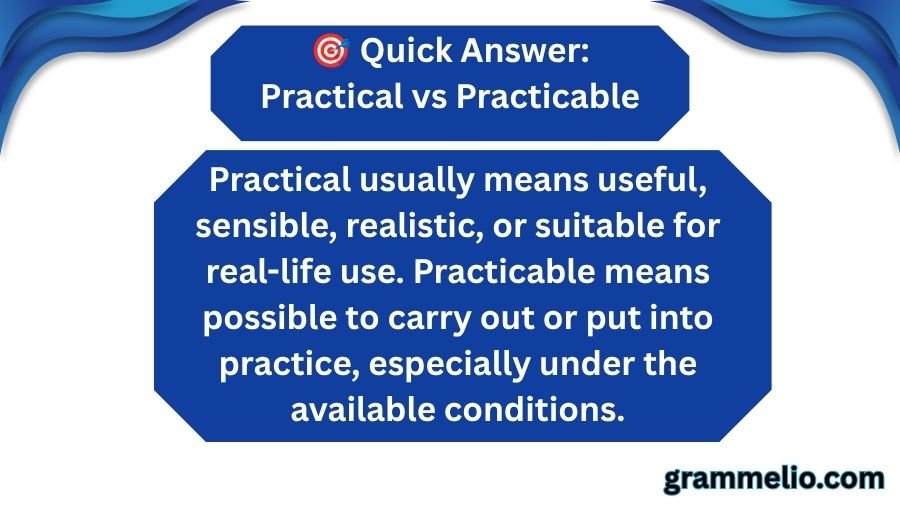
Practical usually means useful, sensible, realistic, or suitable for real-life use. Practicable means possible to carry out or put into practice, especially under the available conditions.
For example, “This is a practical solution” means the solution is sensible and useful. “This plan is practicable” means the plan can actually be carried out.
Is Practical the Same as Practicable?
No, practical and practicable are related but not identical. Practical focuses more on usefulness, common sense, or real-world value, while practicable focuses mainly on whether something can be done successfully.
Consider these examples:
- ✅ The company needs a practical way to reduce costs.
- ❌ The company needs a practicable way to reduce costs.
The first sentence suggests that the company wants a sensible and useful method. The second is not necessarily grammatically wrong, but it changes the focus. It asks whether the method can actually be carried out.
Here is another pair:
- ✅ Walking to work is practical because I live nearby.
- ❌ Walking to work is practicable because I live nearby.
“Practicable” can work when the main idea is that walking is possible. However, “practical” is better when the speaker is saying that walking is a sensible choice.
Practical: The Main Idea
Practical describes something that works well in real life or makes good sense.
It can refer to:
- useful ideas
- sensible choices
- realistic solutions
- hands-on skills
- real-world concerns
- people who think sensibly
For example:
She gave me practical advice about finding a new job.
The advice is useful and realistic.
Practicable: The Main Idea
Practicable describes something that is possible to do or carry out.
For example:
The engineer must determine whether the proposed design is practicable.
The question is whether the design can actually be carried out.
The difference is small but useful: practical asks whether something is sensible or useful, while practicable asks whether something is possible to put into action.
📊 Practical vs Practicable at a Glance
The easiest way to understand the pair is to compare their main jobs in a sentence.
| Form | Type | Meaning | Example | Correct/Incorrect |
|---|---|---|---|---|
| Practical | Adjective | Useful or sensible in real life | We need a practical solution. | ✅ Correct |
| Practicable | Adjective | Possible to carry out | The plan is practicable. | ✅ Correct |
| Practical | Adjective | Concerned with actual use | She has practical skills. | ✅ Correct |
| Practicable | Adjective | Capable of being done | The route is practicable. | ✅ Correct |
| Practicable for useful | Mixed idea | Usually needs clearer wording | This tool is practicable for daily use. | ⚠️ Awkward in many contexts |
What Does Practical Mean in Everyday English?
Practical is the more common word of the two. It usually describes something useful, sensible, realistic, or suited to actual conditions.
I often tell students to connect practical with the idea of “What works well in real life?”
For example:
- ✅ Buying a used car was a practical choice.
- ❌ Buying a used car was a practicable choice.
The first sentence says that buying the used car made good sense. Perhaps it saved money and met the person’s needs.
Practical Can Mean Useful
A practical object is useful for a real purpose.
- ✅ These shoes are practical for hiking.
- ❌ These shoes are practicable for hiking.
The shoes may be comfortable, strong, and suitable for the activity. That is why “practical” works naturally.
Practical Can Mean Sensible
A practical decision is one that makes sense based on real conditions.
- ✅ Taking the train was the most practical option.
- ❌ Taking the train was the most practicable option.
Here, the writer is not simply asking whether taking the train is possible. The writer is saying it is the smartest or most sensible choice.
Practical Can Describe Skills
The word can also describe skills that involve doing something rather than only studying ideas.
- practical experience
- practical skills
- practical training
- practical knowledge
- practical advice
For example:
The course gives students practical skills they can use at work.
That means students learn skills that have direct real-world value.
When Should You Use Practicable?
Use practicable when you want to say that something can be done, carried out, or put into practice.
For example:
- ✅ The proposed changes are practicable.
- ❌ The proposed changes are practical.
The second sentence can still be correct, but it has a different meaning. “Practical” could mean the changes are sensible or useful. “Practicable” specifically points toward their ability to be carried out.
A useful question is:
Can this actually be done?
If that is your main question, practicable may be the better choice.
Practicable Often Appears in Formal Writing
You are more likely to see practicable in formal, technical, legal, engineering, government, or policy writing.
Examples include:
- as soon as practicable
- where practicable
- to the extent practicable
- if practicable
- wherever practicable
These phrases focus on what can realistically be done under particular conditions.
For example:
Please submit the documents as soon as practicable.
This means the documents should be submitted as soon as it is reasonably possible to do so.
💡 Test Tip: Ask “Useful or Possible?”
Here is the fastest test I use when teaching this distinction.
Ask yourself two questions:
- Is the main idea “useful, sensible, or realistic”?
→ Choose practical. - Is the main idea “possible to carry out”?
→ Choose practicable.
| Meaning | Best Choice | Example |
|---|---|---|
| Useful | Practical | This is a practical tool. |
| Sensible | Practical | That was a practical decision. |
| Realistic | Practical | We need a practical plan. |
| Possible to carry out | Practicable | The proposal is practicable. |
| Able to be implemented | Practicable | The changes are practicable. |
This simple test will solve most cases.
What Are the Correct Uses of Practical?
Practical has several common uses, so it is worth learning them separately.
Practical as “Useful”
When something helps you accomplish a real task, it can be practical.
This backpack is practical for travel.
It may have enough pockets, strong straps, and useful storage space.
Practical as “Sensible”
When a choice makes good sense, call it practical.
It was practical to bring an umbrella because rain was expected.
The choice was sensible because it matched the situation.
Practical as “Realistic”
A practical plan is one that considers real limits such as time, money, space, or available resources.
We need a practical budget for the project.
The speaker wants a budget that can work in the real world.
Practical as “Hands-On”
Practical can describe learning that involves doing something.
The students received practical training in the laboratory.
They did not only read about the subject. They worked with it directly.
Meaning Summary for Practical
| Meaning | Word Type | Example Sentence |
|---|---|---|
| Useful | Adjective | This is a practical device. |
| Sensible | Adjective | That was a practical choice. |
| Realistic | Adjective | We need a practical plan. |
| Hands-on | Adjective | The class includes practical training. |
| Real-world | Adjective | She has practical experience. |
Can Practicable Mean the Same as Practical?
Sometimes the meanings overlap, but they should not be treated as exact synonyms.
Practicable is closely connected to the idea of possibility. Practical is broader and often includes usefulness, common sense, and suitability.
Compare these sentences:
- ✅ The proposal is practicable.
- ✅ The proposal is practical.
Both may be correct. But they answer different questions.
The first asks:
Can we carry it out?
The second asks:
Does it make sense and work well in real life?
That small difference can change the tone of a sentence.
📝 Case Study: A Workplace Email
Imagine that a manager wants to introduce a four-day workweek.
An employee writes:
- ❌ I think the four-day workweek is practical because our current system cannot support it.
The sentence is confusing because the reason given actually suggests that the idea may not be workable.
A clearer version would be:
- ✅ I am not sure the four-day workweek is practicable with our current staffing levels.
Now the focus is whether the plan can actually be implemented.
Later, the manager might say:
- ✅ If we can hire another employee, the four-day workweek could become a practical option.
Here, “practical” means the option could make sense and work well in everyday business.
I once edited a workplace memo with almost exactly this kind of problem. The writer knew that both words were related to “doing,” but the sentence was really about whether a plan made sense, not merely whether it was possible. Changing one word made the whole paragraph clearer.
How Does Grammar Explain the Difference?
Both practical and practicable are adjectives. They can describe nouns or appear after linking verbs such as “is,” “seems,” and “becomes.”
The main difference is semantic rather than grammatical.
Practical normally expresses usefulness, suitability, common sense, or real-world value.
Practicable expresses the possibility of carrying something out.
This means that neither word is simply the “correct spelling” of the other. They are separate words with related meanings.
Practical in a Sentence
We need a practical solution.
“Practical” describes the solution. The writer wants something useful and realistic.
Practicable in a Sentence
We need a practicable solution.
This places more attention on whether the solution can actually be carried out.
Both forms can appear before a noun or after a linking verb:
- a practical plan
- a practicable plan
- the plan is practical
- the plan is practicable
The surrounding context determines which meaning is intended.
📋 Correct vs Incorrect at a Glance
| Sentence | Correct/Incorrect | Why |
|---|---|---|
| This is a practical solution to our problem. | ✅ Correct | The solution is useful and sensible. |
| The plan is practicable with our current resources. | ✅ Correct | The plan can be carried out. |
| She gave me practical advice. | ✅ Correct | The advice is useful and realistic. |
| We need a practicable pair of shoes. | ❌ Incorrect/Awkward | “Practical” is the natural word for usefulness. |
| The project is not practicable without more funding. | ✅ Correct | The project cannot reasonably be carried out without funding. |
Why Do People Confuse Practical and Practicable?
People confuse these words because they look almost identical and share a similar connection to the idea of putting something into action.
There is also a major overlap in meaning. Something that can be done may also be useful. Something useful may also be possible. That overlap makes the choice harder.
I once caught myself typing practicable in an article where I clearly meant “useful.” I noticed the sentence sounded overly formal. When I changed it to practical, the meaning became much more natural.
Other common causes include:
- fast typing
- autocorrect
- relying on sound instead of meaning
- lack of knowledge
- assuming similar-looking words are interchangeable
- reading formal language without checking context
⚠️ Common Mistakes With Similar Words
The confusion between these words is part of a larger English pattern. Many words look or sound similar but have different jobs.
| Confusing Pair | Main Difference | Example |
|---|---|---|
| Its / It’s | Possession vs contraction | The dog wagged its tail. |
| Your / You’re | Possession vs “you are” | You’re holding your book. |
| Affect / Effect | Usually verb vs noun | Stress can affect sleep. |
| Advice / Advise | Noun vs verb | She gave me advice. |
| Principal / Principle | Person/main vs rule | The principal explained the principle. |
| Practical / Practicable | Useful/sensible vs possible to carry out | We need a practical plan. |
Learning to focus on meaning rather than spelling can prevent many of these errors.
Which Practical vs Practicable Forms Are Wrong?
Most mistakes happen when writers choose one word simply because it looks familiar.
| Wrong Form or Use | What’s Wrong | Correct Form |
|---|---|---|
| a practicable pair of shoes | Focus is usefulness | a practical pair of shoes |
| practical to complete the task | Usually needs a noun or clearer structure | practicable to complete the task / practical to use |
| practicable advice | Advice is normally useful or sensible | practical advice |
| a practicable solution for daily life | Often means useful rather than merely possible | a practical solution |
| a practical plan when meaning “possible to implement” | May miss the intended focus | a practicable plan |
| very practicable lifestyle | Usually unnatural when describing usefulness | very practical lifestyle |
The word practicable is not wrong simply because it is less common. It becomes wrong or awkward when the sentence needs the broader meaning of usefulness or common sense.
Where Did Practical and Practicable Come From?
The two words have a shared history connected with the idea of doing or putting something into action. Their forms developed along related paths, which helps explain why modern English speakers can confuse them.
Over time, practical became widely used for things connected with actual use, real-world experience, and sensible action. Practicable developed with a narrower focus on what can be done or carried out.
A simple timeline can help show the modern distinction.
| Period | Form | General Development |
|---|---|---|
| Earlier English | Related forms of “practice” | Connected with doing or action |
| Later English | Practical | Became strongly linked with real-world use |
| Later English | Practicable | Became linked with what can be done |
| Modern English | Practical | Common in everyday and professional speech |
| Modern English | Practicable | More common in formal contexts |
You do not need to memorize the history to use the words correctly. The modern meaning is what matters most.
How Are Practical and Practicable Used in Different Contexts?
The context can make the choice much easier. Practical is common in everyday speech, while practicable appears more often when writers discuss whether a plan or action can be carried out.
| Context | Which Term to Use | Example |
|---|---|---|
| Everyday conversation | Practical | That is a practical idea. |
| Professional writing | Either, depending on meaning | We need a practical solution. |
| Technical planning | Practicable when focusing on feasibility | The design is practicable. |
| Creative writing | Practical for everyday usefulness | She carried a practical bag. |
| Social media/texting | Practical | That sounds practical to me. |
Everyday Conversation
Native speakers commonly use practical in daily conversations.
That’s a practical way to handle it.
You would rarely need practicable in casual speech.
Professional Writing
Both words can be useful in professional writing.
Use practical for sensible recommendations:
We need a practical approach to customer service.
Use practicable when discussing whether an action can be implemented:
The proposed changes are not practicable within the current budget.
Creative Writing
Practical often works well when describing objects, choices, or people.
She was practical enough to bring a jacket.
Practicable is less common unless the story has a formal or technical setting.
Social Media and Texting
Practical is the natural choice in most casual digital communication.
That sounds like a practical idea!
Practicable can sound unusually formal in a short text.
What Common Phrases Use Practical?
Practical appears in many common phrases. These expressions are worth learning because they show how native speakers naturally use the word.
| Phrase | Meaning |
|---|---|
| Practical advice | Advice that can be useful in real life |
| Practical experience | Experience gained by doing something |
| Practical skills | Skills useful for real tasks |
| Practical solution | A sensible and workable answer |
| Practical approach | A realistic way of handling something |
| Practical knowledge | Knowledge that can be used in real situations |
These phrases are especially common in education, employment, business, and everyday conversation.
Which Fixed Expressions Use Practicable?
Practicable has fewer everyday expressions, but it appears in several formal phrases.
| Phrase | Meaning |
|---|---|
| As soon as practicable | As soon as reasonably possible |
| Where practicable | Where it can reasonably be done |
| If practicable | If it is possible to do |
| Wherever practicable | In every place where it can be done |
| To the extent practicable | As far as can reasonably be done |
These expressions are common in formal instructions, policies, rules, and official documents.
🧠 How Can You Remember the Difference?
I recommend using a two-word memory trick:
Practical = useful.
Practicable = possible.
Think of a practical object as something that helps you.
Think of a practicable plan as something you can carry out.
For example:
Is this backpack useful? → Practical.
Can this plan be carried out? → Practicable.
You can also remember that practicable often sounds more formal. If you are writing a casual sentence and simply mean “useful” or “sensible,” practical will usually be the better choice.
What Alternatives Can Replace Practical?
Several words can sometimes replace practical, but the replacement depends on the exact meaning.
| Alternative | Works When | Does Not Work When |
|---|---|---|
| Useful | Something provides real value | You specifically mean possible |
| Sensible | A choice makes good sense | You mean technical feasibility |
| Realistic | Something fits real conditions | You only mean useful |
| Workable | A plan can function successfully | You mean hands-on learning |
| Convenient | Something makes life easier | You mean broad common sense |
For example, “practical advice” can become “useful advice” in many situations. But “practical experience” does not always mean exactly the same thing as “useful experience.”
What Alternatives Can Replace Practicable?
Practicable can often be replaced with words such as possible, feasible, or workable, depending on the sentence.
| Alternative | Works When | Does Not Work When |
|---|---|---|
| Possible | Something can happen or be done | You mean useful or sensible |
| Feasible | A plan can realistically be carried out | The tone is very casual |
| Workable | A plan can function | You mean simple usefulness |
| Achievable | A goal can be reached | You mean hands-on skills |
| Doable | Something can be done | Very formal writing requires a more formal term |
For example:
The plan is practicable.
can often become:
The plan is feasible.
The exact choice depends on tone and context.
Why Does Choosing the Right Word Matter?
Choosing between these words matters because small differences can change what your reader thinks you mean.
Clarity in Communication
Clear word choice tells your reader exactly what you want to say.
Compare:
We need a practical plan.
This suggests a sensible and useful plan.
We need a practicable plan.
This suggests a plan that can actually be carried out.
The distinction may be small, but it can matter in business, engineering, education, and policy writing.
Professionalism
Accurate word choice makes professional writing easier to trust.
A report filled with words that do not quite fit can make the writer appear careless. Choosing the precise word shows control over language.
Digital Communication
Emails, websites, social posts, and online articles are read quickly. Readers should not have to stop and figure out what a sentence means.
A simple sentence is often better than a complicated one.
Choose practical when you mean useful or sensible. Choose practicable when you mean possible to carry out.
That rule is short, but it solves a surprising number of problems.
Good writing does not just sound right; it makes the intended meaning easy to see.
| Situation | Why Getting It Right Matters |
|---|---|
| Resume | Shows strong language control |
| Client email | Prevents confusion |
| Published content | Improves clarity and credibility |
| Social post | Makes the message easier to understand |
Is There a Special Exception to Remember?
There is no major spelling exception that changes the basic rule. However, practicable has a strong role in formal phrases such as “as soon as practicable” and “where practicable.”
In these expressions, the word clearly points to what can reasonably be done.
For example:
- ✅ Please respond as soon as practicable.
- ❌ Please respond as soon as practical.
The second version may appear in informal writing, but as soon as practicable is the established formal expression when the intended meaning is “as soon as reasonably possible.”
How Can You Check Your Choice Quickly?
Use this checklist whenever you are unsure.
| Question | If Yes → Use |
|---|---|
| Does it mean useful? | Practical |
| Does it mean sensible? | Practical |
| Does it mean realistic? | Practical |
| Does it describe hands-on experience? | Practical |
| Does it mean possible to carry out? | Practicable |
| Does it mean capable of implementation? | Practicable |
| Is the phrase “as soon as ___”? | Practicable |
| Is the phrase “where ___”? | Practicable |
Practice Examples
1. We need a ___ solution that does not cost too much.
Answer: practical
2. The engineers are checking whether the design is ___.
Answer: practicable
3. She gave me ___ advice about saving money.
Answer: practical
These three examples cover the central difference.
Can Practical and Practicable Both Be Correct?
Yes. Sometimes both words can be grammatically correct, but they emphasize different ideas.
Consider:
The plan is practical.
This can mean the plan is sensible, useful, and realistic.
Now consider:
The plan is practicable.
This means the plan can be carried out.
A plan could theoretically be practicable without being especially practical. For example, a company might be able to carry out an expensive project, but that does not mean the project is a sensible use of money.
This is one of the best ways to understand the distinction.
Possible does not always mean sensible.
That is why English has both words.
Why Do Similar Words Cause So Many Errors?
English has many word pairs that share letters, sounds, or historical connections. Writers often choose words by appearance instead of meaning.
The best way to avoid this is to slow down for one second and ask what you actually mean.
If your thought is:
“This is a good idea because it will work well.”
choose practical.
If your thought is:
“We can actually carry this out.”
choose practicable.
This method is more reliable than trying to memorize long dictionary definitions.
How Does Practical vs Practicable Work in Formal Writing?
Formal writing often makes the distinction more visible because writers need to discuss plans, policies, systems, and actions.
Consider a policy document:
The organization should adopt a practical approach to staff training.
The emphasis is on a sensible approach.
Now consider:
The organization should determine whether the proposed training schedule is practicable.
The emphasis is on whether the schedule can be carried out.
This difference is especially useful when writing:
- business reports
- project plans
- academic papers
- technical documents
- policies
- instructions
- professional emails
How Does Practical vs Practicable Work in Academic Writing?
Academic writers should choose the word based on the claim they are making.
Use practical when discussing real-world value:
The study offers practical benefits for teachers.
Use practicable when discussing whether a method or proposal can be implemented:
The researchers considered whether the method was practicable in rural schools.
The words are not interchangeable simply because both relate to action.
FAQs About Practical vs Practicable
What is the main difference between practical and practicable?
Practical usually means useful, sensible, realistic, or suitable for real-life use. Practicable usually means possible to carry out or put into practice.
Is practical more common than practicable?
Yes. Practical is much more common in everyday English. Practicable is often found in formal, technical, legal, or policy-related writing.
Does practicable mean possible?
Yes. Practicable commonly means capable of being done or carried out under real conditions.
Does practical mean realistic?
Yes. One common meaning of practical is realistic or sensible in real-life conditions.
Is “practical solution” correct?
Yes. Practical solution is a very common phrase. It usually means a solution that is useful, sensible, and realistic.
Is “practicable solution” correct?
Yes, it can be correct when the writer wants to stress that the solution can actually be carried out. It sounds more formal than “practical solution.”
Should I say “practical advice” or “practicable advice”?
Use practical advice. Advice is usually described as practical when it is useful, sensible, and helpful in real life.
Should I say “as soon as practical” or “as soon as practicable”?
In formal writing, as soon as practicable is the standard choice when you mean “as soon as reasonably possible.”
Can a plan be both practical and practicable?
Yes. A plan can be both possible to carry out and sensible or useful. In that case, both words can describe different qualities of the same plan.
What is an easy trick for remembering practical vs practicable?
Remember: practical = useful or sensible, while practicable = possible to do. Ask yourself whether you are talking about value or possibility.
Practical vs Practicable: A Final Comparison
| Feature | Practical | Practicable |
|---|---|---|
| Main idea | Useful or sensible | Possible to carry out |
| Common in daily speech | Yes | Less common |
| Common in formal writing | Yes | Yes |
| Describes useful objects | Yes | Usually no |
| Describes sensible choices | Yes | Not usually |
| Describes feasibility | Sometimes | Strongly |
| Describes hands-on skills | Yes | No |
| Common phrase “as soon as” | No | Yes |
| Common phrase “where” | No | Yes |
🎯 Final Recap: Practical vs Practicable
This practical vs practicable comparison brings the main differences together in one quick reference.The easiest way to remember the difference is to focus on the question behind the sentence.
Practical answers:
Is it useful, sensible, or realistic?
Practicable answers:
Can it actually be done?
Use practical for useful advice, sensible choices, realistic plans, hands-on skills, and real-world value.
Use practicable when you are talking about whether an action, plan, design, or proposal can be carried out.
When both seem possible, look closely at your intended meaning. If you are discussing usefulness, choose the everyday word. If you are discussing feasibility, the more formal word may be the better fit.
Conclusion
Practical vs practicable becomes much easier once you stop focusing on their similar spelling and focus on their different ideas. Practical usually means useful, sensible, realistic, or suited to real life. Practicable usually means possible to carry out. 😊
When I edit a sentence containing either word, I ask one simple question: “Am I talking about usefulness or possibility?” That question usually gives me the answer in seconds.
Remember the shortcut: practical means useful or sensible; practicable means possible to do. If you keep that distinction in mind, you will be able to handle these words confidently in essays, emails, reports, websites, and everyday conversations. ✨
Good word choice does not have to be complicated. Sometimes one simple question is all you need to make your writing clearer.

[…] memory tricks, and common mistakes so you can choose the right word with confidence. ✍️ Practical vs Practicable | Populace vs Populous | Persecute vs […]
[…] down step by step so you can choose the right word with confidence. ✍️ Presence vs Presents | Practical vs Practicable | Populace vs […]