I often see writers pause when they come across presence vs presents, and I understand why. The two words look and sound similar, but they have very different jobs in a sentence. If you are a student, teacher, job seeker, blogger, or professional writer, knowing the difference can make your writing much clearer.
I have taught and edited English for years, and I have seen how one small spelling choice can change the meaning of an entire sentence. Presence vs presents is especially tricky because one word can describe being somewhere, while the other can refer to gifts or an action. 🎯
The good news is that the difference is easy to learn once you connect each word to its meaning. In this guide, I will show you simple rules, examples, memory tricks, and common mistakes so you can choose the right word with confidence. ✍️ Practical vs Practicable | Populace vs Populous | Persecute vs Prosecute
🎯 Quick Answer: Presence vs Presents
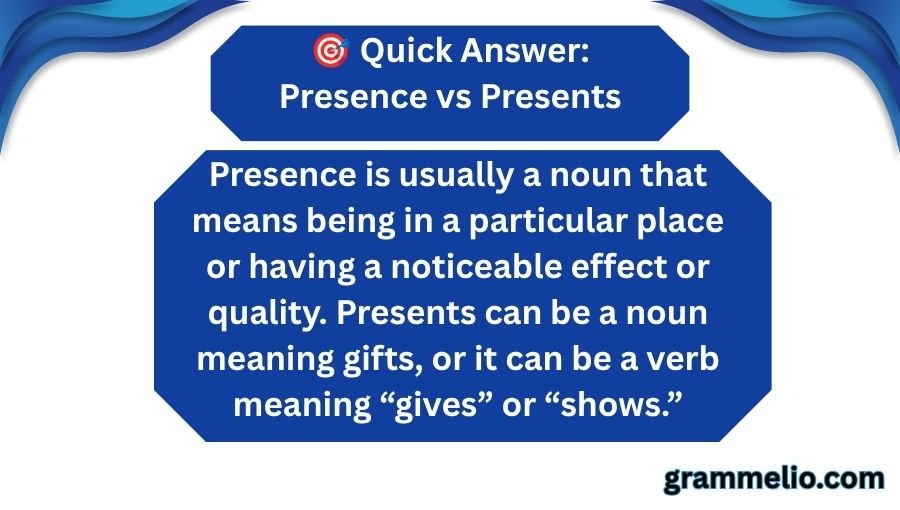
Presence is usually a noun that means being in a particular place or having a noticeable effect or quality. Presents can be a noun meaning gifts, or it can be a verb meaning “gives” or “shows.”
A simple trick is this: presence = being there, while presents = gifts or gives.
| Word | Main Meaning | Example |
|---|---|---|
| Presence | Being in a place or having an effect | Her presence made everyone feel calm. |
| Presents | Gifts | We opened our birthday presents. |
| Presents | Gives or shows | He presents the report every Friday. |
Presence vs Presents: Understanding the Basics
The key difference between presence vs presents is meaning and grammar. Although the words are closely spelled, they usually serve different purposes.
Presence is a noun. It often describes the fact that someone or something is somewhere. It can also describe a strong or noticeable quality that someone has.
Presents has two common uses. As a plural noun, it means gifts. As a verb, it is the third-person singular form of “present,” meaning someone gives, introduces, shows, or delivers something.
Presence: Meaning and Correct Use
Presence means the state or fact of being in a particular place. It can also describe the effect someone or something has simply by being there.
For example:
- “Your presence made the meeting more enjoyable.”
- “The security guard noticed the presence of a stranger.”
- “Her presence in the classroom helped the students feel safe.”
In each sentence, presence is a noun.
Think of it as answering the question: Who or what is there?
Presents: Gifts
When presents means gifts, it is a plural noun.
For example:
- “The children opened their presents.”
- “I bought three presents for my family.”
- “She wrapped the presents before the party.”
Here, presents refers to things that people give to others.
Presents: Gives or Shows
Presents can also be a verb.
For example:
- “Maria presents the plan to the team.”
- “The teacher presents a new lesson each Monday.”
- “The museum presents a special exhibition this month.”
Here, “presents” means something close to gives, introduces, displays, or shows.
| Form | Type | Meaning | Example | Correct/Incorrect |
|---|---|---|---|---|
| Presence | Noun | Being somewhere | His presence helped us. | ✅ Correct |
| Presents | Plural noun | Gifts | I bought presents. | ✅ Correct |
| Presents | Verb | Gives or shows | She presents the award. | ✅ Correct |
| Presence | Verb | Not a standard use | She presence the report. | ❌ Incorrect |
| Presents | Noun meaning “being there” | Wrong word for this meaning | His presents was welcome. | ❌ Incorrect |
🎯 Is Presence the Same as Presents?
No, presence and presents are not the same word. Presence normally refers to being somewhere or having an effect, while presents can mean gifts or can describe an action such as giving, showing, or introducing something.
The easiest way to separate them is to look at the sentence around the word.
If you are talking about being there, choose presence.
If you are talking about gifts, choose presents.
If someone gives, shows, or introduces something, choose presents.
Examples That Show the Difference
✅ Her presence made the room feel warmer.
The sentence is about her being there.
❌ Her presents made the room feel warmer.
This changes the meaning. Now “presents” sounds like gifts, not her physical or emotional presence.
✅ The children were excited to open their presents.
The sentence clearly refers to gifts.
❌ The children were excited about his presence.
This sentence is grammatically possible, but it means something completely different. It is not talking about gifts.
| Meaning | Correct Word | Example |
|---|---|---|
| Being somewhere | Presence | His presence was reassuring. |
| A noticeable effect | Presence | She has a strong stage presence. |
| Gifts | Presents | The presents were under the tree. |
| Gives or shows | Presents | He presents the results today. |
💡 How Can You Remember Presence vs Presents?
I recommend using a three-part memory test.
Test 1: Think “being there”
If you can replace the word with being there, use presence.
“Her presence was comforting.”
You could say:
“Her being there was comforting.”
The meaning stays close.
Test 2: Think “gifts”
If the sentence is about birthday, holiday, wedding, or other gifts, use presents.
“We opened our presents.”
Think:
“We opened our gifts.”
Test 3: Think “gives or shows”
If the word is an action, ask whether someone is giving, showing, introducing, or delivering something.
“He presents the award.”
You could understand this as:
“He gives the award.”
The exact meaning depends on context, but presents is the verb.
💡 Test Tip
I use this quick test when editing:
There → presence.
Gifts → presents.
Gives/shows → presents.
If you remember those three ideas, you can solve most presence vs presents questions in seconds.
| Question to Ask | If Yes | Use |
|---|---|---|
| Does it mean being somewhere? | Yes | Presence |
| Does it mean a gift? | Yes | Presents |
| Does it mean gives or shows? | Yes | Presents |
| Does it describe someone’s effect or influence? | Yes | Presence |
📝 Case Study: A Simple Workplace Example
Imagine a team is preparing for an important presentation. One employee, Daniel, has been absent from several meetings. On the day of the final meeting, he arrives and helps the group solve a difficult problem.
A coworker might say:
“Daniel’s presence made a real difference.”
Here, presence means Daniel being there. His physical attendance had an effect on the group.
Now imagine that Daniel gives the team a set of notebooks as a thank-you gift.
A coworker might say:
“Daniel brought presents for everyone.”
Now presents means gifts.
Finally, imagine Daniel is the person explaining the project to the manager.
You could write:
“Daniel presents the project to the manager.”
Here, presents is a verb. It means he gives or explains the project formally.
I once edited a short workplace announcement where the writer used “presents” when they meant “presence.” The sentence was meant to praise an employee for attending an important event. Instead, it sounded as though the employee had brought gifts. The writer laughed when we spotted it, but the example showed why one letter can matter.
📚 Grammar Rules Explanation
The grammar rule behind presence vs presents is simple: the words belong to different grammatical forms and meanings.
Presence functions as a noun. It names the state of being present or an effect created by someone or something.
Presents has two common grammatical roles.
First, it can be a plural noun. In that role, it means gifts.
Second, it can be a verb. It is the third-person singular present-tense form of “present.”
For example:
“She presents the information clearly.”
The subject is “she.” The verb is “presents.”
Compare that with:
“Her presence is appreciated.”
Here, “presence” is a noun.
The surrounding words often give you a strong clue. Articles and possessive words can also help.
For example:
- “his presence”
- “her presence”
- “their presence”
- “the presence of danger”
These structures commonly point to the noun presence.
On the other hand:
- “birthday presents”
- “Christmas presents”
- “wedding presents”
usually point to gifts.
And structures such as:
- “she presents”
- “he presents”
- “the company presents”
usually use presents as a verb.
Most standard English reference sources treat these as distinct words with distinct meanings. The safest approach is to focus on the meaning and grammatical role instead of relying only on spelling.
Correct vs Incorrect at a Glance
| Sentence | Correct/Incorrect | Why |
|---|---|---|
| Her presence was comforting. | ✅ Correct | “Presence” means being there. |
| We opened our birthday presents. | ✅ Correct | “Presents” means gifts. |
| The speaker presents the award. | ✅ Correct | “Presents” is a verb. |
| Her presents was comforting. | ❌ Incorrect | “Presents” does not mean being there. |
| We felt his presents during the meeting. | ❌ Incorrect | The intended meaning is “presence.” |
⚠️ Why Do People Confuse Presence and Presents?
People confuse these words because they look almost identical. Both begin with “presen-,” and both are pronounced in ways that can sound similar in some sentences.
There are several common reasons for the confusion:
- Fast typing: People often type quickly and choose the first familiar spelling.
- Autocorrect: Software may suggest or accept the wrong form.
- Lack of knowledge: Writers may know the words separately but not know when to use each one.
- Sound-based spelling: Some people choose a spelling based on how a word sounds.
- Context errors: A writer may focus on the whole sentence without checking the exact meaning of the word.
I once caught myself typing “presents” in a sentence about a speaker’s presence at an event. I was moving quickly and had the sentence in my head before I noticed the extra “s.” That small mistake reminded me that even experienced writers should proofread familiar words.
Common Grammar Confusions
| Confusing Pair | Correct Difference |
|---|---|
| It’s / Its | “It’s” means “it is”; “its” shows possession. |
| Your / You’re | “Your” shows possession; “you’re” means “you are.” |
| Their / There / They’re | Possession, place, and “they are.” |
| Then / Than | “Then” relates to time; “than” is used in comparisons. |
| Affect / Effect | Often an action versus a result, though usage can vary. |
| Presence / Presents | Being there versus gifts or gives/shows. |
Common Wrong Forms and Uses
| Wrong Form | What’s Wrong | Correct Form |
|---|---|---|
| His presents was helpful. | “Presents” does not mean being there. | His presence was helpful. |
| Her presents made us happy. | If you mean she was there, the noun is wrong. | Her presence made us happy. |
| I felt their presents at the event. | The intended meaning is their being there. | I felt their presence at the event. |
| We opened our birthday presence. | Gifts are called presents. | We opened our birthday presents. |
| She presence the report. | “Presence” is not used as this verb. | She presents the report. |
| Their presents was requested. | “Presence” is needed if you mean attendance. | Their presence was requested. |
🎯 Presence vs Presents in Everyday Writing
In everyday conversation, the right word depends on what you want to say.
If you are talking about someone attending a party, meeting, class, or event, presence is usually the correct choice.
For example:
“Thank you for your presence at the ceremony.”
If you are talking about gifts, use presents:
“Thank you for the birthday presents.”
If someone is showing something to an audience, use presents as a verb:
“She presents her ideas clearly.”
These three meanings cover most everyday situations.
💼 Presence vs Presents in Professional Writing
Professional writing requires extra care because small word errors can affect how polished your message sounds.
Consider this email:
“Thank you for your presents at yesterday’s meeting.”
If the writer means attendance, the sentence contains an error.
The better version is:
“Thank you for your presence at yesterday’s meeting.”
Now consider:
“The company presents its annual report next week.”
This is correct because “presents” is a verb.
Professional writers should always check whether the word describes attendance, gifts, or an action.
| Context | Which Term to Use | Example |
|---|---|---|
| Everyday conversation | Presence or presents, depending on meaning | We appreciated her presence. |
| Professional writing | Presence for attendance/effect | Your presence is requested. |
| Professional presentation | Presents for the action | He presents the findings. |
| Holiday discussion | Presents for gifts | The children opened presents. |
✍️ How Do These Words Work in Creative Writing?
Creative writing gives both words plenty of room to appear, but their meanings remain separate.
A novelist might write:
“Her presence changed the mood of the room.”
This creates an idea about influence or atmosphere.
The same story might say:
“The children gathered around the presents.”
Here, the word describes gifts.
A writer could also use the verb:
“The host presents a strange challenge to the guests.”
The context makes the meaning clear.
When I teach word choice, I tell writers not to choose a word simply because it looks familiar. Instead, they should imagine the scene. If the scene contains a person being there, think presence. If it contains wrapped gifts, think presents.
📱 Presence vs Presents in Texting and Social Media
Text messages and social posts often contain quick spelling mistakes. Because people type fast, presence vs presents can easily become a problem.
For example:
✅ “Thanks for being there. Your presence meant so much.”
❌ “Thanks for being there. Your presents meant so much.”
The second sentence could accidentally suggest that the person gave gifts.
However, this sentence is correct:
“Thank you for the presents!”
That clearly refers to gifts.
Social media captions can also use presence in emotional messages:
“Your presence made this day unforgettable.”
That wording is natural and warm.
| Digital Situation | Correct Choice | Example |
|---|---|---|
| Thanking someone for attending | Presence | Your presence meant a lot. |
| Talking about gifts | Presents | Thanks for the presents! |
| Describing a presentation | Presents | She presents her work online. |
| Talking about someone’s influence | Presence | He has a strong online presence. |
🗣️ Common Phrases With Presence
Presence appears in many common English phrases. Learning these expressions can make the difference easier to remember.
| Phrase | Meaning |
|---|---|
| Be in the presence of | Be near or with someone or something |
| In someone’s presence | While someone is there |
| Physical presence | Actually being in a location |
| Strong presence | A noticeable or powerful effect |
| Stage presence | The ability to command attention while performing |
| Online presence | A person’s or organization’s activity and visibility online |
These phrases all connect to the basic idea of being there or having an effect.
Common Phrases With Presents
Presents also appears in familiar phrases when it means gifts.
| Phrase | Meaning |
|---|---|
| Birthday presents | Gifts given for a birthday |
| Christmas presents | Gifts given at Christmas |
| Wrapped presents | Gifts covered in wrapping |
| Open presents | Unwrap gifts |
| Exchange presents | Give gifts to each other |
| Surprise presents | Unexpected gifts |
The context makes the meaning easy to identify.
🔄 Synonyms and Alternatives
Sometimes you can replace presence with another word or phrase. The best choice depends on the exact meaning.
For example, attendance can work when you specifically mean being at an event. Company can work when you mean someone’s companionship. existence may work in some formal contexts, but it does not always have the same meaning.
For presents, you can often use gifts when you mean things given to someone. When “presents” is a verb, alternatives include shows, introduces, delivers, or gives, depending on the sentence.
| Alternative | Works When | Does Not Work When |
|---|---|---|
| Attendance | You mean being at an event | You mean a person’s overall effect |
| Gifts | You mean presents people receive | “Presents” means gives or shows |
| Company | You mean someone’s companionship | You mean physical attendance in a formal sense |
| Shows | “Presents” means displays | “Presents” means gifts |
| Gives | “Presents” means gives | You need the noun meaning gifts |
🎯 Why Does Getting Presence vs Presents Right Matter?
Correct word choice improves clarity. It also makes your writing look more careful and professional.
Imagine writing a thank-you card:
“Your presents made our wedding special.”
The reader may think you mean gifts.
But if you mean the people who attended made the day special, write:
“Your presence made our wedding special.”
The difference is small in spelling but large in meaning.
A useful rule is:
Clear words create clear messages.
That principle matters in school papers, resumes, client emails, websites, invitations, and social posts.
| Situation | Why Getting It Right Matters |
|---|---|
| Resume or cover letter | Shows careful word choice |
| Client email | Prevents confusion |
| Published content | Protects clarity and credibility |
| Social post | Helps readers understand your meaning |
💡 How To Remember the Difference
I suggest building a visual connection.
Picture a person standing in a room.
That person has presence.
Now picture several wrapped boxes under a tree.
Those are presents.
Finally, picture a person standing at a podium and showing a report to an audience.
That person presents the report.
This mental picture works because it connects each spelling with a different action or idea.
The Three-Word Memory Trick
Remember:
Presence = there.
Presents = gifts.
Presents = gives/shows.
You do not need a complicated grammar rule. You just need to identify the meaning.
🧠 Practice: Choose the Correct Word
Try these sentences before looking at the answers.
Practice 1
“Thank you for your ______ at the ceremony.”
The answer is presence because the sentence refers to being at the ceremony.
Practice 2
“The children placed their ______ under the tree.”
The answer is presents because the sentence refers to gifts.
Practice 3
“She ______ the award to the winner.”
The answer is presents because it is a verb meaning gives.
Practice Table
| Sentence | Answer | Reason |
|---|---|---|
| We appreciated his ______ at the event. | Presence | Being there |
| I wrapped the birthday ______. | Presents | Gifts |
| She ______ the award. | Presents | Gives |
| Her ______ changed the mood. | Presence | Effect or influence |
| They opened their ______. | Presents | Gifts |
⚠️ Special Usage Notes
One useful point is that presence can refer to more than simple physical attendance.
For example:
“The company has a strong online presence.”
This does not mean the company is physically standing somewhere. It means the company is active, visible, or noticeable online.
Similarly:
“She has a powerful stage presence.”
This describes the effect she has while performing. It is not simply about standing on a stage.
These uses are still connected to the main idea of presence: being noticeable or having an effect.
By contrast, presents as a plural noun remains focused on gifts:
“The presents were wrapped in silver paper.”
As a verb, however, it has a wider range of meanings:
“The host presents the award.”
“The company presents a new product.”
“The teacher presents the lesson.”
The exact meaning comes from the context.
❓ Why Do Presence and Presents Look So Similar?
They look similar because they share most of their letters. The spelling difference is easy to overlook when reading or typing quickly.
The final -ce in presence is part of the noun’s spelling. The final -ts in presents creates a different word form.
Instead of trying to memorize every letter, connect the spelling to meaning:
- presence → someone or something is there
- presents → gifts
- presents → gives or shows
That approach is faster and more reliable.
🔍 Can Presents Ever Mean Something Other Than Gifts?
Yes. Presents can be a verb.
For example:
“The scientist presents her findings.”
Here, presents does not mean gifts. It means she gives or shows the findings to others.
This is one of the most important points in learning presence vs presents because the word “presents” has two common uses.
| Use of Presents | Part of Speech | Example |
|---|---|---|
| Gifts | Plural noun | The presents are wrapped. |
| Gives | Verb | He presents the award. |
| Shows | Verb | She presents the evidence. |
| Introduces | Verb | The host presents the speaker. |
📋 Quick Recap Checklist
Use this checklist whenever you are unsure.
| Question | If Yes → Use |
|---|---|
| Do I mean someone being there? | Presence |
| Do I mean someone’s effect or influence? | Presence |
| Do I mean gifts? | Presents |
| Do I mean someone gives something? | Presents |
| Do I mean someone shows or introduces something? | Presents |
Practice Examples
- “Your ______ at the meeting was appreciated.”
- Presence
- “The children opened their ______.”
- Presents
- “The manager ______ the new plan.”
- Presents
If you can answer these three, you understand the core difference.
FAQs About Presence vs Presents
What is the difference between presence and presents?
Presence means being somewhere or having a noticeable effect. Presents can mean gifts, or it can be a verb meaning gives, shows, or introduces something.
Is “presence” singular or plural?
Presence is normally a singular noun. Its plural form is presences, although the plural is less common and is used when talking about multiple instances or types of presence.
Does presents mean gifts?
Yes. Presents is a plural noun when it means gifts.
For example:
“She received several birthday presents.”
Can presents be a verb?
Yes. Presents is also the third-person singular present-tense form of the verb present.
For example:
“He presents the report every Monday.”
Which is correct: “Thank you for your presence” or “Thank you for your presents”?
If you are thanking someone for attending or being somewhere, “Thank you for your presence” is correct.
If you are thanking someone for gifts, “Thank you for your presents” is correct.
Which word should I use for attendance?
Use presence when you mean that someone was physically or noticeably there.
For example:
“Your presence at the meeting was appreciated.”
You can also use attendance when the focus is specifically on attending an event.
Is “presents” always about gifts?
No. It can also be a verb.
For example:
“The speaker presents the results.”
Here, it means the speaker gives or shows the results.
How can I remember the difference quickly?
Use the simple memory trick:
Presence = being there.
Presents = gifts or gives/shows.
Is “online presence” correct?
Yes. Online presence is a common expression. It refers to how visible or active a person, company, organization, or brand is online.
Which sentence is correct: “Her presence made me happy” or “Her presents made me happy”?
If you mean that having her there made you happy, the correct sentence is:
“Her presence made me happy.”
If you mean that gifts from her made you happy, you could say:
“Her presents made me happy.”
The two sentences have different meanings.
🎯 Final Takeaway
Presence vs presents becomes much easier when you focus on meaning rather than spelling. Presence is a noun connected with being somewhere, being noticeable, or having an effect. Presents can be a plural noun meaning gifts, or it can be a verb meaning gives, shows, or introduces.
When I proofread, I use a simple three-question test: Is the sentence about being there? Choose presence. Is it about gifts? Choose presents. Is someone giving or showing something? Choose presents.
A tiny spelling difference can create a very different message, but you do not need to memorize a complicated rule. Just connect each word to its meaning. 🧠 Once that habit becomes automatic, these two words are easy to separate.
So remember: presence means being there; presents means gifts or gives/shows. Keep that rule in mind, and your writing will stay clear, accurate, and confident. ✨

[…] Let’s break the pair down step by step so you can choose the right word with confidence. ✍️ Presence vs Presents | Practical vs Practicable | Populace vs […]