Have you ever stopped while writing and wondered whether someone was being persecuted or prosecuted? I have seen this mix-up many times, even in otherwise strong writing. The words persecute vs prosecute look and sound alike, but they describe very different actions.
One is about treating someone cruelly or unfairly over time. The other is about taking legal action against someone who is accused of a crime. If you are a student, teacher, professional writer, editor, or simply someone who wants clearer English, knowing this difference can save you from an embarrassing mistake. 😊
Once you learn the small memory trick I use with my students, these two words become much easier to separate. Let’s break down the difference in a simple way. ✨ Perquisite vs Prerequisite | Personal vs Personnel | Patience vs Patients
🎯 Quick Answer: Persecute vs Prosecute
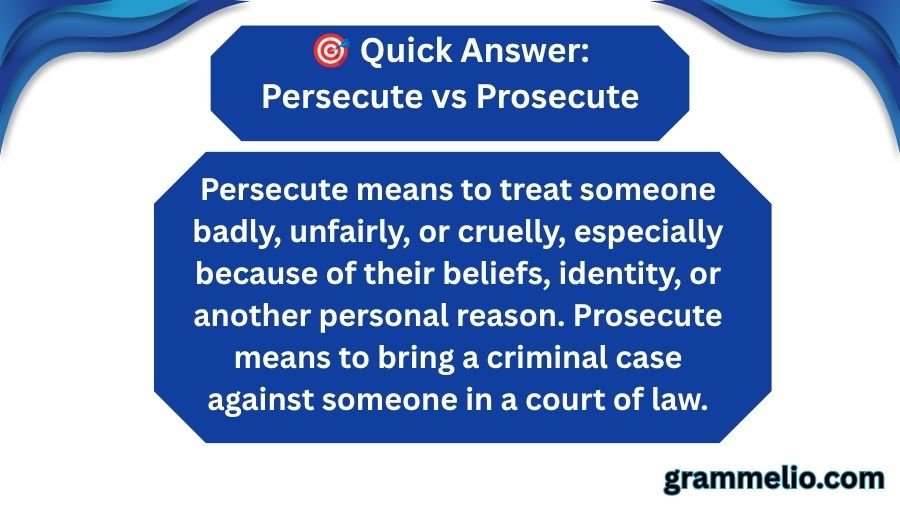
Persecute means to treat someone badly, unfairly, or cruelly, especially because of their beliefs, identity, or another personal reason. Prosecute means to bring a criminal case against someone in a court of law.
A simple way to remember the difference is this: persecute is about cruel treatment, while prosecute is about legal action.
| Word | Basic Meaning | Main Area | Simple Example |
|---|---|---|---|
| Persecute | Treat someone cruelly or unfairly | Personal, social, political, or religious treatment | The group was persecuted for its beliefs. |
| Prosecute | Take legal action against someone | Law and courts | The state decided to prosecute the suspect. |
What Is the Difference Between Persecute and Prosecute?
The main difference is the type of action each word describes. Persecute describes repeated or ongoing mistreatment, while prosecute describes formal legal action.
Think of the two words as belonging to different worlds:
- Persecute → unfair or cruel treatment
- Prosecute → criminal court action
- Persecution → the act of persecuting
- Prosecution → the process of bringing a criminal case
The spelling is close because both words begin with per- or pro- and end with -ecute. That visual similarity causes trouble. However, their meanings are not interchangeable.
Here is a quick comparison:
| Form | Type | Meaning | Example | Correct/Incorrect |
|---|---|---|---|---|
| Persecute | Verb | Treat cruelly or unfairly | The community was persecuted for its beliefs. | ✅ Correct |
| Prosecute | Verb | Bring a legal case against someone | The attorney will prosecute the case. | ✅ Correct |
| Persecution | Noun | Cruel or unfair treatment | The family fled because of persecution. | ✅ Correct |
| Prosecution | Noun | Legal action against an accused person | The prosecution presented evidence. | ✅ Correct |
| Persecute for a crime | Verb phrase | Incorrect use when legal action is meant | The state will persecute him for fraud. | ❌ Incorrect |
🧭 Persecute: Meaning and Correct Use
Persecute means to repeatedly treat a person or group in a cruel, hostile, or unfair way. The mistreatment may happen because of religion, race, political views, identity, beliefs, or another characteristic.
The word usually suggests more than one unpleasant event. It often describes a pattern of harassment, punishment, oppression, or abuse.
Persecute in Social or Religious Contexts
You may see persecute in discussions about people who are targeted because of their beliefs.
For example:
The community was persecuted because of its religious beliefs.
The sentence does not describe a court case. It describes unfair treatment directed at the community.
Persecute in Political Contexts
The word can also describe people who are targeted because of their political views.
The journalist claimed that officials were persecuting critics of the government.
Again, the focus is unfair treatment rather than a criminal trial.
Persecute in Everyday Writing
You can use the word outside major historical or political situations when someone is being repeatedly targeted or harassed.
The new student felt persecuted by classmates who constantly mocked him.
The idea is continued hostile treatment.
| Meaning | Word Type | Example Sentence |
|---|---|---|
| Cruel treatment of a person | Verb | The workers said they were being persecuted. |
| Targeting a group | Verb | The minority group was persecuted for its beliefs. |
| Repeated harassment | Verb | She felt persecuted by her former coworkers. |
💡 Test Tip
Ask yourself:
“Am I talking about cruel treatment or a court case?”
If the answer is cruel or unfair treatment, choose persecute.
If the answer is a criminal court case, choose prosecute.
That one question solves most persecute vs prosecute problems.
⚖️ Prosecute: Meaning and Correct Use
Prosecute means to bring a legal case against someone, especially a person accused of committing a crime.
The word belongs mainly to the language of law.
For example:
The district attorney decided to prosecute the suspect.
This means the legal authorities will pursue a criminal case against the suspect.
Prosecute a Person
A prosecutor may prosecute a person who is accused of a crime.
The state will prosecute the defendant for fraud.
Here, prosecute means to take legal action through the criminal justice system.
Prosecute a Case
You can also use prosecute with words such as case.
The attorney will prosecute the case.
In this use, the word describes the act of presenting the case for the government or another legal authority.
Prosecution as a Noun
The noun prosecution refers to the legal side that brings a criminal case or, depending on context, the process of pursuing that case.
The prosecution presented several pieces of evidence.
This is a legal setting, so prosecution is the correct noun.
| Legal Use | Example | Meaning |
|---|---|---|
| Prosecute a suspect | The state will prosecute the suspect. | Bring a criminal case against the person |
| Prosecute a defendant | The attorney will prosecute the defendant. | Take legal action |
| Prosecute a case | She will prosecute the case. | Present and pursue the case |
| Criminal prosecution | The case resulted in prosecution. | Formal legal action |
📝 Case Study: A Simple Workplace Example
This persecute vs prosecute case study shows how choosing the wrong word can completely change the meaning of a workplace message. Imagine that a manager sends an email after an employee is accused of stealing company property.
The manager writes:
“The company will persecute the employee for theft.”
That sentence sounds serious, but persecute is the wrong word. It suggests cruel or unfair treatment.
A better sentence would be:
“The authorities may prosecute the employee for theft.”
Now the meaning is clear. The sentence describes formal legal action.
I once edited a workplace document in which a writer used persecute when discussing a criminal investigation. The surrounding paragraph was professional, but that single word changed the meaning completely. We replaced it with prosecute, and the sentence immediately made sense.
The lesson is simple: when the action involves charges, court proceedings, or criminal law, think prosecute.
| Situation | Best Word | Why |
|---|---|---|
| A group is targeted because of its beliefs | Persecute | It describes unfair treatment |
| A suspect faces a criminal case | Prosecute | It describes legal action |
| A person is repeatedly harassed | Persecute | It describes ongoing mistreatment |
| A prosecutor presents a criminal case | Prosecute | It belongs to legal procedure |
📚 Grammar Rules Explanation
The difference between these words is mainly a difference in meaning and context.
Persecute is a transitive verb. It normally takes a person or group as its object.
The regime persecuted the minority group.
The verb tells us that the group experienced cruel or unfair treatment.
Prosecute is also a transitive verb. It is used when someone takes formal legal action against an accused person or pursues a legal case.
The state prosecuted the defendant.
The important grammar point is not simply the spelling. It is the meaning of the verb in the sentence.
Standard English reference works and dictionaries distinguish these words clearly. They should not be treated as interchangeable spellings.
Correct vs Incorrect at a Glance
| Sentence | Correct/Incorrect | Why |
|---|---|---|
| The government persecuted the religious minority. | ✅ Correct | The sentence describes unfair treatment. |
| The government prosecuted the religious minority for a crime. | ✅ Correct | The sentence describes legal action. |
| The attorney will prosecute the suspect. | ✅ Correct | A legal case is involved. |
| The attorney will persecute the suspect. | ❌ Incorrect | The intended meaning is legal action. |
| The villagers were prosecuted because of their beliefs. | ❌ Incorrect | If the meaning is cruel treatment, “persecuted” is needed. |
❓ Why Do People Confuse Persecute and Prosecute?
People confuse these words because they look and sound remarkably similar. Both are verbs, both contain -cute, and both can appear in serious writing about difficult situations.
But their meanings developed in different directions.
Another problem is that both words can appear in news stories. A report might discuss a person being persecuted and another person being prosecuted in the same article. That makes the distinction even harder for learners.
I once caught myself typing persecute in a draft about a criminal case. I noticed the mistake during proofreading because the sentence was clearly about a prosecutor. That small check reminded me that even experienced writers can make this error when typing quickly.
Three Common Reasons for the Mix-Up
- Fast typing: Your fingers may choose the familiar-looking word.
- Autocorrect: Software does not always understand the meaning of a sentence.
- Lack of vocabulary knowledge: If you have only seen the words occasionally, their meanings can blend together.
| Common Confusion | Correct Choice | Reason |
|---|---|---|
| Cruel treatment vs legal action | Persecute / Prosecute | The meanings are different |
| Similar spelling | Check the middle letters | “Per-” and “pro-” signal different words |
| Similar pronunciation | Check the sentence context | Sound alone may not help |
| Legal writing | Prosecute | The word belongs to court language |
| Religious or political oppression | Persecute | The word describes targeting or mistreatment |
⚠️ Common Mistakes With Persecute vs Prosecute
The most common error is using persecute when the writer means prosecute. One of the most common persecute vs prosecute mistakes is using persecute when the sentence is actually about a criminal case.
A second error happens in the opposite direction. Writers sometimes use prosecute when they mean that someone has been treated unfairly.
Here are several specific mistakes:
| Wrong Form | What’s Wrong | Correct Form |
|---|---|---|
| The lawyer will persecute the defendant. | The sentence describes legal action. | The lawyer will prosecute the defendant. |
| The group was prosecuted for its beliefs. | The sentence describes unfair treatment. | The group was persecuted for its beliefs. |
| The government persecuted the suspect in court. | Court action is intended. | The government prosecuted the suspect in court. |
| The family was prosecuted by local officials for being different. | If unfair targeting is meant, the legal verb is wrong. | The family was persecuted by local officials. |
| The prosecutor decided to persecute the case. | “Persecute” cannot mean pursue a legal case. | The prosecutor decided to prosecute the case. |
| The community faced prosecution because of its religion. | If the meaning is oppression rather than criminal charges, the noun is wrong. | The community faced persecution because of its religion. |
Other Word Pairs That Cause Similar Problems
English has many pairs that look alike but have different meanings.
| Confusing Pair | First Word | Second Word |
|---|---|---|
| Affect / Effect | Usually a verb | Usually a noun |
| Advice / Advise | Noun | Verb |
| Compliment / Complement | Praise | Complete or match |
| Principal / Principle | Person or main item | Rule or belief |
| Persecute / Prosecute | Unfair treatment | Legal action |
🧠 How Can You Remember the Difference?
A simple memory trick can make persecute vs prosecute much easier.
Think:
Persecute = pressure and pain
The word begins with per-, and you can connect it mentally with people being pressured, targeted, or mistreated.
Prosecute = prosecutor
The word prosecutor begins with prosecut-, just like prosecute. A prosecutor works with criminal cases.
So:
Persecute → cruel treatment
Prosecute → prosecutor and court
You do not need to memorize a long definition. Just connect prosecute with prosecutor.
| Memory Clue | Word | Meaning |
|---|---|---|
| Pressure and mistreatment | Persecute | Treat cruelly or unfairly |
| Prosecutor | Prosecute | Bring a legal case |
| Persecution | Persecute | Unfair treatment |
| Prosecution | Prosecute | Legal action |
🌎 Usage in Different Contexts
The correct word depends heavily on context. The same basic distinction applies in conversation, professional writing, creative writing, and online communication. Understanding persecute vs prosecute in different contexts makes it easier to choose the right word in everyday, professional, and legal writing.
Everyday Conversation
In everyday speech, persecute may describe someone who feels repeatedly targeted.
“I feel like my coworkers are persecuting me.”
However, this word can sound quite strong. For ordinary teasing or one unpleasant event, simpler words such as harass, target, or bother may fit better.
Professional Writing
In professional writing, precision matters. Use prosecute when discussing criminal charges or legal proceedings.
“The district attorney plans to prosecute the defendant.”
Use persecute when describing systematic or repeated unfair treatment.
“The report describes how the group was persecuted.”
Creative Writing
Writers may use either word depending on the story.
The king persecuted anyone who challenged his rule.
Or:
The court decided to prosecute the merchant for fraud.
Social Media and Texting
Online writing often uses informal language. Still, the meaning does not change.
| Context | Which Term to Use | Example |
|---|---|---|
| Everyday conversation | Persecute for unfair treatment | They felt persecuted by the group. |
| Professional writing | Prosecute for legal action | The agency may prosecute the company. |
| Creative writing | Either, depending on meaning | The ruler persecuted his enemies. |
| Social media/texting | Either, depending on context | Is the state going to prosecute him? |
❓ Can Persecute Mean the Same Thing as Prosecute?
No. Persecute and prosecute do not mean the same thing.
Persecute focuses on cruel, hostile, or unfair treatment. Prosecute focuses on legal action, especially criminal proceedings.
For example:
The community was persecuted because of its beliefs.
This tells us about mistreatment.
The suspect was prosecuted for fraud.
This tells us about a criminal case.
Changing one word changes the central meaning of the sentence.
❓ Is Someone Prosecuted or Persecuted for a Crime?
Someone is generally prosecuted for a crime.
For example:
The defendant was prosecuted for tax fraud.
Use persecuted if the person is being unfairly targeted or mistreated.
The journalist claimed she was persecuted because of her political views.
A useful test is to ask whether there is a formal legal case. If there is, prosecuted is likely the correct choice.
❓ Is It Persecution or Prosecution?
The answer depends on what you mean.
Persecution means cruel or unfair treatment of a person or group.
Prosecution means legal action against someone accused of a crime.
Compare:
The refugees fled religious persecution.
The prosecution presented evidence in court.
The first sentence is about mistreatment. The second is about the legal process.
| Noun | Meaning | Example |
|---|---|---|
| Persecution | Cruel or unfair treatment | They escaped persecution. |
| Prosecution | Legal action | The prosecution called another witness. |
❓ Can You Be Prosecuted and Persecuted at the Same Time?
Yes, it is possible for both words to apply in the same situation, but they describe different actions.
For example, a person could face a legitimate criminal prosecution while also claiming that officials are persecuting them unfairly.
The two words would still keep their separate meanings:
- Prosecuted = subjected to legal proceedings.
- Persecuted = subjected to cruel or unfair treatment.
The context must tell you which action is being discussed.
❓ What Is the Difference Between Persecution and Prosecution?
Persecution is repeated cruel or unfair treatment. Prosecution is legal action, usually involving a criminal case.
The endings can help you remember the difference:
- -secution → think of a legal case when it comes from prosecute.
- -secution after per- → think of people being targeted or mistreated.
When reading a sentence, focus on the meaning rather than the similar spelling.
❓ Is It Correct to Say “Prosecute Someone for Their Beliefs”?
Usually, that sentence means the person is facing legal action because of their beliefs. If you mean that the person is being unfairly targeted or oppressed because of those beliefs, persecute is normally the better word.
Compare:
The authorities prosecuted him for violating the law.
The authorities persecuted him because of his beliefs.
The first sentence describes a legal process. The second describes unfair treatment.
❓ What Is the Past Tense of Persecute and Prosecute?
The past tense of persecute is persecuted.
The past tense of prosecute is prosecuted.
Notice the spelling difference:
persecuted
prosecuted
The same difference appears in the nouns:
persecution
prosecution
| Base Verb | Past Tense | Noun |
|---|---|---|
| Persecute | Persecuted | Persecution |
| Prosecute | Prosecuted | Prosecution |
❓ Is “Persecuted” Always About Religion?
No. Religion is one common context, but persecuted can describe unfair treatment for many reasons.
A person or group may be described as persecuted because of political views, identity, beliefs, social status, or another characteristic.
For example:
The journalist said critics were persecuting her because of her views.
The word does not automatically mean religious persecution.
❓ Which Word Should I Use in Legal Writing?
Use prosecute when you mean bringing or pursuing a criminal case.
Use persecute only when the legal writing is discussing unfair or cruel treatment.
Because legal documents require precision, replacing one word with the other can create confusion about the meaning of an important sentence.
❓ How Do I Quickly Tell Persecute and Prosecute Apart?
Use the prosecutor test.
If you can connect the sentence to a prosecutor, defendant, charges, court, or criminal case, choose prosecute.
If the sentence describes harassment, oppression, targeting, or cruel treatment, choose persecute.
| Question to Ask | Answer | Word |
|---|---|---|
| Is there a criminal case? | Yes | Prosecute |
| Is there a prosecutor? | Yes | Prosecute |
| Is someone being cruelly targeted? | Yes | Persecute |
| Is a group being oppressed? | Yes | Persecute |
| Is a court case being pursued? | Yes | Prosecute |
💬 Common Phrases With Persecute and Prosecute
Neither word has a large set of everyday idioms, but several useful phrases appear often.
| Phrase | Meaning |
|---|---|
| Persecute a group | Treat a group cruelly or unfairly |
| Persecute someone for their beliefs | Target someone because of their beliefs |
| Religious persecution | Unfair treatment based on religion |
| Political persecution | Unfair treatment based on political views |
| Prosecute a defendant | Bring a criminal case against a defendant |
| Prosecute a case | Pursue a legal case |
These phrases can help you recognize the correct word faster when reading.
🔄 Synonyms and Alternatives
Sometimes another word may communicate your meaning more clearly. However, synonyms are not always exact replacements. When choosing a synonym, first understand the persecute vs prosecute difference so you do not replace the word with something that changes the meaning.
For persecute, alternatives include harass, oppress, target, and mistreat.
For prosecute, alternatives may include bring charges against, take legal action against, or bring a case against.
| Alternative | Works When | Does Not Work When |
|---|---|---|
| Harass | Repeated unwanted treatment | You specifically mean a criminal case |
| Oppress | Serious unfair control or treatment | You mean formal court action |
| Mistreat | General bad treatment | You need a legal term |
| Bring charges against | Criminal accusations | You mean social or personal harassment |
| Take legal action against | Legal proceedings | You mean general unfair treatment |
🎯 Why Getting Persecute vs Prosecute Right Matters
Using the right word matters because these terms can change the meaning of an entire sentence.
Clarity in Communication
Readers need to know whether someone is being mistreated or facing legal proceedings.
Compare:
The government prosecuted the group.
This suggests a legal case.
The government persecuted the group.
This suggests unfair or cruel treatment.
Those are very different claims.
Professionalism
A spelling or word-choice mistake in a legal report, article, school paper, or business document can make the writer look careless.
The problem is especially serious when the word changes the facts being communicated.
Digital Communication
Online posts spread quickly. A wrong word can confuse readers and lead to unnecessary arguments.
A clear sentence is worth the extra second of proofreading.
“The right word makes the intended meaning easier to see.”
| Situation | Why Getting It Right Matters |
|---|---|
| Resume or professional profile | Shows strong language skills |
| Client email | Prevents confusion |
| Published article | Protects accuracy and credibility |
| Social media post | Reduces misunderstanding |
✏️ Practice Examples
Try choosing the correct word before looking at the answers.
Example 1
The government decided to ___ the suspect for fraud.
Answer: prosecute
A criminal case is involved.
Example 2
The minority community was ___ because of its beliefs.
Answer: persecuted
The sentence describes unfair treatment.
Example 3
The attorney will ___ the case next month.
Answer: prosecute
An attorney can prosecute a legal case.
Example 4
The family said they had been ___ by local officials.
Answer: persecuted
If the meaning is repeated unfair treatment, persecuted is correct.
| Practice Sentence | Correct Word | Reason |
|---|---|---|
| The state will ___ the accused. | Prosecute | Legal action |
| The group was ___ for its beliefs. | Persecute | Unfair treatment |
| The attorney will ___ the case. | Prosecute | Court action |
| The family claimed it was ___. | Persecute | Targeting or mistreatment |
✅ Quick Recap Checklist
Use this checklist whenever you are unsure.
| Question | If Yes → Use |
|---|---|
| Is someone facing a criminal case? | Prosecute |
| Is a prosecutor involved? | Prosecute |
| Are charges being brought? | Prosecute |
| Is someone being cruelly targeted? | Persecute |
| Is a group being oppressed? | Persecute |
| Is the problem based on beliefs or identity? | Persecute |
Three Final Practice Sentences
- The district attorney plans to prosecute the suspect.
- The community was persecuted because of its beliefs.
- The prosecution began after investigators gathered enough evidence.
If you can identify why each word works, you have mastered the basic distinction.
FAQs About Persecute vs Prosecute
What does persecute mean?
Persecute means to treat someone or a group cruelly, unfairly, or harshly, often repeatedly and because of a belief, identity, or other characteristic.
What does prosecute mean?
Prosecute means to bring or pursue a criminal case against someone in a legal system.
Is prosecute a legal word?
Yes. Prosecute is strongly associated with criminal law and the act of bringing a legal case against an accused person.
Is persecute always negative?
Yes, the word describes harmful or unfair treatment. It normally carries a strongly negative meaning.
Can a person be prosecuted for a belief?
A person can be prosecuted if authorities bring a legal case based on alleged unlawful conduct. If the intended meaning is that the person is unfairly targeted because of a belief, persecuted is the better word.
What is the noun form of persecute?
The noun form is persecution. It refers to cruel or unfair treatment.
What is the noun form of prosecute?
The noun form is prosecution. It refers to legal action or the side of a criminal case that brings the case.
Is it “religious persecution” or “religious prosecution”?
The usual phrase for unfair treatment because of religion is religious persecution.
Is it “prosecuted for fraud” or “persecuted for fraud”?
If someone faces a criminal case for fraud, the correct phrase is prosecuted for fraud.
What is the easiest way to remember the difference?
Connect prosecute with prosecutor and court cases. Connect persecute with cruel or unfair treatment. If there is a legal case, think prosecute. If there is oppression or targeting, think persecute.
🏁 Conclusion
Persecute vs prosecute becomes much easier when you focus on meaning instead of spelling. Persecute describes cruel, unfair, or repeated treatment of a person or group. Prosecute describes formal legal action, especially bringing a criminal case against someone. The related nouns follow the same pattern: persecution means unfair treatment, while prosecution refers to legal action or the legal side pursuing a criminal case.
When I proofread writing, I use one simple question: “Is this about mistreatment or a court case?” If it is mistreatment, choose persecute. If it is a criminal case, choose prosecute. That quick test works in school essays, professional documents, news writing, and everyday communication.
Once you connect prosecute with a prosecutor and persecute with unfair treatment, the difference becomes much easier to remember. ✨
Remember: cruel treatment is persecution; legal action is prosecution. Choose the word that matches the action.




[…] the end, you should be able to choose the right word with confidence. 😊 Persecute vs Prosecute | Perquisite vs Prerequisite | Personal vs […]