Have you ever typed a sentence and paused because you could not decide between casual vs causal? You are not alone. These two words look and sound similar, but they have very different meanings.
I often see this mix-up in emails, school writing, blog posts, and everyday messages. Casual vs causal becomes much easier once you connect each word with its main idea. Casual usually describes something relaxed, informal, or not planned in a formal way.
Causal describes something related to a cause or something that produces an effect. 😊 Once you learn that simple difference, you can choose the right word with confidence.
In this guide, I will explain the meanings, grammar rules, common mistakes, examples, memory tricks, and real-life uses so you can tell these words apart quickly. Let’s make this confusing pair simple. 👍 Biannual vs Biennial | Weary vs Wary | Weak vs Week
🎯 Quick Answer: Casual vs Causal
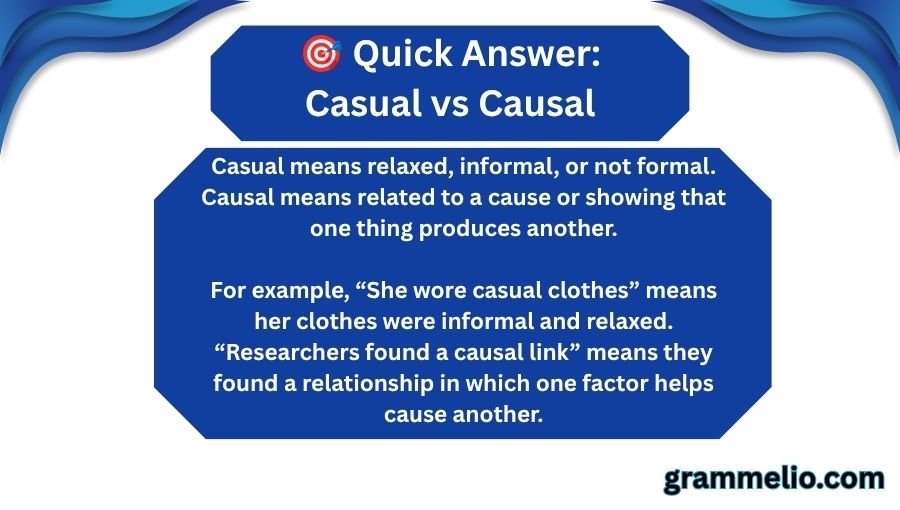
Casual means relaxed, informal, or not formal. Causal means related to a cause or showing that one thing produces another.
For example, “She wore casual clothes” means her clothes were informal and relaxed. “Researchers found a causal link” means they found a relationship in which one factor helps cause another.
A simple memory trick is:
- Casual = relaxed
- Causal = cause-related
If you are talking about clothes, conversation, behavior, or a relaxed setting, casual is usually the word you need. If you are talking about causes, effects, research, or why something happened, causal is usually correct.
Related Word Forms
These words have useful related forms, especially when you need to change the part of speech in a sentence.
| Form | Type | Example |
|---|---|---|
| casual | adjective | We had a casual meeting. |
| casually | adverb | He casually mentioned the news. |
| casualness | noun | Her casualness made everyone comfortable. |
| causal | adjective | The study found a causal connection. |
| causally | adverb | The events were causally connected. |
| causation | noun | The research examined causation. |
| cause | noun/verb | We need to find the cause. |
Notice that casual and causal are not different forms of the same word. They are separate words with separate meanings.
Understanding the Basics of Casual vs Causal
The easiest way to understand casual vs causal is to focus on the ideas behind them. Casual connects to informality and a relaxed style. Causal connects to causes and effects.
| Form | Type | Meaning | Example | Correct/Incorrect |
|---|---|---|---|---|
| casual | adjective | relaxed or informal | He wore casual clothes. | ✅ Correct |
| causal | adjective | related to a cause | The study found a causal link. | ✅ Correct |
| casual | adjective | related to cause and effect | The evidence was casual. | ❌ Incorrect |
| causal | adjective | relaxed or informal | We had a causal lunch. | ❌ Incorrect |
| casually | adverb | in a relaxed or informal way | She casually answered the question. | ✅ Correct |
The key difference is simple:
Casual describes a style or manner. Causal describes a cause-and-effect relationship.
Casual Means Relaxed or Informal
The word casual is used when something is relaxed, informal, ordinary, or not highly planned.
You might describe these things as casual:
- casual clothing
- casual conversation
- casual behavior
- a casual meeting
- a casual restaurant
- a casual relationship
- a casual attitude
- a casual workplace setting
For example:
“The company has a casual dress code.”
This means employees do not have to wear highly formal clothing.
Another example:
“We had a casual conversation after class.”
The conversation was relaxed. It was not a formal meeting or serious presentation.
Causal Means Connected to a Cause
Causal is used when you are talking about the reason something happens or a relationship between a cause and an effect.
For example:
“The researchers found a causal relationship between the two factors.”
This means the evidence suggests that one factor causes or helps produce a change in the other.
You may see causal in:
- science
- medicine
- economics
- psychology
- statistics
- research papers
- business analysis
- academic writing
A causal relationship is stronger than simply noticing that two things happen together. If one event causes another, there is a cause-and-effect connection.
A Quick Test Tip 💡
When I teach this difference, I recommend replacing the word mentally.
Ask:
Does the sentence mean “relaxed” or “informal”?
If yes, use casual.
Ask:
Does the sentence mean “related to a cause”?
If yes, use causal.
| Meaning | Word Type | Example Sentence |
|---|---|---|
| Relaxed or informal | casual | The party had a casual atmosphere. |
| Not formal | casual | He sent a casual message. |
| Related to a cause | causal | The report discusses causal factors. |
| Showing cause and effect | causal | The study examined causal links. |
Is Casual the Same as Causal?
No, casual and causal are not synonyms. Casual describes something relaxed or informal, while causal describes a connection involving a cause.
This is why the words cannot normally be swapped.
Consider these examples:
“She wore a casual jacket.”
The jacket is informal or relaxed in style.
“The researchers studied causal factors.”
The researchers studied factors that contribute to an outcome.
The spelling difference is only one letter, but the meaning changes completely.
Why Do People Confuse Casual and Causal?
People often confuse these words because they look extremely similar. Both begin with “casu-,” and both can appear in formal and everyday writing.
I once edited a short workplace guide where the writer described a “casual relationship” when the intended meaning was a relationship between two variables that might involve cause and effect. The writer knew the concept but had typed the more familiar word. A quick context check fixed the problem.
Three common reasons cause this mistake:
- Fast typing: People type quickly and do not reread every word.
- Autocorrect: A writing tool may not recognize a meaning-based mistake because both words are correctly spelled.
- Lack of knowledge: Someone may know one word well but have rarely seen the other.
| Confusing Pair | Main Difference |
|---|---|
| casual / causal | relaxed vs. cause-related |
| affect / effect | influence vs. result |
| advice / advise | noun vs. verb |
| accept / except | receive vs. exclude |
| loose / lose | not tight vs. misplace |
| your / you’re | possession vs. “you are” |
The problem with casual vs causal is especially interesting because spell-check may not help. Both words are legitimate English words.
Casual vs Causal at a Glance
The fastest way to remember the difference is to connect each word to one central idea.
| Feature | Casual | Causal |
|---|---|---|
| Core idea | Relaxed | Cause |
| Common role | Adjective | Adjective |
| Used for | Style, behavior, settings | Causes, effects, relationships |
| Opposite idea | Formal | Non-causal or unrelated |
| Common phrase | casual clothes | causal relationship |
| Example | casual conversation | causal factor |
Casual in Everyday English
Casual is common in normal conversation. It can describe a person, event, outfit, relationship, or style.
Examples include:
- “I prefer casual clothes.”
- “We had a casual dinner.”
- “He has a casual way of speaking.”
- “The meeting was casual.”
- “She gave me a casual greeting.”
The word does not always mean careless. It often simply means informal or relaxed.
Causal in Academic and Professional English
Causal is more common in formal or technical writing.
Examples include:
- “The researchers investigated causal factors.”
- “The report does not prove a causal relationship.”
- “The team studied causal effects.”
- “The analysis identified several causal variables.”
It is especially useful when you need to discuss why something happened.
Correct Meanings and Uses
When Should You Use Casual?
Use casual when the sentence describes something relaxed, informal, or not highly formal.
For example:
“The office allows casual clothing.”
Here, casual describes the type of clothing.
Another example:
“We had a casual chat before the meeting.”
The chat was informal.
When Should You Use Causal?
Use causal when you are describing a cause, an effect, or a relationship in which one factor produces or influences an outcome.
For example:
“The study found evidence of a causal connection.”
The sentence is about cause and effect.
Another example:
“The report lists several causal factors.”
The factors help explain why something occurred.
What Is the Difference Between Casual and Causal in a Sentence?
The difference depends on what you are trying to describe.
If you are describing how something feels, looks, sounds, or happens, casual may be appropriate.
If you are describing why something happens or what produces an effect, causal is usually appropriate.
| Sentence | Meaning |
|---|---|
| We had a casual meeting. | The meeting was informal. |
| We studied causal factors. | We studied factors that help cause an outcome. |
| She wore casual shoes. | The shoes were informal or relaxed in style. |
| The report explains causal effects. | The report explains effects connected to causes. |
📝 Case Study: A Workplace Mix-Up
Imagine that a manager sends this email:
“Tomorrow’s meeting will be causal, so there is no need to wear formal clothes.”
The intended meaning is probably that the meeting will be relaxed.
The correct sentence is:
“Tomorrow’s meeting will be casual, so there is no need to wear formal clothes.” ✅
Now imagine a research team writes:
“The study found a casual link between sleep and performance.”
If the team means that one factor may cause an effect, the better sentence is:
“The study found a causal link between sleep and performance.” ✅
The first situation is about style. The second is about cause and effect.
That is the heart of the distinction.
Grammar Rules Explanation
The grammar rule is straightforward: casual and causal are adjectives, but they describe different ideas.
Casual modifies nouns connected to informality, relaxation, or an easygoing style.
Examples:
- casual clothes
- casual conversation
- casual event
- casual tone
Causal modifies nouns connected to causes and effects.
Examples:
- causal relationship
- causal factor
- causal link
- causal effect
The mistake usually occurs when writers choose the word based on sound instead of meaning. Since both words are spelled correctly, a standard spell-checker may not flag the error.
Most standard English dictionaries treat these as distinct words with distinct meanings. The safest approach is to check the meaning of the sentence rather than relying on spelling alone.
Correct vs Incorrect at a Glance
| Sentence | Correct/Incorrect | Why |
|---|---|---|
| She wore casual clothes to the picnic. | ✅ Correct | The clothes were informal. |
| The researchers examined causal factors. | ✅ Correct | The factors were related to causes. |
| The report found a casual relationship between the variables. | ❌ Incorrect | The intended idea is cause and effect. |
| We had a causal dinner with friends. | ❌ Incorrect | A relaxed dinner is casual. |
| The researchers found a causal connection. | ✅ Correct | The sentence describes cause and effect. |
⚠️ Common Mistakes With Casual and Causal
The biggest mistake is choosing the word because it sounds right.
For example:
“We had a causal conversation.” ❌
If you mean the conversation was relaxed, use casual:
“We had a casual conversation.” ✅
Another common mistake is using casual when discussing research.
“The researchers found a casual effect.” ❌
If the researchers mean an effect produced by a cause, causal is the correct choice:
“The researchers found a causal effect.” ✅
I once caught myself typing “casual relationship” in a draft about data analysis. I stopped because the sentence was clearly about cause and effect. That small pause reminded me that even experienced writers can make meaning-based spelling mistakes.
| Common Mistake | Why It Happens | Better Choice |
|---|---|---|
| causal clothes | The writer chooses by sound | casual clothes |
| casual relationship in research | The writer knows “casual” better | causal relationship |
| causal conversation | The writer means informal | casual conversation |
| casual factor | The writer means a cause | causal factor |
| causal meeting | The writer means relaxed | casual meeting |
Common Wrong Forms for This Specific Pair
| Wrong Form | What’s Wrong | Correct Form |
|---|---|---|
| causal clothes | “Causal” does not mean informal | casual clothes |
| casual factor | “Casual” does not mean cause-related | causal factor |
| causal conversation | A relaxed conversation is casual | casual conversation |
| casual effect | A cause-and-effect idea is causal | causal effect |
| causal style | If the style is relaxed, use casual | casual style |
| casual relationship between variables | If cause is intended, use causal | causal relationship |
Where Does Casual Fit in Everyday Conversation?
Casual is very common in everyday English because people often talk about relaxed clothes, informal plans, and friendly conversations.
You might say:
“Let’s keep the dinner casual.”
This means there is no need for formal clothes, formal behavior, or a formal event.
You might also say:
“It was just a casual conversation.”
That means the conversation was relaxed and informal.
By contrast, causal is less common in ordinary conversation. You are more likely to see it when someone discusses research, data, business, science, or explanations.
How Is Casual vs Causal Used in Professional Writing?
In professional writing, both words can be useful, but they appear in different situations.
Casual may describe a workplace style:
“The company has a casual dress policy.”
Causal may appear in reports or analysis:
“The team investigated causal factors behind the decline.”
Using the wrong word can make a professional document sound careless. A reader may understand your intended meaning, but the mistake can still reduce confidence in your writing.
| Context | Which Term to Use | Example |
|---|---|---|
| Everyday conversation | casual | We had a casual chat. |
| Professional writing | casual or causal, depending on meaning | The office has a casual dress code. |
| Creative writing | casual | His casual tone hid his concern. |
| Social media/texting | casual | It was a casual weekend. |
How Does Casual vs Causal Work in Creative Writing?
Creative writers often use casual to describe tone, speech, clothing, behavior, or settings.
For example:
“She gave him a casual smile.”
The smile seems relaxed or natural.
Causal can appear in fiction when the story discusses reasons and consequences:
“The detective searched for the causal chain behind the accident.”
However, this use is more formal and less common in simple storytelling.
Can You Use Casual and Causal as Nouns?
Usually, no. Both casual and causal are most often used as adjectives.
For example:
“It was a casual meeting.” ✅
Here, casual describes “meeting.”
“The report identified causal factors.” ✅
Here, causal describes “factors.”
If you need a noun related to causal, words such as cause, causation, or causality may be appropriate depending on the sentence.
For casual, related nouns can include casualness or a noun that names the thing being described.
| Adjective | Possible Related Noun | Example |
|---|---|---|
| casual | casualness | His casualness made the room feel relaxed. |
| causal | cause | We need to identify the cause. |
| causal | causation | The paper discusses causation. |
Common Phrases With Casual
Some combinations with casual are especially common.
| Phrase | Meaning |
|---|---|
| casual clothes | Informal clothing |
| casual conversation | Relaxed, informal talk |
| casual meeting | An informal meeting |
| casual attitude | Relaxed way of behaving |
| casual relationship | A relationship that is not highly serious or formal |
| casual Friday | A workplace day when less formal clothing is allowed |
These phrases are easy to remember because they all connect to the idea of being relaxed or informal.
Common Phrases With Causal
Causal is often used with words connected to research and analysis.
| Phrase | Meaning |
|---|---|
| causal relationship | A relationship involving cause and effect |
| causal link | A connection involving a cause |
| causal factor | Something that helps produce an outcome |
| causal effect | An effect produced by a cause |
| causal mechanism | A process that explains how a cause produces an effect |
| causal analysis | Study focused on causes and effects |
A useful clue is that causal often appears beside technical words such as “factor,” “effect,” “relationship,” and “analysis.”
Synonyms and Alternatives
You can sometimes replace these words with other terms, but the replacement must match the intended meaning.
| Alternative | Works When | Does Not Work When |
|---|---|---|
| informal | You mean relaxed or not formal | You mean cause-related |
| relaxed | You mean easygoing | You are describing a scientific cause |
| unofficial | You mean not formal or official | You mean cause and effect |
| cause-related | You need a plain explanation of causal | You mean relaxed |
| cause-and-effect | You want to explain causal clearly | You are describing clothing or behavior |
For example, instead of:
“We had a casual meeting.”
you could say:
“We had an informal meeting.”
But you cannot replace causal with “informal” in:
“The researchers studied causal factors.”
That would completely change the meaning.
Why Does Getting Casual vs Causal Right Matter?
Correct word choice improves clarity. A reader should not have to guess what you mean.
This matters in several settings:
- school assignments
- workplace emails
- research reports
- resumes
- websites
- social media
- business documents
A simple spelling difference can change the meaning of an entire sentence.
“Clear words make clear ideas easier to understand.”
That principle is especially useful with words that look alike.
| Situation | Why Getting It Right Matters |
|---|---|
| Resume | Shows careful writing |
| Client email | Prevents confusion |
| Published content | Builds reader trust |
| Social post | Keeps your meaning clear |
How To Remember the Difference
Here is my favorite memory trick:
Casual = Calm
Both ideas suggest something relaxed.
Think:
Casual → calm, comfortable, informal
Examples:
- casual clothes
- casual dinner
- casual conversation
Causal = Cause
The spelling gives you a useful clue.
Causal → cause
If you are discussing why something happened, think causal.
Examples:
- causal factor
- causal link
- causal relationship
You can also use the two-word reminder:
Casual = relaxed. Causal = cause.
Say it aloud a few times. It is short enough to remember when you are writing quickly.
Is There a Special Exception to the Rule?
There is no major exception that changes the basic distinction. The most useful approach is still to focus on meaning.
One thing to remember is that casual relationship can be correct in some contexts. For example, it can describe a relationship that is informal or not serious. That does not mean the relationship is about cause and effect.
Compare:
“They have a casual relationship.” ✅
This can mean their relationship is informal or not committed.
“The study found a causal relationship between the variables.” ✅
This means the study is discussing cause and effect.
The noun after the adjective often gives you a helpful clue about which meaning is intended.
🎯 Quick Recap Checklist
Use this checklist whenever you are unsure.
| Question | If Yes → Use |
|---|---|
| Does it mean relaxed? | casual |
| Does it mean informal? | casual |
| Does it describe clothing or style? | casual |
| Does it describe a relaxed conversation? | casual |
| Is the sentence about a cause? | causal |
| Is it about cause and effect? | causal |
| Does it describe a research relationship? | causal |
| Does it describe a factor producing an outcome? | causal |
Practice Examples
- “I wore a ______ shirt to the picnic.”
Answer: casual ✅ - “The scientists studied the ______ relationship between the variables.”
Answer: causal ✅ - “We had a ______ conversation after work.”
Answer: casual ✅
If you can connect casual with “relaxed” and causal with “cause,” you already know the main rule.
FAQs About Casual vs Causal
What is the difference between casual and causal?
Casual means relaxed or informal. Causal means related to a cause or a cause-and-effect relationship.
Is it a casual relationship or a causal relationship?
Both can be correct, but they mean different things. A casual relationship can mean an informal or non-serious relationship. A causal relationship means a relationship involving cause and effect.
Is it casual conversation or causal conversation?
The normal phrase is casual conversation when you mean relaxed or informal talk. Causal conversation would suggest a conversation related to causes, which is uncommon.
Is it casual clothes or causal clothes?
The correct phrase is casual clothes. Casual clothes are informal or relaxed clothing.
Is it a causal factor or a casual factor?
The correct phrase is usually causal factor when you mean a factor that helps cause an outcome.
Can causal mean informal?
No. Causal does not mean informal. Use casual for something relaxed or informal.
Can casual mean cause-and-effect?
No. Casual does not normally describe a cause-and-effect relationship. Use causal for that meaning.
Is causal more formal than casual?
Usually, causal appears more often in academic, scientific, and analytical writing because discussions of causes and effects are common in those fields. Casual is widely used in everyday and professional English.
How can I remember casual vs causal?
Remember this simple rule: casual = relaxed, causal = cause. If you are talking about an informal style, choose casual. If you are talking about why something happens, choose causal.
Which word should I use in a research paper?
Use causal when you are discussing cause and effect. For example, “The study examined the causal relationship between the two variables.” Use casual only when you genuinely mean informal or relaxed.
Key Differences Between Casual and Causal
The difference can be reduced to two simple ideas.
Casual describes something informal, relaxed, or easygoing.
Causal describes something connected to a cause or an effect.
| Word | Simple Meaning | Memory Word | Example |
|---|---|---|---|
| casual | relaxed or informal | calm | casual clothes |
| causal | related to a cause | cause | causal relationship |
The words look similar, but they belong to different meaning groups.
Why Context Is Your Best Guide
When two words look alike, context is often more useful than pronunciation or spelling.
Consider:
“The relationship was ______.”
If you mean the relationship was informal or not serious, casual works.
If you mean one factor caused an effect on another, causal works.
Now consider:
“The meeting was ______.”
A relaxed meeting is casual. Calling it causal would change the meaning and probably create confusion.
This is why I recommend reading the entire sentence before choosing the word. Do not select a word simply because it looks familiar.
Final Comparison: Casual vs Causal
| Question | Casual | Causal |
|---|---|---|
| Means relaxed? | ✅ Yes | ❌ No |
| Means informal? | ✅ Yes | ❌ No |
| Connected to a cause? | ❌ No | ✅ Yes |
| Common in everyday speech? | ✅ Yes | Less common |
| Common in research writing? | Sometimes | ✅ Yes |
| Describes clothing? | ✅ Yes | ❌ No |
| Describes cause-and-effect links? | ❌ No | ✅ Yes |
| Easy memory clue | calm | cause |
Conclusion
Casual vs causal becomes much easier when you remember one simple rule: casual means relaxed or informal, while causal means related to a cause. 😊 If you are describing clothes, conversation, behavior, meetings, or an easygoing style, choose casual. If you are discussing causes, effects, research findings, or relationships between factors, choose causal.
I recommend using the memory pair “casual = relaxed” and “causal = cause.” It is quick, clear, and works in most writing situations. When you are unsure, stop and ask what the sentence actually means. Is it about style and informality? Or is it about why something happened?
That small habit can prevent a surprisingly common writing error. Whether you are writing a school paper, a professional email, a research report, or a quick message, choosing the right word makes your meaning sharper.
Remember: casual is about being relaxed; causal is about causes. 👍


[…] the simple rule behind these words, you will have a much easier time choosing the correct one. Casual vs Causal | Biannual vs Biennial | Weary vs […]