Have you ever typed a word that sounded right but looked completely wrong when you saw it on the screen? That happens often with augur vs auger because the two words sound similar, yet they have very different meanings and uses.
One word is linked to signs and predictions, while the other names a tool used for drilling holes. 🔍
As an English teacher and editor, I see this kind of spelling mix-up often. The good news is that the difference is simple once you connect each word with its main idea.
Augur is usually a verb meaning to suggest or predict that something will happen. Auger is mainly a noun for a tool with a spiral part used to bore holes into wood, soil, ice, or other materials.
In this guide, I will explain augur vs auger with simple definitions, examples, tables, memory tricks, common mistakes, and practical writing tips.
By the end, you should be able to choose the right word quickly and confidently. ✨ Attendant vs Attendance | Assay vs Essay | Appose vs Oppose
🎯 Quick Answer: Augur vs Auger
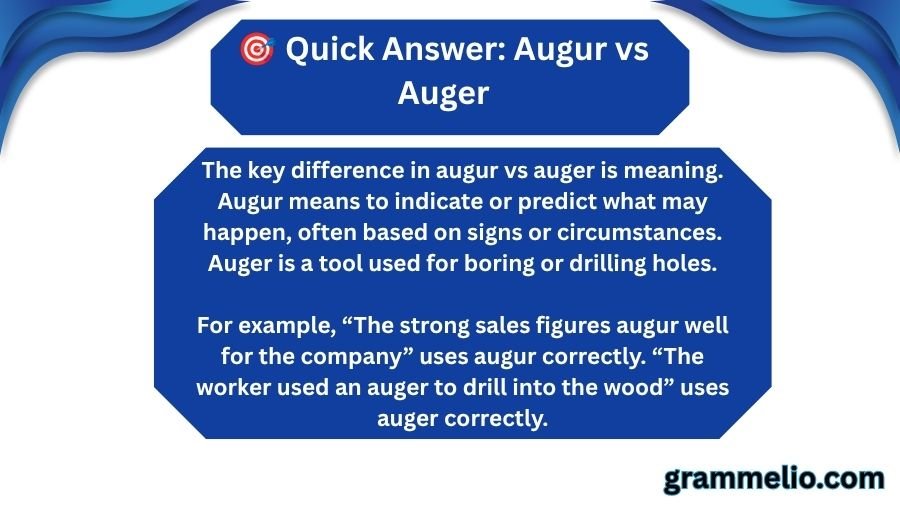
The key difference in augur vs auger is meaning. Augur means to indicate or predict what may happen, often based on signs or circumstances. Auger is a tool used for boring or drilling holes.
For example, “The strong sales figures augur well for the company” uses augur correctly. “The worker used an auger to drill into the wood” uses auger correctly.
Augur vs Auger at a Glance
The easiest way to understand these words is to connect each one to a different idea.
| Form | Type | Meaning | Example | Correct/Incorrect |
|---|---|---|---|---|
| augur | Verb | To suggest or predict an outcome | The results augur well for us. | ✅ Correct |
| augur | Noun | A person who predicts events, especially in older or formal use | The ancient augur read the signs. | ✅ Correct |
| auger | Noun | A tool used to bore holes | He picked up an auger. | ✅ Correct |
| auger | Verb | To bore or drill a hole | They augered through the soil. | ✅ Correct |
| auger | Verb when prediction is intended | Not the normal word for predicting an outcome | The results auger well. | ❌ Incorrect |
The simplest memory rule is:
Augur = signs, predictions, or outcomes.
Auger = a drilling or boring tool.
Is Augur the Same as Auger?
No, augur and auger are not the same word. They have different meanings even though they look and sound very similar.
Augur relates to signs, predictions, or what an event suggests about the future. Auger relates to boring or drilling holes.
Consider these examples:
- “The early results augur well for the project.” ✅
- “The early results auger well for the project.” ❌
The first sentence says the results suggest a good outcome. The second incorrectly uses the drilling word.
Now compare:
- “The carpenter used an auger to make the hole.” ✅
- “The carpenter used an augur to make the hole.” ❌
Here, the tool is an auger.
What Does Augur Mean?
Augur can be used as a verb meaning to suggest or indicate what is likely to happen. It can also be used as a noun for a person who interprets signs or predicts events, especially in historical or formal contexts.
The verb is especially common in phrases such as “augur well” and “augur badly.”
Augur as a Verb
When augur is a verb, it tells us what something seems to predict or suggest.
Examples:
The positive review augurs well for the new restaurant. ✅
The review suggests that the restaurant may do well.
The sudden drop in sales does not augur well for the company. ✅
The drop in sales suggests that the company may face problems.
The sunny weather augurs well for the outdoor event. ✅
The weather gives us a reason to expect a successful event.
Augur as a Noun
As a noun, augur can refer to a person who predicts events by interpreting signs. This use is less common in everyday modern writing.
For example:
The ancient augur studied the signs before the ceremony. ✅
Here, augur refers to a person.
| Meaning | Word Type | Example Sentence |
|---|---|---|
| Suggest a future result | Verb | The news augurs well for the team. |
| Suggest a bad result | Verb | The delay does not augur well. |
| Person who predicts events | Noun | The augur interpreted the signs. |
💡 Test Tip
Ask yourself:
“Am I talking about what something suggests will happen?”
If the answer is yes, augur is probably the word you need.
What Does Auger Mean?
Auger usually refers to a tool used to bore or drill a hole. An auger often has a spiral or screw-like shape that helps it cut into a material.
You may see augers used for:
- drilling into wood
- boring holes in soil
- drilling ice
- moving grain or other materials
- construction work
- agricultural work
The word can also function as a verb. To auger means to bore or drill using an auger or a similar tool.
Examples:
The farmer used an auger to drill into the ground. ✅
The worker augered a hole through the wooden board. ✅
We need a larger auger for this job. ✅
| Meaning | Word Type | Example Sentence |
|---|---|---|
| Drilling or boring tool | Noun | The mechanic used an auger. |
| To bore with an auger | Verb | They augered a hole in the soil. |
| Tool for moving material | Noun | The machine has a grain auger. |
Why Do People Confuse Augur and Auger?
People confuse these words mainly because they are very similar in spelling and sound. Their first three letters are identical, and only one vowel changes near the end.
There is also a major difference between how the words are used. Augur is more common in formal or written language, while auger often appears in technical, construction, farming, woodworking, or outdoor contexts.
I once edited a short business report in which the writer used “auger well” when they meant that a new policy seemed promising. The sentence was easy to understand after correction, but the wrong spelling changed the word entirely. That is why I recommend learning each word through its meaning rather than memorizing the spelling alone.
The Core Memory Connection
Think:
Augur → outcome
Auger → hole
That two-word connection can help you choose correctly in seconds.
| Word | Think About | Main Idea |
|---|---|---|
| augur | Outcome | Suggest or predict |
| auger | Hole | Drill or bore |
Key Differences Between Augur and Auger
The words differ in meaning, word type, and context. This simple comparison makes augur vs auger easier to understand when you need to choose the right word quickly.
| Difference | Augur | Auger |
|---|---|---|
| Main idea | Prediction or suggestion | Drilling or boring |
| Common role | Verb | Noun |
| Other role | Noun | Verb |
| Typical context | News, business, predictions | Construction, farming, woodworking |
| Memory word | Outcome | Hole |
| Example | The news augurs well. | He used an auger. |
The spelling difference is small, but the meaning difference is large.
How To Use Augur in a Sentence
Use augur when something provides a sign about a future result.
Here are several common sentence patterns.
“Augur Well”
This is one of the most useful expressions with the word.
The strong first quarter augurs well for the company. ✅
It means the strong first quarter suggests that the company may have a successful year.
“Augur Badly”
The word can also suggest a negative result.
The team’s injuries do not augur well for the championship game. ✅
This means the injuries suggest that the team may struggle.
“Augur for”
You may also see augur for when something points toward a particular result.
The new policy may augur for better cooperation. ✅
The phrase means that the policy may suggest or support that outcome.
| Pattern | Meaning | Example |
|---|---|---|
| augur well | Suggest a good result | The results augur well. |
| augur badly | Suggest a poor result | The delay augurs badly. |
| augur for | Point toward a result | The change may augur for growth. |
How To Use Auger in a Sentence
Use auger when you mean a drilling or boring tool or the act of boring with one.
The plumber brought an auger to clear the pipe. ✅
The farmer used an auger to drill into the soil. ✅
The carpenter selected a hand auger for the job. ✅
In technical writing, the exact kind of auger may matter. For example, people may talk about soil augers, ice augers, hand augers, or grain augers.
| Sentence | Meaning |
|---|---|
| He bought an auger. | He bought a drilling or boring tool. |
| She used an auger in the garden. | She used the tool to bore into soil. |
| They augered a hole. | They bored a hole using an auger. |
Can Auger Be Used as a Verb?
Yes. Auger can be used as a verb when it means to bore or drill using an auger or a similar tool.
For example:
The crew augered through the soil. ✅
This describes a drilling action.
However, do not use auger when you mean “predict” or “suggest.”
The good results auger a successful year. ❌
Better:
The good results augur a successful year. ✅
The difference is only one letter, but the meanings are completely different.
Can Augur Be Used as a Noun?
Yes. Augur can be a noun referring to a person who predicts or interprets signs, especially in historical contexts.
For example:
The augur examined the signs before the ceremony. ✅
In modern everyday English, however, the verb augur is much more likely to appear than the noun.
| Use | Example | Common Today? |
|---|---|---|
| augur as verb | The news augurs well. | Yes |
| augur as noun | The augur read the signs. | Less common |
| auger as noun | He used an auger. | Yes |
| auger as verb | They augered the hole. | Yes, especially technical |
Correct vs Incorrect at a Glance
The following examples show the difference clearly.
| Sentence | Correct/Incorrect | Why |
|---|---|---|
| The good news augurs well for the company. | ✅ Correct | It suggests a good future result. |
| The good news augers well for the company. | ❌ Incorrect | “Auger” refers to drilling, not prediction. |
| The worker used an auger to drill the hole. | ✅ Correct | An auger is a drilling tool. |
| The worker used an augur to drill the hole. | ❌ Incorrect | “Augur” does not name the drilling tool. |
| The poor results do not augur well. | ✅ Correct | The results suggest a poor outcome. |
📝 Case Study: A Workplace Writing Example
Imagine that a manager sends this email to a team:
“Our strong customer response augers well for the new product.”
That sentence is incorrect because the manager is talking about what the response suggests about the future.
The corrected sentence is:
“Our strong customer response augurs well for the new product.” ✅
Now imagine a completely different workplace situation. A maintenance worker says:
“I need an auger to make this hole.”
That sentence is correct because the worker needs a drilling tool.
I once caught myself typing the wrong one while writing about a positive business result. I stopped because the sentence sounded strange. I asked myself, “Am I talking about a hole?” I was not. That quick question helped me choose augur.
Workplace Comparison
| Situation | Correct Word | Example |
|---|---|---|
| Positive sales suggest future growth | augur | Sales augur well for growth. |
| Worker needs a drilling tool | auger | Bring the auger. |
| A report suggests a good outcome | augur | The report augurs well. |
| A farmer drills soil | auger | The farmer used an auger. |
Grammar Rules Explanation
The basic grammar rule is simple: choose the word according to its meaning.
Augur is used when something suggests, indicates, or predicts an outcome. It is especially common in expressions about whether future results look good or bad.
Auger is used for a tool that bores or drills, and it can also work as a verb for the act of boring with such a tool.
Standard English reference sources distinguish these words by meaning and usage. The safest approach is not to focus on their similar spelling. Instead, identify the action or idea in your sentence first.
If the sentence is about a future outcome, choose augur.
If the sentence is about drilling or boring, choose auger.
A Simple Grammar Test
Replace the word with one of these phrases:
- “suggests what will happen” → augur
- “drilling tool” → auger
For example:
The results ___ well for the company.
Replace the blank with “suggest a good future.” That gives you augur.
Now:
The worker picked up the ___.
Replace the blank with “drilling tool.” That gives you auger.
⚠️ Common Mistakes With Augur and Auger
These mistakes happen because the words are so close in spelling.
Common causes include:
- fast typing
- autocorrect
- spell-check suggestions
- hearing the words instead of seeing them
- limited knowledge of the words
- unfamiliarity with formal vocabulary
A person may know the correct meaning but still type the wrong vowel.
Similar Grammar Confusions
| Confusing Pair | Correct Difference |
|---|---|
| its / it’s | possession vs. “it is” |
| your / you’re | possession vs. “you are” |
| their / there / they’re | possession, place, or “they are” |
| affect / effect | influence/action vs. result |
| accept / except | receive/agree vs. exclude |
| augur / auger | predict/suggest vs. drill |
Common Wrong Forms for This Specific Term
| Wrong Form | What’s Wrong | Correct Form |
|---|---|---|
| The results auger well. | Wrong word for prediction | The results augur well. |
| Use an augur to drill the hole. | Wrong word for the tool | Use an auger to drill the hole. |
| The news augers well for us. | “Augers” changes the meaning | The news augurs well for us. |
| He bought an augur. | Wrong spelling for the tool | He bought an auger. |
| The machine augurs into the soil. | Wrong verb for drilling | The machine augers into the soil. |
How To Remember the Difference
A strong memory trick can prevent most mistakes. The best way to remember augur vs auger is to connect each word with its main idea: future outcomes for augur and holes or drilling for auger.
Think of this:
AUGUR = FUTURE
AUGER = HOLE
You can also remember:
Augur tells you what may happen. Auger helps make a hole.
That sentence is short enough to remember when writing.
| Memory Trick | Word | Meaning |
|---|---|---|
| Future | augur | Suggest a result |
| Hole | auger | Drill or bore |
| Good sign | augur | Predict a positive result |
| Tool | auger | Boring or drilling tool |
Usage in Different Contexts
The correct word depends strongly on context.
| Context | Which Term to Use | Example |
|---|---|---|
| Everyday conversation | Either, depending on meaning | The news augurs well. |
| Professional writing | augur for predictions; auger for tools | The figures augur well for growth. |
| Creative writing | Either, depending on context | The dark clouds augured trouble. |
| Social media/texting | Either, depending on meaning | Great sales numbers augur well! |
In casual writing, augur may sound somewhat formal. In many everyday conversations, people may simply say “suggests” or “looks promising.”
Auger, by contrast, is natural when discussing tools, farming, construction, or drilling.
Common Phrases With Augur
Unlike auger, the word augur appears in a few useful expressions.
| Phrase | Meaning |
|---|---|
| augur well | Suggest a good result |
| augur badly | Suggest a bad result |
| augur ill | Suggest something negative |
| augur for success | Point toward success |
| augur for change | Suggest that change may happen |
For example:
The team’s recent wins augur well for the playoffs. ✅
The early warning signs augur badly for the project. ✅
Common Uses of Auger
Auger appears in many practical and technical phrases.
| Phrase | Meaning |
|---|---|
| hand auger | A manually operated boring tool |
| soil auger | A tool used to bore into soil |
| ice auger | A tool used to drill through ice |
| grain auger | Equipment used to move grain |
| drill auger | An auger used for drilling |
These phrases all relate to the physical meaning of auger.
Synonyms and Alternatives for Augur
Sometimes you can replace augur with a simpler word.
| Alternative | Works When | Does Not Work When |
|---|---|---|
| suggest | Something points toward an outcome | You mean a drilling tool |
| indicate | Evidence points to a result | You mean physical boring |
| predict | You are discussing a future event | You need a specific formal nuance |
| signal | Something gives a sign | You are naming a tool |
For example:
The results augur well for the company.
Could become:
The results suggest a good future for the company.
The meaning remains similar.
Synonyms and Alternatives for Auger
There are also alternatives for the physical meaning of auger.
| Alternative | Works When | Does Not Work When |
|---|---|---|
| drill | You mean a tool or drilling action | The exact tool must be an auger |
| boring tool | You need a broad description | Technical precision matters |
| boring machine | You mean larger equipment | You specifically mean a hand auger |
| hole drill | Informal explanation | Formal technical wording is required |
When precision matters, auger is often better than a broad substitute.
Why Does Getting Augur and Auger Right Matter?
Correct word choice makes your writing clearer. It also shows that you understand the meaning of the words you use.
A spelling mistake between these terms can change the entire idea of a sentence. A reader may understand your meaning from context, but the error can still make your writing look careless.
“Clear words make clear ideas.”
That simple principle matters in school, business, publishing, and online communication.
| Situation | Why Getting It Right Matters |
|---|---|
| Resume | Shows attention to language |
| Client email | Builds professional trust |
| Published content | Protects accuracy and credibility |
| Social post | Prevents confusing readers |
Does Augur Usually Refer to a Positive Outcome?
Not always. Augur can suggest either a positive or negative result.
For example:
The strong sales augur well for the company. ✅
This is positive.
But:
The repeated delays do not augur well for the project. ✅
This is negative.
The word itself does not mean “good.” The surrounding words tell us whether the predicted outcome is positive or negative.
| Expression | Meaning |
|---|---|
| augurs well | Suggests something good |
| does not augur well | Suggests something bad |
| augurs badly | Suggests a poor result |
| augurs ill | Suggests trouble |
Is Auger Only Used for Drilling Holes?
No. Auger is strongly connected with boring or drilling, but different types of augers can be designed for different jobs.
For example, an auger may be used to move grain or other loose materials. In technical settings, the exact type of auger depends on the material and task.
The main memory rule remains the same:
Auger belongs to the world of tools, boring, drilling, and material movement.
Why Are Augur and Auger Easy to Mix Up?
The main reason is their almost identical spelling.
Both begin with:
A-U-G-U
Only the final vowel pattern changes.
There is also a pronunciation similarity in many forms of English. When people hear the words rather than see them written, the distinction may not feel obvious.
| Reason | Effect |
|---|---|
| Similar spelling | Easy to mistype |
| Similar sound | Easy to mishear |
| Autocorrect | May suggest the wrong form |
| Rare word exposure | Meaning may be unclear |
| Fast typing | One vowel gets changed |
The best defense is to learn the meaning pair rather than the spelling pair alone.
How To Choose the Correct Word Every Time
Use this three-step method.
Step 1: Identify the topic
Ask whether the sentence is about a future outcome or a physical tool.
Step 2: Test the replacement
Try replacing the word with:
- suggest/predict → augur
- drilling tool → auger
Step 3: Read the sentence again
Make sure the word fits naturally.
For example:
The strong economy ___ well for businesses.
“Suggests a good future” fits, so the answer is augurs.
Now:
The worker used an ___ to bore the hole.
“Drilling tool” fits, so the answer is auger.
| Question | Answer |
|---|---|
| Is the sentence about a future result? | Use augur. |
| Is the sentence about drilling? | Use auger. |
| Is it about a boring tool? | Use auger. |
| Is something suggesting what may happen? | Use augur. |
Quick Recap Checklist
Use this checklist whenever you are unsure.
| Question | If Yes → Use |
|---|---|
| Does the word mean “suggest or predict”? | augur |
| Does it describe a future outcome? | augur |
| Is it a drilling or boring tool? | auger |
| Does it describe boring into material? | auger |
| Does the phrase say “augur well”? | augur |
Practice Examples
- The excellent test results augur well for the student’s future. ✅
- The farmer used an auger to drill into the soil. ✅
- The poor weather does not augur well for the event. ✅
FAQs About Augur vs Auger
What is the difference between augur and auger?
Augur means to suggest or predict a future outcome. Auger usually means a tool used to bore or drill holes. The two words are spelled and pronounced similarly but have different meanings.
Is it “augur well” or “auger well”?
The correct phrase is “augur well.” It means that something suggests a good future result.
Example:
The strong sales numbers augur well for the company. ✅
What does augur mean in simple English?
Augur means “suggest what may happen.” If something augurs well, it suggests that a good result is likely.
What is an auger used for?
An auger is used for boring or drilling. Depending on the type, it may be used in soil, wood, ice, construction work, farming, or other tasks.
Can auger be a verb?
Yes. Auger can be a verb meaning to bore or drill with an auger or similar tool.
Example:
The crew augered through the soil. ✅
Can augur be a noun?
Yes. Augur can be a noun for a person who predicts or interprets signs. This use is less common in everyday modern English than the verb.
Is augur a synonym for predict?
In many contexts, yes. Augur can mean to suggest or indicate a future result. However, it often describes what signs or circumstances suggest rather than making a direct prediction.
How can I remember augur vs auger?
Use the memory trick “Augur = future; auger = hole.” If you are talking about what something suggests will happen, use augur. If you are talking about a drilling or boring tool, use auger.
Which is correct: “The results augur well” or “The results auger well”?
“The results augur well” is correct. The sentence means that the results suggest a positive future outcome.
Why do augur and auger get confused?
They are easy to confuse because their spellings and sounds are very similar. They also appear in different areas of language. Augur is often used in formal writing about future results, while auger is common in technical or practical writing about tools and drilling.
Final Thoughts on Augur vs Auger
Augur vs auger becomes much easier once you connect each word with its core meaning. Augur is about signs, predictions, and future outcomes. Auger is about drilling, boring, and tools.
When you see a sentence about business results, weather, plans, warnings, or future success, ask whether something is suggesting what may happen. If it is, choose augur. When you see a sentence about soil, wood, ice, construction, farming, or a drilling tool, choose auger. 🔑
I recommend remembering just two words: future and hole. Future points you toward augur. Hole points you toward auger.
Once that connection becomes automatic, this confusing pair is no longer difficult. You will be able to spot the right spelling quickly, write with confidence, and avoid one of those small errors that can distract readers from an otherwise strong piece of writing.
Augur predicts the direction; auger makes the hole. Remember that, and you will rarely mix them up again. ✨




[…] in simple US English. By the end, you should be able to choose the right word with confidence. 😊 Augur vs Auger | Attendant vs Attendance | Assay vs […]
[…] be able to choose the right word without stopping to second-guess yourself. Avenge vs Revenge | Augur vs Auger | Attendant vs […]