Have you ever typed a sentence and stopped because you could not decide between fair vs fare? I have seen this mix-up many times in student papers, emails, and everyday messages. The words look and sound the same, but they do very different jobs. One can describe something as reasonable or even refer to a public event. The other usually relates to the cost of a trip or the food served at a meal. 😊
The good news is that you do not need to memorize a long grammar rule. You only need to look at what the word means in the sentence.
In this guide, I will show you how to tell them apart, give you simple examples, explain common mistakes, and share easy memory tricks. By the end, fair vs fare should feel much easier to handle. ✨ Faint vs Feint | Etymology vs Entomology | Epitaph vs Epithet
🎯 Quick Answer: Fair vs Fare
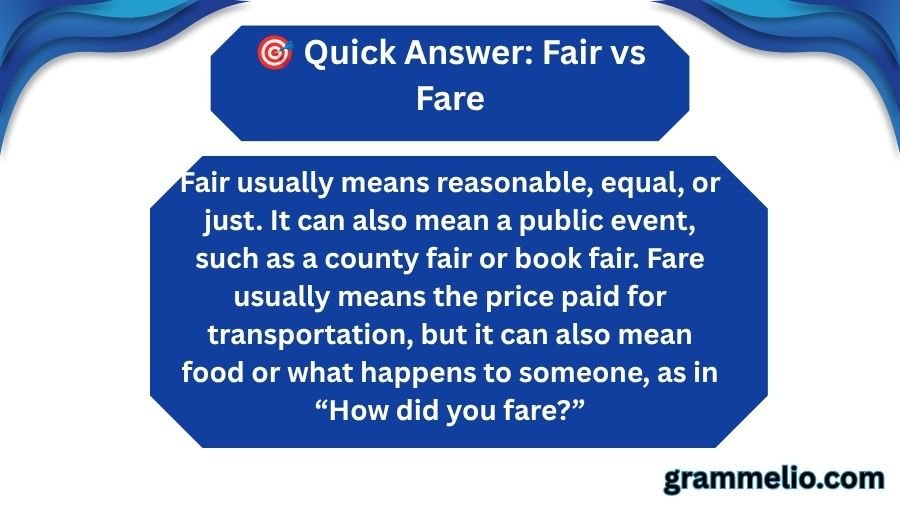
Fair usually means reasonable, equal, or just. It can also mean a public event, such as a county fair or book fair. Fare usually means the price paid for transportation, but it can also mean food or what happens to someone, as in “How did you fare?”
A simple memory trick is this: fare often connects to paying for a ride, while fair often connects to equal treatment or an event.
| Word | Main Meaning | Example |
|---|---|---|
| fair | Reasonable or just | The teacher gave everyone a fair chance. |
| fair | A public event | We visited the county fair. |
| fare | Transportation cost | The bus fare is $2. |
| fare | Food or a person’s outcome | The restaurant serves simple fare. |
🔤 Related Word Forms
The two words have several useful forms and phrases. Learning these forms helps you recognize the correct word even when the sentence changes.
| Form | Type | Example |
|---|---|---|
| fair | adjective | That was a fair decision. |
| fair | noun | We went to the state fair. |
| fairly | adverb | She was treated fairly. |
| fairness | noun | Everyone deserves fairness. |
| fare | noun | The train fare increased. |
| fares | plural noun | Airline fares can change. |
| fared | past tense verb | He fared well on the test. |
| faring | present participle | How are you faring at work? |
The forms fairly, fairness, fared, and faring are especially useful because they show how the basic meanings develop into other grammatical forms.
🧩 Understanding the Basics of Fair vs Fare
The easiest way to understand fair vs fare is to separate their meanings before you think about spelling.
Fair is commonly connected with justice, equal treatment, acceptable conditions, appearance, or a public event. Fare is commonly connected with transportation prices, food, or the way someone performs or gets along.
| Form | Type | Meaning | Example | Correct/Incorrect |
|---|---|---|---|---|
| fair | adjective | Just or reasonable | The rule is fair. | ✅ Correct |
| fair | noun | Public event | The school fair starts Friday. | ✅ Correct |
| fare | noun | Transportation price | What is the train fare? | ✅ Correct |
| fare | noun | Food | The café offers Italian fare. | ✅ Correct |
| fare | verb | Perform or get along | How did she fare? | ✅ Correct |
| fare | noun | Just treatment | The rule is fare. | ❌ Incorrect |
Think of the sentence as a clue. If you can replace the word with just, reasonable, or equal, you probably need fair. If you can replace it with price for a ride, you need fare.
⚖️ Is Fair the Word for Justice and Equal Treatment?
Yes. Fair is the correct word when you are talking about justice, equal treatment, or a reasonable decision. This is one of its most common uses.
Consider these examples:
- The judge made a fair decision.
- Every student deserves a fair chance.
- That does not seem fair to me.
- We need a fair way to divide the work.
- The manager gave both workers a fair opportunity.
Sentence breakdown
Take this sentence:
The coach gave every player a fair chance.
Here, fair describes the noun chance. It tells us that the chance was equal and reasonable.
Now compare it with:
The coach charged every player a fare.
That sentence would mean the players were charged a transportation price. The meaning changes completely.
💡 Test Tip
Try replacing the word with just.
If the sentence still makes sense, fair is likely correct.
Everyone deserves a fair chance.
Everyone deserves a just chance.
The second sentence sounds less natural, but the meaning is clear enough to show why fair works.
🎡 When Does Fair Mean an Event?
Fair can also be a noun that describes a public event where people gather for entertainment, shopping, food, contests, or displays.
Examples include:
- county fair
- state fair
- school fair
- science fair
- book fair
- job fair
- craft fair
For example:
My children are excited about the county fair.
Here, fair has nothing to do with justice or transportation. It names an event.
A science fair may feature student projects. A book fair may sell books. A county fair may have rides, games, food, and contests.
| Type of Fair | What It Usually Includes | Example |
|---|---|---|
| county fair | Rides, food, contests | We went to the county fair. |
| science fair | Student projects | Her project won at the science fair. |
| book fair | Books for sale | The school is holding a book fair. |
| job fair | Employers and job seekers | I found the company at a job fair. |
| craft fair | Handmade products | They sell candles at the craft fair. |
🚍 When Does Fare Mean the Price of Transportation?
Fare is the correct word when you mean the money charged for a ride on a bus, train, taxi, subway, airplane, or other form of transportation.
Examples:
The bus fare is five dollars.
What is the train fare to Boston?
The airline raised its fares.
Here, fare refers to the amount of money a passenger pays.
This meaning appears often in travel writing and everyday conversation.
| Transportation | Example With Fare |
|---|---|
| Bus | The bus fare went up. |
| Train | I paid the train fare online. |
| Taxi | The taxi fare was higher than expected. |
| Subway | You can pay the subway fare with a card. |
| Airplane | The airline offers lower fares in winter. |
A useful memory trick is to connect the first letter of fare with fee. It is not a formal grammar rule, but it can help you remember that transportation fare involves money.
🍽️ Can Fare Also Mean Food?
Yes. Fare can also refer to the type of food served or sold in a place.
For example:
The restaurant serves traditional Mexican fare.
The café offers light fare for lunch.
The festival had plenty of local fare.
This use is more common in formal, descriptive, or food-related writing than in very casual speech. Still, it is a useful meaning to know.
| Phrase | Meaning | Example |
|---|---|---|
| local fare | Food common to a place | The market sells local fare. |
| traditional fare | Traditional food | Guests enjoyed traditional fare. |
| simple fare | Basic food | We had simple fare after the hike. |
| light fare | Small or less-heavy food | The café serves light fare. |
Notice that fare is not always about transportation. The key is the meaning of the sentence.
📝 How Does Fair vs Fare Work in Real Life?
In everyday communication, context usually makes the correct choice clear. If someone is talking about rules, treatment, or equality, fair is usually the answer. If someone is talking about a ticket, ride, or transportation cost, fare is usually the answer.
I once edited a short travel email in which a writer asked, “Is the hotel near the airport, and what is the fair?” The writer meant the transportation price. I changed fair to fare. The rest of the email was perfectly clear, so one small spelling change fixed the problem.
That is why context matters more than sound. The two words are pronounced alike in standard US English, so listening alone will not always help.
| Situation | Correct Word | Example |
|---|---|---|
| Equal treatment | fair | We need a fair system. |
| Reasonable price | fair | That is a fair price. |
| Public event | fair | We visited a county fair. |
| Bus ticket cost | fare | The bus fare is affordable. |
| Food style | fare | The restaurant serves local fare. |
| Performance or outcome | fare | How did you fare in the interview? |
📚 Grammar Rules Explanation
The grammar rule behind fair vs fare is simple: the words are homophones, meaning they sound alike but have different meanings and spellings.
Fair can function as an adjective or noun. As an adjective, it can describe something as just, reasonable, or acceptable. As a noun, it can name a public event.
Fare is commonly used as a noun for a transportation price or a type of food. It can also be a verb meaning to perform, progress, or get along.
The correct choice depends on meaning, not sound.
Standard reference sources and dictionaries agree on this basic distinction. You do not need a complicated rule. Ask what the word is doing in your sentence.
Correct vs Incorrect at a Glance
| Sentence | Correct/Incorrect | Why |
|---|---|---|
| The teacher was fair to everyone. | ✅ Correct | Fair means just or equal. |
| The teacher was fare to everyone. | ❌ Incorrect | Fare does not mean just. |
| What is the bus fare? | ✅ Correct | Fare means transportation cost. |
| What is the bus fair? | ❌ Incorrect | Fair does not mean transportation cost. |
| We went to the county fair. | ✅ Correct | Fair names an event. |
🚫 Why Do People Confuse Fair and Fare?
People confuse these words mainly because they sound exactly alike. When we speak, there is no spelling difference to hear.
Typing makes the problem worse. Autocorrect may also choose the wrong word because both spellings are real English words.
There are three common reasons:
- Fast typing — People type what they hear without checking meaning.
- Autocorrect — Software may accept the wrong word because it is correctly spelled on its own.
- Lack of knowledge — A writer may know both words but not know which meaning belongs to each one.
I once caught myself typing “fare price” when I meant “fair price.” I was moving quickly and had transportation on my mind. The sentence looked strange when I reread it. That quick reread saved me from sending the mistake.
Similar Grammar Confusions
| Confused Words | Main Difference | Example |
|---|---|---|
| its / it’s | possession vs. “it is” | The dog wagged its tail. |
| your / you’re | possession vs. “you are” | You’re holding your bag. |
| their / there / they’re | possession, place, “they are” | They’re over there with their bags. |
| to / too / two | direction, also, number | I want two tickets too. |
| then / than | time vs. comparison | She arrived later than I did. |
| fair / fare | justice/event vs. price/food/outcome | The fare was high, but the service was fair. |
Common Wrong Forms for Fair and Fare
| Wrong Form | What’s Wrong | Correct Form |
|---|---|---|
| The bus fair is $3. | The word for transportation cost is fare. | The bus fare is $3. |
| That is not fare. | The intended meaning is “not just.” | That is not fair. |
| We went to the county fare. | The event is a fair. | We went to the county fair. |
| What did you fair on the test? | The verb meaning “perform” is fare. | How did you fare on the test? |
| The restaurant serves local fair. | The food meaning uses fare. | The restaurant serves local fare. |
| Everyone deserves a fare chance. | The intended meaning is equal or reasonable. | Everyone deserves a fair chance. |
🧠 How Can You Remember the Difference?
A good memory trick can make this distinction almost automatic.
Think of fair as being connected to fair treatment.
- fair rules
- fair decision
- fair chance
- fair price
- fair treatment
Think of fare as being connected to travel or food.
- bus fare
- train fare
- taxi fare
- airline fare
- local fare
There is another useful trick. If you can ask “How did someone do?”, the verb fare may be correct:
How did you fare on your exam?
How is the new employee faring?
| Memory Clue | Word | Example |
|---|---|---|
| Equal or just | fair | a fair decision |
| Reasonable | fair | a fair price |
| Public event | fair | a book fair |
| Transportation cost | fare | a train fare |
| Food | fare | local fare |
| Performance/outcome | fare | How did you fare? |
💼 Fair vs Fare in Professional Writing
Professional writing needs accuracy because a small spelling error can distract readers from your main message.
Imagine a travel company writing:
“Our new bus fair is affordable.”
The reader can probably understand the sentence. Still, the error makes the company look less careful.
The correct sentence is:
“Our new bus fare is affordable.”
Now consider:
“We believe every customer deserves fare treatment.”
The intended word is fair:
“We believe every customer deserves fair treatment.”
| Professional Situation | Better Choice | Example |
|---|---|---|
| Pricing travel | fare | Our fares are listed online. |
| Company policy | fair | We use fair hiring practices. |
| Customer treatment | fair | Customers deserve fair service. |
| Food description | fare | The menu features local fare. |
💬 Fair vs Fare in Everyday Conversation
Both words appear in normal speech, but the listener depends heavily on context because the words sound the same.
Someone might say:
“The fare was expensive.”
You know they mean the cost of transportation if they were talking about a taxi or bus.
Someone might say:
“That isn’t fair.”
You know they mean the situation is unjust or unreasonable.
Because the sound is identical, speakers often do not notice which spelling they would need in writing. That is why proofreading is especially useful with homophones.
📱 Fair vs Fare in Texting and Social Media
Casual messages often contain spelling mistakes, but choosing the right word still helps your message look clear.
For example:
❌ “The Uber fair was expensive.”
✅ “The Uber fare was expensive.”
Or:
❌ “That is so fare!”
✅ “That is so fair!”
Social media posts are short, so readers may not have much context. A wrong homophone can make a sentence confusing or unintentionally funny.
| Context | Which Term to Use | Example |
|---|---|---|
| Everyday conversation | fair or fare based on meaning | That is fair. |
| Professional writing | fair or fare based on meaning | The fare has increased. |
| Creative writing | fair or fare based on meaning | The village fair filled the square. |
| Social media/texting | fair or fare based on meaning | The train fare is crazy today. |
🎨 Fair in Creative Writing
Writers often use fair to describe justice, beauty, or an event. The word can add detail to a story.
For example:
The mayor promised a fair trial.
Children ran toward the summer fair.
She wanted a fair chance to prove herself.
In creative writing, context usually makes the meaning clear. The same word can carry different meanings depending on how it is used.
Fare can also appear in creative writing:
The travelers counted their coins before paying the fare.
The inn served warm local fare.
No one knew how the young sailor would fare.
These uses show why understanding the full range of each word is useful.
🗣️ Common Phrases With Fair and Fare
Several everyday phrases make the difference easier to remember.
| Phrase | Meaning |
|---|---|
| fair and square | honestly and without cheating |
| fair chance | an equal or reasonable opportunity |
| fair game | something considered acceptable to criticize, discuss, or target |
| fair enough | an expression showing acceptance |
| bus fare | the price of a bus ride |
| taxi fare | the price of a taxi ride |
You may also hear:
- fair play — honest and respectful behavior in a game or competition
- fair price — a reasonable price
- airfare — the price charged for air travel
- fare well — an older-style expression meaning to do well or succeed
These phrases are useful because they give you ready-made patterns.
🔄 Synonyms and Alternatives
Sometimes you can replace one of these words with another word, but the replacement depends on the meaning.
| Alternative | Works When | Does Not Work When |
|---|---|---|
| just | fair means morally right | fair means a public event |
| reasonable | fair means acceptable | fair means an event |
| equal | fair means equal treatment | fair means attractive or an event |
| ticket price | fare means transportation cost | fare means food |
| food | fare means food served | fare means transportation cost |
For example, you can say:
The decision was fair.
Or:
The decision was just.
But you cannot replace fair in:
We went to the county fair.
with just. The meaning is completely different.
Likewise, ticket price can explain transportation fare, but it cannot replace fare when you are talking about food.
💡 Why Context Is Your Best Test
When you are unsure about fair vs fare, do not stare at the two spellings. Look at the sentence around them.
Ask yourself:
Is this about justice or equality?
Use fair.
Is this a public event?
Use fair.
Is this the cost of transportation?
Use fare.
Is this food?
Use fare.
Is this about how someone performed or got along?
Use fare.
This method is faster than trying to remember a complicated grammar rule.
🎯 A Simple Decision Test
Use this five-question test whenever you hesitate.
| Question | If Yes → Use |
|---|---|
| Does the word mean just or reasonable? | fair |
| Does it describe equal treatment? | fair |
| Does it name a public event? | fair |
| Does it mean transportation cost? | fare |
| Does it describe food or performance? | fare |
Practice Examples
- The airline lowered its ___ for the holiday.
- Answer: fare ✈️
- Everyone should receive a ___ chance.
- Answer: fair ⚖️
- We are going to the school ___ tomorrow.
- Answer: fair 🎪
The trick is not the sound. The trick is the meaning.
🌟 Why Getting Fair and Fare Right Matters
Correct word choice improves clarity, professionalism, and trust. A reader may understand a homophone mistake, but repeated errors can make writing seem rushed.
A resume should look polished. A client email should be clear. A published article should use the correct word. Even a short social post benefits from accurate spelling.
“Clear words make simple ideas easier to trust.”
That is especially true when two words sound exactly alike.
| Situation | Why Getting It Right Matters |
|---|---|
| Resume | Shows care and writing skill |
| Client email | Prevents confusion and looks professional |
| Published content | Builds reader trust |
| Social post | Makes short messages easier to understand |
⚠️ Special Cases You Should Know
There are a few expressions where the meaning may not be obvious at first.
Fare can mean someone’s result or experience:
She fared well in her new job.
Here, fare is a verb. It does not involve money or food.
The phrase fair enough is also common. It usually means that the speaker accepts or understands another person’s point.
“I cannot stay late tonight.”
“Fair enough.”
Another phrase is fair game. It can mean something is considered open to discussion, criticism, or action under the situation being described.
These expressions reinforce the larger rule: do not choose a word by sound alone. Choose it by meaning.
🧪 Case Study: A Travel Email
Imagine that a customer writes this email:
“Hi, I am planning to take the train from Philadelphia to New York. Can you tell me the fair for a one-way ticket?”
The meaning is obvious, but the spelling is wrong.
The corrected version is:
“Hi, I am planning to take the train from Philadelphia to New York. Can you tell me the fare for a one-way ticket?”
Why?
Because fare means the amount paid for transportation.
Now imagine a different email:
“I appreciate your fair response to my complaint.”
Here, fair is correct because the writer means reasonable and just.
| Original Meaning | Correct Word | Reason |
|---|---|---|
| Cost of train ticket | fare | Transportation price |
| Reasonable response | fair | Just or reasonable |
| School event | fair | Public event |
| Food served at restaurant | fare | Type of food |
| Performance on a test | fare | How someone did |
📌 Fair vs Fare at a Glance
The entire distinction can be reduced to a few key ideas.
Fair commonly means:
- just
- equal
- reasonable
- acceptable
- a public event
Fare commonly means:
- transportation cost
- food
- how someone performs or gets along
| Word | Core Idea | Example |
|---|---|---|
| fair | Justice | That is a fair rule. |
| fair | Equality | Give everyone a fair chance. |
| fair | Event | The county fair begins today. |
| fare | Travel cost | The bus fare is cheap. |
| fare | Food | The restaurant serves local fare. |
| fare | Performance | She fared well at the interview. |
❓ Why Do People Confuse Fair and Fare?
They are commonly confused because they sound the same but have different spellings and meanings. This makes them homophones.
The best way to avoid the mistake is to focus on context. Ask what the sentence means before choosing the spelling.
❓ Is Fair Used Only to Mean Equal?
No. Fair has several meanings. It can mean just, reasonable, acceptable, or a public event. In some contexts, it can also describe appearance or weather.
For example:
That is a fair price.
Here, fair means reasonable.
❓ Is Fare Only Used for Transportation?
No. Fare can refer to transportation costs, food, or someone’s performance or progress.
Examples include:
The train fare is expensive.
The restaurant serves local fare.
How did you fare at the meeting?
❓ What Is the Difference Between Fair and Fare in a Sentence?
Fair usually relates to justice, equality, reasonableness, or an event. Fare usually relates to transportation cost, food, or how someone performs.
The sentence’s meaning tells you which spelling to choose.
❓ Is It Fair Price or Fare Price?
The correct expression is fair price when you mean a reasonable price.
For example:
The seller offered me a fair price.
Fare is used for the price charged for transportation:
The taxi fare was $20.
❓ Is It Bus Fair or Bus Fare?
The correct expression is bus fare. It means the amount of money paid for a bus ride.
The bus fare is $2.
“Bus fair” is incorrect when you mean the cost of the ride.
❓ How Do You Remember Fair vs Fare?
Remember fair for justice, equal treatment, and events. Remember fare for transportation, food, and performance.
A quick clue is to connect fare with travel costs.
❓ What Does Fare Mean as a Verb?
As a verb, fare means to perform, progress, or get along in a particular situation.
For example:
How did you fare on your exam?
The team fared well this season.
❓ What Does Fair Mean as a Noun?
As a noun, fair can mean a public event where people gather for activities, entertainment, displays, sales, or contests.
For example:
We visited the county fair.
It can also appear in names such as a science fair or book fair.
❓ Are Fair and Fare Homophones?
Yes. In standard US English, fair and fare are homophones because they have the same pronunciation but different spellings and meanings.
That is why spelling depends on context.
❓ What Is the Easiest Rule for Fair vs Fare?
Use fair for something just, equal, reasonable, or an event. Use fare for transportation cost, food, or someone’s performance.
When in doubt, ask what the word means in the sentence.
✅ Quick Recap Checklist
Use this final checklist whenever you are unsure.
| Question | If Yes → Use |
|---|---|
| Am I talking about justice? | fair |
| Am I talking about an equal chance? | fair |
| Am I naming an event? | fair |
| Am I talking about a bus, train, taxi, or airline price? | fare |
| Am I describing food? | fare |
| Am I describing how someone performed? | fare |
Final Practice
1. The teacher gave everyone a ___ chance.
Answer: fair ✅
2. The subway ___ increased last month.
Answer: fare ✅
3. We bought books at the school ___.
Answer: fair ✅
These three examples cover the most common meanings.
🏁 Conclusion
Fair vs fare becomes much easier once you focus on meaning instead of sound. 😊 Use fair when you mean just, equal, reasonable, or a public event. Use fare when you mean a transportation price, food, or how someone performs in a situation. The two words may sound alike, but their jobs in a sentence are different.
When I edit writing, I recommend a simple habit: stop for a second when you see a homophone. Ask what the sentence is trying to say. If the idea is about equal treatment, choose fair. If it is about a ride’s cost, food, or someone’s performance, choose fare.
With a little practice, the correct spelling will become natural. You will no longer need to guess based on sound. You will simply read the meaning and choose the word that fits.
Remember the rule: fair is about what is just; fare is about the cost, food, or how someone does. ✨



[…] mistakes. By the end, you should be able to choose the right word quickly and confidently. 😊 Fair vs Fare | Faint vs Feint | Etymology vs […]