Have you ever stopped while writing because you were unsure whether incidence vs incidents was the right choice? I have seen this mix-up in student essays, workplace reports, emails, and even polished articles. The words look and sound related, but they do different jobs in a sentence. Incidence usually refers to how often something happens, especially when discussing a condition, event, or problem as a measured rate. Incidents, on the other hand, is the plural form of incident and means separate events or occurrences. ✍️
Once you see this simple difference, the choice becomes much easier. In this guide, I will explain incidence vs incidents with clear definitions, examples, tables, memory tips, common mistakes, and practical situations.
By the end, you should feel confident choosing the right word in school, work, and everyday writing. 😊 Gild vs Guild | Hypercritical vs Hypocritical | Holy vs Wholly
🎯 Quick Answer: Incidence vs Incidents
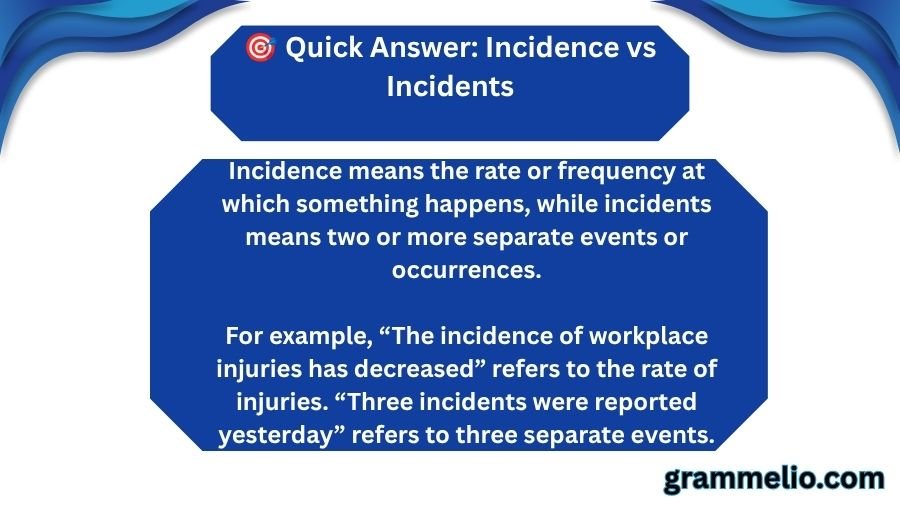
Incidence means the rate or frequency at which something happens, while incidents means two or more separate events or occurrences.
For example, “The incidence of workplace injuries has decreased” refers to the rate of injuries. “Three incidents were reported yesterday” refers to three separate events.
Related Word Forms You Should Know
The words in this comparison come from two different base words: incidence and incident. Knowing their related forms can make the difference easier to remember.
| Form | Type | Example |
|---|---|---|
| incidence | Noun | The incidence of errors is low. |
| incident | Singular noun | The incident happened at noon. |
| incidents | Plural noun | Several incidents were reported. |
| incidental | Adjective | The damage was incidental. |
| incidentally | Adverb | Incidentally, I saw the report. |
The key point is that incidence does not mean “one incident.” It is a noun about the occurrence or rate of something. Meanwhile, incident names an event itself.
Understanding Incidence vs Incidents
The easiest way to understand incidence vs incidents is to ask one simple question:
Am I talking about a rate or frequency, or am I talking about separate events?
Use incidence when you are discussing how often something occurs, especially in a group, population, period, or area.
Use incidents when you are talking about multiple individual events.
Incidence: Meaning and Correct Use
Incidence is a noun that describes the occurrence or frequency of something, often as a rate.
You might see it in writing about:
- health
- safety
- crime
- accidents
- disease
- workplace problems
- technical errors
- social issues
- research findings
For example:
The incidence of workplace injuries has fallen this year.
The sentence does not describe individual injuries. Instead, it discusses how frequently workplace injuries occur.
Another example:
Researchers studied the incidence of asthma among children.
Here, the writer is interested in the occurrence of asthma within a particular group.
Incidents: Meaning and Correct Use
Incidents is the plural form of incident. It refers to multiple individual events, especially events that are unusual, unwanted, or noteworthy.
For example:
The manager reviewed three incidents from last week.
The manager is looking at three separate events.
Another example:
Several incidents occurred near the station.
The sentence refers to multiple occurrences rather than a measured rate.
Incidence vs Incidents Comparison
| Form | Type | Meaning | Example | Correct/Incorrect |
|---|---|---|---|---|
| incidence | Noun | Rate or frequency of occurrence | The incidence of errors is rising. | ✅ Correct |
| incident | Noun | One event | The incident was reported. | ✅ Correct |
| incidents | Noun | Multiple events | Five incidents were reported. | ✅ Correct |
| incidents | Noun | Rate or frequency | The incidents of flu increased. | ❌ Incorrect in this intended meaning |
| incidence | Noun | Several individual events | Three incidence occurred. | ❌ Incorrect |
The last two examples show why the distinction matters. If you mean a rate, use incidence. If you mean separate events, use incident or incidents.
Is Incidence the Same as Incidents?
No. Incidence and incidents are related in meaning, but they are not interchangeable.
Incidence focuses on occurrence as a rate or level. Incidents focuses on individual events.
Think of the difference this way:
- Incidence = How often?
- Incident = What happened?
- Incidents = What events happened?
Consider these sentences:
The incidence of car accidents increased.
This tells us that car accidents became more common.
Several car accidents were reported.
This tells us that several separate accidents happened.
Both sentences can discuss the same general topic, but they give different information.
A Simple Comparison
| Question | Best Word | Example |
|---|---|---|
| How often does something happen? | incidence | The incidence of errors is high. |
| What happened once? | incident | The incident was investigated. |
| What happened several times? | incidents | Several incidents were investigated. |
| What is the rate of occurrence? | incidence | The incidence of illness fell. |
| How many separate events occurred? | incidents | Four incidents occurred. |
Why Do People Confuse Incidence and Incidents?
People often confuse these words because they are related in sound and appearance. Both are connected to the idea of something happening or occurring.
There is also a strong visual trap. The beginning of incidence looks similar to incident. When people type quickly, they may choose the form that feels familiar instead of checking the meaning.
I once reviewed a short workplace report in which a writer had described “the incidents of equipment failure” when the report was actually discussing the rate of failure across several months. The sentence looked reasonable at first. Once I asked, “Are you counting events or measuring frequency?” the correction became obvious: incidence was the better choice.
This is a useful lesson. Do not choose between these words based only on how they look. First decide what you mean.
💡 Test Tip: Ask the “How Often?” Question
When you are unsure, replace the word mentally with rate or frequency.
If the sentence still makes sense, incidence may be the correct choice.
The incidence of software errors increased.
Try:
The frequency of software errors increased.
The meaning works.
Now consider:
Five incidents were reported.
You cannot naturally replace incidents with frequency.
Five frequencies were reported.
That changes the meaning completely.
| Quick Test | If the Answer Is Yes | Use |
|---|---|---|
| Am I talking about frequency? | Yes | incidence |
| Am I measuring how often something occurs? | Yes | incidence |
| Am I naming one event? | Yes | incident |
| Am I naming several events? | Yes | incidents |
| Am I counting separate occurrences? | Yes | incidents |
Key Differences Between Incidence and Incidents
The main difference is grammatical as well as semantic.
Incidence is an uncountable-style noun when used to describe occurrence or frequency. It does not normally mean a collection of individual events.
Incidents is a countable plural noun. You can have one incident, two incidents, ten incidents, or hundreds of incidents.
This gives us a very useful contrast:
The incidence of theft is increasing.
versus:
The number of theft incidents is increasing.
The first sentence emphasizes frequency or occurrence. The second emphasizes individual cases.
Incidence vs Incidents at a Glance
| Feature | Incidence | Incidents |
|---|---|---|
| Base word | incidence | incident |
| Number | Usually treated as a mass or rate concept | Plural |
| Main idea | Frequency or occurrence | Separate events |
| Can be counted directly? | Usually no | Yes |
| Common question | How often? | How many events? |
| Common setting | Research, health, statistics, reports | News, workplace, security, daily life |
How Can You Use Incidence in a Sentence?
You can use incidence when a sentence discusses how common something is or how frequently it occurs.
Here are several common patterns.
Incidence + of + noun
This is one of the most useful structures.
The incidence of illness has decreased.
The incidence of workplace accidents remains high.
The incidence of errors was lower than expected.
The phrase incidence of is especially common when the writer discusses a condition, problem, behavior, or event as something that can occur at different rates.
Incidence in Research
Research writing often discusses the incidence of something within a population or group.
The study examined the incidence of injuries among athletes.
The focus is not on listing every injury. The focus is on how frequently injuries occurred within the group being studied.
Incidence in Workplace Writing
You may also see it in business and safety reports.
The company is working to reduce the incidence of workplace accidents.
This sounds formal because the sentence is discussing the general frequency of accidents.
Incidence in Public Discussions
The word can also appear in general writing.
The incidence of online scams has become a growing concern.
Again, the idea is frequency or occurrence, not a list of separate scams.
| Meaning | Word Type | Example Sentence |
|---|---|---|
| Rate of occurrence | Noun | The incidence of injuries declined. |
| Frequency within a group | Noun | The study measured the incidence of errors. |
| General occurrence | Noun | The incidence of fraud remains a concern. |
When Should You Use Incidents?
Use incidents when you can point to separate events.
For example:
The police investigated several incidents.
You can imagine one event, another event, and another event.
The same principle works in school, business, transportation, technology, and everyday life.
Workplace Example
The supervisor documented four safety incidents.
There are four individual events.
Technology Example
The support team recorded several incidents involving failed logins.
Again, each incident is a separate occurrence.
Everyday Example
We had two strange incidents during the trip.
The speaker is referring to two events.
News Example
Several incidents were reported during the game.
The word incidents identifies separate events.
| Context | Correct Term | Example |
|---|---|---|
| Safety rate | incidence | The incidence of injuries declined. |
| Safety events | incidents | Three safety incidents were recorded. |
| Disease frequency | incidence | The incidence of the condition increased. |
| Individual events | incidents | Several incidents were investigated. |
📝 Case Study: A Workplace Report
Imagine that a company is reviewing its safety records.
During one month, employees experienced eight separate accidents. The manager wants to describe those eight events.
The manager could write:
Eight safety incidents were reported in May.
That is correct because the report is counting separate events.
Now imagine the manager wants to discuss the broader trend over five years:
The incidence of workplace injuries has decreased over the past five years.
That is also correct. The focus has changed from individual events to the overall frequency of injuries.
The distinction can be summarized like this:
| Workplace Purpose | Better Choice | Example |
|---|---|---|
| Count separate events | incidents | Six incidents were reported. |
| Discuss frequency | incidence | The incidence of injuries fell. |
| Describe one event | incident | The incident occurred Monday. |
| Discuss a long-term pattern | incidence | The incidence of accidents declined. |
This is one reason precise word choice matters in professional writing. A report may contain both words, but each one can serve a different purpose.
Grammar Rules Explanation
The grammar behind incidence vs incidents becomes simple when you separate the meanings.
Incidence is a noun used to discuss the occurrence or frequency of something.
Incident is a countable noun that refers to an event.
Incidents is simply the plural form of incident.
The words therefore cannot freely replace one another.
For example:
The incidence of errors increased.
Here, incidence functions as the noun describing the frequency of errors.
Compare:
Three incidents were recorded.
Here, incidents is a plural countable noun. It identifies three separate events.
Most standard English reference sources make this same basic distinction between the noun incidence and the noun incident. The safest approach is still to focus on the meaning of your sentence.
Correct vs Incorrect at a Glance
| Sentence | Correct/Incorrect | Why |
|---|---|---|
| The incidence of accidents has fallen. | ✅ Correct | It describes the frequency of accidents. |
| Five incidents were reported. | ✅ Correct | It describes five separate events. |
| Three incidence were reported. | ❌ Incorrect | Incidence is not the plural of incident. |
| The incidence of errors increased. | ✅ Correct | It describes the rate or frequency. |
| The manager reviewed several incidence. | ❌ Incorrect | The plural events should be incidents. |
⚠️ Common Mistakes With Incidence and Incidents
Most mistakes happen because writers remember that the words are related but forget that they have different meanings.
Here are some common reasons:
Fast Typing
When people type quickly, they often select a familiar-looking word without stopping to check the sentence.
Autocorrect
Autocorrect may not catch a meaningful word used in the wrong place. Both incidence and incidents are legitimate English words, so a spelling checker may not flag the mistake.
Lack of Knowledge
If someone has never learned the distinction, the words can appear interchangeable.
I once caught myself typing incidents in a sentence about a long-term rate. The word looked perfectly normal on the screen. I only noticed the problem when I asked myself what the sentence was actually measuring. That quick meaning check fixed it.
Similar Grammar Confusions
| Confusion | Correct Difference |
|---|---|
| it’s / its | It’s = it is; its = possession |
| your / you’re | Your = possession; you’re = you are |
| their / they’re | Their = possession; they’re = they are |
| affect / effect | Usually verb vs. noun, depending on use |
| then / than | Then relates to time; than compares |
| incidence / incidents | Frequency or rate vs. separate events |
Common Wrong Forms and Uses
| Wrong Form | What’s Wrong | Correct Form |
|---|---|---|
| three incidence | Treats incidence as plural events | three incidents |
| several incidence | Uses the wrong noun for separate events | several incidents |
| incidence were reported | Treats incidence like plural countable events | incidents were reported |
| an incidence occurred | Usually means an individual event but uses the wrong word | an incident occurred |
| the incidents of accidents increased | May be unclear if the intended meaning is frequency | the incidence of accidents increased |
The final example deserves care. Incidents can be correct if you truly mean separate events. If you mean the overall rate, incidence is usually the better word.
Why Does Context Matter So Much?
Understanding incidence vs incidents becomes much easier when you look at what the sentence is actually trying to measure.
Context determines whether you are discussing a pattern or an event. Context determines whether you are discussing a pattern or an event.
Consider these two sentences:
The incidence of theft is high in the area.
Police investigated several theft incidents in the area.
The first sentence describes a broad pattern. The second describes specific cases.
This difference appears across many fields.
Health
The incidence of the condition increased.
This discusses frequency.
Security
Security officers recorded four incidents.
This discusses separate events.
Education
The incidence of reading difficulties was examined.
This discusses occurrence within a group.
Customer Service
The team reviewed several customer incidents.
This discusses individual events.
Usage in Different Context
The distinction between incidence vs incidents remains important across everyday, professional, creative, and digital communication. The correct choice depends on what you are trying to say. Both terms can appear in formal and informal writing, but they are common in different situations.
The correct choice depends on what you are trying to say. Both terms can appear in formal and informal writing, but they are common in different situations.
| Context | Which Term to Use | Example |
|---|---|---|
| Everyday conversation | incidents for events | We had two strange incidents. |
| Professional writing | incidence for rates | The incidence of errors declined. |
| Creative writing | incident/incidents for events | The incident changed everything. |
| Social media/texting | incidents for events | There were a few weird incidents today. |
In professional or research writing, incidence can be especially useful when discussing trends.
In everyday conversation, incident and incidents are more likely when people are talking about things that happened.
Common Phrases With Incidence
There are several natural combinations with incidence. These phrases often help writers use the word correctly.
| Phrase | Meaning |
|---|---|
| incidence of disease | Frequency or occurrence of disease |
| incidence of accidents | Frequency of accidents |
| incidence of injury | Frequency of injury |
| incidence of crime | Frequency or occurrence of crime |
| high incidence | A high level or frequency of occurrence |
| low incidence | A low level or frequency of occurrence |
Examples:
The city has a high incidence of traffic accidents.
The program aims to reduce the incidence of workplace injuries.
The report found a low incidence of equipment failure.
Notice that these phrases describe frequency, not a list of individual events.
Common Phrases With Incidents
Incidents commonly appears with words that describe reporting, recording, reviewing, or investigating events.
| Phrase | Meaning |
|---|---|
| several incidents | Several separate events |
| reported incidents | Events that were reported |
| safety incidents | Events involving safety |
| security incidents | Events involving security |
| serious incidents | Events with serious consequences |
| isolated incidents | Separate events that are not part of a broad pattern |
For example:
The company investigated several security incidents.
The school recorded two safety incidents.
The manager reviewed all reported incidents.
These phrases work because the writer is talking about individual events.
How Can You Remember the Difference?
I recommend using a two-word memory trick: A simple way to remember incidence vs incidents is to connect each word with the question it answers.
Incidence = frequency.
Incidents = events.
You can also connect the words to questions.
Ask:
“How often?” → incidence
“How many events?” → incidents
For example:
How often do these errors occur?
The incidence of errors.
Now ask:
How many separate errors were reported?
Several incidents.
Memory Table
| If You Mean… | Think… | Use |
|---|---|---|
| Frequency | How often? | incidence |
| Rate | How common? | incidence |
| One event | What happened? | incident |
| Multiple events | What events happened? | incidents |
This method is fast enough to use while editing an email or writing an exam answer.
Can Incidence Be Used With Numbers?
Professional writing benefits from precise word choice because readers need to understand whether you are describing events or trends. In professional reports, knowing the difference between incidence vs incidents can help readers understand whether you are describing a trend or counting individual events.
Yes, but be careful about what the number represents.
You may discuss an incidence rate or a measured level of occurrence. However, if you are simply counting individual events, incidents is normally the right word.
Compare:
The incidence rate increased.
with:
Ten incidents were reported.
The first concerns a rate. The second concerns a count.
| Number Situation | Better Choice | Example |
|---|---|---|
| Measured rate | incidence | The incidence rate rose. |
| Number of events | incidents | Ten incidents were recorded. |
| General frequency | incidence | The incidence of errors is low. |
| Individual cases | incidents | Ten incidents occurred. |
Can You Say “An Incidence”?
Usually, this is not the best choice when you mean one event.
If you mean one specific event, use an incident:
An incident occurred during the meeting. ✅
Not:
An incidence occurred during the meeting. ❌
Incidence is generally used for the broader idea of occurrence or frequency.
This is one of the most useful corrections to remember because an incident sounds natural when describing one event.
Can You Say “Several Incidence”?
No, not when you mean several individual events.
Use:
Several incidents occurred. ✅
Not:
Several incidence occurred. ❌
If you want to discuss the frequency of something, restructure the sentence:
The incidence of these events increased. ✅
The two sentences express related ideas, but they are grammatically and semantically different.
Incidence vs Incidents in Professional Writing
Professional writing benefits from precise word choice because readers need to understand whether you are describing events or trends. In professional reports, knowing the difference between incidence vs incidents can help readers understand whether you are describing a trend or counting individual events.
Imagine a safety manager writing:
We recorded seven incidents this quarter.
That tells management that seven separate events were documented.
Now consider:
The incidence of workplace accidents decreased this quarter.
That tells management that accidents became less frequent.
Both statements could appear in the same report.
| Report Goal | Example |
|---|---|
| Count events | We recorded seven incidents. |
| Describe a trend | The incidence of accidents decreased. |
| Discuss one event | The incident was investigated. |
| Compare frequency | The incidence was higher last year. |
Why It Matters for Clear Communication
Correct word choice helps readers understand exactly what you mean.
A reader may interpret incidence as a measure of frequency. They may interpret incidents as separate events. Choosing the wrong word can therefore change the message.
A simple rule is enough:
Good writing tells readers whether you are counting events or describing how often they happen.
Why Accuracy Matters
| Situation | Why Getting It Right Matters |
|---|---|
| Resume | Shows careful control of language |
| Client email | Prevents confusion |
| Published content | Improves accuracy and trust |
| Social post | Makes the message easier to understand |
A useful writing principle is: “Choose the word that matches the idea, not just the sound.”
That principle applies far beyond this pair.
How Can You Check Your Sentence Before Publishing?
Use a three-step editing process. When editing, use the meaning test to check whether your sentence handles incidence vs incidents correctly.
Step 1: Find the Word
Look for incidence, incident, or incidents.
Step 2: Identify the Meaning
Ask whether you are talking about frequency or an event.
Step 3: Test the Sentence
Try replacing incidence with frequency.
If the meaning remains logical, you probably have the right word.
Try replacing incidents with events.
If that works, incidents may be correct.
| Original | Mental Replacement | Result |
|---|---|---|
| incidence of errors | frequency of errors | Works |
| several incidents | several events | Works |
| three incidence | three events | Does not work |
| incidence of injuries | frequency of injuries | Works |
| reported incidents | reported events | Works |
Quick Recap Checklist
Before choosing between these words, run through this checklist.
| Question | If Yes → Use |
|---|---|
| Am I describing how often something happens? | incidence |
| Am I discussing a rate or frequency? | incidence |
| Am I describing one specific event? | incident |
| Am I describing several separate events? | incidents |
| Can I replace the word with “frequency”? | incidence |
| Can I replace the word with “events”? | incidents |
Practice Examples
- The incidence of workplace injuries has decreased. ✅
Why? The sentence describes frequency. - The company investigated four incidents. ✅
Why? The sentence counts four separate events. - An unusual incident occurred during the meeting. ✅
Why? The sentence describes one event.
FAQs About Incidence vs Incidents
What is the difference between incidence and incidents?
Incidence refers to the occurrence or frequency of something, while incidents refers to multiple individual events.
Is incidence singular or plural?
Incidence is a singular noun. It usually describes the occurrence or frequency of something rather than a collection of countable events.
Is incidents the plural of incident?
Yes. Incidents is the standard plural form of incident.
Should I use incidence or incidents for several events?
Use incidents when you mean several separate events.
Several incidents were reported. ✅
If you mean how frequently those events occur, use incidence.
The incidence of such events has increased. ✅
Can I say “three incidence”?
No. If you mean three separate events, say three incidents.
Three incidents were reported. ✅
Can I use incidence when talking about frequency?
Yes. That is one of the main uses of incidence.
The incidence of workplace injuries decreased.
The sentence discusses how frequently workplace injuries occur.
What is the difference between incident and incidence?
An incident is an event or occurrence. Incidence refers to the occurrence or frequency of something, especially when discussing a broader pattern or rate.
Is “an incidence occurred” correct?
Usually, no, if you mean one event. Use an incident occurred instead.
An incident occurred during the meeting. ✅
What is an easy way to remember incidence vs incidents?
Remember:
Incidence = frequency.
Incidents = events.
Ask “How often?” for incidence and “How many events?” for incidents.
Which word is better in a formal report?
Either can be correct, depending on the meaning. Use incidence for frequency or occurrence rates and incidents for separate events being counted, reported, or investigated.
Conclusion: Incidence vs Incidents Made Simple
Incidence vs incidents becomes much easier once you focus on meaning instead of spelling. 😊 Use incidence when you are discussing how often something happens, its frequency, or its general rate of occurrence. Use incident for one specific event and incidents for two or more separate events.
For a quick final test, ask yourself: Am I measuring frequency, or am I counting events? If you are measuring frequency, choose incidence. If you are counting events, choose incident or incidents.
This small distinction can make your writing much clearer. It is especially useful in reports, research, workplace communication, news writing, and educational content. Once you practice the “how often?” versus “how many events?” test, the choice becomes almost automatic.
Remember: incidence tells you how often; incidents tell you what happened. ✨



[…] memory tricks, and practical situations so you can choose the right word with confidence. ✍️ Incidence vs Incidents | Gild vs Guild | Hypercritical vs […]
[…] grammar rules, and practice sentences to help the distinction stick. ✍️ Indict vs Indite | Incidence vs Incidents | Gild vs […]